

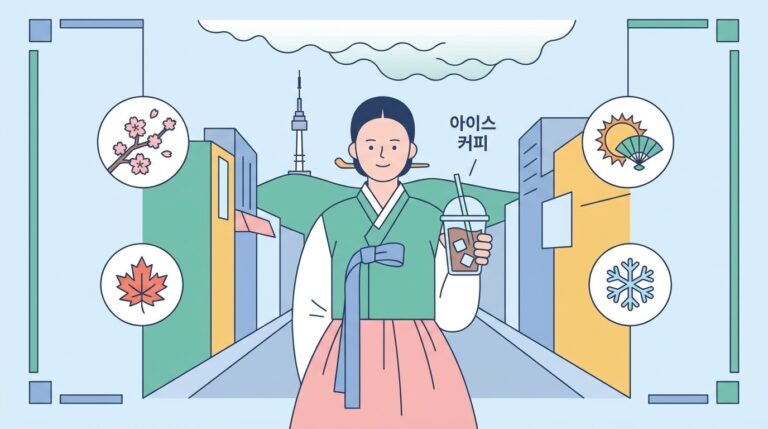
How to Compare Korean Weather with Your Hometown Like a Native
Phase 1: Empathy & Relatable Storytelling
안녕하세요! 매일한글 에디터입니다. (Hello! I’m your Daily Hangul editor.)
Remember your very first summer or winter in Korea? Picture this: You step out of Incheon Airport in late July, expecting a pleasant tropical breeze, only to be hit with a wall of humidity that feels like walking straight into a hot bowl of steaming Samgyetang (ginseng chicken soup). Or maybe you arrived in January, bracing for romantic K-drama snowfall, but got slapped by the razor-sharp Siberian wind known locally as Kalbaram (knife-wind).
Whenever Korean friends or colleagues ask, “고향 날씨는 어때요? 한국보다 더워요?” (How is the weather back home? Is it hotter than Korea?), many B1 learners freeze up. You probably end up saying something flat like “제 고향은 덥습니다. 한국도 덥습니다.” (My hometown is hot. Korea is also hot.) While grammatically correct, it misses all the flavor, nuance, and connection of a real conversation. Weather is Korea’s ultimate universal icebreaker—whether in the elevator with your landlord or waiting for iced americanos with your boss. Master comparing weather, and you unlock effortless daily small talk and instant social bonding.
Phase 2: 3 Core Expressions for Weather Comparison
1. [고향]보다 훨씬 더 [형용사]해요 (Gohyang-boda hwolssin deo [adjective]-haeyo)
- Pronunciation: Goh-hyang-boh-dah hwol-sseen duh [adjective]-heh-yoh (Think of hwolssin with an energetic whoosh sound, expressing a dramatic difference).
- Meaning: Literal: “Much more [adjective] than my hometown” | Nuance: “Night and day difference; significantly more intense.”
- K-Culture Moment: Seen frequently on travel variety shows like Welcome, First Time in Korea? when foreign guests describe Seoul’s biting winters compared to their mild homelands.
- Editor’s Insight: 훨씬 (hwolssin) adds natural emotional emphasis. Pairing it with 더 (deo – more) gives your sentence that fluent B1 rhythm.
- Situation Spectrum: Casual: ✅ | Semi-formal: ✅ | Formal: ⚠️ (Use 더욱 ~합니다 in business presentations)
- 🤔 Think About It: In English, we often use static figures (“It’s 10 degrees colder”), but Koreans love emotional qualifiers like 훨씬 (by far) or 완전 (totally). Why do you think Korean favors sensory emphasis over exact numbers in casual chats?
2. [고향]에 비하면 한국은 양반이에요 ([Gohyang]-e bihamyeon Hangugeun yangban-ieyo)
- Pronunciation: [Goh-hyang]-eh bee-hah-myeon Han-goo-geun yahng-bahn-ee-eh-yoh (Yangban sounds like ‘yahng-bahn’, referring to traditional noblemen who stay calm and poised).
- Meaning: Literal: “Compared to [my hometown], Korea is a nobleman” | Nuance: “Korea is mild/a walk in the park compared to where I come from.”
- K-Culture Moment: Used by characters in workplace K-Dramas during heatwaves to humorously downplay hardships when comparing hometown extremes.
- Editor’s Insight: 양반 (Yangban) historically meant aristocrat. Figuratively, calling a situation 양반 means it is gentle, orderly, or very manageable compared to something worse.
- Situation Spectrum: Casual: ✅ | Semi-formal: ✅ | Formal: 🚫
- 🤔 Think About It: How does using historical social classes (양반) as everyday idioms reflect Korea’s cultural storytelling mindset?
3. [고향]과 다르게 한국은 습도가 높아요 ([Gohyang]-gwa dareuge Hangugeun seupdoga nop-ayo)
- Pronunciation: [Goh-hyang]-gwah dah-reuh-geh Han-goo-geun seup-doh-gah nohp-ah-yoh (Seupdo sounds like ‘soup-dough’, easy to remember because high humidity feels heavy like warm soup!).
- Meaning: Literal: “Unlike [my hometown], Korea has high humidity” | Nuance: “The key difference isn’t just temperature; it’s the sticky, muggy air.”
- K-Culture Moment: Weather forecast segments on morning news explaining why the perceived temperature (체감온도) feels 5 degrees hotter in July.
- Editor’s Insight: ~와/과 다르게 (unlike ~) is a clean, versatile B1 comparative tool for pinpointing specific weather characteristics like humidity, wind, or dry spells.
- Situation Spectrum: Casual: ✅ | Semi-formal: ✅ | Formal: ✅
- 🤔 Think About It: Does your native tongue distinguish dry heat from humid heat with dedicated cultural idioms, or do you rely strictly on technical words?
Phase 3: Textbook Korean vs. Real-World Korean
Situation 1: Describing a Scorching Summer Day
- 📖 교과서 한국어 (Textbook): 한국 여름은 제 고향보다 기온이 높고 덥습니다. (Hangugeun yeoreumeun je gohyangboda gioni nopgo deopseumnida. – Korean summer has higher temperatures and is hotter than my hometown.)
- 🗣️ 진짜 한국어 (Real Native): 한국 여름은 고향보다 훨씬 푹푹 쪄요. (Hanguk yeoreumeun gohyangboda hwolssin pukpuk jjyeoyo. – Korean summer is way more sweltering/steamy than back home.)
- 💡 왜 다를까? (Why the difference?): Textbooks use technical vocabulary (기온이 높다), whereas locals rely on vivid onomatopoeia like 푹푹 찌다 (literally “steaming like dumplings in a steamer”) to express sensory discomfort.
Situation 2: Emphasizing Similar Weather
- 📖 교과서 한국어 (Textbook): 두 지역의 날씨가 거의 비슷합니다. (Du jiyeogui nalssiga geoui biseuthamnida. – The weather of both regions is almost similar.)
- 🗣️ 진짜 한국어 (Real Native): 거기나 여기나 습한 건 매한가지예요. (Geogina yeogina seuphan geon maehan-gaji-yeyo. – Whether there or here, the humidity is pretty much the same deal.)
- 💡 왜 다를까? (Why the difference?): Native speakers use idiomatic colloquial phrases like 매한가지 (the same thing/no difference) to sound conversational rather than robotic.
Phase 4: K-Culture Deep Dive & Non-Verbal Manners
4-1. 눈치 (Nunchi) & Gestures
When discussing weather in Korea, facial empathy is 50% of the conversation. When someone sighs and says “오늘 진짜 덥죠?” (It’s really hot today, right?), fan your collar slightly or exhale softly while nodding in agreement. If you say Korea’s winter is nothing compared to your home country (e.g., Canada or Northern Europe), avoid sounding dismissive or superior. Smile warmly, chuckle, and use ~에 비하면 양반이에요 to make it lighthearted banter rather than a boast.
4-2. Cultural Codes: “Eoljukah” and Seasonal Cravings
Korea’s climate extremes gave birth to fascinating cultural quirks. Even during sub-zero Arctic blasts, you will see Koreans proudly clutching iced coffees. This lifestyle is nicknamed 얼죽아 (Eoljukah), an acronym for “얼어 죽어도 아이스 아메리카노” (Even if I freeze to death, I’m drinking Iced Americano!). In summer, instead of cold salads, Koreans practice 이열치열 (Iyeol-chiyeol)—curing heat with boiling hot foods like Samgyetang to sweat out internal toxins.
Phase 5: Real-Life Roleplay Scenario
- Setting: Break room terrace at a Seoul office building on a sweltering July afternoon. Heavy cicada buzzing in the background.
- Characters: You (Foreign professional) & Minho (Korean colleague holding two iced coffees).
- 민호 (Minho): 와, 오늘 날씨 장난 아니죠? 숨이 턱턱 막혀요. (Wa, oneul nalssi jangnan anijyo? Sumi teokteok mak-hyeoyo.)
🎭 [Wipes sweat with a handkerchief and hands you an iced coffee]
“Wow, today’s weather is no joke, right? I can barely breathe.” -
You (학습자): 진짜요! 고향에 비하면 한국 여름은 훨씬 푹푹 쪄요. (Jinjja-yo! Gohyang-e bihamyeon Hanguk yeoreumeun hwolssin pukpuk jjyeoyo.)
🎭 [Receives the coffee with two hands and sighs with empathy]
“Seriously! Compared to my hometown, Korean summer is way more sweltering.” -
민호 (Minho): 그래요? 고향은 여름에 한국보다 덜 더운 편인가요? (Geuraeyo? Gohyangeun yeoreume Hangukboda deol deoun pyeon-ingayo?)
🎭 [Takes a sip and looks curious]
“Really? Is your hometown on the less-hot side compared to Korea in summer?” -
You (학습자): 기온은 비슷한데, 고향과 다르게 한국은 습도가 너무 높아요. (Gioneun biseuthande, gohyanggwa dareuge Hangugeun seupdoga neomu nop-ayo.)
🎭 [Gestures stickiness with a slight smile]
“The temperature is similar, but unlike back home, Korea’s humidity is so high.” -
민호 (Minho): 맞아요, 한국은 장마철 지나면 습기 때문에 체감온도가 훅 올라가죠. (Majayo, Hangugeun jangmacheol jinamyeon seupgi ttaemune chegam-ondoga huk ollagajyo.)
🎭 [Nods in deep agreement]
“Exactly. After the monsoon season, the perceived temperature shoots up because of humidity.” -
You (학습자): 그래도 사무실 에어컨 밑에 있으니까 살 것 같아요. (Geuraedo samusil eeokeon mite isseunikka sal geot gat-ayo.)
🎭 [Holds the chilled cup against cheek comfortably]
“Still, being under the office AC makes me feel alive again.” -
민호 (Minho): 하하, 맞아요. 겨울엔 또 고향 날씨랑 비교하면 어때요? (Haha, majayo. Gyeouren tto gohyang nalssirang bigyohamyeon eottaeyo?)
🎭 [Laughs and leans against the railing]
“Haha, true. How about winter compared to your hometown?” -
You (학습자): 겨울은 고향이 훨씬 추워서 한국 겨울은 양반이에요! (Gyeoureun gohyangi hwolssin chuwoseo Hanguk gyeoureun yangban-ieyo!)
🎭 [Grins cheerfully]
“Winter is much colder back home, so Korean winter is a walk in the park!”
🔀 Interactive Branching Choice
Minho says: “이번 주말에 폭염이라는데 주말에 뭐 해요?” (They say a heatwave is coming this weekend, what are you doing?)
- Option A: 집에서 에어컨 틀고 넷플릭스나 보려고요. 나가면 녹아내려요! (Jib-eseo eeokeon teulgo netpeullikseuna boryeogoyo. Nagamyeon noganaeryeoyo!)
👉 [Best Choice – 100% Native Vibe]: Natural humor (녹아내려요 – I will melt down) and casual everyday phrasing. - Option B: 날씨가 덥기 때문에 아무것도 안 합니다. (Nalssiga deopgi ttaemune amugeotdo an hamnida.)
👉 [Bad Choice – Robotic]: Sounds like an official written report or textbook exercise. - Option C: 한국 날씨는 최악이라서 밖에 안 나가요. (Hanguk nalssineun choe-agiraseo bakke an nagayo.)
👉 [Risk Choice – Culturally Harsh]: Using 최악 (the absolute worst) sounds overly critical and halts friendly conversation.
Phase 6: 10-Second Emotion Shadowing Drill
Read aloud along with the emotional rhythm markers (/ = brief pause):
[🥵 더위에 지쳐 혀를 내두르며]
한국 여름은 / 고향보다 / 훨씬 더 푹푹 쪄요!
(Hanguk yeoreumeun / gohyangboda / hwolssin deo pukpuk jjyeoyo!)-
[😎 여유롭고 유쾌하게]
저희 고향 추위에 비하면 / 한국 겨울은 / 완전 양반이에요.
(Jeohui gohyang chuwie bihamyeon / Hanguk gyeoureun / wanjeon yangban-ieyo.) -
[🤔 진지하게 차이점을 짚으며]
기온은 비슷한데 / 고향과 다르게 / 습도가 유독 높아요.
(Gioneun biseuthande / gohyanggwa dareuge / seupdoga yudok nop-ayo.)
Phase 7: K-Culture Mini Dictionary
- 푹푹 찌다 (Pukpuk jjida) | To be sweltering / steaming hot
Mimetic verb describing suffocating, sauna-like humid heat. Used constantly throughout July and August. - 체감온도 (Chegam-ondo) | Perceived / Sensible temperature (Heat index / Wind chill)
Essential daily buzzword during weather forecasts explaining why 30°C feels like 36°C with humidity. - 열대야 (Yeoldae-ya) | Tropical night phenomenon
Refers to summer nights where temperatures stay above 25°C, prompting late-night riverside picnics at the Han River. - 꽃샘추위 (Kkot-saem-chuwi) | Last spring cold snap
Poetic expression meaning “the cold weather that is jealous of the blooming spring flowers” (March-April).
Phase 8: Survival Kit for Travelers
Top 3 Weather Survival Phrases
- 혹시 오늘 비 올 확률이 높아요? (Hoksi oneul bi ol hwangnyuri nop-ayo?)
Is there a high chance of rain today? | Pro Tip: Essential before embarking on day trips to hiking trails or theme parks. - 실내가 에어컨 때문에 너무 추워요. (Silnaega eeokeon ttaemune neomu chuweoyo.)
The indoor area is too cold because of the air conditioning. | Pro Tip: Useful in cafes or buses to politely request a temperature adjustment. - 일교차가 커서 겉옷 챙겨야 해요. (Ilgyochaga keoseo geot-ot chaenggyeoya haeyo.)
The daily temperature difference is big, so I need to bring a jacket. | Pro Tip: Great for spring and autumn outings in Korea.
Editor’s Travel Note
- Install the official Korea Meteorological Administration Weather App or check Naver Weather widgets before stepping out. During monsoon season (장마), Korean convenience stores sell sturdy umbrellas for under 10,000 KRW right by the entrance.
Phase 9: Go One Step Deeper
In Korea, talking about the weather is never just about meteorology; it is an expression of 정 (Jeong) and communal care. When an elder or colleague asks if you find the cold bearable compared to back home, they are implicitly asking, “Are you taking good care of your health? Are you adjusting well to life here?” Acknowledging their empathy with comparative language builds warm interpersonal bridges that go far beyond surface-level conversation.
💬 Your Turn: How does your hometown weather compare to Korea? Try writing one sentence using ~보다 훨씬 in the comments below!
Phase 10: FAQ & Common Mistakes
Q: Can I use “더” (deo) without “훨씬” (hwolssin)?
A: Yes! 더 simply means “more” (e.g., 한국이 더 더워요 = Korea is hotter). Adding 훨씬 boosts the degree to “significantly / much more”, which sounds richer and more expressive.
Q: What is the difference between “~와/과 다르게” and “~에 비해서”?
A: ~와/과 다르게 emphasizes qualitative differences (e.g., dry vs. humid), whereas ~에 비해서 emphasizes relative degree or quantitative comparison (e.g., cooler compared to last year).
Q: Is calling the weather “양반이다” rude to older people?
A: Not at all! It is a widely accepted, polite idiomatic phrase that brings a friendly smile to native speakers when spoken by foreigners.
🚨 흔한 실수 (Common Mistakes) Checklist
- ❌ 고향보다 한국이 더 많이 더워요. (Awkward direct translation of ‘much’)
👉 ✅ 고향보다 한국이 훨씬 더워요. (Use 훨씬 for adjective intensity). - ❌ 한국은 고향과 틀려요. (Confusing ‘different’ with ‘wrong’)
👉 ✅ 한국은 고향과 달라요. (다르다 = different, 틀리다 = incorrect). - ❌ 제 고향 날씨는 한국 날씨를 비교해요. (Broken particle)
👉 ✅ 제 고향 날씨는 한국 날씨와/에 비해 달라요. (Use correct comparison particles).
Phase 11: Action Missions & K-Culture Challenge
- 🥉 Bronze Mission (Solo): Look up today’s temperature in Seoul and your hometown. Say aloud: “[Hometown]보다 서울이 훨씬 [더워요/추워요]!”
- 🥈 Silver Mission (Social): Post a photo of your local weather on Instagram Stories with the caption: “한국 날씨에 비하면 여긴 양반이에요 ☀️”.
- 🥇 Gold Mission (Real Life): Next time you visit a Korean cafe or chat with a Korean friend, initiate small talk comparing seasonal humidity.
- 🎮 K-Culture Bonus Mission: Watch an episode of a Korean variety show (like I Live Alone or Running Man) and spot when cast members complain about 푹푹 찌는 날씨 (steamy weather) or mention 얼죽아.
Phase 12: Interactive Quiz Challenge
Test your weather comparison mastery! Click each toggle to reveal the answer.
Q1. Situation Challenge: How do you say ‘Compared to my hometown, Korea’s winter is very mild/easy to endure’?
- Options:
1) 고향보다 한국 겨울이 너무 틀려요.
2) 고향에 비하면 한국 겨울은 양반이에요.
3) 고향과 다르게 한국 겨울은 최악이에요. - Answer: 2번 (고향에 비하면 한국 겨울은 양반이에요.)
- Explanation: ~에 비하면 양반이에요 is the exact native idiom used to describe something that is gentle or manageable compared to an extreme.
Q2. Fill in the Blank: 한국은 고향(____) 다르게 여름철 습도가 유독 높아요.
- Answer: 과 (gwa)
- Explanation: When the preceding noun ends in a consonant (고향 ends with ㅇ), the correct connective particle is 과. (고향과 다르게 = Unlike my hometown).
Q3. Culture True/False: ‘Eoljukah’ (얼죽아) means eating piping hot chicken soup on the hottest summer day.
- Answer: False
- Explanation: Eating hot soup on hot days is called 이열치열 (Iyeol-chiyeol). Eoljukah (얼죽아) refers to drinking iced americano even in freezing sub-zero winter weather!







