

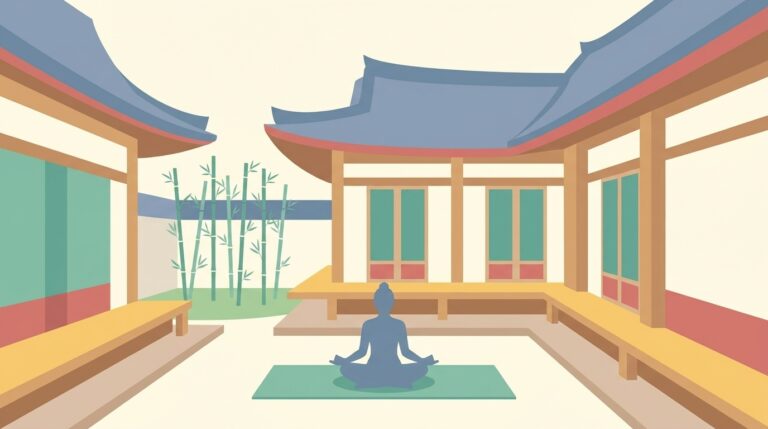
Breathe In Seoul: How Modern Koreans Find Zen in a Fast-Paced World
Phase 1: Empathy & Cultural Context
안녕하세요! 매일한글 (Daily Hangul) editor here!
Imagine walking down the neon-drenched streets of Gangnam on a Friday evening. The energy is electric, the subway is packed, and the relentless pulse of Korea’s ppalli-ppalli (fast-paced) lifestyle is everywhere. Yet, just an hour later, you could be sitting barefoot on the polished wooden floor of a quiet Buddhist temple in Bukhansan, listening to the resonant chime of a wind bell (punggyeong) surrounded by pine trees.
Modern South Korea lives at the crossroads of hyper-digital hustle and ancient contemplative traditions. Today, Korean young adults, exhausted by burnout and hyper-connectivity, are redefining spirituality. It’s no longer just about traditional religious doctrines; it’s about practical mindfulness—from weekend temple stays (templestay) and digital detox tea houses in Insa-dong to mindful spacing out (meongttearigi) by the Han River.
If you want to discuss inner peace, mental decluttering, or spiritual restoration with native Korean speakers at an advanced (C1) level, basic textbook phrases won’t capture the subtle emotional depth of these practices. In this guide, backed by real feedback from our advanced learners, you’ll master the authentic vocabulary, cultural etiquette, and nuanced discourse of modern Korean mindfulness.
Phase 2: Core Expressions Deep Dive
1. 마음을 비우다 (Maeumeul biuda)
- Pronunciation: [Mae-um-eul bi-u-da] (Sounds like “May-oom-eul bee-oo-da”)
- Meaning: Literal: “To empty one’s heart/mind.” | Nuance: Releasing worldly attachments, overthinking, greed, or lingering mental clutter.
- K-Culture Moment: Seen frequently in healing reality shows like Three Meals a Day or dramas like My Liberation Notes, when overwhelmed characters escape the city to recharge.
- Editor’s Insight: While English often says “clear your head,” 마음 (maeum) encompasses both mind and emotional heart. When you say 마음을 비우다, you imply letting go of emotional baggage and ego-driven expectations, not just taking a mental break.
- Situation Spectrum: Casual: ✅ | Semi-formal: ✅ | Formal: ✅
- 🤔 Think About It: Does your native culture view mental clarity as a cognitive reset (“clearing thoughts”) or an emotional purification (“emptying the heart”)?
2. 온전히 나에게 집중하다 (Onjeonhi naege jipjunghada)
- Pronunciation: [On-jeon-hi na-e-ge jip-jung-ha-da] (Sounds like “On-jeon-hee nah-eh-geh jeep-joong-hah-dah”)
- Meaning: Literal: “To completely/fully focus on myself.” | Nuance: Practicing radical self-presence, mindfulness without external validation or distraction.
- K-Culture Moment: K-pop idols during wellness vlogs and lifestyle influencers practicing solo yoga or tea ceremonies in traditional Hanok retreats often use this expression to describe boundary-setting.
- Editor’s Insight: The adverb 온전히 (onjeonhi) means “wholly, intactly, without any missing piece.” Using it elevates your speech instantly to a thoughtful, reflective C1 register.
- Situation Spectrum: Casual: ✅ | Semi-formal: ✅ | Formal: ✅
- 🤔 Think About It: In a collective society that heavily prioritizes group harmony, why do you think Koreans find the phrase 온전히 나에게 집중하다 so restorative?
3. 뇌에 휴식을 주다 / 멍때리다 (Noe-e hyusigeul juda / Meong-ttae-ri-da)
- Pronunciation: [Noe-e hyu-sik-eul ju-da] / [Meong-ttae-ri-da]
- Meaning: Literal: “To give the brain rest” / “To space out blankly.” | Nuance: Intentional aimlessness as micro-meditation.
- K-Culture Moment: The famous annual “Han River Spacing Out Contest” (Hangang Meongttaerigi Daehoe), where participants compete to maintain a flatlined heart rate while doing absolutely nothing.
- Editor’s Insight: While 멍때리다 was once considered a sign of laziness or distraction, modern Korean culture has reclaimed it as an organic form of mindfulness (불멍 – watching a bonfire, 물멍 – gazing at water, 숲멍 – zoning out in a forest).
- Situation Spectrum:
- 뇌에 휴식을 주다: Casual: ✅ | Semi-formal: ✅ | Formal: ✅
- 멍때리다: Casual: ✅ | Semi-formal: ⚠️ | Formal: 🚫
- 🤔 Think About It: Is deliberate “zoning out” treated as wasted time or recognized as valid restorative meditation in your culture?
Phase 3: Textbook Korean vs. Real Korean
Scenario 1: Describing the purpose of going on a spiritual retreat
- 📖 Textbook Korean: 저는 영적 평온을 찾고 스트레스를 해소하기 위해 절에 방문했습니다. (Jeoneun yeongjeok pyeong-on-eul chatgo seuteureseureul haesohagi wihae jeore bangmunhaessseumnida. – I visited a temple to seek spiritual calm and relieve stress.)
- 🗣️ Real Korean (C1 Natural): 복잡한 생각 좀 내려놓고, 온전히 마음 정리 겸 힐링하러 템플스테이 왔어요. (Bokjap-han saenggak jom naeryeonotgo, onjeonhi maeum jeong-ri gyeom hillinghareo tempeulseute-i wasseoyo. – I came to this temple stay to lay down my cluttered thoughts, organize my mind, and get some genuine healing.)
- 💡 Why the Difference? Real Korean speakers balance expressive verbs (생각을 내려놓다 – to lay down thoughts) with modern everyday lifestyle terms like 힐링 (healing) and 마음 정리 (mental decluttering).
Scenario 2: Suggesting someone take a mental breather
- 📖 Textbook Korean: 명상을 통해 마음을 차분하게 가라앉히는 것이 좋습니다. (Myeongsang-eul tonghae maeumeul chabunhage garaanj-hineun geosi joseumnida. – It is good to calm your mind down through meditation.)
- 🗣️ Real Korean (C1 Natural): 요즘 너무 번아웃 온 것 같은데, 스마트폰 끄고 잠깐 숨 좀 돌려요. (Yojeum neomu beon-aut on geot gateunde, seumateupon kkeugo jamkkan sum jom dollyeoyo. – You seem totally burned out lately; turn off your smartphone and catch your breath for a moment.)
- 💡 Why the Difference? Advanced conversational Korean frequently utilizes dynamic idiomatic expressions like 숨을 돌리다 (to catch one’s breath / take a pause) and relatable terms like 번아웃 (burnout).
Phase 4: K-Culture Deep Dive & Non-verbal Manners
4-1. Nunchi & Etiquette in Contemplative Spaces
When visiting a Korean temple (jeol), traditional tea house (dawan), or quiet meditation center:
* Hapjang (합장): Place your palms together in front of your chest and bow slightly at a 30 to 45-degree angle when greeting monks or fellow meditators. Avoid loud vocal greetings like “ANNYEONGHASEYO!”
* Mind the Threshold (문턱): Never step directly on the raised wooden threshold of a temple hall or Hanok door. Always step cleanly over it. Stepping on the threshold is considered bad luck and disrespectful to the architectural spirit of the temple.
* Mugeon (묵언 – Noble Silence): In tea meditation or dawn walks, follow the unspoken rule of silence. Speak in low, hushed tones only when essential.
4-2. Cultural Code: The Evolution of Temple Stay & “Meong”
What used to be ascetic Buddhist discipline has transformed into an accessible secular lifestyle trend in South Korea. Prominent figures, including BTS leader RM, frequently visit temples like Hwaeomsa and Jingwansa to reflect on art and identity. For modern Koreans, meditation is not necessarily an escape into dogma; rather, it is an essential counterweight to hyper-competitive corporate life.
Phase 5: Real-Life Roleplay Scenario
Setting: You are attending an afternoon tea and mindfulness session at a serene Hanok tea house nestled in Bukchon, Seoul. You are speaking with Sunim (Venerable Monk) / Tea Master Ji-an.
Characters:
* You: A traveler/professional seeking clarity amidst life transitions.
* Master Ji-an: A calm, perceptive tea master with a gentle smile.
Master Ji-an: [🎭 두 손으로 따뜻한 발효차를 건네며 따뜻한 미소를 짓는다]
             차 한 잔 드시면서, 복잡했던 바깥일은 잠시 잊어보세요.
             (Cha han jan deusimyeonseo, bokjaphaetdeon bakkat-ireun jamsi ijeoboseyo.)
             "Take a sip of tea, and leave the complex outside world behind for a moment."

You:          [🎭 찻잔을 두 손으로 받쳐 들고 향을 음미하며]
             감사합니다, 스님. 요즘 일상이 너무 바빠서 마음을 비우기가 쉽지 않더라고요.
             (Gamsahamnida, seunim. Yojeum ilsang-i neomu bappaseo maeumeul bi-ugiga swipji anteoragoyo.)
             "Thank you, Sunim. Life has been so busy lately that emptying my mind hasn't been easy."

Master Ji-an: [🎭 차분한 목소리로 고개를 끄덕이며]
             억지로 생각을 없애려 하면 오히려 더 떠오르지요. 그저 차의 온기만 느껴보세요.
             (Eokjiro saenggageul eop-saeryeo hamyeon ohi-ryeo deo tteo-oreujiyo. Geujeo cha-ui on-giman neuk-kyeoboseyo.)
             "If you force yourself to erase thoughts, they bubble up even more. Just feel the warmth of the tea."

You:          [🎭 가슴에 손을 얹고 천천히 숨을 내쉬며]
             그렇군요. 온전히 지금 이 순간에 머무르는 법을 잊고 살았던 것 같아요.
             (Geureokunyo. Onjeonhi jigeum i sun-gan-e meomureuneun beobeul itgo saratdeon geot gat-ayo.)
             "I see. It feels like I had forgotten how to remain wholly in this very moment."

Master Ji-an: [🎭 은은한 목탁 소리를 배경으로 차를 한 번 더 따르며]
             숨을 들이쉬고 내쉴 때, 내 몸의 감각에 귀를 기울여 보세요. 어떤 느낌이 드나요?
             (Sumeul deuriswigo naeswil ttae, nae mom-ui gamgage gwireul gi-uryeo boseyo. Eotteon neukkim-i deunayo?)
             "As you inhale and exhale, listen closely to the sensations in your body. What do you feel?"

You:          [🎭 눈을 감고 미소를 지으며 홀가분한 표정을 짓는다]
             가슴에 꽉 차 있던 답답함이 스르륵 풀리는 기분이에요.
             (Gaseume kkwak cha itdeon dapdaphami seureureuk pullineun gibunieyo.)
             "It feels as though the tightness in my chest is gently unraveling."

Master Ji-an: [🎭 합장을 하며 인자하게 눈인사를 건넨다]
             참 좋습니다. 그 고요한 마음이 바로 당신의 본래 모습입니다.
             (Cham joseumnida. Geu goyohan maeumi baro dangsin-ui bollae moseubimnida.)
             "Wonderful. That tranquil state is your true, natural self."

You:          [🎭 공손히 합장으로 답례하며]
             오늘 귀한 가르침 덕분에 뇌에도 마음에도 깊은 휴식을 얻고 갑니다.
             (Oneul gwihan gareuchim deokbune noe-edo maeum-edo gipeun hyusigeul eotgo gamnida.)
             "Thanks to your precious wisdom today, both my brain and heart found deep rest."
🔀 Interactive Choice Point
At the end of the conversation, Master Ji-an asks: “이 고요함을 일상으로 돌아가서도 유지할 수 있겠습니까?” (Will you be able to maintain this tranquility once you return to your daily life?)
- Choice A: “노력해 보겠지만, 일상에 치이다 보면 금방 잊어버릴까 봐 걱정돼요. 그래도 작은 호흡부터 챙겨볼게요.” (I’ll try, but I worry I’ll forget when overwhelmed by daily life. Still, I’ll start with small conscious breaths.)
- 👉 Feedback [Best]: Excellent! Expresses realistic self-awareness using the native phrase 일상에 치이다 (be overwhelmed by daily routine) while committing to mindfulness.
- Choice B: “당연하죠! 스님이 시키는 대로 완벽하게 살겠습니다.” (Of course! I will live perfectly just as you commanded, Monk.)
- 👉 Feedback [Bad]: Overly dramatic and rigid. Meditation is not about blind obedience or perfectionism.
- Choice C: “절에 있을 때만 좋고 나가면 다 소용없더라고요.” (It’s only good while in a temple; once I leave it’s all useless anyway.)
- 👉 Feedback [Risk]: A bit too blunt and dismissive of the practice, which disrupts the reflective atmosphere.
Phase 6: 10-Second Emotion Shadowing Drill
Pay attention to the natural pause markers (/) and emotional tone cues!
[🧘 차분하고 고요하게 - Calm & Peaceful]
“복잡한 생각은 / 잠시 내려놓고 / 온전히 / 이 순간에 머물러 보세요.”
(Bokjap-han saenggak-eun / jamsi naeryeonotgo / onjeonhi / i sun-gan-e meomulleo boseyo.)-
[🌿 후련하고 홀가분하게 - Relieved & Refreshed]
“차 한 잔 마시며 / 멍때리고 있으니까 / 머릿속이 / 맑아지는 것 같아요.”
(Cha han jan masimyeo / meong-ttaerigo isseunikka / meorissog-i / malg-ajineun geot gat-ayo.) -
[🤝 정중하고 감사한 태도로 - Polite & Reverent]
“마음을 비우는 법을 / 배우고 나니 / 일상을 살아갈 / 힘이 생겼습니다.”
(Maeumeul biuneun beobeul / bae-ugo nani / ilsang-eul saragal / him-i saenggyeossseumnida.)
Phase 7: K-Culture Mini Dictionary
- 템플스테이 (Templestay) [Tem-peul-seu-te-i]
- Meaning: Experiential Buddhist temple stay program.
- Usage: Used widely for weekend wellness getaways, monk-guided meditations, and 108-bow rituals.
- 묵언수행 (Mugeonsuhaeng) [Muk-eon-su-haeng]
- Meaning: Silent ascetic practice (Noble Silence).
- Usage: Used literally in monasteries, or colloquially among friends when someone decides to stay off social media and avoid chit-chat: “나 오늘 묵언수행 중이야!” (I’m on a silence vow today!)
- 불멍 / 물멍 / 숲멍 (Bulmeong / Mulmeong / Supmeong)
- Meaning: Mindfully zoning out while watching fire (bul), water (mul), or forest greenery (sup).
- Usage: High-frequency lifestyle slang applied to camping, Han River picnics, and aesthetic café visits.
- 디지털 디톡스 (Digital Ditokseu) [Di-ji-teol Di-tok-seu]
- Meaning: Digital detox.
- Usage: Powering down smartphones during retreats to restore mental focus.
Phase 8: Traveler’s Survival Kit
Top 3 Survival Phrases for Meditation Spaces
- 혹시 묵언 프로그램인가요? (Hoksi mugeon peurogeuraem-in-gayo?)
- “Is this a silent practice program?”
- Pro Tip: Ask this at registration desks in meditation retreats to understand noise expectations.
- 공양은 몇 시에 시작하나요? (Gongyang-eun myeot si-e sijakhanayo?)
- “What time does the temple meal (Gongyang) start?”
- Pro Tip: Buddhist monastic meals are called 공양 (gongyang), not just 식사 (siksa).
- 차담 신청할 수 있을까요? (Chadam sincheonghal su isseulkkayo?)
- “Can I request a tea conversation (with the monk)?”
- Pro Tip: 차담 (chadam) refers to an informal, deep conversation over tea with a resident master.
Editor’s Travel Note
- Booking Retreats: Use the official Templestay Korea Reservation Portal to search and reserve English-friendly monastic stays across Korea.
- Top Seoul Zen Spots: For historic in-city serenity, visit Bongeunsa in Gangnam or Jingwansa in Eunpyeong Hanok Village via Naver Map App Download.
Phase 9: “One Step Deeper” (Cultural Reflection)
In classical Korean Seon (Zen) Buddhism, the core question is “이뭣고?” (I-mweot-go? – What is this?), urging practitioners to question the nature of the self. In hyper-modern South Korea, where individuals are constantly measured by test scores, titles, and social comparison (nam-ui siseon), contemplative spaces offer a rare sanctuary where your social resume disappears. Stepping onto temple grounds means stepping outside of the societal gaze and reconnecting with your inner baseline.
💬 Your Turn: When was the last time you practiced “마음 비우기” (emptying your mind)? What is your favorite way to reset your mental state when burnout strikes? Share your thoughts below in Korean or English!
Phase 10: FAQ & Common Mistakes
Q: Can non-Buddhists or non-religious people participate in Korean temple stays and meditation?
A: Absolutely! Over 70% of participants view Korean templestays as cultural and psychological wellness experiences rather than religious conversions. All activities, including bowing and chanting, are voluntary.
Q: What is the exact difference between ‘마음을 비우다’ and ‘생각을 비우다’?
A: 생각을 비우다 refers specifically to stopping overthinking and cognitive noise. 마음을 비우다 goes deeper; it implies letting go of emotional attachments, desires, frustrations, or greed.
Q: Is ‘멍때리다’ rude to say in formal conversation?
A: Yes. 멍때리다 is vivid colloquial slang. In formal contexts (e.g., business or polite presentations), use 뇌에 휴식을 주다 (give the brain rest) or 사색에 잠기다 (be lost in deep contemplation).
🚨 Common Mistakes Alert
- Mistake: Pronouncing 공양 (gongyang – monastic meal) like 공연 (gong-yeon – musical performance).
- Correct Action: Keep the vowel clear: Gong-YANG is food for the spirit; Gong-YEON is a show!
- Mistake: Stepping firmly on the door threshold (문턱) when entering a temple hall.
- Correct Action: Always step over the threshold cleanly without touching it.
- Mistake: Using aggressive body language or talking loudly on the temple grounds.
- Correct Action: Keep your hands folded gently in front (Chasu / 차수) and speak softly.
Phase 11: Action Missions
- 🥉 Bronze Mission (Solo): Practice saying the Phase 6 shadowing drills out loud 3 times with the recorded emotional tones.
- 🥈 Silver Mission (Social): Post a photo of your tea, nature view, or quiet corner with the Korean caption: “오늘 하루는 온전히 나에게 집중하는 시간 🍵 #마음비우기 #힐링”
- 🥇 Gold Mission (Real Life): Next time you meet a Korean friend or tutor, share your experience: “요즘 너무 바빠서 주말에 멍때리면서 힐링 좀 하려고요.”
- 🎮 K-Culture Challenge: Watch an episode of a Korean travel/healing variety show (like Youth Over Flowers or Hyori’s Homestay) and spot whenever cast members say 힐링, 마음 정리, or 멍때리기!
Phase 12: Interactive Quiz Challenge
Quiz 1: Situational Judgment
Your Korean friend looks deeply exhausted from working 60-hour weeks. Which response is the most natural and empathetic (C1 level)?
* A) “교회나 절에 가서 종교를 믿으세요.”
* B) “요즘 너무 무리한 것 같은데, 주말에 스마트폰 끄고 푹 쉬면서 생각 좀 비워요.”
* C) “멍때리는 건 시간 낭비니까 공부를 더 하세요.”
🔍 Click to Reveal Answer & Explanation
Correct Answer: B
Explanation: Option B shows sophisticated empathy and naturally combines 무리하다 (overdo it) and 생각을 비우다 (clear thoughts). Option A is pushy, and Option C is insensitive.
Quiz 2: Fill in the Blank
Complete the sentence with the appropriate C1 adverb meaning “wholly / completely in one’s pure self”:
“남들의 시선에서 벗어나 [_________] 나 자신에게 집중해 보세요.”
🔍 Click to Reveal Answer & Explanation
Correct Answer: 온전히 (onjeonhi)
Explanation: 온전히 means “wholly / purely without compromise.” (온전히 나 자신에게 집중하다 is a classic mindfulness collocation).
Quiz 3: True / False Cultural Check
Stepping directly on the raised wooden threshold (문턱) of a temple hall is considered a traditional way to show respect to the builders.
🔍 Click to Reveal Answer & Explanation
Correct Answer: False
Explanation: You must never step on the threshold. Always step over it. Stepping on the threshold is considered disrespectful.







