

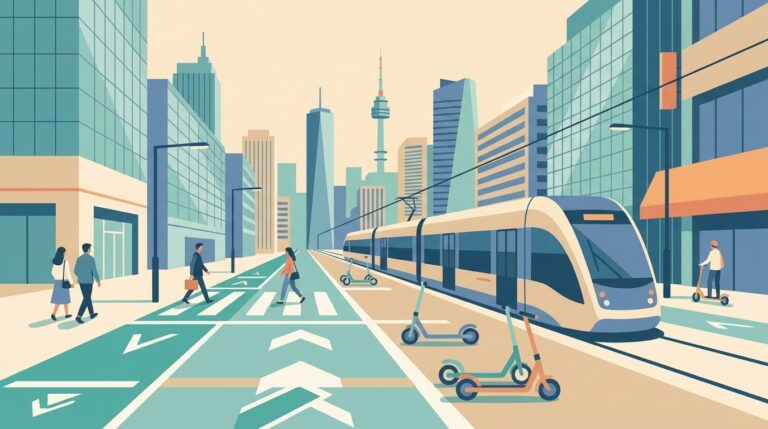
Navigating Seoul’s Mobility Frontier: Mastering C2 Debates on Personal Mobility Lanes
Phase 1: 공감 (Story Immersion Opening)
안녕하세요! 매일한글 에디터입니다.
Picture this: You are walking down the bustling streets of Teheran-ro in Gangnam after an intellectually stimulating business forum. Neon signs flicker against the sleek glass skyscrapers, and the evening breeze carries the irresistible aroma of street-side tteokbokki. Suddenly, an electric kickboard silently zips past your elbow at 25 km/h, mounting the curb and weaving between pedestrians before vanishing into the night. Your Korean colleague turns to you, sighs, and remarks on the severe clash between urban innovation and pedestrian safety.
At a C2 proficiency level, you are no longer merely asking for directions or ordering coffee. You are expected to articulate nuanced perspectives on socio-technical governance, debate high-stakes urban policies, and dissect public disputes such as expanding dedicated lanes for personal mobility (PM) devices. In modern South Korea, the tension between eco-friendly micro-mobility (Kik-bor-deu culture) and pedestrian rights (Bohaeng-gwon) is one of the hottest municipal topics.
This masterclass draws upon authentic civic council transcripts, high-level corporate debates, and real feedback from foreign policy analysts living in Seoul. By the end of this guide, you will command the sophisticated lexicon, rhetorical cadence, and socio-cultural framing needed to debate South Korea’s smart city evolution like a seasoned policymaker.
Phase 2: 핵심 표현 3선 심층 분석 (Top 3 Core Expressions)
1. 보행권을 침해하다 (Bo-haeng-gwoneul chim-hae-ha-da)
- Pronunciation: [Boh-haeng-gwoneul chim-hae-ha-da] (Sounds like “boh-heng-gwon” followed by a sharp “chim-hae-ha-da”)
- Meaning: Literal: To infringe upon pedestrian rights | Real Nuance: To severely disrupt or endanger the fundamental safety and freedom of movement of pedestrians in shared public spaces.
- K-Culture Moment: Frequently featured in investigative news programs like SBS’s Curious Stories Y (궁금한 이야기 Y) or JTBC investigative specials when addressing sidewalk chaos and reckless PM riders (Kik-ra-ni).
- Editor’s Insight: This phrase carries significant legal and ethical weight in Korean public discourse. Pair it with adverbs like
심각하게 (severely)or근본적으로 (fundamentally)during high-level debates.- Situation Spectrum: Casual: ⚠️ | Semi-formal: ✅ | Formal/Debate: ✅
- 🤔 Think About It: How does your home country conceptualize the hierarchy between non-motorized pedestrians and motorized micro-mobility users?
2. 인프라 확충이 시급하다 (In-peu-ra hwak-chung-i si-geup-ha-da)
- Pronunciation: [In-peu-ra hwak-choong-ee shee-geup-ha-da] (Think of English “infra” followed by a crisp “hwak-choong” and an urgent “shee-geup-ha-da”)
- Meaning: Literal: Infrastructure expansion is urgent | Real Nuance: Highlighting an immediate, critical necessity to build systemic physical or legislative foundations before accidents escalate.
- K-Culture Moment: Heard during municipal council hearings in dramas like Stranger (비밀의 숲) or political dramas like Chief of Staff (보좌관) when civic planners petition the Seoul Metropolitan Government for budget allocations.
- Editor’s Insight:
시급하다indicates a critical tipping point where delays cause immediate harm. It elevates your argument from a mere suggestion to an imperative necessity.- Situation Spectrum: Casual: ⚠️ | Semi-formal: ✅ | Formal/Debate: ✅
- 🤔 Think About It: Why does Korean debate culture prioritize structural infrastructure over individual moral responsibility in public safety discussions?
3. 규제 샌드박스를 적용하다 (Gyu-je saen-deu-bak-seu-reul jeok-yong-ha-da)
- Pronunciation: [Gyoo-jeh sen-deu-bak-seu-reul jeog-yong-ha-da] (Crisp articulation on “gyoo-jeh”, loanword “sandbox”, and formal verb “jeog-yong”)
- Meaning: Literal: To apply a regulatory sandbox | Real Nuance: Temporarily suspending or easing stringent regulations within specific test zones to pilot cutting-edge mobility innovations safely.
- K-Culture Moment: Common in tech innovation scenes like tvN’s Start-Up (스타트업) where founders negotiate testing permits for autonomous transport in Pangyo Techno Valley.
- Editor’s Insight: In South Korea’s fast-moving tech sector, this term showcases deep familiarity with administrative law and GovTech initiatives.
- Situation Spectrum: Casual: 🚫 | Semi-formal: ✅ | Formal/Debate: ✅
- 🤔 Think About It: How do temporary regulatory relaxations shape the speed of tech adoption across diverse cultural landscapes?
Phase 3: 교과서 한국어 vs 진짜 한국어 (Textbook vs. Real Korean)
Scenario 1: Proposing separate lanes during an urban planning meeting
- 📖 교과서 한국어: PM 전용 도로를 더 많이 만들어야 사고가 안 납니다. (PM jeonyong dororeul deo mani mandeureoya sagoga an namnida.)
- 🗣️ 진짜 한국어: 보차도 분리와 PM 전용 차로 확충 없이는 사고율을 구조적으로 낮추기 어렵습니다. (Bochado bunriwa PM jeonyong charo hwakchung eopsineun sagoyureul gujojeogeuro natchugi eoryeopseumnida.)
- 💡 왜 다를까? C2-level policy Korean substitutes conversational conditional clauses with analytical compound nouns (
보차도 분리– sidewalk-roadway segregation) and structural qualifiers (구조적으로– structurally).
Scenario 2: Addressing illegal PM parking along subway exits
- 📖 교과서 한국어: 사람들이 킥보드를 아무 데나 버려서 길이 복잡해요. (Saramdeuri kikbodeureul amu dena beoryeoseo giri bokjaphaeyo.)
- 🗣️ 진짜 한국어: 무단 방치된 전동 킥보드로 인해 보행 안전이 심각하게 위협받고 있는 실정입니다. (Mudan bangchidoen jeondong kikbodeuro inhae bohaeng anjeoni simgakhage wieopbatgo inneun siljeongimnida.)
- 💡 왜 다를까? The phrase
실정입니다(this is the harsh reality) instantly anchors the statement in authoritative sociopolitical commentary rather than everyday grumbling.
Phase 4: K-Culture 딥다이브 & 비언어적 매너 (K-Culture Deep Dive)
4-1. 눈치 (Nunchi) & Debate Manners in High-Stakes Forums
When participating in Korean institutional discussions regarding urban safety:
* The Incline of Respectful Disagreement: Avoid direct confrontational negations like “그건 틀렸습니다” (That is wrong). Instead, begin with a gentle head tilt and validate the counter-party’s premise: “그 취지에는 전적으로 공감합니다만…” (While I fully empathize with the underlying spirit of that proposal…).
* Eye Line & Controlled Cadence: Maintain steady eye contact during factual delivery, slightly lowering your gaze when reviewing data sheets to demonstrate measured deliberation.
4-2. The ‘Kik-rani’ Phenomenon and Smart City Friction
In Korea, the portmanteau word 킥라니 (Kik-rani = Kickboard + Gorani [Water Deer]) emerged to describe reckless PM users who dash out unpredictably into traffic, mimicking wild deer on Korean mountain roads. While Seoul strives to be a premier carbon-neutral smart city, rapid hardware deployment without dedicated infrastructure has created genuine generational and urban friction. Grasping this cultural context is vital when framing PM lane policies in Korea.
Phase 5: 실전 롤플레이 시나리오 (Interactive Roleplay Scenario)
Setting: A high-level policy forum at Seoul City Hall. You are seated opposite Director Kang (강 국장), a veteran urban transit authority official.
- 강 국장: 현재 보도 위 PM 사고가 급증하면서 시민들의 반발이 거셉니다. 전면적인 이용 규제를 검토해야 하지 않겠습니까? (Hyeonjae bodo wi PM sagoga geupjeunghamyeonseo simindeurui banbari geoseumnida. Jeonmyeonjeogin iyong gyujereul geomtohaeya haji anketseumnikka?)
- 🎭 Furrowing his brows while tapping a file folder on the mahogany desk.
- (Pedestrian sidewalk accidents involving PMs are soaring, sparking severe civic backlash. Shouldn’t we consider comprehensive usage bans?)
- You (A/B/C Choice): [Your turn to respond]
-
강 국장: 일각에서는 기존 자전거 도로와의 혼용을 제안하지만, 규격과 속도 차이로 인해 또 다른 갈등을 낳고 있습니다. (Ilgageseoneun gijon jajeongeo dorowaui honyongeul jeanhajiman, gyugyeokgwa sokdo chai-ro inhae tto dareun galdeungeul nako isseumnida.)
- 🎭 Nodding slowly, waiting to test your policy depth.
- (Some suggest shared use with existing bicycle lanes, but discrepancies in size and speed are generating secondary conflicts.)
- You: 도로교통법 개정과 함께 마이크로 모빌리티 전용 규격을 제도화해야 합니다. (Dorogyotongbeop gaejeonggwa hamkke ma-i-keu-ro mo-bil-li-ti jeonyong gyugyeogeul jedohwahae-ya hamnida.)
- 🎭 Adjusting your mic, maintaining calm and composed eye contact.
- (We must institutionalize dedicated micro-mobility standards alongside road traffic amendments.)
- 강 국장: 하지만 예산 확보와 차로 축소에 따른 운전자들의 저항은 어떻게 돌파하시겠습니까? (Hajiman yesan hwakbowa charo chuksoe ttareun unjeonjadeurui jeohangeun eotteoke dolpahasigetseumnikka?)
- 🎭 Leaning forward with an inquisitive posture.
- (Yet how will you overcome budget constraints and pushback from automobile drivers facing lane reductions?)
- You: 탄소중립 기금과의 연계 및 다이어트 차로(Road Diet) 시범 구역을 통한 실증 데이터 확보가 선행되어야 합니다. (Tansojungnip gigeumgwaui yeongye mit da-i-eo-teu charo sibeom guyeogeul tonghan siljeung de-i-teo hwakboga seonhaengdoe-eo-ya hamnida.)
- 🎭 Presenting a structured infographic slide calmly.
- (We must first secure empirical data via road-diet pilot zones while linking funding to carbon-neutral grants.)
- 강 국장: 일리 있는 통찰이군요. 실무 협의체 구성에 착수해 봅시다. (Illi inneun tongcharigunyo. Silmu hyeob-uiche guseonge chaksuhae bopsida.)
- 🎭 Smiles subtly and signs your proposal brief.
- (That is a sound insight. Let us initiate a working-level task force.)
🔀 인터랙티브 분기점 (Choose your strategic opening response):
- Choice A (Risk): 무조건 법으로 금지하면 스타트업들이 다 망하니까 그냥 놔둡시다. (Simply doing nothing to save startups is reckless and disregards public safety.)
- Choice B (Bad): 규제는 나쁜 것이니 사용자들이 알아서 조심해야 합니다. (Blaming user ethics without institutional solutions fails standard policy evaluation.)
- Choice C (Best): 단순 규제보다는 PM 전용 도로 확충과 입법 정비를 병행하는 투트랙 접근이 바람직합니다. (Advocating a two-track approach combining infrastructure expansion and legal modernization shows C2-level policy mastery.)
Phase 6: 10초 감정 섀도잉 드릴 (10-Second Emotion Shadowing Drill)
Practice these lines with cadence breaks (/) and emotional intentionality:
- [🧐 냉철하고 단호하게 | Analytical & Decisive]
- 단순한 / 단속 위주의 행정은 / 근본적인 해결책이 / 될 수 없습니다. (Dan-sun-han / dan-sok wi-ju-ui haeng-jeong-eun / geun-bon-jeog-in hae-gyeol-chaeg-i / doel su eop-seum-ni-da.)
- [🏛️ 설득력 있고 무게감 있게 | Persuasive & Visionary]
- 보행자의 안전권과 / 친환경 이동수단의 공존을 위한 / 제도적 결단이 / 필요합니다. (Bo-haeng-ja-ui an-jeon-gwon-gwa / chin-hwan-gyeong i-dong-su-dan-ui gong-jon-eul wi-han / je-do-jeok gyeol-dan-i / pir-yo-ham-ni-da.)
Phase 7: K-Culture 미니 사전 (Core Urban Lexicon)
- 보차도 분리 (Bo-cha-do bun-ri) | Grade-separated segregation of walkways and roadways | Vital in civil engineering debates regarding pedestrian safety.
- 공유 모빌리티 (Gong-yu mo-bil-li-ti) | Shared micro-mobility ecosystem | Encompasses apps like Ttareungyi, Swing, and Beam operating across metropolitan hubs.
- 교통 정온화 (Gyo-tong jeong-on-hwa) | Traffic calming measures | Techniques like speed tables, chicanes, and shared street paradigms.
- 도로 다이어트 (Do-ro da-i-eo-teu) | Road Diet / Lane reduction | Reallocating excess automobile lanes to build bicycle and PM-dedicated paths.
Phase 8: 여행자를 위한 생존 키트 (Urban Survival Kit)
Top 3 On-the-Ground Expressions:
- “전동 킥보드 주차 구역이 어디인가요?” (Where is the designated kickboard parking station?) — Prevents municipal towing fines.
- “여기서 타시면 보행자 전용 도로라 위반입니다.” (Riding here violates regulations as this is a pedestrian-only zone.) — Polite intervention.
- “헬멧 미착용 시 범칙금이 부과될 수 있습니다.” (Fines apply if riding without a certified safety helmet.) — Legal safeguard.
🧳 Editor’s Mobility Travel Note:
When exploring Seoul’s multimodal transit network, make sure to look up the official 네이버 지도 대중교통 길찾기 앱 to verify real-time designated parking zones and bike-lane availability. In South Korea, riding PM devices on designated pedestrian footpaths carries an administrative fine (Beomchikgeum), and a valid motorcycle/driver’s license is legally mandatory.
Phase 9: “한 발 더 깊이” (Cultural Essay & Thought Question)
South Korea’s rapid transformation into a hyper-connected metropolis often creates intense spatial competition within high-density municipal corridors. The personal mobility debate is not merely a technical transport question; it reflects the ongoing philosophical negotiation between the collectivist premium placed on civic harmony (공공의 안녕) and the individual pursuit of swift mobility (빨리빨리 문화). When urban spaces are limited, how a society allocates its physical asphalt reveals its fundamental communal priorities.
💬 Your Turn: In your home country, how are micro-mobility lanes physically negotiated between motorists and pedestrians? Share your thoughts below in advanced Korean!
Phase 10: FAQ & 오해 방지 (FAQ & Common Mistakes)
Q: Can foreign residents legally ride shared electric kickboards in Korea?
A: Yes, but you must register a valid domestic driver’s license or an International Driving Permit (IDP) with the respective shared mobility platform app, and you must wear a certified helmet at all times.
Q: Are PM devices legally allowed on general bicycle lanes (자전거 전용도로)?
A: Yes, under amended Korean Road Traffic law, PM devices conforming to safety specifications (under 25 km/h, under 30 kg) may operate on bicycle lanes unless specifically signposted otherwise.
Q: What is the official administrative penalty for riding an e-scooter on sidewalks?
A: Sidewalk riding incurs a ₩30,000 fine for traffic violation, which escalates to direct criminal liability under the Special Act on Traffic Accidents if a pedestrian collision occurs.
🚨 흔한 실수 (Common Mistakes) 경고판:
- Mistake 1: Translating “scooter lane” as 스쿠터 도로 (Incorrect: 스쿠터 refers to motor scooters/mopeds. Use
PM 전용 차로or개인형 이동장치 전용 도로). - Mistake 2: Using everyday slang like 킥보드 in formal legislative or municipal policy papers (Correct:
개인형 이동장치 (PM)). - Mistake 3: Saying 자동차 길 (Incorrect. Use
차도 [Cha-do]or차로 [Cha-ro]in analytical contexts).
Phase 11: 액션 미션 & 참여 유도 (Action Missions)
- 🥉 Bronze: Record yourself reading the Phase 6 Shadowing Drill with correct pause markers.
- 🥈 Silver: Write a 3-sentence critique on urban PM regulations using the phrase
보차도 분리and tag @DailyHangul. - 🥇 Gold: Draft a short policy memorandum (150 words) debating whether road diets (
도로 다이어트) should be mandated across central business districts in Seoul. - 🎮 K-Culture Mission: Watch an episode of a Korean current affairs talk show (such as 100-Minute Debate / 100분 토론) and identify 3 instances of advanced modal ending particles (
~에 기인하다,~에 국한되다).
Phase 12: 인터랙티브 퀴즈 챌린지 (Interactive Quiz Challenge)
1. Situation Judgment:
Which phrase is most appropriate when addressing a municipal budget committee to urge separate PM infrastructure?
* (A) 킥보드 때문에 시끄러우니 다 없애버립시다.
* (B) 보행 안전권 확보와 지속가능한 모빌리티 생태계 구축을 위해 전용 차로 확충이 시급합니다.
* (C) 사람들이 조심해서 타면 도로 공사는 필요 없습니다.
2. Fill-in-the-Blank:
새로운 이동수단 기술을 검증하기 위해 특정 구역 내 규제를 완화하는 제도를 규제 _______(이)라고 부릅니다.
3. True or False:
In South Korea, it is legally permissible to ride an electric PM on ordinary pedestrian sidewalks as long as you yield to pedestrians.
🔍 정답 및 해설 (Click to Reveal Answers)
- Answer: (B) — Demonstrates polished C2 rhetoric balance, incorporating policy concepts like safety rights (
보행 안전권) and sustainable ecosystems (지속가능한 모빌리티 생태계). - Answer: 샌드박스 (Sandbox) —
규제 샌드박스(Regulatory Sandbox). - Answer: False — Riding on pedestrian sidewalks is strictly illegal under the Road Traffic Act and punishable by fines.







