

Phase 1: Empathy (Story-Driven Opening)
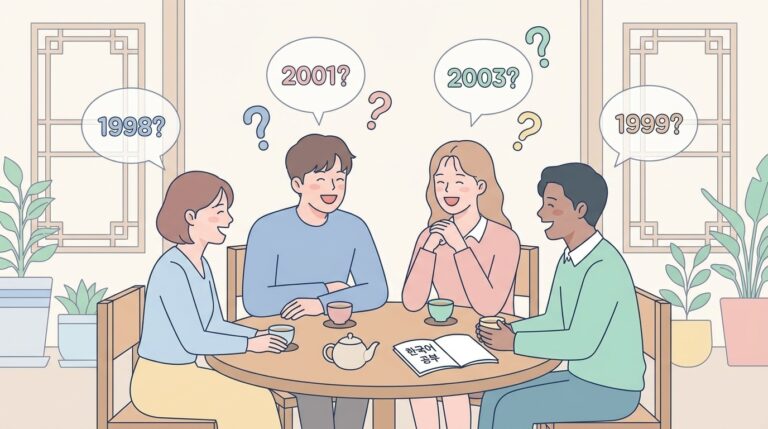
안녕하세요! Daily Hangul Editor here! Have you ever been enjoying a lively K-BBQ dinner with Korean friends, only to witness a sudden, hilarious debate erupt over someone’s birth month? Imagine this: Minho is born in December 1994, and Sujin is born in January 1995. Technically, they were born in different calendar years. Yet, because Sujin entered elementary school early alongside 1994-born children, she considers herself Minho’s same-age friend (dong-gap). But then enters Jihoon, born in July 1995, who calls Minho Hyung (older brother) but wants to treat Sujin as an equal friend. Suddenly, everyone stops chewing their samgyeopsal. The hierarchy has collapsed!
In Korea, this infamous social phenomenon is called 족보가 꼬이다 (jokboga kkoida)—literally meaning “the family tree is tangled.” Navigating Korean titles (hocheing) and age hierarchy can feel like solving an advanced algebra puzzle, especially when the notorious “early birth year” (빠른 년생, bpareun nyeonsaeng) enters the equation. Don’t worry! By mastering a few conversational lifesavers, you can glide through these social puzzles with charm, humor, and respect just like a seasoned Seoulite.
Phase 2: Top 3 Essential Expressions In-Depth
1. 저 빠른 95예요 (Jeo bpareun gu-o-yeyo)
- Pronunciation: [Jeo bpa-reun gu-o-ye-yo] (Sounds like “Chaw bbah-reun goo-oh-ye-yo”)
- Meaning: Literal: “I am an early 95.” | Actual: “I was born in early 1995 (Jan/Feb), so I went to school with 1994-born friends and consider them my peers.”
- K-Culture Moment: Frequently heard on Korean variety shows like Running Man or Knowing Bros when guest idols establish hierarchy within seconds of meeting.
- Editor’s Insight: Korea used to allow children born in January and February to enter primary school a year earlier. While the law changed in 2009, anyone born before then still uses this phrase to claim their school cohort age!
- Situation Spectrum: Casual: ✅ | Semi-formal: ✅ | Formal: ⚠️
- 🤔 Think About It: In Western cultures, your birth year dictates everything. Why do you think school entry cohort holds so much social weight in Korea?
2. 족보 꼬여요! (Jokbo kkoyeoyo!)
- Pronunciation: [Jok-bo kko-yeo-yo] (Sounds like “Choke-boh kkoh-yuh-yoh”)
- Meaning: Literal: “The genealogy tree is tangling!” | Actual: “This makes our mutual age hierarchy super awkward/confusing!”
- K-Culture Moment: The classic line delivered in K-dramas when two mutual friends realize their mutual connection makes their honorific titles contradictory.
- Editor’s Insight: Use this with a lighthearted laugh when you realize friend A calls friend B Unnie, but you call friend A a friend and friend B Dongsaeng. It instantly turns awkward tension into a bonding joke.
- Situation Spectrum: Casual: ✅ | Semi-formal: ✅ | Formal: 🚫
- 🤔 Think About It: How does your native language express a breakdown in social protocol or awkward group dynamics?
3. 그냥 편하게 말 놓으세요 (Geunyang pyeonhage mal no-euseyo)
- Pronunciation: [Geu-nyang pyeon-ha-ge mal no-eu-se-yo] (Sounds like “Goo-nyang pyun-hah-gay mahl no-oo-seh-yoh”)
- Meaning: Literal: “Just lower your speech comfortably.” | Actual: “Please feel free to drop the formal honorifics and speak casually with me.”
- K-Culture Moment: When two characters in a romance drama decide to move from polite distance (jondaenmal) to warm intimacy (banmal).
- Editor’s Insight: This is the ultimate diplomatic move when age calculations get too tangled. Suggesting this clears the air and shows humility.
- Situation Spectrum: Casual: ✅ | Semi-formal: ✅ | Formal: ⚠️
- 🤔 Think About It: Dropping formality in Korean is an explicit verbal contract, unlike the subtle transition in English.
Phase 3: Textbook Korean vs. Real Korean
Situation 1: Asking someone’s age to establish hierarchy
- 📖 교과서 한국어 (Textbook): 몇 살이에요? (Myeot sari-eyo? – How old are you?)
- 🗣️ 진짜 한국어 (Real-life): 몇 년생이세요? (Myeot nyeonsaeng-iseyo? – What birth year are you?)
- 💡 Why is it different? Asking direct age can feel blunt. Asking for the birth year (nyeonsaeng) avoids confusion with different age calculation systems and leads naturally to resolving school cohort status.
Situation 2: Suggesting to be friends despite an ambiguous age gap
- 📖 교과서 한국어 (Textbook): 우리 친구 합시다. (Uri chingu hapsida. – Let us do friendship.)
- 🗣️ 진짜 한국어 (Real-life): 그냥 친구 해요, 우리! (Geunyang chingu haeyo, uri! – Let’s just be same-age friends!)
- 💡 Why is it different? Textbook phrasing sounds like signing a business contract. The real spoken phrase sounds warm, spontaneous, and friendly.
Phase 4: K-Culture Deep Dive & Non-Verbal Manners
4-1. 눈치 (Nunchi) & Body Gestures
When 족보 (jokbo) gets tangled at a social gathering, your body language matters as much as your words:
* The Head Tilt & Soft Laugh: When you realize an age conflict is happening, do not insist on your hierarchy aggressively. Tilt your head slightly, smile warmly, and chuckle.
* Two-Handed Beverage Handling: Until the hierarchy is officially settled, continue passing drinks and clinking glasses with both hands supported at the wrist or elbow.
4-2. Cultural Code: The School Cohort Bond (Hakbeon & Hak-gun)
In Korean society, shared experience in the educational system often overrides raw biological months. Entering school in March creates a tight collective identity (donggi). If you were born in January 1996 and studied alongside 1995 babies, your entire psychological baseline is 1995. Knowing this prevents you from accidentally offending someone by calling them younger than their class peers!
Phase 5: Real-Life Roleplay Scenario
Setting: A trendy pocha (tent bar) in Hongdae. You are out with Minwoo (born in late 1994) and Yuna (born in Feb 1995, an “early 95”).
- Minwoo: 유나야, 너 95년생이지? (Yunaya, neo gu-o nyeonsaeng-iji?)
🎭 While pouring soda, raising an eyebrow— Yuna, you’re born in ’95, right? - Yuna: 네, 오빠! 근데 저 빠른 95예요! (Ne, oppa! Geunde jeo bpareun gu-o-yeyo!)
🎭 Waving her hand gently with a playful grin— Yes, Oppa! But I’m an early ’95! - Minwoo: 아, 그럼 94랑 학교 같이 다녔겠네? (Ah, geureom gu-sa-rang hakgyo gachi danyeot-genne?)
🎭 Nodding understandingly— Ah, so you went to school with ’94s? - Yuna: 맞아요! 그래서 94 친구들이랑 다 친구 먹었어요. (Majayo! Geuraeseo gu-sa chingudeul-irang da chingu meogeosseoyo.)
🎭 Clinking her glass— Exactly! So I’m friends with all ’94s. - Minwoo: (Looking at you) 그럼 우리 셋 호칭 어떻게 하지? (Geureom uri set hoching eotteoke haji?)
🎭 Scratching back of his head— Then how do the three of us sort out our titles? - You: 저도 95년생인데, 이러면 족보 꼬여요! (Jeodo gu-o nyeonsaeng-inde, ireomyeon jokbo kkoyeoyo!)
🎭 Chuckling playfully— I’m born in ’95 too, our tree is getting tangled! - Yuna: 어머, 진짜요? 그럼 우리 다 동갑 할까요? (Eomeo, jinjjayo? Geureom uri da donggap halkkayo?)
🎭 Clapping hands together— Oh my, really? Shall we all just treat each other as same-age friends? - Minwoo: 그래, 복잡한데 그냥 말 편하게 하자! (Geurae, bokjaphande geunyang mal pyeonhage haja!)
🎭 Smiling widely and pouring drinks for everyone— Yeah, it’s complicated, let’s just speak comfortably!
🔀 Interactive Choice Point
What would you say if you want to keep things smooth?
* Option A: “안 돼요. 한국 법으로는 제가 동생이에요.” (No way. By Korean law I am younger.)
* Option B: “좋아요! 복잡하니까 그냥 친구 해요!” (Sounds great! Since it’s complicated, let’s just be friends!)
* Option C: “그럼 민우 씨한테만 형이라고 부를게요.” (Then I will call only Minwoo Hyung and ignore Yuna.)
- Choice Feedback:
- Option A (Bad): Kills the social vibe by turning a fun dinner into a legal debate.
- Option B (Best): Warm, flexible, and embraces the cultural solution smoothly!
- Option C (Risk): Creates an awkward divide within a small group setting.
Phase 6: 10-Second Emotion Shadowing Drill
Practice these with native rhythm and intonation:
[😅 Laughing off an awkward moment]
저 빠른 95라서 / 족보가 좀 꼬여요!
(Jeo bpareun gu-o-raseo / jokboga jom kkoyeoyo!)-
[🤗 Warmly extending friendship]
우리 복잡하게 생각하지 말고 / 그냥 친구 해요!
(Uri bokjaphage saenggakhaji malgo / geunyang chingu haeyo!) -
[🤝 Polite and relaxing the mood]
편하게 / 말씀 낮추셔도 돼요.
(Pyeonhage / malsseum natchusyeodo dwaeyo.)
Phase 7: K-Culture Mini Dictionary
- 빠른 년생 (Bpareun Nyeonsaeng) | Early birth year cohort | Refers to people born in January or February who entered primary school early under the old system.
- 족보 브레이커 (Jokbo Beure-ikeo) | Hierarchy/Genealogy Breaker | Slang for an “early birth year” person whose friendships scramble the age hierarchy among mutual acquaintances.
- 동갑 (Dong-gap) | Same age | People sharing the exact same social age status, allowing instant casual speech (banmal).
- 말 놓다 (Mal Not-da) | To drop honorific speech | The explicit social step of switching from polite language (jondaenmal) to informal Korean.
Phase 8: Traveler’s Survival Kit
Top 3 Survival Phrases
- 몇 년생이세요? (Myeot nyeonsaeng-iseyo?) — What year were you born in? (Pro Tip: The best starter line at youth meetups!)
- 말 편하게 하셔도 돼요. (Mal pyeonhage hasyeodo dwaeyo.) — You can speak comfortably with me. (Pro Tip: Relieves pressure when meeting older locals.)
- 우리 동갑이네요! (Uri donggap-ineyo!) — We are the same age! (Pro Tip: Guaranteed to generate instant smiles and high-fives.)
Editor’s Travel Note
When heading out to meet local friends in Seoul’s nightlife districts, make sure you have the Naver Map App navigation guide installed to navigate vibrant streets easily. Also, remember that in group payment situations after resolving age hierarchy, the oldest or most senior person (hyung/unnie) often generously offers to treat the first round!
Phase 9: Going One Step Deeper
Korean honorifics are not merely grammar rules; they are social roadmaps reflecting relational harmony. Unlike individualistic frameworks where age is an isolated personal fact, in Korea, age determines responsibilities, caregiving roles, and conversational tone. When an “early birth year” tangles the hierarchy, Koreans use humor, compromise, and mutual consent rather than strict dogma. It shows that beneath the strict rules, Korean communication deeply values mutual comfort.
💬 Your Turn: Have you ever experienced a funny misunderstanding because of Korean age calculation or titles? Share your story in the comments below!
Phase 10: FAQ & Common Mistakes
Q: Does the “Early Birth Year” system still exist for kids today in Korea?
A: No. The Korean Elementary and Secondary Education Act was reformed, and starting with children born in 2003 (enrolled in 2009), early school entry by birth month was phased out. However, adults born before 2003 actively live with this social reality daily!
Q: As a foreigner, do I have to follow the ‘early birth year’ rules?
A: Not strictly. Koreans are very understanding with international friends. However, if you understand the concept and say, “저 빠른 년생 알아요!” (I know what early birth year is!), your Korean friends will be amazed by your cultural fluency.
Q: What should I do if two friends want me to call one ‘Oppa’ and one ‘Friend’, but they are the same age?
A: Simply suggest: “우리 다 같이 친구 해요!” (Let’s all just be friends!) or respect each individual relationship one-on-one.
🚨 Common Mistakes Alert!
- Mistake 1: Dropping honorifics (banmal) immediately without asking. Correct Action: Always wait for the agreement “말 놓을까요?” first.
- Mistake 2: Insisting strictly on calendar month differences when school cohorts align. Correct Action: Respect the school cohort age claim flexibly.
- Mistake 3: Calling an older acquaintance by their first name alone. Correct Action: Attach ssi (씨) or proper titles (Hyung/Noona/Oppa/Unnie).
Phase 11: Action Mission & Engagement
- 🥉 Bronze Mission: Practice saying “저 빠른 [Your Year]년생이에요” 5 times aloud in front of a mirror.
- 🥈 Silver Mission: Post a comment below stating your birth year in Korean format (e.g., “저는 98년생이에요!”).
- 🥇 Gold Mission: In your next Korean conversation or language exchange, ask: “몇 년생이세요?” instead of “몇 살이에요?”.
- 🎮 K-Culture Mission: Watch an episode of a Korean variety show (like Knowing Bros) and spot the exact moment guests negotiate their jokbo and birth years!
Phase 12: Interactive Quiz Challenge
1. Situational Quiz: You were born in February 1998 and attended school with 1997 babies. How do you introduce your age status naturally?
* A) 저 족보 브레이커예요.
* B) 저 빠른 98이에요.
* C) 저 나이 없어요.
2. Fill-in-the-Blank:
우리 복잡하니까 그냥 편하게 말 ( ______ ). (Let’s just drop honorifics comfortably since it’s complicated.)
* Hint: 놓으세요 / 가세요
3. True or False:
All Korean children born in January today still automatically enter school a year early.
* (True / False)
🔍 Click here to reveal Answers & Explanations!
- Answer: B (저 빠른 98이에요. Clear, natural, and instantly explains your school cohort status!)
- Answer: 놓으세요 (말 놓으세요 means to lower/drop honorific speech comfortably.)
- Answer: False (The official early school admission system was discontinued for students born after 2003!)







