

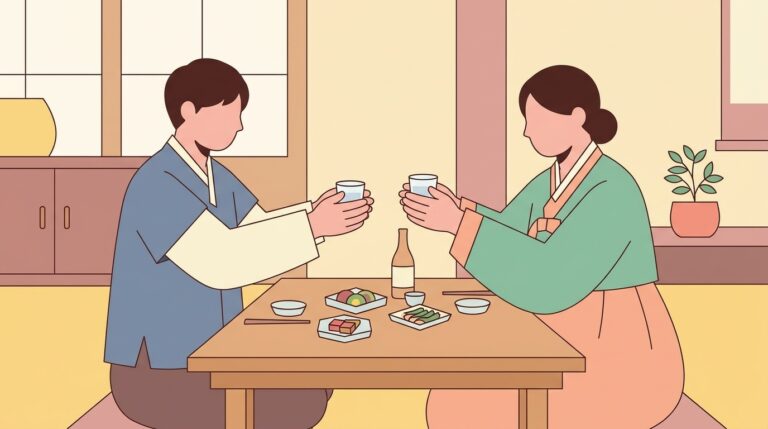
Phase 1: Empathy (Story-Driven Opening)
안녕하세요! 매일한글 에디터입니다. (Hello! I’m your Daily Hangul editor.)
Picture this: You are sitting at a buzzing Korean BBQ restaurant in Hongdae. The pork belly is sizzling, K-pop is playing in the background, and your Korean coworkers or friends are smiling warmly. Suddenly, someone picks up a green bottle of Soju to refill your glass. You freeze. Do you hold the glass with one hand? Should you pour your own drink first? Why is everyone turning their heads away while taking a sip?
If you have watched K-dramas like Itaewon Class or Business Proposal, you have definitely seen these subtle dinner table moments. In Korea, pouring and receiving drinks is not just about quenching thirst—it is a heartfelt language of respect, connection, and warmth (Jeong). When you know the unspoken rules of Korean drinking etiquette, you instantly transform from an awkward outsider into someone Koreans love having at their table. Based on hundreds of real questions from beginner learners, I have put together this foolproof A2 beginner guide so you can clink glasses with absolute confidence!
Phase 2: Deep Dive into Top 3 Key Expressions
1. 한잔 받으세요 (Hanjan badeuseyo)
- Pronunciation: [han-jan ba-deu-se-yo] (Sounds like “Hahn-zhan bah-deu-say-yo”, rhyming with ‘say yo’)
- Meaning: “Please accept a drink” / “Let me pour you a glass.”
- K-Culture Moment: Seen in company dinners (hoesik) when a junior colleague politely offers to pour a drink for a senior colleague or manager.
- Editor’s Insight: Hanjan literally means “one glass”, but Koreans use it casually to mean “a drink”. Saying this before pouring shows polite consideration.
- Situation Spectrum: Casual (⚠️) / Semi-formal (✅) / Formal (✅)
- 🤔 Think About It: In your home country, do people ask permission before pouring a drink for someone else, or do they just pour freely?
2. 건배해요! (Geonbaehaeyo!)
- Pronunciation: [geon-bae-hae-yo] (Sounds like “Gun-bay-hay-yo”)
- Meaning: “Let’s cheers!” / “Cheers!”
- K-Culture Moment: The universal clinking phrase shouted in every K-drama celebration scene around a table full of side dishes.
- Editor’s Insight: Geonbae (건배) literally translates to “dry the glass” (empty the cup), but at casual dinners, taking a small sip after clinking is completely fine!
- Situation Spectrum: Casual (✅) / Semi-formal (✅) / Formal (⚠️ – use ‘위하여 (wihayeo)’ for very formal toasts)
- 🤔 Think About It: Why do you think saying “cheers” together creates such instant bonding across cultures?
3. 제가 따를게요 (Jega ttareulgeyo)
- Pronunciation: [je-ga tta-reul-ge-yo] (The ‘tta’ sound is sharp and popping, like a crisp ‘double T’)
- Meaning: “I will pour (for you).”
- K-Culture Moment: Used whenever you notice someone’s glass is empty and you want to offer them a refill before your own.
- Editor’s Insight: Using jega (polite ‘I’) paired with -eulgeyo (gentle intention) makes your offer sound smooth, friendly, and respectful.
- Situation Spectrum: Casual (⚠️ – use ‘내가 따를게’ ) / Semi-formal (✅) / Formal (✅)
- 🤔 Think About It: In Korea, pouring your own drink is considered a small taboo. How does serving others first shift the social atmosphere?
Phase 3: Textbook Korean vs. Real-life Korean
Situation 1: Offering to pour a drink
- 📖 교과서 한국어 (Textbook Korean): 술을 드시겠습니까? (Suleul deusigesseumnikka? – “Would you like to consume alcoholic beverage?”)
- 🗣️ 진짜 한국어 (Real Korean): 한잔 드릴까요? (Hanjan deurilkkayo? – “May I offer you a glass?”)
- 💡 Why the difference? The textbook phrasing sounds like an official flight attendant announcement. Real Koreans use hanjan (a glass) to keep the vibe warm and respectful without being stiff.
Situation 2: When someone offers you another drink but you are full
- 📖 교과서 한국어 (Textbook Korean): 저는 더 이상 마실 수 없습니다. (Jeoneun deo isang masil su eopseumnida. – “I am incapable of drinking further.”)
- 🗣️ 진짜 한국어 (Real Korean): 저는 괜찮아요, 천천히 마실게요! (Jeoneun gwaenchanayo, cheoncheonhi masilgeyo! – “I’m okay, I’ll sip slowly!”)
- 💡 Why the difference? Direct refusals can feel slightly abrupt. Acknowledging the offer gently while promising to drink at your own pace maintains the warm mood.
Phase 4: K-Culture Deep Dive & Non-Verbal Manners
4-1. Nunchi (눈치) & Two-Hand Etiquette
- The Golden Two-Hand Rule: Never pour or receive a drink with just one hand when drinking with someone older or of higher status. Place your right hand firmly on the bottle/glass, and rest your left hand gently under your right wrist or forearm. It represents sincerity and total attention.
- Turning Your Head: When drinking with elders or managers, turn your upper body slightly away to the side, shield the glass with your hand, and take a sip. Drinking face-to-face can look overly casual.
- Never Let a Glass Sit Empty (and never pour your own!): Self-pouring is called Matjan (맞잔) or Jajak (자작). In Korean culture, pouring for others builds friendship. Keep an eye out with your nunchi (social awareness) when someone’s glass reaches the bottom quarter.
4-2. Cultural Code: The ‘Somaek’ Phenomenon & Pojangmacha
From street-side orange tents (pojangmacha) to neon-lit barbecue joints, drinking culture in Korea revolves around pairing food and drinks (Anju – 안주). Mixing Soju and Beer creates Somaek (소맥), celebrated with rhythmic glass-tapping and lively toasts. Knowing these table manners will instantly earn you nods of admiration from Korean friends!
Phase 5: Real-Life Roleplay Scenario
Setting: A cozy Samgyeopsal (pork belly) restaurant after work. You are sitting across from Team Leader Min (민 팀장님), your kind Korean mentor.
- 민 팀장: 오늘 프로젝트 끝내느라 고생 많았어요! (Oneul peurojekteu kkeunnaeneura gosaeng manasseoyo! / “You worked so hard finishing today’s project!”)
🎭 Min picks up a green Soju bottle and smiles. - Learner (You): 감사합니다, 팀장님! (Gamsahamnida, timjangnim! / “Thank you, Team Leader!”)
🎭 You hold your small glass with both hands and lift it slightly off the table. - 민 팀장: 자, 한잔 받으세요. (Ja, hanjan badeuseyo. / “Here, let me pour you a glass.”)
🎭 Min pours Soju with his right hand holding the bottle and his left hand touching his right elbow. - Learner (You): 감사합니다! 제가 팀장님도 한잔 채워 드릴게요. (Gamsahamnida! Jega timjangnimdo hanjan chaewo deurilgeyo. / “Thank you! Let me fill your glass too.”)
🎭 You set down your glass, hold the bottle with both hands, and pour into Min’s glass. - 민 팀장: 오, 한국 예절 잘 아시네요! 건배할까요? (Oh, hanguk yejeol jal asineyo! Geonbaehalkkayo? / “Oh, you know Korean etiquette so well! Shall we cheers?”)
🎭 Min lifts his glass with a warm grin. - Learner (You): 네, 팀장님! 건배해요! (Ne, timjangnim! Geonbaehaeyo! / “Yes, Team Leader! Cheers!”)
🎭 You gently clink the rim of your glass slightly lower than Min’s glass. - 민 팀장: 우리 팀을 위하여! (Uri timeul wihayeo! / “For our team!”)
🎭 Min takes a sip. - Learner (You): (You turn your head to the side, covering your glass with your left hand, and take a sip.)
🔀 Interactive Choice Point: Min’s glass is now empty!
- Option A: Pick up the bottle with one hand and pour it quickly without saying anything.
- Option B: Say “팀장님, 한잔 더 드릴까요?” (Shall I give you one more glass?) while holding the bottle with two hands.
- Option C: Pour Soju into your own empty glass first, then offer him a bottle.
Feedback:
* Choice A (Risk): One-handed pouring looks dismissive to someone older.
* Choice B (Best! ⭐): Perfect! It shows high nunchi, polite language, and proper two-hand posture.
* Choice C (Bad): Self-pouring (Jajak) breaks the social flow of Korean table etiquette!
Phase 6: 10-Second Emotion Shadowing Drill
Practice these lines with emotion and pause markers (/):
[😊 Grateful & Polite]
감사합니다! / 제가 한잔 / 따라 드릴게요!
(Gam-sa-ham-ni-da! / Je-ga han-jan / tta-ra deu-ril-ge-yo!)
“Thank you! / Let me / pour you a glass!”-
[🥳 Bright & Cheerful]
오늘 너무 즐거웠어요! / 다 같이 / 건배해요!
(O-neul neo-mu jeul-geo-wo-sseo-yo! / Da ga-chi / geon-bae-hae-yo!)
“Today was so much fun! / All together / let’s cheers!” -
[😌 Respectful & Humble]
천천히 / 마시겠습니다! / 감사합니다.
(Cheon-cheon-hi / ma-si-get-seum-ni-da! / Gam-sa-ham-ni-da.)
“I will / drink slowly! / Thank you.”
Phase 7: K-Culture Mini Dictionary
- 안주 (Anju) | Drinking Snacks/Food | Food specifically paired with alcohol in Korea (e.g., crispy Jeon with Makgeolli, or Samgyeopsal with Soju).
- 회식 (Hoesik) | Company Dinner / Team Gathering | A quintessential Korean corporate tradition where colleagues eat and drink together after work to foster teamwork.
- 원샷 (Wonsyat) | One-shot / Bottoms Up | Slang adapted from English, used playfully among close friends to down the whole glass in one go.
- 막차 (Makcha) | The Last Train / Bus | The ultimate excuse to wrap up a drinking session before the subway lines stop running around midnight!
Phase 8: Traveler’s Survival Kit
Survival Expressions Top 3
- 물 좀 주세요 (Mul jom juseyo) – “Please give us some water.” (Pro Tip: Essential when the spicy food or Soju starts kicking in!)
- 건배! (Geonbae!) – “Cheers!” (Pro Tip: Keep eye contact and smile warmly as glasses touch.)
- 잘 먹었습니다! (Jal meogeotseumnida!) – “I ate very well / Thank you for the meal!” (Pro Tip: Say this to the restaurant owner when stepping out.)
Editor’s Travel Note
- Getting Home Safe: If you drink late into the night in Seoul, download and check the Kakao T Taxi App guide to hail a trusted licensed taxi directly to your hotel without language barriers.
- Cashless Dining: 99% of Korean dining spots accept credit cards, but having small cash is helpful for cozy street food carts after drinks.
Phase 9: A Step Deeper (Reflective Insight)
In many Western cultures, drinking is an individual experience—you manage your own cup, choose your own pace, and refill whenever you wish. In Korea, however, a drinking table is a shared communal ecosystem. The act of holding a bottle with two hands and looking after your neighbor’s glass reflects a deep cultural value: acknowledging the presence and comfort of others before your own. When you pour a drink for someone in Korea, you are not just serving liquid; you are offering respect, care, and a warm bridge of connection.
💬 Your Turn: How does drinking etiquette in your culture compare to Korea’s two-handed pouring tradition? Share your thoughts below!
Phase 10: FAQ & Avoiding Misunderstandings
Q: What should I do if I don’t drink alcohol for personal or health reasons?
A: You don’t have to drink alcohol! Accept the first pour with two hands politely, set it down, and ask for soft drinks or water by saying “술을 못 마셔서 사이다로 마실게요!” (I can’t drink alcohol, so I’ll drink cider/soda!). Koreans will gladly cheers with your soda glass.
Q: Do I need to use two hands with friends of the same age?
A: No! Among same-age friends (chingu) or younger people, one hand is completely fine and natural. Two hands are reserved for elders, seniors, or people you are meeting for the first time.
Q: Why do glasses clink lower?
A: As a sign of humility and respect toward someone older or of higher rank, juniors intentionally tap the rim of their cup slightly lower than the other person’s cup.
🚨 Common Mistakes Alert
- Pouring into a half-full glass: Wait until the glass is almost completely empty before refilling, unless the person specifically asks.
- Holding the glass on the table while receiving: Always lift your glass slightly with both hands when someone offers a drink.
- Pouring your own glass (자작): It is considered lonely or slightly impolite to self-pour at a group table. Let someone pour for you!
Phase 11: Action Mission
- 🥉 Bronze Mission (Solo Practice): Practice the two-handed pouring gesture in front of a mirror while saying: “제가 따라 드릴게요!”
- 🥈 Silver Mission (Social Connection): Comment below with your favorite Korean food to pair with drinks (Chimaek, Samgyeopsal, or Pajeon).
- 🥇 Gold Mission (Real Life): Next time you visit a Korean restaurant or eat with Korean speakers, pour a drink using both hands and say “한잔 받으세요!”
- 🎮 K-Culture Hunt: Watch one episode of any K-drama and spot a character turning their head sideways to drink. Notice how natural it looks!
Phase 12: Interactive Quiz Challenge
Q1. When an older coworker pours you a drink, what is the best way to receive it?
* A) Leave the cup on the table and watch them pour.
* B) Lift the cup with both hands and say “감사합니다”.
* C) Take the bottle from them and pour it yourself.
Q2. Fill in the blank:
다 같이 잔을 들고 “______!” 하고 외쳐요. (Let’s all raise our glasses and shout “Cheers!”)
* A) 안녕 (Annyeong)
* B) 건배 (Geonbae)
* C) 주세요 (Juseyo)
Q3. [True / False] In Korean culture, it is completely normal and encouraged to pour your own Soju at a group dinner.
👉 Click here to check the Answers & Explanations!
- Q1 Answer: B) Always lift the glass with both hands to show respect and gratitude.
- Q2 Answer: B) 건배 (Geonbae) – The standard Korean toast for cheering together!
- Q3 Answer: False – Self-pouring (jajak) is discouraged in group settings; letting others pour for you fosters community and warmth (Jeong).







