

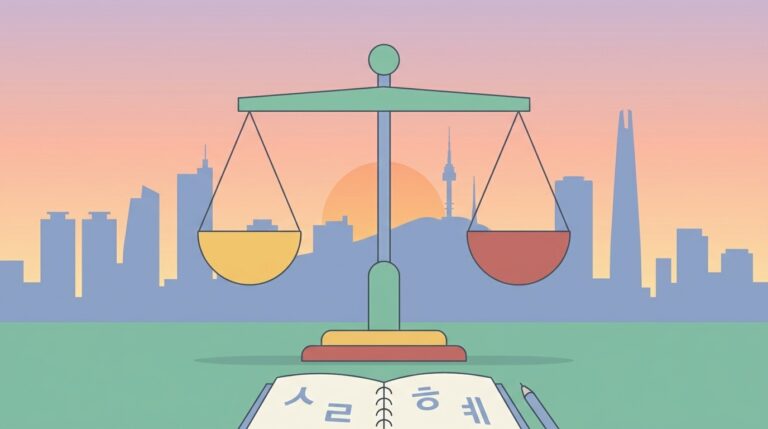
Decoding Justice in Modern Korea: Beyond Drama Tropes and Textbook Korean
안녕하세요! Welcome back to Daily Hangul! As your trusted cultural navigator, I am thrilled to dive into one of the most intellectually stimulating topics in contemporary Korean discourse: 현대 사회의 정의란 무엇인가 (What is Justice in Modern Society?).
Phase 1: Empathy & Storytelling
Have you ever watched hit K-dramas like Stranger (비밀의 숲), Vincenzo, or The Glory, and wondered why Korean viewers react so intensely to the concept of “Fairness”? Perhaps you’ve found yourself in a late-night debate at a cozy pocha in Sinchon with Korean friends, only to hit a linguistic wall when trying to express complex ethical stances beyond a simplistic “이것은 나빠요 (This is bad).”
In contemporary South Korea, the discussion around “Justice” is rarely purely abstract or Kantian. Instead, it is intensely personal, practical, and woven into daily competitive realities—from university entrance exams to housing markets and workplace hierarchy. When international learners reach the C1 level, moving past basic emotional words into nuanced sociopolitical commentary is the exact breakthrough needed to engage in authentic, high-level discussions with native speakers. This guide draws upon real classroom debates and native sociocultural observations to equip you with the exact vocabulary, metaphors, and non-verbal cues to articulate modern ethics like a sophisticated insider.
Phase 2: 3 Key Expressions Deep Dive
1. 공정과 상식 (Gong-jeong-gwa Sang-sik)
- Pronunciation: gong-jeong-gwa sang-sik (Sounds like “Gong-jung-gwa Sahng-seek”)
- Meaning: Literal: “Fairness and Common Sense” | Nuance: The absolute baseline of procedural fairness and ethical decency expected from institutions and leaders.
- K-Culture Moment: Constantly heard in political debates, news editorials, and legal dramas when citizens protest against systemic corruption or nepotism.
- Editor’s Insight: In Korea, 공정 (Fairness) often implies a level playing field where everyone starts from the exact same line, while 상식 (Common sense) represents the unwritten moral consensus of society.
- Situation Spectrum: Casual ⚠️ | Semi-formal ✅ | Formal ✅
- 🤔 Think About It: Does “fairness” in your home country focus more on equality of opportunity or equality of outcome? In Korea, public sentiment heavily prioritizes strict equality of opportunity and procedural transparency.
2. 내로남불 (Nae-ro-nam-bul)
- Pronunciation: nae-ro-nam-bul (Rhymes with “Neigh-ro-nam-bull”)
- Meaning: Literal: “내가 하면 로맨스, 남이 하면 불륜” (If I do it, it’s romance; if someone else does it, it’s an affair) | Nuance: Blatant double standards and ethical hypocrisy.
- K-Culture Moment: Used relentlessly in media and online communities to call out public figures who criticize others for actions they themselves secretly commit.
- Editor’s Insight: Although born as political satire, this 4-character slang is widely recognized in top-tier journalism and academic discussions to dissect moral double standards.
- Situation Spectrum: Casual ✅ | Semi-formal ✅ | Formal ⚠️
- 🤔 Think About It: Why does Korean culture condemn hypocrisy (내로남불) so fiercely? In a high-context, tight-knit society, moral consistency is crucial for collective trust.
3. 기울어진 운동장 (Gi-ul-eo-jin Un-dong-jang)
- Pronunciation: gi-u-reo-jin un-dong-jang (Sounds like “Ghee-wool-uh-jin Oon-dong-jahng”)
- Meaning: Literal: “A tilted playground/sports field” | Nuance: An uneven playing field; a structurally rigged or inherently disadvantageous system.
- K-Culture Moment: Often cited in debates regarding generational wealth gaps, corporate monopoly abuses, or the job search market (취업난).
- Editor’s Insight: Use this when you want to argue that an individual’s failure is not due to lack of effort, but due to systemic socioeconomic imbalances.
- Situation Spectrum: Casual ✅ | Semi-formal ✅ | Formal ✅
- 🤔 Think About It: How do structural inequalities get framed in your language? In Korean, the visual metaphor of an athletic pitch tilted against one team immediately drives the argument home.
Phase 3: Textbook Korean vs. Real Korean
Situation 1: Calling out an unfair institutional decision
- 📖 교과서 한국어 (Textbook): “그 규정은 형평성에 어긋난다고 생각합니다.” (Geu gyujeongeun hyeongpyeongseonge eogeunnandago saenggakhapnida. – I think that regulation lacks equity.)
- 🗣️ 진짜 한국어 (Real Native C1): “애초에 출발선 자체가 다른 기울어진 운동장이잖아요.” (Aechoe chulbalseon jachega dareun giuleojin undongjang-ijanh-ayo. – From the very beginning, the starting line itself isn’t the same; it’s a completely tilted playing field.)
- 💡 Why the difference? While 형평성 is formal and passive, invoking the visual metaphor of 출발선 (starting line) and 기울어진 운동장 conveys a sharp, critical grasp of modern social critique.
Situation 2: Criticizing institutional hypocrisy in social debates
- 📖 교과서 한국어 (Textbook): “그들의 태도에는 이중 잣대가 존재합니다.” (Geudeurui taedoeneun ijung jatdaega jonjaehapnida. – There is a double standard in their attitude.)
- 🗣️ 진짜 한국어 (Real Native C1): “완전 내로남불의 전형을 보여주고 있네요.” (Wanjeon naeronambul-ui jeonhyeong-eul boyeojugo itneyo. – They are demonstrating the textbook definition of double standards.)
- 💡 Why the difference? 이중 잣대 sounds like a direct English translation, whereas 내로남불 captures the collective emotional frustration Koreans feel toward moral pretension.
Phase 4: K-Culture Deep Dive & Non-Verbal Manners
4-1. 눈치 (Nunchi) & Non-Verbal Communication in Philosophical Debates
When discussing justice or ethics in Korea, passion must be balanced with composure. Aggressively pointing fingers or raising your voice disrupts 화합 (social harmony). Instead, native speakers lean slightly forward, tilt their heads thoughtfully, and soften sharp critiques using hedging markers like “제 생각에는…” (In my view…) or “~라는 시각도 있잖아요” (There is also the perspective that…). Maintain steady eye contact without glaring, nodding slowly to validate the other person’s perspective before offering a counter-analysis.
4-2. Cultural Code: The Evolution of “Justice” in K-Media
Notice how modern Korean dramas have shifted from clear-cut good vs. evil fairy tales to morally gray “dark hero” narratives (Vincenzo, Taxi Driver). This reflects modern societal skepticism toward traditional institutions. The intense national dialogue around “수저계급론” (Spoon Class Theory) has shaped a unique public demand: if systemic justice fails, procedural transparency and meritocratic fairness (공정) must be rigorously defended.
Phase 5: Real-Life Roleplay Scenario
Setting: A quiet university seminar study room near Hyehwa. You are discussing social mobility and modern justice with Min-jun, a thoughtful Korean graduate student.
- Min-jun: 솔직히 요즘 청년 세대가 느끼는 박탈감은 상상 이상이에요. 노력만으로는 한계가 있잖아요.
(Soljikhi yojeum cheongnyeon sedega neukkineun baktalgam-eun sangsang sang-ieyo. Noryeokman-eoroneun hangyega itjanh-ayo.)
“Honestly, the sense of relative deprivation felt by the younger generation today is beyond imagination. Effort alone has its limits, doesn’t it?”
🎭 [한숨을 푹 쉬며 텀블러를 만지작거린다 – Sighs deeply, fidgeting with his tumbler] -
You: 맞아요. 사회 구조적인 불평등이 심화되면서 공정한 기회조차 보장받기 힘든 게 현실이죠.
(Maj-ayo. Sahoe gujojeokin bulpyeongdeung-i simhwadoemyeonseo gongjeonghan gihoejocha bojangbatgi himdeun ge hyeonsil-ijyo.)
“That’s true. As structural social inequality deepens, it’s reality that even fair opportunities are rarely guaranteed.”
🎭 [진지한 눈빛으로 고개를 끄덕인다 – Nods with a serious gaze] -
Min-jun: 맞아요. 다들 겉으로는 정의와 공정을 외치지만, 실제로는 자기 밥그릇 챙기기에 급급하죠.
(Maj-ayo. Dadeul geoteoroneun jeong-uiwa gongjeong-eul oechijiman, siljeroneun jagi bapgeureut chaenggigie geupgeuphajyo.)
“Exactly. Everyone champions justice and fairness on the surface, but in reality, they’re just busy guarding their own self-interests.”
🎭 [씁쓸한 미소를 지으며 – Smiling bitterly] -
You: 그게 바로 전형적인 내로남불 아닐까요? 기준이 상황에 따라 바뀌니까요.
(Geuge baro jeonhyeongjeokin naeronambul anilkkayo? Gijun-i sanghwang-e ttara bakkwinikkayo.)
“Isn’t that the classic definition of double standards? Because standards change depending on convenience.”
🎭 [차분하게 목소리를 낮추며 – Calmly lowering tone] -
Min-jun: 정확해요. 결국 출발선이 다른 기울어진 운동장을 바로잡는 게 진정한 정의의 시작 아닐까요?
(Jeonghwakhaeyo. Gyeolguk chulbalseon-i dareun giuleojin undongjang-eul barojabneun ge jinjeonghan jeong-ui-ui sijak anilkkayo?)
“Spot on. In the end, isn’t leveling this tilted playing field where starting lines differ the true beginning of justice?”
🎭 [공감하며 눈을 맞춘다 – Making eye contact in strong agreement] -
You: 동감합니다. 단순히 결과의 평등보다는 과정의 투명성이 더 시급한 과제인 것 같아요.
(Donggamhapnida. Dansunhi gyeolgwa-ui pyeongdeungbodaneun gwajeong-ui tumyeongseong-i deo sigeuphan gwaje-in geot gat-ayo.)
“I completely agree. Rather than mere equality of outcome, procedural transparency seems to be the far more urgent priority.”
🎭 [수첩에 메모를 적으며 덧붙인다 – Writing notes in notebook while adding] -
Min-jun: 와, 그 관점 정말 날카롭네요! 토론 발표 때 그 논리를 꼭 인용해야겠어요.
(Wa, geu gwanjeom jeongmal nalkaropneyo! Toron balpyo ttae geu nollireul kkok inyonghaeyagess-eoyo.)
“Wow, that insight is really sharp! We should definitely quote that logic during our debate presentation.”
🎭 [감탄하며 엄지를 치켜세운다 – Admiringly giving a thumbs up] -
You: 좋죠! 함께 논리적인 대안까지 정리해보면 훨씬 설득력 있을 거예요.
(Jotjyo! Hamkke nollijeokin dae-an-kkaji jeongrihaebomyeon hwolssin seoldeukryeok isseul geoyeyo.)
“Sounds great! If we organize concrete logical alternatives together, it will be much more persuasive.”
🎭 [밝게 웃으며 화답한다 – Responding with a warm smile]
🔀 Interactive Branching Point
How would you conclude your stance on modern meritocracy when Min-jun asks: “Do you think pure meritocracy (능력주의) is truly fair?”
- Option A: “완전 공평하죠. 능력 없는 사람이 도태되는 건 당연한 자연의 법칙 아닌가요?”
- Feedback: [Bad 🚫] Far too blunt and socially callous. It disregards structural privilege and sounds dismissive in Korean intellectual discourse.
- Option B: “능력주의도 시험 기회가 공평할 때나 의미가 있죠. 기울어진 운동장에서는 특권의 대물림이 될 위험이 커요.”
- Feedback: [Best ⭐] Eloquent, analytical, and empathetic C1-level argumentation that balances individual effort with structural critique.
- Option C: “저는 잘 모르겠고, 그냥 취업만 잘 되면 장땡인 것 같아요.”
- Feedback: [Risk ⚠️] Overly cynical and colloquial (장땡). It abruptly lowers the intellectual tone of a high-level academic discussion.
Phase 6: 10-Second Emotion Shadowing Drill
Master the rhythmic pauses (/) and authentic emotional intonations:
- [🔥 단호하고 비판적으로 – Firm & Critical]
“출발선이 다른데 / 공정을 논하는 건 / 어불성설이죠.”
(Chulbalseon-i dareunde / gongjeong-eul nonhaneun geon / eobulseongseorijyo.)
“When the starting lines differ / discussing fairness / is a total contradiction.” -
[🤔 차분하고 통찰력 있게 – Reflective & Insightful]
“진정한 정의란 / 취약계층의 목소리까지 / 포용하는 것입니다.”
(Jinjeonghan jeong-uiran / chwiakgyecheung-ui moksorikkaji / poyonghaneun geosimnida.)
“True justice / means embracing / even the voices of the vulnerable.” -
[🥺 씁쓸하고 공감하며 – Empathetic & Somber]
“자신의 기득권만 챙기려는 / 내로남불식 태도가 / 참 안타까워요.”
(Jasin-ui gideukgwonman chaenggiryeoneun / naeronambulsik taedoga / cham antakkawoyo.)
“This attitude of double standards / seeking only to protect one’s vested privileges / is truly regrettable.”
Phase 7: K-Culture Mini Dictionary
- 공정 (Gong-jeong) | Fairness / Procedural Equity | The most prominent sociopolitical watchword among young Koreans, highlighting transparency in hiring, testing, and evaluation.
- 수저계급론 (Sujeo Gyegeub-ron) | Spoon Class Theory | A modern socioeconomic theory categorizing individuals from “Gold Spoon” to “Dirt Spoon” based on inherited family wealth.
- 내로남불 (Nae-ro-nam-bul) | Double Standards / Hypocrisy | Essential cultural terminology used across dinner tables, media headlines, and political debates.
- 정의구현 (Jeong-ui Gu-hyeon) | Realization of Justice | Popular online and real-world slang used when a wrongdoer receives swift poetic justice or legal punishment.
Phase 8: Traveler Survival Kit
Top 3 Survival Phrases for Mindful Discussions
- “각자의 입장이 다를 수 있죠.” (Gakja-ui ibjang-i dareul su itjyo.) – “Different people can have different perspectives.”
- Pro Tip: Perfect conversational de-escalator when a cultural or ethical debate becomes overly intense.
- “사회적 합의가 필요한 부분입니다.” (Sahoejeok hab-uiga piryohan bubun-imnida.) – “This is an area that requires broader social consensus.”
- Pro Tip: Highly sophisticated C1 response when asked about controversial modern policies.
- “원칙을 지키는 것이 가장 중요해요.” (Wonchikeul jikineun geosi gajang jung-yohaeyo.) – “Adhering to principles is what matters most.”
- Pro Tip: Universal sentence to express your foundational ethical values clearly.
Editor’s Travel & Cultural Note
If you plan to join university open forums, cultural salons, or language exchanges in Seoul, navigating locations smoothly is essential. Be sure to check transport routes via the Naver Map App Download Page rather than Google Maps, which has limited transit features in South Korea.
Phase 9: Going One Step Deeper
In traditional Korean philosophy rooted in Confucianism and Jeong (정), justice was closely tied to communal welfare, mutual benevolence (In, 仁), and moral duty. However, modern hyper-competitive Korean society has synthesized these traditional roots with fierce demands for meritocratic precision. When modern Koreans demand “정의” and “공정”, they are not just seeking abstract virtue; they are demanding a promise that their sleepless nights, sacrifices, and honest efforts will not be invalidated by backdoor privileges.
💬 Your Turn: In your culture, what is considered the ultimate test of justice—procedural fairness, equal distribution, or moral redemption? Share your thoughts in the comments below!
Phase 10: FAQ & Common Mistakes
Q: Can I use “내로남불” in a formal business meeting or thesis presentation?
A: While “내로남불” appears frequently in news headlines, in a formal corporate presentation or academic thesis, it is better to use formal equivalents like “이중 잣대” (double standard) or “도덕적 해이” (moral hazard).
Q: What is the exact difference between “공평 (Gong-pyeong)” and “공정 (Gong-jeong)”?
A: 공평 (Fairness/Impartiality) emphasizes treating everyone equally without bias (equal distribution), whereas 공정 (Justice/Equity) emphasizes adhering strictly to just rules, legitimate procedures, and ethical standards.
Q: Why do Koreans react so strongly to university admission controversies?
A: In Korea, education is historically viewed as the single most legitimate vehicle for social mobility. When procedural integrity (공정) in entrance exams is compromised, it shakes the foundation of public trust.
🚨 Common Mistakes Alert Board
- ❌ Mistake 1: Translating “justice” directly as “사법 (Judicature)”. -> Correct Action: Use “정의 (Moral/Social Justice)” for philosophical and ethical topics.
- ❌ Mistake 2: Using informal banmal when debating heavy topics with older acquaintances. -> Correct Action: Always maintain 해요체 or 하십시오체 with honorific markers (~시-).
- ❌ Mistake 3: Overusing “틀렸어요” (You are wrong) during intellectual disagreement. -> Correct Action: Soften your critique with “그렇게 볼 수도 있지만, 다른 측면도 있어요” (One could see it that way, but there is another side).
Phase 11: Action Missions
- 🥉 Bronze Mission (Self-Practice): Record your voice shadowing the 3 emotion drills in Phase 6. Listen back to check if your pauses match natural Korean cadence.
- 🥈 Silver Mission (Social Sharing): Write a 2-sentence reflection in Korean using the word 기울어진 운동장 or 공정 on your language learning social account.
- 🥇 Gold Mission (Real-world Execution): Bring up a current social issue with your Korean tutor or language partner, using the phrase “과정의 공정성과 결과의 평등 중 무엇이 더 중요할까요?” (Which is more important: procedural fairness or equality of outcome?).
- 🎮 K-Culture Mission: Watch an episode of a legal K-drama (Stranger or Extraordinary Attorney Woo) and spot at least one occurrence of 공정 or 정의구현.
Phase 12: Interactive Quiz Challenge
1. Situation Judgment: Which phrase best fits someone who strictly penalizes others for rule violations while excusing their own identical mistakes?
2. Fill in the Blank: “출발선이 다른 불평등한 사회 구조를 비유할 때 흔히 ‘__________ 운동장’이라고 부른다.”
3. True or False: In contemporary Korean, 내로남불 is an ancient 4-character Chinese idiom (사자성어) written in Hanja.
👉 Click to view Answers & Explanations
- Answer: 내로남불 (Nae-ro-nam-bul). It specifically targets double standards and moral hypocrisy.
- Answer: 기울어진 (Gi-ul-eo-jin / Tilted). The phrase 기울어진 운동장 represents an uneven playing field.
- Answer: False (X). 내로남불 is a modern acronym created from “내가 하면 로맨스, 남이 하면 불륜”, cleverly styled to mimic a classical 4-character idiom.







