

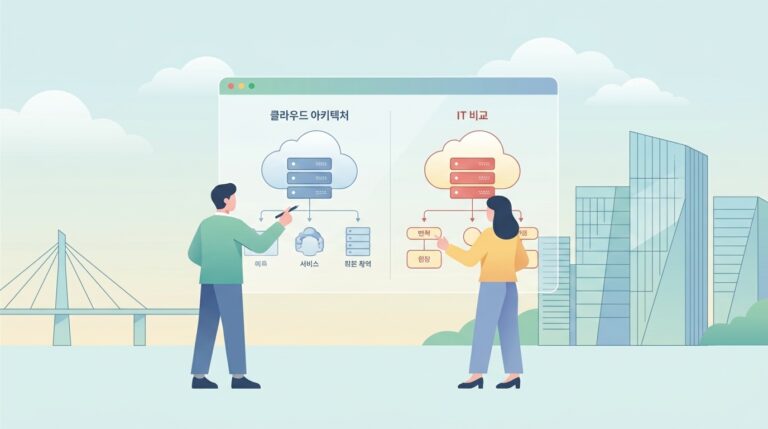
Mastering Cloud Computing Comparisons in Korean Tech Meetings: From Pangyo Startups to Enterprise
Phase 1: Empathy & Story Opening
안녕하세요! 매일한글 에디터입니다.
Picture this: You are sitting in an ultra-modern glass conference room in Pangyo Techno Valley—South Korea’s bustling Silicon Valley—surrounded by engineers, product owners, and stakeholders. Just like a scene straight out of the hit K-Drama Start-Up, the whiteboard is filled with infrastructure diagrams comparing AWS, Microsoft Azure, and Naver Cloud Platform (NCP). Your team lead leans in and asks: “이번 프로젝트 아키텍처는 가성비랑 확장성 측면에서 어디가 제일 적합할까요?” (Considering cost-efficiency and scalability, which architecture suits our project best?)
At the C1 level, simply saying “AWS가 좋아요” (AWS is good) will not cut it. Discussing IT cloud computing in Korean demands technical nuance, strategic phrasing, and an understanding of how Korean tech teams balance vendor lock-in, data sovereignty regulations, and ROI. When international professionals transition into Korean tech ecosystems, they often struggle not with technical competence, but with framing architectural debates politely yet persuasively. This guide combines real feedback from foreign engineers working in top Korean tech firms to give you the vocabulary, cultural instincts, and executive polish needed to lead high-stakes tech discussions.
Phase 2: Top 3 Core Expressions Deep Dive
1. 가성비와 확장성을 고려했을 때 (Gaseongbiwa hwakjangseong-eul goryeohaesseul ttae)
- Pronunciation: Gah-seong-bee-wah hwahk-jahng-seong-eul go-ryeo-haet-seul ttae (Sounds like “gah-seong-bee” + “park-jang-song”)
- Meaning: Literal: When considering price-to-performance ratio and scalability. / Real Nuance: “When balancing cost-efficiency against future growth potential…”
- K-Culture Moment: The staple opening phrase used by CTOs pitching architecture trade-offs in K-Drama boardrooms.
- Editor’s Insight: 가성비 (price-to-performance) is an everyday Korean obsession, but pairing it with 확장성 (scalability) immediately elevates your discourse to executive C1 tech Korean.
- Situation Spectrum: Casual ⚠️ | Semi-formal ✅ | Formal ✅
- 🤔 Think About It: In your native language, do you emphasize budget or technical superiority first when pitching architecture?
2. 레거시 시스템과의 연동성 측면에서 (Regeosi siseutemgwaui yeondongseong cheungmyeon-eseo)
- Pronunciation: Reh-guh-see she-seu-tem-gwah-ui yeon-dong-seong cheung-myeon-eh-seo
- Meaning: Literal: In terms of interlocking with legacy systems. / Real Nuance: “Regarding backward compatibility and integration with our existing tech stack…”
- K-Culture Moment: Used heavily when legacy conglomerates (chaebols) modernize and debate hybrid clouds versus total migrations.
- Editor’s Insight: 연동성 (interoperability/integration) is the ultimate buzzword when convincing conservative stakeholders who dread system downtime.
- Situation Spectrum: Casual 🚫 | Semi-formal ✅ | Formal ✅
- 🤔 Think About It: Notice how Korean creates professional compounds by chaining nouns (연동성 측면 – interoperability aspect) rather than using long descriptive relative clauses.
3. 보안 규제 준수 여부가 관건입니다 (Boan gyuje junsu yeobuga gwangeon-imnida)
- Pronunciation: Boh-ahn gyoo-jeh joon-soo yeo-boo-gah gwahn-geon-eem-nee-dah
- Meaning: Literal: Whether security regulations are complied with is the key. / Real Nuance: “Compliance with strict regulatory and security mandates is the deciding factor.”
- K-Culture Moment: Essential during fintech and public sector bidding wars where Korea’s ISMS-P and CSAP certifications dictate vendor selection.
- Editor’s Insight: 관건 (the crux/key factor) commands immediate respect. Ending your proposal with ~가 관건입니다 makes you sound like a seasoned consultant.
- Situation Spectrum: Casual 🚫 | Semi-formal ✅ | Formal ✅
- 🤔 Think About It: How does highlighting institutional compliance before technical merit shift the dynamics of tech leadership in your country?
Phase 3: Textbook Korean vs. Real-World Korean
Situation 1: Discussing Cost Differences
- 📖 교과서 한국어 (Textbook): 두 서비스의 가격이 다릅니다. (The prices of the two services are different.)
- 🗣️ 진짜 한국어 (Real-World C1): 인스턴스 단가 차이도 크고, 장기적인 TCO(총소유비용) 관점에서 짚고 넘어가야 합니다. (The instance unit cost discrepancy is significant, so we must evaluate this through long-term TCO.)
- 💡 왜 다를까? Textbook Korean uses simple adjectives (다르다), whereas real Korean IT pros speak in financial metrics (TCO 관점, 단가) and cautious action verbs (짚고 넘어가다 – to carefully examine).
Situation 2: Recommending a Vendor Match
- 📖 교과서 한국어 (Textbook): 저는 이 클라우드 서비스가 제일 좋다고 생각합니다. (I think this cloud service is the best.)
- 🗣️ 진짜 한국어 (Real-World C1): 저희 현재 인프라 핏(fit)에는 이쪽 서비스가 훨씬 수월하게 붙을 것 같습니다. (Looking at our current infrastructure fit, this service will integrate much more smoothly.)
- 💡 왜 다를까? Korean engineering culture prefers humble, pragmatic framing (수월하게 붙다 – to connect/hook up smoothly) over dogmatic assertions of superiority.
Phase 4: K-Culture Deep Dive & Non-Verbal Tech Manners
4-1. 눈치 (Nunchi) & Meeting Gestures
In Korean engineering discussions, technical disagreements must never feel like personal attacks on a colleague’s architecture choice. When pushing back against a colleague’s cloud vendor preference, use the 완충 제스처 (cushion gesture): place your palms flat on the table, tilt your head slightly in contemplation, and preface your counterpoint with “팀장님 말씀도 맞지만…” (What the team lead said is valid, however…). Keep eye contact steady but soften your tone to preserve team cohesion (화합).
4-2. Cultural Code: Public Cloud vs. Local Ecosystems
Korea holds a unique position in global cloud computing. While AWS and Azure dominate global market share, domestic powerhouses like Naver Cloud Platform (NCP) and NHN Cloud wield strong advantages in public sector and financial data storage due to domestic CSAP (Cloud Security Assurance Program) compliance. Knowing when to advocate for global scalability versus domestic compliance marks the difference between a textbook speaker and a true Pangyo insider.
Phase 5: Real-World Roleplay Scenario
Setting: A hybrid architecture review meeting at a fintech startup in Pangyo.
Characters: Alex (Lead Cloud Architect) & Team Lead Min (Infrastructure Director).
- Turn 1 (Min): 알렉스 님, 이번 데이터 파이프라인 구축할 때 AWS랑 네이버 클라우드 중에서 어디로 가는 게 맞을까요? (Alex, for building our new data pipeline, do you think we should go with AWS or Naver Cloud Platform?)
- Turn 2 (Alex): 🎭 노트북 화면에서 벤치마크 지표를 가리키며 현재 파이프라인의 처리 속도와 확장성을 고려했을 때는 AWS가 기술적으로 앞서 있습니다. (Pointing at benchmark metrics on the laptop screen: Considering processing speed and scalability, AWS holds a technical edge.)
- Turn 3 (Min): 기술적으로는 그런데, 금융 규제나 데이터 주권 가이드라인 문제는 없을까요? (Technically yes, but won’t we run into financial regulatory and data sovereignty issues?)
- Turn 4 (Alex): 🎭 차분하게 고개를 끄덕이며 바로 그 점 때문에 하이브리드 구성을 제안드리고 싶습니다. 민감 데이터는 국내 리전에 두고, 머신러닝 연산만 글로벌 CSP로 돌리는 방향입니다. (Nodding calmly: That is precisely why I suggest a hybrid setup. We keep sensitive data in domestic regions and run only ML computing on global CSPs.)
- Turn 5 (Min): 그렇게 하면 벤더 락인(Vendor Lock-in) 위험도 줄이고 운영 안정성도 확보할 수 있겠네요. (That would reduce vendor lock-in risks while securing operational stability.)
- Turn 6 (Alex): 🎭 자신감 있는 미소를 지으며 맞습니다. 초기 마이그레이션 비용은 들겠지만, 장기적인 TCO 관점에서는 훨씬 유리합니다. (Exactly. There will be initial migration costs, but from a long-term TCO perspective, it is far more advantageous.)
- Turn 7 (Min): 좋습니다. 그럼 두 안의 예상 단가와 아키텍처 비교표를 내일 스프린트 미팅 전까지 정리해 주실 수 있나요? (Great. Could you organize the estimated unit costs and architecture comparison chart before tomorrow’s sprint meeting?)
- Turn 8 (Alex): 🎭 정중하게 메모를 적으며 네, 온프레미스 연동 테스트 결과까지 포함해서 슬랙 채널에 바로 공유해 두겠습니다. (Noting it down politely: Yes, I will include the on-premise integration test results and share them on Slack immediately.)
🔀 Interactive Choice Point: How Should Alex Close the Pitch?
- Option A: “무조건 제 말이 맞으니까 AWS로 바로 결제 승인 올려주세요.” (I am unconditionally right, so please approve the AWS payment immediately.)
- Feedback (Bad): Highly confrontational and ignores team hierarchy and budget protocols.
- Option B: “보안 준수와 운영 비용 사이의 트레이드오프를 수치화해서 보고서로 올리겠습니다.” (I will quantify the trade-offs between security compliance and operational costs and submit a report.)
- Feedback (Best): Demonstrates exceptional executive maturity, analytical rigor, and professional business Korean.
- Option C: “글쎄요, 팀장님이 원하시는 대로 아무거나 하셔도 상관없습니다.” (Well, it does not matter to me; just do whatever you want, Team Lead.)
- Feedback (Risk): Displays lack of ownership and passive disengagement.
Phase 6: 10-Second Emotion Shadowing Drill
Practice reading these sentences aloud, paying close attention to natural pauses (/) and emotional tone:
[🧐 신중하고 분석적으로 / Deliberate & Analytical]- “가성비와 확장성을 / 종합적으로 검토했을 때, / 멀티 클라우드 전략이 / 가장 현실적인 대안입니다.” (Gaseongbiwa hwakjangseong-eul / jonghapjeogeuro geomtohaesseul ttae, / meolti keulla-oo-deu jeollyagi / gajang hyeonsiljeogin daean-imnida.)
[💡 확신에 찬 전문가 톤 / Confident & Professional]- “레거시 시스템과의 연동성 측면에서 / 다운타임을 최소화하려면 / 단계적 마이그레이션이 필수적입니다.” (Regeosi siseutemgwaui yeondongseong cheungmyeon-eseo / da-oon-ta-eem-eul choe-so-hwa-hayeo-myeon / dangyejeok ma-ee-geu-reyi-syeon-i pilsujeog-imnida.)
[🤝 공감하며 대안 제시 / Empathetic & Solution-Oriented]- “초기 도입 비용 부담은 있지만, / 장기적인 유지보수 효율을 따져보면 / 이쪽이 훨씬 유리합니다.” (Chogi do-ip biyong budam-eun itjiman, / jang-gijeogin yuji-bosu hyo-yul-eul ttajyeo-bomyeon / i-jjogi hwolssin yuri-hamnida.)
Phase 7: Mini K-Culture Tech Dictionary
- 온프레미스 vs 클라우드 마이그레이션 (On-premise vs Cloud Migration)
- Pronunciation: On-peu-reh-mee-seu vs Keul-lah-oo-deu Mah-ee-geu-reyi-syeon
- Usage: Transitioning physical in-house servers to remote cloud environments in enterprise IT discussions.
- 멀티 클라우드 전략 (Multi-cloud Strategy)
- Pronunciation: Meol-ti Keul-lah-oo-deu Jeol-lyak
- Usage: Deploying multiple cloud vendors simultaneously to prevent systemic downtime and manage vendor leverage.
- 벤더 락인 (Vendor Lock-in / 종속성)
- Pronunciation: Ben-deo Rak-in
- Usage: Discussing the risks of becoming overly dependent on proprietary APIs and cloud infrastructures.
- 데이터 주권 (Data Sovereignty)
- Pronunciation: De-ee-teo Joo-gwon
- Usage: Legal requirements dictating that customer data and sensitive records remain physically hosted within South Korea.
Phase 8: Expat Tech Professional Survival Kit
Top 3 Survival Tech Phrases
- “아키텍처 구성도 슬랙으로 전달해 드렸습니다.” (Ah-ki-tek-cheo goo-seong-do seul-raek-eu-ro jeon-dal-hae deu-ryeot-seum-nee-dah.)
- Pro Tip: Use this to confirm delivering deliverables directly after architectural debates.
- “CSAP 인증 여부 확인이 선행되어야 합니다.” (CSAP in-jeung yeo-boo hwak-in-i seon-haeng-doe-eo-yah ham-nee-dah.)
- Pro Tip: Bring this up early in enterprise or public project pitches to establish compliance competence.
- “PoC(개념 증명) 테스트 먼저 진행해 보시죠.” (PoC te-seu-teu meon-jeo jin-haeng-hae bo-shi-jyo.)
- Pro Tip: The best phrase to de-escalate theoretical disagreements and move to empirical validation.
Editor’s Tech Hub Travel Note
If you are visiting or working in Pangyo (Seongnam-si), explore the co-working lounges around Pangyo Station Exit 1. Install 네이버 지도 앱 (Naver Map App) for real-time metro and Pangyo shuttle bus schedules, and use Kakao T for convenient enterprise taxi transit between Seoul and Gyeonggi tech hubs.
Phase 9: A Step Deeper (한 발 더 깊이)
In Western engineering culture, architectural criticism is often direct and dispassionate—ideas are tested through blunt debate. In Korean high-tech workplaces, however, communication is fundamentally relational. Technical critique is wrapped in honorific cushioning (쿠션어) and collective framing (저희 – ‘we’ instead of 내 – ‘my’). When you balance precise technical vocabulary with linguistic humility, Korean engineers will respect not just your technical prowess, but your maturity as a leader who values collective harmony.
💬 Your Turn: Have you ever encountered a clash between technical directness and relational communication in your own workspace? Share your experiences in the comments below!
Phase 10: FAQ & Common Mistakes
Q: Is it acceptable to use English IT abbreviations like TCO, SLA, and PoC in Korean meetings?
A: Absolutely. Korean tech companies in Pangyo and Teheran-ro frequently use global acronyms (TCO, SLA, CI/CD, PoC, SaaS). However, pronounce them clearly with Korean phonetic flow (e.g., 티씨오, 에스엘에이, 피오씨).
Q: How do I disagree with a Senior Engineer’s cloud vendor choice politely?
A: Use the “Acknowledge & Pivot” method. Start with “선배님 말씀처럼 [Vendor A]의 안정성도 우수하지만, [Vendor B]의 비용 효율성 측면도 함께 고려해보면 어떨까요?” (As you noted, Vendor A is very stable, but what if we also consider Vendor B’s cost efficiency?).
Q: Why do Korean teams care so much about local CSPs like Naver Cloud?
A: For public, financial, and healthcare sectors, South Korean compliance standards (ISMS-P and CSAP) strictly regulate where data resides, making localized CSP partnerships indispensable.
🚨 Common Mistakes Warning Board
- ❌ Mistake 1: Saying “그건 틀렸습니다” (That is wrong) during a tech critique.
- 👉 Correct Action: Say “그 방안도 일리 있지만, 다른 변수를 고려해 보면 어떨까요?” (That makes sense too, but what if we look at other variables?).
- ❌ Mistake 2: Translating “cost-effective” as simply “싸다” (cheap).
- 👉 Correct Action: Use professional terms like “가성비가 뛰어나다” (excellent price-performance) or “비용 최적화(Cost Optimization)”.
- ❌ Mistake 3: Dropping honorific suffixes when referring to counterparts (알렉스가 ❌ -> 알렉스 님이 ✅).
Phase 11: Action Missions
- 🥉 Bronze Mission (Solo Practice): Record yourself reading the 3 Shadowing Drill sentences with correct pausing in under 45 seconds.
- 🥈 Silver Mission (Social Engagement): Post a sentence using ~측면에서 (in terms of…) describing your favorite programming language on social media and tag @DailyHangul.
- 🥇 Gold Mission (Real-World Execution): In your next tech standup or study group, propose a solution using the phrase “가성비와 확장성을 고려했을 때…”.
- 🎮 K-Culture Mission: Watch an episode of K-Drama Start-Up or Search: WWW and spot at least two instances where characters negotiate tech solutions using honorific cushions.
Phase 12: Interactive Quiz Challenge
1. Situation Judgment Quiz
Which response is most appropriate when your manager asks why you prefer Cloud Service B over Legacy on-premise servers?
* A) 레거시 시스템은 너무 낡아서 쓰레기입니다.
* B) 확장성과 장기적인 유지보수 비용 측면에서 클라우드 전환이 유리하다고 판단됩니다.
* C) 그냥 제가 쓰고 싶어서 골랐습니다.
🔍 Click to Reveal Answer & Explanation
Correct Answer: B
Explanation: Option B uses advanced C1 expressions (확장성, 유지보수 비용 측면, 판단됩니다) presenting an objective, data-driven perspective. Option A is offensive, while Option C shows zero professional accountability.
2. Fill-in-the-Blank Quiz
Complete the sentence with the correct technical term:
“초기 구축 단계에서는 보안 규제 준수 _____가 가장 중요한 _____입니다.”
🔍 Click to Reveal Answer & Explanation
Correct Answer: 여부 / 관건
Full Sentence: 보안 규제 준수 여부(whether or not)가 가장 중요한 관건(key factor)입니다.
3. Cultural True or False
Statement: In Korean tech corporations, you should immediately reject an unviable architecture suggestion by stating “불가능합니다” (It is impossible) without sugarcoating.
🔍 Click to Reveal Answer & Explanation
Correct Answer: False (F)
Explanation: Direct negation causes conversational friction. Professional Korean engineers soften rejection by analyzing feasibility (“현재 리소스로는 다소 무리가 따를 수 있어서 대안을 검토해야 합니다”).







