

Phase 1: 공감 (Story-Driven Opening)
안녕하세요! 매일한글 에디터입니다. (Hello! I’m your Daily Hangul editor.)
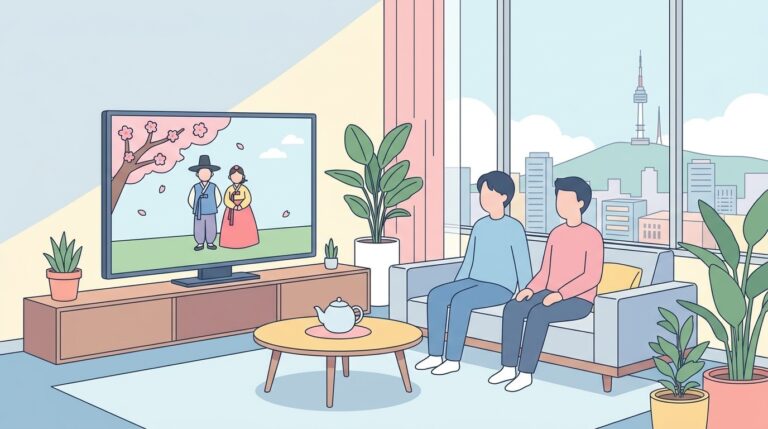
Picture this: You are chilling with your Korean friends on a cozy Friday night, binge-watching the latest trending weekend drama. Right at the cliffhanger of Episode 6, the wealthy heir dramatically shields the female lead in the rain with an oversized black umbrella, while slow-motion water droplets sparkle under neon streetlights. Your Korean friend rolls their eyes, laughs, and mutters, “아, 또 시작이네… 완전 클리셰 범벅인데 왜 재밌지?” (Ah, here we go again… It’s totally stuffed with clichés, but why is it so good?).
You completely understood the scene, but when your friend turns to you and asks, “이 드라마 어때?” (What do you think of this drama?), your mind freezes. All you can summon from your vocabulary bank is “재미있어요” (It’s fun) or “배우가 멋있어요” (The actor is cool). You desperately want to dissect the predictable plot twists, praise how the director subverted typical romance tropes, or complain about the ridiculous lack of narrative plausibility—like a genuine intermediate (B2) reviewer.
Analyzing genre tropes and narrative clichés is the ultimate gateway to mastering authentic Korean cultural discourse. In this guide, backed by years of coaching intermediate learners who want to move beyond textbook praise, we will equip you with the sharp, witty vocabulary needed to review K-Dramas like a native critic.
Phase 2: 핵심 표현 3선 심층 분석 (Top 3 Core Expressions)
1. 뻔하다 (Ppeonhada)
- Pronunciation: [Ppeon-ha-da] (Think of the sharp pop sound ‘Ppeon’ like popping bubble wrap, followed by a relaxed ‘ha-da’)
- Meaning: Literal: “To be obvious / transparent” ➔ Real Nuance: “Utterly predictable / cliché / seen-it-a-thousand-times”
- K-Culture Moment: The moment an estranged childhood friend miraculously appears as the new company CEO in episode 4.
- Editor’s Insight: While 초급 (beginners) say “예상할 수 있어요” (I can predict it), B2 speakers use 뻔하다 or 뻔한 전개 (predictable plot development). Be careful: calling someone’s actions 뻔하다 directly to their face can sound confrontational, but for drama critiques, it is pure gold.
- Situation Spectrum: Casual: ✅ | Semi-formal: ✅ | Formal: ⚠️ (In professional critiques, use ‘예측 가능한 전개’)
- 🤔 Think About It: Why does Korean pop culture have so many distinct words for predictability? Does your native language distinguish between a “comfortable classic trope” and a “boring, predictable cliché”?
2. 클리셰를 비틀다 (Keulliswereul biteulda)
- Pronunciation: [Keul-li-sye-reul bi-teul-da] (Pronounce ‘biteulda’ with a slight wrenching motion in your pitch, mimicking the word ‘twist’)
- Meaning: Literal: “To twist a cliché” ➔ Real Nuance: “Subverting traditional tropes / subverting expectations creatively”
- K-Culture Moment: When the heroine rescues the wealthy CEO from a kidnapping instead of waiting to be saved in a damsel-in-distress setup.
- Editor’s Insight: 비틀다 literally means to twist or wring out (like a wet towel). When paired with 클리셰 (cliché), it shows you appreciate a director’s deliberate storytelling technique. It is the hallmark phrase of thoughtful K-Drama reviews.
- Situation Spectrum: Casual: ✅ | Semi-formal: ✅ | Formal: ✅
- 🤔 Think About It: How does subverting traditional gender roles in recent K-dramas reflect the changing sociological landscape in modern Korea?
3. 개연성이 떨어지다 (Gaeyeonseongi tteoleojida)
- Pronunciation: [Gae-yeon-seong-i tteo-reo-ji-da] (Flow smoothly: ‘Gae-yeon-seong’ sounds like ‘gay-yawn-sung’)
- Meaning: Literal: “Plausibility / probability drops” ➔ Real Nuance: “Lacking logical flow / plot holes that break immersion”
- K-Culture Moment: When a character survives a 50-meter cliff fall with merely a stylish band-aid on their cheek in the next episode.
- Editor’s Insight: Intermediate learners often say “말이 안 돼요” (It doesn’t make sense). While accurate, saying 개연성이 떨어진다 instantly elevates your critique to an analytical B2 level, proving you understand formal narrative critique terms.
- Situation Spectrum: Casual: ✅ | Semi-formal: ✅ | Formal: ✅
- 🤔 Think About It: Korean audiences are known to be fierce critics regarding 개연성. Why are K-Drama fans so passionate about logical continuity even in fantasy dramas?
Phase 3: 교과서 한국어 vs 진짜 한국어 (Textbook vs. Real Korean)
Situation 1: Critiquing a tear-jerker scene that feels overly engineered
- 📖 교과서 한국어: “이 드라마는 슬픈 장면이 너무 많이 나와서 줄거리가 예상 가능합니다.” (This drama has too many sad scenes, so the storyline is predictable.)
- 🗣️ 진짜 한국어: “완전 뻔한 신파극인데, 배우들 연기력이 좋아서 나도 모르게 눈물 나더라.” (It’s totally a predictable tear-jerking melodrama, but the acting was so phenomenal that I teared up involuntarily.)
- 💡 왜 다를까? Koreans frequently use the genre term 신파 (Shinpa – exaggerated emotional melodrama) rather than just saying “sad story.” Acknowledging that something is a cliché while praising the acting showcases sophisticated conversational balance.
Situation 2: Commenting on absurd plot holes in a trending thriller
- 📖 교과서 한국어: “이야기의 전개에 논리적인 이유가 부족합니다.” (Logical reasoning is lacking in the plot development.)
- 🗣️ 진짜 한국어: “솔직히 후반부에 개연성은 밥 말아먹었는데, 전개가 빨라서 팝콘각이야.” (Honestly, the plot plausibility went completely down the drain in the second half, but the pacing is so fast it’s pure popcorn entertainment.)
- 💡 왜 다를까? The colorful idiom 밥 말아먹다 (to ruin completely, literally ‘to mix into rice soup’) paired with 팝콘각 (perfect popcorn flick material) turns a stiff academic review into lively, relatable chatter.
Phase 4: K-Culture 딥다이브 & 비언어적 매너 (Deep Dive & Non-Verbal Manners)
4-1. 눈치 (Nunchi) & Non-Verbal Reactions in K-Drama Banter
When discussing tropes with Korean drama fans, your body language tells half the story:
* The Cliché Sigh: When a character makes an absurdly foolish choice (like entering a dark basement alone), place one hand lightly on your forehead, exhale through slightly parted lips, and tilt your head with a half-smile. This signals: I recognize the trope, and I’m playfully exasperated.
* The K-Heartflutter Reaction (심쿵/입틀막): When a romantic twist successfully flips a cliché, briefly cover your open mouth with both hands (입틀막 – mouth covering in shock). It demonstrates high emotional empathy with the show.
4-2. Cultural Code: The Evolution from ‘Makjang’ to ‘Genre Deconstruction’
Traditionally, Korean television flourished on 막장 (Makjang – absurdly exaggerated plotlines involving secret identities, amnesia, and kimchi slaps). However, modern MZ-generation viewers demand clever genre self-awareness. Dramas like Vincenzo or Extraordinary Attorney Woo became global hits precisely because they knowingly played with classic K-Drama tropes and subverted them with witty humor. Mastering these review terms allows you to participate in active fan communities (like Theqoo or DC Inside).
Phase 5: 실전 롤플레이 시나리오 (Roleplay Scenario)
Setting: A trendy rooftop cafe in Seongsu-dong, Seoul. You (Alex) are discussing yesterday’s finale of a hot new fantasy-romance drama with Minji, your Korean colleague and ultimate drama connoisseur.
- 민지 (Minji): “알렉스 씨, 어제 ‘달빛 연인’ 막방 봤어요? 결말 진짜 충격적이지 않았어요?”
(Alex, did you watch the finale of ‘Moonlight Lovers’ yesterday? Wasn’t the ending totally shocking?) - 알렉스 (Alex):
🎭 고개를 끄덕이며 턱을 괸다 (Nodding and resting chin on hand)“네, 봤어요! 솔직히 초반에는 재벌 3세 이야기라서 흔한 클리셰 범벅인 줄 알았거든요.”
(Yes, I did! Honestly, in the beginning, because of the 3rd-generation chaebol storyline, I thought it was just stuffed with clichés.) - 민지 (Minji): “맞아요. 계약 결혼에 기억상실증까지 다 나왔잖아요. 그래서 중도 하차할 뻔했어요.”
(Right. It had everything from contract marriage to amnesia. I almost dropped the show.) - 알렉스 (Alex):
🎭 눈을 반짝이며 (With sparkling eyes)“그런데 10화부터 주인공이 클리셰를 완전히 비틀어버렸잖아요.”
(But from episode 10, the main lead completely twisted the clichés around.) - 민지 (Minji): “그쵸! 남주가 구해주는 게 아니라 여주가 문제를 직접 해결하는 장면, 진짜 사이다였어요!”
(Right! The scene where the female lead resolves the issue herself instead of being rescued by the male lead was so refreshing!) - 알렉스 (Alex):
🎭 아쉬운 듯 입술을 삐죽이며 (Pouting slightly as if disappointed)“다만 마지막 회에서 악역이 갑자기 착해진 건 좀 개연성이 떨어지지 않았나요?”
(However, wasn’t it a bit lacking in plausibility how the villain suddenly turned good in the final episode?) - 민지 (Minji): “아, 완전 공감해요! 급하게 해피엔딩으로 마무리 지으려는 티가 팍팍 났어요.”
(Ah, total agreement! It was so obvious they rushed to slap on a happy ending.) - 알렉스 (Alex):
🎭 미소 지으며 커피를 마신다 (Smiling and taking a sip of coffee)“그래도 주말마다 덕분에 도파민 폭발했어요. 다음엔 무슨 드라마 달릴까요?”
(Still, thanks to it, my dopamine exploded every weekend. What drama should we binge next?)
🔀 인터랙티브 분기점 (Interactive Branching):
If Minji asks: “알렉스 씨는 결말의 그 반전 장면 어땠어요?” (How was that twist scene in the ending for you?)
- Option A: “재미없었어요. 말이 안 돼요.” (It wasn’t fun. It doesn’t make sense.)
- ❌ Feedback (Bad): Too blunt and simplistic. It sounds like an A1 beginner and abruptly kills the conversational momentum.
- Option B: “반전 자체는 신선했는데, 복선 회수가 부족해서 개연성은 좀 아쉬웠어요.” (The twist itself was fresh, but because the foreshadowing wasn’t wrapped up well, the plausibility was a bit disappointing.)
- 🏆 Feedback (Best): Perfect B2 level! Balances constructive critique (신선했다) with analytical vocabulary (복선 회수, 개연성).
- Option C: “완전 막장 드라마라서 작가님 멱살 잡고 싶었어요!” (It was an absolute makjang drama, I wanted to grab the writer by the collar!)
- ⚠️ Feedback (Risk): Very native-like slang, but might sound overly aggressive or hyperbolic depending on how close you are with the speaker.
Phase 6: 10초 감정 섀도잉 드릴 (10-Second Emotion Shadowing Drill)
Practice reading these lines aloud with the indicated pause (/) and pitch modulation:
[😤 약간의 답답함과 통달한 어조 - Slightly frustrated yet perceptive]- “처음엔 / 뻔한 신데렐라 스토리인 줄 알았는데, / 뒤로 갈수록 / 반전이 대박이더라.”
(Cheo-eum-en / ppeon-han sin-de-rel-la seu-to-ri-in jul a-rat-neun-de, / dwi-ro gal-su-rok / ban-jeon-i dae-bak-i-deo-ra.)
- “처음엔 / 뻔한 신데렐라 스토리인 줄 알았는데, / 뒤로 갈수록 / 반전이 대박이더라.”
[🤩 흥분되고 신선한 충격을 받은 톤 - Excited and pleasantly shocked]- “삼각관계 클리셰를 / 이렇게 세련되게 / 비틀 줄은 / 진짜 몰랐어!”
(Sam-gak-gwan-gye keul-li-sye-reul / i-reoh-ge se-ryeon-doe-ge / bi-teul ju-reun / jin-jja mol-rat-seo!)
- “삼각관계 클리셰를 / 이렇게 세련되게 / 비틀 줄은 / 진짜 몰랐어!”
[🤔 진지하고 날카로운 비평가 톤 - Analytical critic tone]- “배우들 연기는 / 갓벽했는데, / 스토리 개연성이 / 너무 떨어져서 / 몰입이 깨졌어.”
(Bae-u-deul yeon-gi-neun / gat-byeok-haet-neun-de, / seu-to-ri gae-yeon-seong-i / neo-mu tteo-reo-jyeo-seo / mo-rip-i kkae-jyeot-seo.)
- “배우들 연기는 / 갓벽했는데, / 스토리 개연성이 / 너무 떨어져서 / 몰입이 깨졌어.”
Phase 7: K-Culture 미니 사전 (Mini Dictionary: 4 Essential Terms)
- 막장 (Makjang) | Extremely sensational & unrealistic melodrama
- Usage: Refers to plots with crazy secrets, absurd birth mysteries, and shocking betrayals. “이 드라마 완전 막장인데 중독성 있어.” (This drama is total makjang, but so addictive.)
- 입덕 부정기 (Ip-deok Bu-jeong-gi) | Denial phase before becoming a hardcore fan
- Usage: In romantic comedies, when the proud protagonist refuses to admit they are falling in love. “남주 지금 입덕 부정기 겪는 중이네.” (The male lead is currently going through his fan-denial phase.)
- 떡밥 (Tteok-bap) | Foreshadowing / Plot breadcrumbs (Literally ‘fish bait’)
- Usage: Clues dropped by writers for upcoming twists. “1화에 나온 그 시계, 엄청난 떡밥이었어.” (That watch in episode 1 was a massive plot breadcrumb.)
- 사이다 (Sa-i-da) | Refreshing, cathartic justice (Literally ‘cider / Sprite’)
- Usage: When a villain is humiliated or truth prevails without drag. “여주인공의 당당한 팩트 폭행, 완전 사이다!” (The heroine’s confident reality check was totally refreshing!)
Phase 8: 여행자 & K-콘텐츠 팬을 위한 생존 키트 (Survival Kit)
Survival Expressions TOP 3:
- “여기 드라마 촬영지 맞나요?” (Yeo-gi deu-ra-ma chwal-yeong-ji mat-na-yo?) — Pro Tip: Essential when visiting iconic K-Drama cafes in Ikseon-dong or Gangwon-do.
- “스포일러 하지 말고 결말만 말해줘요, 해피엔딩이에요?” (Seu-po-il-leo ha-ji mal-go gyeol-mal-man mal-hae-jwo-yo, hae-pi-en-ding-i-e-yo?) — Pro Tip: Saves you from heartbreak before committing 16 hours to a tear-jerking tragedy.
- “이 배우 전작이 뭐예요?” (I bae-u jeon-ja-gi mwo-ye-yo?) — Pro Tip: Great icebreaker with Korean staff at pop-up exhibitions.
Editor’s Travel Note:
When exploring drama hotspots in Korea, search real-time filming locations and honest Korean netizen ratings using 네이버 지도 앱 다운로드 (Naver Map App Download) for location tagging, or check 왓챠피디아 드라마 리뷰 모음 (Watcha Pedia Drama Review Collection) to read raw, unfiltered B2 Korean user reviews before visiting thematic exhibitions.
Phase 9: “한 발 더 깊이” (Cultural Insights & Essay)
K-Drama clichés are not merely lazy writing; they are communal emotional rituals. Traditional Korean storytelling values 한 (Han – collective sorrow) and 흥 (Heung – explosive joy), creating a narrative rhythm where intense hardships must be dramatically resolved through cathartic closure. When Koreans dissect clichés over chicken and beer, it is an affectionate cultural sport. By debating these storytelling patterns, viewers collectively celebrate how modern Korean narratives honor heritage tropes while boldly deconstructing them for a global audience.
💬 Your Turn: What is your all-time favorite K-Drama cliché (e.g., piggyback rides, subway PPL, fake dating), and which drama twisted it most creatively? Share your review in the comments below using one of our B2 phrases!
Phase 10: FAQ & 오해 방지 (FAQ & Common Mistakes)
Q: Can I use ‘뻔하다’ to describe a person?
A: You must be very careful. Saying “너 진짜 뻔하다” means “You are so transparent / predictable (in a negative, deceitful way).” To praise someone’s consistency, say “한결같다” (steady/unchanging) instead.
Q: What is the exact difference between ‘신파’ and ‘멜로’?
A: 멜로 (Melo) refers broadly to romance and melodrama genres. 신파 (Shinpa) specifically highlights exaggerated, tear-jerking tropes designed purely to force viewers to cry through artificial family tragedies.
Q: Is ‘개연성이 없다’ completely interchangeable with ‘말이 안 되다’?
A: 말이 안 되다 is colloquial and broad (used for everyday illogical events). 개연성이 없다/떨어지다 is a sophisticated literary term evaluating whether events make sense within the established internal logic of the fictional world.
🚨 흔한 실수 (Common Mistakes) 경고판:
- Mistake: Saying “이 드라마는 클리셰예요” (This drama is a cliché).
- Correct Action: In Korean, 클리셰 is a noun modifier or part of a phrase. Say “이 드라마는 클리셰가 많아요” (This drama has many clichés) or “클리셰 범벅이에요” (stuffed with clichés).
- Mistake: Confusing 반전 (twist) with 발전 (development/progress).
- Correct Action: When talking about plot twists, clearly say “결말에 엄청난 반전이 있어요”.
- Mistake: Overusing 재미있다 for every review.
- Correct Action: Substitute with 몰입감이 좋다 (great immersion), 흡인력 있다 (gripping pull), or 시간 순삭이다 (time flew by).
Phase 11: 액션 미션 & 참여 유도 (Action Missions)
- 🥉 Bronze Mission (Solo Practice): Pick the latest K-Drama you watched and record a 15-second voice memo saying: “이 드라마는 [뻔하다 / 클리셰를 비틀었다 / 개연성이 아쉽다].”
- 🥈 Silver Mission (Social Share): Post a short review of your favorite drama scene on Instagram or X (Twitter) using the hashtag
#DailyHangulDramaand#클리셰비틀기. - 🥇 Gold Mission (Real-world Chat): Next time you talk with a Korean friend or language exchange partner, ask them: “최근에 본 드라마 중에 개연성 최고였던 작품 있어요?” and discuss their response!
- 🎮 K-Culture Mission: Watch the first episode of a newly aired drama this week and count how many classic tropes (umbrella scene, accidental fall-and-catch, wrist grab) appear in the first 30 minutes.
Phase 12: 인터랙티브 퀴즈 챌린지 (Interactive Quiz)
1. [상황 판단] Which sentence represents the most natural B2-level critique of a drama with illogical plot leaps?
* (A) 이 드라마는 진짜 재미가 조금 부족하고 스토리가 이상해요.
* (B) 배우들 비주얼은 훌륭하지만, 후반부 스토리 개연성이 다소 떨어져서 아쉬웠어요.
* (C) 드라마가 너무 나빠서 텔레비전을 껐습니다.
2. [빈칸 채우기] Complete the sentence:
“뻔한 삼각관계 이야기를 여주인공 중심의 성장물로 신선하게 (_______) 연출이 돋보였다.”
* (A) 비틀어버린
* (B) 던져버린
* (C) 지워버린
3. [True / False] 문화 상식:
Koreans use the word ‘사이다 (Saida)’ in drama reviews only when talking about product placement (PPL) carbonated drinks.
* (True / False)
🔍 정답 및 해설 확인하기 (Click to reveal answers & explanations)
- 정답: (B)
- 해설: (B) uses sophisticated intermediate phrasing (스토리 개연성이 다소 떨어져서 아쉬웠어요) balancing compliments and constructive critique.
- 정답: (A) 비틀어버린
- 해설: The idiom is 클리셰를 비틀다 (to subvert/twist a cliché). Adding -어 버리다 emphasizes the thoroughness of the director’s creative choice.
- 정답: False
- 해설: In modern slang, 사이다 metaphorically refers to any moment of refreshing, satisfying emotional release or justice against unfairness, contrasting with 고구마 (frustrating, suffocating moments like eating dry sweet potatoes).
- 해설: In modern slang, 사이다 metaphorically refers to any moment of refreshing, satisfying emotional release or justice against unfairness, contrasting with 고구마 (frustrating, suffocating moments like eating dry sweet potatoes).







