

Phase 1: Empathy (Story-Driven Opening)
안녕하세요! 매일한글 에디터입니다.
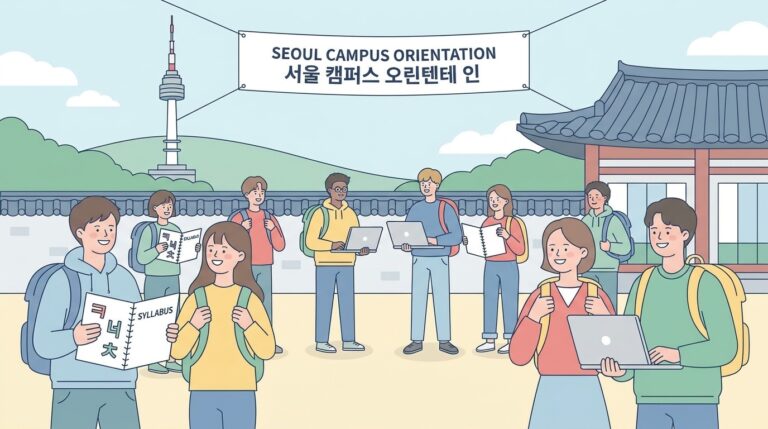
Imagine this: You step into a crowded university auditorium in Seoul. Fluorescent lights buzz overhead, hundreds of freshmen are chattering in rapid-fire Korean, and friendly upperclassmen (선배 – seonbae) are waving colorful neon signboards for your department. You clutch your campus map, your heart pounding like an audition scene in a campus K-drama like Cheese in the Trap or Weightlifting Fairy Kim Bok-joo. Orientation Day (오리엔테이션 or OT) is thrilling, but when professors start explaining complex course registration (수강 신청 – sugang sincheong) rules and syllabus codes in natural native speed, panic can easily set in.
Many of our B1 learners share the same frustration: “I know how to say hello, but when sunbaes start explaining credits, lecture limits, and department groups during OT, I completely freeze!” Don’t worry at all. Attending university orientation in Korea isn’t just about collecting syllabi; it’s your golden gateway to making lifelong friends, landing insider course-enrollment hacks, and adapting smoothly to Korean student culture. Based on real classroom scenarios and feedback from international students across Korea, this practical guide gives you the essential phrases, unwritten social etiquette, and confidence you need to rock your Korean university orientation!
Phase 2: Deep Dive into 3 Core Expressions
1. 수강 신청 어떻게 해요? (Sugang sincheong eotteoke haeyo?)
- Pronunciation: [Soo-gang shin-cheong uh-ttuh-keh hae-yo?] (Think of sugang sounding like ‘Sue-gang’ and eotteoke like ‘uh-tough-care’ without the r sound)
- Meaning: Literal: “How do I do course registration?” | Nuance: A natural, polite way to ask seniors or staff for step-by-step guidance on signing up for classes.
- K-Culture Moment: The classic campus drama trope where the confused first-year student sheepishly asks a charismatic senior at the orientation booth for help navigating the university portal.
- Editor’s Insight: In Korea, course registration is famously competitive (often dubbed sugang sincheong jeonjaeng or ‘course registration war’). Asking this early during orientation signals that you are proactive and eager to learn the system.
- Situation Spectrum: Casual ⚠️ | Semi-formal ✅ | Formal ✅
- 🤔 Think About It: In many Western universities, academic advisors build your schedule. In Korea, students select their entire timetable individually. How does this DIY scheduling culture change the way classmates bond and collaborate?
2. 신입생 단톡방 있나요? (Sinipsaeng dantokbangscore innayo? / Sinipsaeng dantokbang innayo?)
- Pronunciation: [Sheen-eep-saeng dahn-tok-bahng eent-nah-yo?] (Say sinip-saeng like ‘seen-ip-sang’ + dantokbang like ‘dahn-talk-bahng’)
- Meaning: Literal: “Is there a freshman group chat?” | Nuance: “Could you add me to the KakaoTalk group for our freshman class/major?”
- K-Culture Moment: During OT icebreaking sessions, the department president stands up and holds up a giant KakaoTalk QR code so everyone can join the group chat simultaneously.
- Editor’s Insight: Dantokbang (단톡방) is an abbreviation for ‘단체 카카오톡 채팅방’ (group KakaoTalk chat room). All essential departmental notices, syllabus changes, and after-party announcements happen here!
- Situation Spectrum: Casual ✅ | Semi-formal ✅ | Formal ⚠️
- 🤔 Think About It: Why do Korean university cohorts rely on unified messaging apps rather than traditional email chains? Notice how instant accessibility reflects the fast-paced (ppalli-ppalli) social rhythm.
3. 이 수업 필수 과목인가요? (I sueop pilsu gwamogingayo?)
- Pronunciation: [Ee soo-up peel-soo gwa-mok-een-gah-yo?] (sueop rhymes with ‘soup-up’ quickly; pilsu sounds like ‘peel-sue’)
- Meaning: Literal: “Is this class a required subject?” | Nuance: Asking whether a lecture is a mandatory general education or major credit prerequisite.
- K-Culture Moment: A student squinting at a complex curriculum flowchart on an auditorium projector screen, double-checking graduation requirements with their assigned student mentor.
- Editor’s Insight: University courses in Korea are strictly split into jeongong pilsu (전공필수 – Major Required) and gyoyang (교양 – Electives). Asking this prevents disastrous graduation delays later!
- Situation Spectrum: Casual ⚠️ | Semi-formal ✅ | Formal ✅
- 🤔 Think About It: How do graduation requirement structures differ in your home country compared to Korea’s credit system (hakjeom)?
Phase 3: Textbook Korean vs. Real Korean
Situation A: Asking for orientation materials
- 📖 교과서 한국어 (Textbook): 저에게 오리엔테이션 책자를 배부해 주시겠습니까? (Jeoege orientteisyeon chaekjareul baebuhye jusigesseumnikka? – “Would you distribute the orientation booklet to me?”)
- 🗣️ 진짜 한국어 (Real-Life): 혹시 OT 자료집 하나 더 받을 수 있을까요? (Hoksi OT jaryojip hana deo badeul su isseulkkayo? – “Excuse me, could I get one more OT handout package?”)
- 💡 왜 다를까?: Real university students use abbreviations like OT for orientation and rely on polite softeners like 혹시 (hoksi – by any chance) rather than stiff military-style honorific endings.
Situation B: Asking a senior about tough professors
- 📖 교과서 한국어 (Textbook): 이 교수님의 강의는 어떠한 난이도를 가지고 있습니까? (I gyosunimui ganguineun eotteohan nanidoreul gajigo osseumnikka? – “What degree of difficulty does this professor’s lecture possess?”)
- 🗣️ 진짜 한국어 (Real-Life): 선배님, 이 교수님 과제나 시험 많이 빡세나요? (Seonbaenim, i gyosunim gwajena siheom mani ppaksenayo? – “Sunbae, does this professor give crazy heavy assignments or exams?”)
- 💡 왜 다를까?: The colloquial adjective 빡세다 (ppakseda – intense/hectic) is universally used by college students across Korea to describe demanding workloads and grading standards.
Phase 4: K-Culture Deep Dive & Non-Verbal Manners
4-1. 눈치 (Nunchi) & Body Language at University OT
- Two-Handed Receive & Give: When upperclassmen or student council members (haksaenghoe) hand you program booklets, campus maps, or snack boxes, always receive them with both hands and a slight 15-degree head bow. It shows instant respect and warmth.
- Seating Nunchi (자리 눈치): During auditorium presentations, avoid isolating yourself in the very back corner. Sit alongside fellow freshmen within your assigned ban (group/department division). Making polite eye contact with peers and nodding when seniors speak demonstrates great nunchi and group solidarity.
4-2. Cultural Code: The Legendary “OT & MT” Culture
In Korean campus life, Orientation (OT) naturally leads to Membership Training (MT). OT focuses on academic orientation and curriculum guidelines, but it transitions quickly into social dinners (Dwitpurip – 뒷풀이). Joining these gatherings is where Korean freshmen form tight networks, swap tips on the best campus cafeterias, and meet their bap-jal-sajuneun yeppeun/meotjin seonbae (the generous seniors who buy lunch for freshmen!).
Phase 5: Real-World Roleplay Scenario
- Setting: The Business Administration Department Orientation Hall. Freshmen are seated in groups while student council mentors walk around answering course registration questions.
- Characters:
- 민우 (Minwoo): A friendly 3rd-year student council senior (seonbae).
- Alex (You): An incoming international freshman trying to organize their first-semester timetable.
Dialogue:
1. 민우: 🎭 (Smiling warmly, handing out course registration booklets) 안녕하세요! 경영학과 신입생 맞으시죠? OT 자료 여기 있어요. (Annyeonghaseyo! Gyeong-yeong-hakgwa sinipsaeng majeosijyo? OT jaryo yeogi isseoyo. – “Hello! You are a freshman in Business Admin, right? Here is your OT material.”)
2. Alex: 🎭 (Bowing slightly while taking the booklet with two hands) 네, 감사합니다 선배님! 처음이라 조금 긴장돼요. (Ne, gamsahamnida seonbaenim! Cheoeum-ira jogeum ginjangdwaeyo. – “Yes, thank you sunbae! Since it is my first time, I am a bit nervous.”)
3. 민우: 🎭 (Chuckles reassuringly) 다들 그래요. 혹시 수강 신청 시스템 써보셨어요? (Dadeul geuraeyo. Hoksi sugang sincheong siseutem sseobosyeosseoyo? – “Everyone feels that way. By any chance, have you tried using the course registration system?”)
4. Alex: 🎭 (Points at the syllabus page with a curious look) 아니요, 아직 안 해봤어요. 1학년 1학기에는 몇 학점 신청하는 게 좋아요? (Aniyo, ajik an haebwasseoyo. Il-hangnyeon il-hakgieneun myeot hakjeom sincheonghaneun ge joayo? – “No, not yet. How many credits is it good to register for in semester 1?”)
5. 민우: 🎭 (Tapping the guidebook) 보통 18학점 듣는데, 필수 교양 두 개는 무조건 넣어야 해요. (Botong sip-pal hakjeom deunneunde, pilsu gyoyang du gaeneun mujogeon neoeoya haeyo. – “Usually 18 credits, but you definitely must include two mandatory electives.”)
6. Alex: 🎭 (Taking quick notes) 아, 그렇군요! 혹시 선배님이 추천해주실 만한 교양 수업 있으세요? (A, geureokunyo! Hoksi seonbaenimi chucheonhaejusil manhan gyoyang sueop isseuseyo? – “Ah, I see! By any chance, do you have any elective courses you’d recommend?”)
7. 민우: 🎭 (Winks and takes out his phone) ‘한국 문화의 이해’ 수업이 꿀강이에요! 아, 우리 신입생 단톡방 들어오셨어요? 초대해 드릴게요. (‘Hanguk munhwaui ihae’ sueobi kkulgang-ieyo! A, uri sinipsaeng dantokbang deureo-osyeosseoyo? Chodaehae deurilgeyo. – “‘Understanding Korean Culture’ is a total GPA booster! Ah, did you join our freshman Kakao group chat? Let me invite you.”)
8. Alex: 🎭 (Smiles brightly and shows KakaoTalk QR code) 와, 정말 감사합니다! 선배님 덕분에 든든해요. (Wa, jeongmal gamsahamnida! Seonbaenim deokbune deundeunhaeyo. – “Wow, thank you so much! Thanks to you, I feel super reassured.”)
🔀 Interactive Decision Branch
What should you say next when Minwoo asks if you want to join the after-orientation dinner (뒷풀이 – dwitpuri)?
* Choice A: “네, 꼭 갈게요! 선배님들이랑 동기들 빨리 친해지고 싶어요.” (Ne, kkok galgeyo! Seonbaenimdeurirang donggideul ppalli chinhaejigo sipeoyo.)
* Feedback (Best Choice): 🌟 Fantastic! Shows eagerness to integrate into student community life and respect for peer bonding.
* Choice B: “싫어요. 피곤해서 그냥 기숙사 갈래요.” (Sireoyo. Pigonhaeseo geunyang gisuksa gallaeyo.)
* Feedback (Bad Choice): ❌ Too blunt! Saying sireoyo (I dislike/refuse) sounds hostile and cuts off social connection instantly.
* Choice C: “오늘은 선약이 있어서 아쉽지만 다음 모임에 꼭 참석할게요!” (Oneureun seonyagi isseoseo aswipjiman daeum moime kkok chamseokhalgeyo!
* Feedback (Risk-Managed Polite Softener): ⚠️ Great diplomatic response if you really cannot attend without offending anyone.
Phase 6: 10-Second Emotion Shadowing Drill
Practice these natural rhythm breaks (/) with real emotional inflection!
[😊 설레고 공손하게 - Excited & Courteous]- “선배님, / 신입생 OT 자료집 / 하나 더 받을 수 있을까요?”
- Seonbaenim, / sinipsaeng OT jaryojip / hana deo badeul su isseulkkayo?
[🤔 진지하고 궁금하게 - Curious & Serious]- “이 강의가 / 전공 필수 과목인지 / 확인하고 싶어요.”
- I ganguiga / jeongong pilsu gwamoginji / hwaginhago sipeoyo.
[🎉 밝고 감사한 톤 - Bright & Grateful]- “단톡방에 초대해 주셔서 / 정말 감사합니다! / 잘 부탁드립니다!”
- Dantokbange chodaehae jusyeoseo / jeongmal gamsahamnida! / Jal butakdeurimnida!
Phase 7: K-Culture Mini Dictionary
- 꿀강 (Kkul-gang) | Literal: Honey Lecture | Usage: A legendary easy A course with manageable workloads, engaging lectures, and fair grading.
- 공강 (Gong-gang) | Literal: Empty Class | Usage: A free period between classes (e.g., 우주공강 – a massive 4-hour gap in your schedule).
- 학점 (Hak-jeom) | Literal: Academic Credits / GPA | Usage: Refers to both credit hours per course (e.g., 3학점) and your letter GPA score.
- 동기 (Dong-gi) | Literal: Same Period Peers | Usage: Classmates who entered university in the exact same year/cohort as you.
Phase 8: International Student Survival Kit
Survival Expressions TOP 3
- “학생증 언제 발급되나요?” (Haksaengjeung eonje balgeupdoenayo? – “When will student IDs be issued?”)
- Pro Tip: You’ll need your student ID to access campus libraries and computer labs for registration day.
- “수강 정정 기간이 언제예요?” (Sugang jeongjeong gigani eonjeyeyo? – “When is the add/drop course period?”)
- Pro Tip: If you fail to register for a coveted lecture on day 1, add/drop week is your second chance.
- “캠퍼스 와이파이 어떻게 연결해요?” (Kaempeoseu wa-i-pa-i eotteoke yeongyeolhaeyo? – “How do I connect to the campus Wi-Fi?”)
- Pro Tip: University Wi-Fi usually requires logging in with your student portal credentials.
Editor’s Travel & Campus Note
Be sure to complete your 에브리타임 (Everytime) 대학생 커뮤니티 앱 다운로드 right after receiving your student verification. Everytime is Korea’s #1 university portal app for building timetables, viewing real professor evaluations, and checking cafeteria menus.
Phase 9: Think Deeper (한 발 더 깊이)
In Korean university culture, academic life is deeply communal rather than purely solitary. From calling older students 선배 (Seonbae) and peers 동기 (Dong-gi) to sharing syllabus secrets during freshman orientation, the campus serves as an initial blueprint of Korean corporate hierarchy and mutual support systems. Embracing this sense of togetherness (우리 문화 – Uri culture) during orientation transforms your study abroad experience from an intimidating challenge into an unforgettable community adventure.
💬 Your Turn: Have you ever attended an orientation abroad? What course registration culture surprised you most? Share your thoughts in the comments below!
Phase 10: FAQ & Common Mistakes
Q: Can I speak casually (반말) to other freshmen I meet at orientation immediately?
A: It is best to start in polite존댓말 (jondaetmal) with phrases like “반가워요! 혹시 몇 살이세요?” (Bangawoyo! Hoksi myeot sariseyo?). Once you confirm you are the same age or mutually agree to speak comfortably, you can transition naturally to informal talk.
Q: What should I do if a course I need fills up in 1 second during sugang sincheong?
A: Do not panic! Mark down the class code, attend the first week, and ask the professor for an override permission slip called chuga sugang sincheong seowonseo (추가 수강 신청 청원서).
Q: Is attendance at the post-OT dinner party mandatory?
A: Not legally mandatory, but highly recommended for international students! Even staying for 1 hour allows you to establish valuable peer connections.
🚨 Common Mistakes Alert
- Calling Upperclassmen ‘Teacher’ (선생님): In universities, refer to seniors as 선배님 (seonbaenim), not 선생님 (seonsaengnim).
- Typing solely in English in Kakao group chats: Always try a short polite Korean greeting first before asking English questions.
- Ignoring Course Codes (gwamok kodeu): Many classes share identical titles; always match the exact 6-digit lecture code when registering.
Phase 11: Action Missions
- 🥉 Bronze Mission (Solo Practice): Read the 3 shadowing drill sentences aloud 5 times while recording your voice on your phone.
- 🥈 Silver Mission (Social Connection): Practice typing a friendly greeting in Korean to your university group chat or study partner.
- 🥇 Gold Mission (Real-Life Mastery): Ask a real Korean student or language exchange partner about their favorite kkulgang (꿀강) recommendation.
- 🎮 K-Culture Mission: Watch an episode of a Korean campus web drama (like Love Playlist or A-TEEN) and spot when students use the words OT, Dong-gi, and Sugang sincheong!
Phase 12: Interactive Quiz Challenge
1. Situation Judgment: You want to ask a senior in your department if a specific lecture has difficult tests and homework. Which phrase is most natural?
* (A) 이 수업 진짜 빡세나요?
* (B) 이 수업 당장 취소할래요.
* (C) 교수님 숙제 그만 주세요.
🔍 Click to Reveal Answer & Explanation
Correct Answer: (A)
Explanation: ‘(A) 이 수업 진짜 빡세나요?’ naturally inquires about class intensity without sounding rude. Option (B) means ‘I want to cancel right now’ and (C) is an inappropriate demand to a professor!
2. Fill-in-the-blank: 신입생 카카오톡 ______ 에 초대해 주세요! (Freshman KakaoTalk group chat)
* (A) 노래방
* (B) 단톡방
* (C) PC방
🔍 Click to Reveal Answer & Explanation
Correct Answer: (B) 단톡방 (Dantokbang = Group chat)
Explanation: 노래방 is karaoke, and PC방 is an internet gaming cafe.
3. True or False: In Korean university culture, orientation is strictly for lectures and you shouldn’t ask questions about professors’ testing styles.
🔍 Click to Reveal Answer & Explanation
Correct Answer: False!
Explanation: Orientation is the prime opportunity to ask seniors for insider advice (kkul-tip) regarding course difficulty, grading trends, and textbook purchases.







