

Phase 1: Empathy & Story Opening
안녕하세요! 매일한글 에디터입니다. (Hello! This is your Daily Hangul editor.)
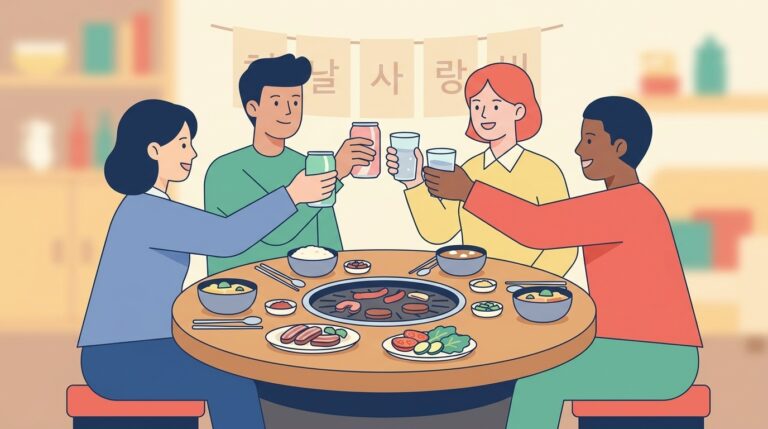
Picture this scene straight out of an office K-drama like Misaeng or Business Proposal: It is 7:30 PM on a brisk Thursday in Seoul. The grill is sizzling with succulent pork belly (samgyeopsal), laughter echoes across the room, and your team leader suddenly raises a fresh bottle of soju, scanning the table to top up everyone’s glass. Your heart skips a beat. You want to bond with your colleagues, but you really cannot drink alcohol tonight—or perhaps you do not drink at all. In the past, turning down a drink in a Korean corporate setting felt like walking on thin ice.
Many of our intermediate learners share this exact worry: “How do I politely decline a drink without spoiling the mood or sounding disrespectful to my team?”
Here is the great news: Korea’s work culture has undergone a massive transformation. Thanks to the rising emphasis on 워라밸 (Work-Life Balance) and personal boundaries, forced drinking culture (gang-gwon) is fading into history. Today, knowing how to decline or substitute drinks smoothly using refined, natural Korean (B2 intermediate level) will actually earn you respect for your tactful etiquette (nunchi). Let’s master the art of navigating modern Korean hoeshik with confidence and grace!
Phase 2: 3 Key Expressions Deep Dive
1. 오늘 컨디션이 좀 안 좋아서요 (Oneul keondisyeoni jom an joaseoyo)
- Pronunciation: [oh-neul keon-dee-syeon-ee jom an jo-ah-seo-yo] (Sounds like “condition-ee”, referring to physical state/wellness)
- Meaning: Literal: “Because my condition is a bit not good today.” / Real Nuance: “I am not feeling at my best tonight, so I’d better take it easy.”
- K-Culture Moment: Seen frequently in office dramas when a junior employee tactfully excuses themselves from consecutive rounds of drinks without giving an overly private medical excuse.
- Editor’s Insight: In Korean, “컨디션 (condition)” specifically refers to one’s physical stamina or energy level. Adding “-아서요/어서요” at the end naturally softens the sentence into a polite explanation rather than a blunt refusal.
- Situation Spectrum: Casual: ✅ | Semi-formal: ✅ | Formal: ✅
- 🤔 Think About It: Notice how Korean speakers prefer attributing refusals to an external state (“my physical energy”) rather than a direct personal preference (“I do not want to”). Why do you think indirect refusal maintains social harmony?
2. 분위기만 맞출게요 / 기분만 낼게요 (Bun-wi-gi-man mat-chul-ge-yo / Gi-bun-man nael-ge-yo)
- Pronunciation: [boon-wee-gee-man mat-chool-geh-yo / gee-boon-man nel-geh-yo]
- Meaning: Literal: “I will just match the vibe / create the mood.” / Real Nuance: “I won’t drink alcohol, but I will enthusiastically join the celebration and toasts!”
- K-Culture Moment: When the team does an energetic collective toast (Geonbae!), an employee holds up a glass of water or cider with a bright smile.
- Editor’s Insight: This magic sentence shows you are 100% engaged in the team spirit even if your glass contains soda. It completely removes any awkwardness from refusing alcohol.
- Situation Spectrum: Casual: ✅ | Semi-formal: ✅ | Formal: ⚠️ (Use ‘기분만 내겠습니다’ in strict formal settings)
- 🤔 Think About It: How does focusing on communal “vibe” (bunwigi) demonstrate empathy in collectivist social settings?
3. 저는 음료수로 짠할게요 (Jeo-neun eum-ryo-su-ro jjan-hal-ge-yo)
- Pronunciation: [juh-neun eum-ryoh-soo-roh jjan-hal-geh-yo] (‘Jjan’ mimics the clinking sound of glasses!)
- Meaning: Literal: “As for me, I will clink with a soft drink.” / Real Nuance: “I’ll toast along with soda/juice!”
- K-Culture Moment: During friendly post-project dinners where everyone grabs whatever beverage they prefer—cider, zero cola, or barley tea.
- Editor’s Insight: ‘짠하다’ (to clink glasses) is a friendly, vibrant colloquial verb. Using it keeps the energy playful and casual without sounding stiff.
- Situation Spectrum: Casual: ✅ | Semi-formal: ✅ | Formal: ⚠️ (Use ‘음료수로 건배하겠습니다’ for formal banquets)
- 🤔 Think About It: Is there an onomatopoeic word in your native language that has turned into a social verb like ‘짠하다’?
Phase 3: Textbook Korean vs. Real Korean
Situation 1: Declining a drink from a senior colleague
- 📖 교과서 한국어 (Textbook): “저는 술을 마실 수 없습니다.” (I cannot drink alcohol.)
- 🗣️ 진짜 한국어 (Real-Life): “죄송하지만, 오늘은 사이다로 대신해도 될까요?” (I’m sorry, but could I substitute cider instead today?)
- 💡 왜 다를까? (Why the difference?): The textbook version sounds overly clinical and defensive. Proposing an alternative beverage with “-로 대신하다” (substitute with) shows proactive politeness.
Situation 2: Leaving after the 1st round without staying for late-night drinking
- 📖 교과서 한국어 (Textbook): “저는 지금 집에 가겠습니다.” (I will go home now.)
- 🗣️ 진짜 한국어 (Real-Life): “저는 오늘 1차만 하고 먼저 일어나 보겠습니다!” (I’ll wrap up with round one and head out first!)
- 💡 왜 다를까? (Why the difference?): Saying “일어나 보다” (literally ‘try getting up’) softens the departure, signaling that you appreciated the dinner while setting a clear, respectful boundary for your personal work-life balance.
Phase 4: K-Culture Deep Dive & Non-Verbal Manners
4-1. 눈치 (Nunchi) & Non-Verbal Dining Etiquette
Even when you are not drinking alcohol, displaying attentive dining manners shows tremendous respect:
* Two-Handed Toasting (두 손 예절): When clinking your soda glass with a senior colleague, support your pouring wrist or hold the base of your glass with your left hand.
* The Lower Rim Rule: Keep the rim of your glass slightly lower than your senior’s glass when clinking.
* The Head Turn (고개 돌리기): While not mandatory for non-alcoholic drinks, slightly turning your head to the side when taking your first sip remains a polite cultural nod.
4-2. Cultural Code: The Evolution of Hoeshik & Worabal
In Korean corporate history, hoeshik (company dinner) was once viewed as an mandatory extension of the workday. However, the rise of 워라밸 (Work-Life Balance) and generational shifts have redefined these gatherings. Nowadays, companies favor “점심 회식” (lunch company meals), cultural activities (bowling, escape rooms), and 1-round dinners that end strictly before 9:00 PM. Declining alcohol is no longer a career risk; it is widely accepted as an individual choice when expressed politely.
Phase 5: Real-Life Roleplay Scenario
Setting: A vibrant Korean BBQ restaurant in Gangnam. Sizzling pork belly, glowing charcoal, and lively chatter.
Characters: Manager Kim (김 부장님, warm but traditional team leader) & You (Smart B2 Intermediate Specialist).
- Turn 1 (Manager Kim): “자, 이번 프로젝트 다들 수고 많았어요! 자, 소주 한 잔씩 받아요!”
(Ja, ibeon peurojekteu dadeul sugo manasseoyo! Ja, soju han janssik badayo! / Alright, everyone worked hard on this project! Here, take a glass of soju!)
🎭 Action: Manager Kim picks up the green soju bottle and smiles warmly. - Turn 2 (You): “부장님, 정말 고생 많으셨습니다!”
(Bujangnim, jeongmal gosaeng maneusyeotseumnida! / Manager Kim, you worked so hard as well!)
🎭 Action: Holding your glass with both hands respectfully. - Turn 3 (Manager Kim): “어라, 빈 잔이네? 내가 한잔 따라줄게요.”
(Eora, bin jan-ine? Naega hanjan ttarajulgeyo. / Oh, your glass is empty? Let me pour you a drink.) - Turn 4 (You): “아, 부장님! 제가 오늘 컨디션이 좀 안 좋아서 그런데, 사이다로 받아도 될까요?”
(A, bujangnim! Jega oneul keondisyeoni jom an joaseo geureonde, saidaro badado doelkkayo? / Ah, Manager! I’m not feeling at my best today, so could I receive cider instead?)
🎭 Action: Making gentle eye contact with an apologetic yet pleasant smile. - Turn 5 (Manager Kim): “그래? 몸이 안 좋으면 무리하지 말아야지. 사이다 여기 있다!”
(Geurae? Momi an joeumyeon murihaji marayaji. Saida yeogi itda! / Really? If you don’t feel well, don’t overdo it. Here is some cider!) - Turn 6 (You): “감사합니다! 저는 오늘 음료수로 열심히 짠하겠습니다!”
(Gamsahamnida! Jeoneun oneul eumryosuro yeolsimhi jjan-hagesseumnida! / Thank you! I’ll gladly toast along with my soft drink tonight!) - Turn 7 (Manager Kim): “좋아, 다 같이 건배합시다! 회사를 위하여!”
(Joa, da gachi geonbaehapsida! Hoesareul wihayeo! / Great, let’s toast together! For the company!) - Turn 8 (You): “위하여!”
(Wihayeo! / Cheers!)
🎭 Action: Clinking your soda glass slightly below Manager Kim’s glass.
🔀 Interactive Choice Point
What would you say if a coworker insists: “딱 한 잔만 마셔요! (Just have one single drink!)”?
* Option A: “싫어요, 저 술 안 마시는 거 아시잖아요.” (I hate it, you know I don’t drink.)
* Option B: “마음만 감사히 받겠습니다! 대신 사이다 원샷 할게요!” (I gladly accept your warm thought! Instead, I’ll take a big sip of cider!)
* Option C: “그냥 제 컵에 두고 안 마실게요.” (Just pour it in my cup and I won’t drink it.)
Feedback:
* Option A (Bad): Too defensive and abrupt. Creates unnecessary social tension.
* Option B (Best): Playful, highly culturally nuanced, sets a boundary while maintaining team spirit.
* Option C (Risk): Leaving untouched alcohol in your cup can create confusing signals and wasted drinks.
Phase 6: 10-Second Emotion Shadowing Drill
Practice these lines with rhythm and authentic vocal tone. Pay attention to the pause slashes (/).
- [🥺 Soft & Apologetic Tone]
“부장님, / 제가 오늘 약을 먹고 있어서 / 술은 좀 어렵습니다.”
(Bujangnim, / jega oneul yageul meokgo isseoseo / sureun jom eoryeopseumnida.)
“Manager, / because I am taking medication today / alcohol is a bit difficult for me.” -
[😊 Bright & Cheerful Team Spirit]
“술은 못 마시지만, / 오늘 끝까지 / 분위기 제대로 맞출게요!”
(Sureun mot masijiman, / oneul kkeutkkaji / bunwigi jedaero matchulgeyo!)
“I can’t drink alcohol, / but until the end / I will match the vibe completely!” -
[🤝 Polite & Decisive Boundary]
“오늘 정말 즐거웠습니다! / 저는 1차만 하고 / 먼저 일어나 보겠습니다.”
(Oneul jeongmal jeulgeowotseumnida! / Jeoneun il-chaman hago / meonjeo ireona bogesseumnida.)
“I had such a great time today! / I will wrap up round one / and get going first.”
Phase 7: K-Culture Mini Dictionary
- 워라밸 (Worabal): Blend of Work-Life Balance. Used everywhere in modern Korea to discuss personal time, boundary setting, and mental health after work hours.
- 회식 (Hoeshik): Company dinner / gathering. Traditionally alcohol-heavy, now diversifying into culinary, cultural, and casual lunch meetups.
- 1차 / 2차 (Il-cha / I-cha): ‘Round 1’ (usually BBQ or main dinner) and ‘Round 2’ (pub, karaoke, or cafe). Declining 2nd rounds is now widely accepted.
- 짠 (Jjan): The onomatopoeia for clinking glasses together; commonly used as a joyful, casual exclamation for “Cheers!”.
Phase 8: Survival Kit for Expats & Travelers
Top 3 Survival Phrases
- “물/사이다 한 캔 부탁드립니다.” (Mul/sa-i-da han kaen bu-tak-deu-rim-ni-da.) — Please give me a bottle of water/can of cider. Pro Tip: Korean ‘사이다 (Cider)’ is lemon-lime soda (like Sprite), not alcoholic apple cider!
- “저는 술을 잘 못해요.” (Jeo-neun su-reul jal mot-hae-yo.) — I am not good with alcohol. (Much gentler than saying “I don’t drink”).
- “다음 모임 때 더 길게 이야기 나눠요!” (Da-eum mo-im ttae deo gil-ge i-ya-gi na-nwo-yo!) — Let’s chat longer during the next get-together! (Great phrase when leaving after round 1).
Editor’s Travel Note
When joining group dinners in Korea, you might need to leave comfortably before the subway closes. Download and set up the Naver Map navigation application to check real-time subway and bus curfew schedules. If you need a quick ride home to preserve your Worabal, the Kakao T taxi hailing service allows easy credit card payments without communication hassles.
Phase 9: “한 발 더 깊이” (Think Deeper)
In traditional Korean communal philosophy, sharing food and drink from the same table symbolized unity and trust (Jeong). Historically, accepting a poured drink represented accepting the other person’s hospitality. Today, Korean society is blending this warm collective affection with deep respect for individual autonomy. Declining a drink today is not seen as breaking trust; rather, it is a healthy evolution toward sustainable camaraderie where everyone feels comfortable.
💬 Your Turn: How does your home culture handle declining drinks at professional or social dinners? Drop your experiences in the comments below!
Phase 10: FAQ & Common Mistakes
Q: Is it considered rude to turn upside down an empty soju glass on the table?
A: Yes, flipping your glass upside down on the table can appear overly blunt or dismissive. Instead, keep your glass right-side up and simply fill it with water, tea, or soda so colleagues know it’s not empty.
Q: What should I say if someone asks why I am not drinking?
A: Keep it brief and light: “건강 관리 중이라서요” (I am taking care of my health) or “내일 중요한 일정이 있어서요” (I have an important schedule tomorrow). No need for lengthy justifications.
Q: Can I leave after the 1st round (1차) without offending anyone?
A: Absolutely. When the bill is being sorted or as people get up to move locations, say: “오늘 정말 즐거웠습니다! 저는 내일 일정이 있어서 먼저 들어가 보겠습니다.” (I had a wonderful time today! I have a schedule tomorrow so I will head home first).
🚨 Common Mistakes Warning Board
- Mistake: Flatly saying “싫어요 (I dislike it / No)” when offered a drink.
Correct Action: Say “마음만 감사히 받겠습니다! (I’ll gladly accept the thought!)”. - Mistake: Leaving your glass completely empty throughout the evening.
Correct Action: Keep your glass topped up with water or soda so people don’t instinctively try to pour soju for you. - Mistake: Disappearing suddenly without saying goodbye (French exit).
Correct Action: Always say a warm, quick goodbye to the host or team lead before leaving.
Phase 11: Action Mission & Interactive Practice
- 🥉 Bronze Mission (Solo): Stand in front of the mirror and practice saying: “저는 사이다로 짠할게요!” with a bright smile 3 times.
- 🥈 Silver Mission (Social): Share your favorite Korean non-alcoholic beverage (like BongBong, Milkis, or Chilsung Cider) on your social media using the hashtag #DailyHangulWorabal.
- 🥇 Gold Mission (Real Life): Next time you dine with Korean friends or colleagues, proactively offer a non-alcoholic toast using “분위기만 맞출게요!”.
- 🎮 K-Culture Mission: Watch an episode of a modern workplace K-Drama (such as Today’s Webtoon or Agency) and spot how characters handle company dinners!
Phase 12: Interactive Quiz Challenge
Test your real-world Korean dinner instincts!
Q1. (Situation Judgment) Your colleague tries to pour you a 3rd glass of beer, but you have reached your limit. What is the most natural B2 response?
1. 술 그만 주세요.
2. 저는 괜찮으니, 콜라로 분위기만 맞출게요!
3. 왜 자꾸 술을 권하세요?
🔍 Click to view the Answer & Explanation
Correct Answer: 2번 (저는 괜찮으니, 콜라로 분위기만 맞출게요!)
Explanation: Option 2 maintains an upbeat, respectful atmosphere while establishing your boundary clearly without confrontation.
Q2. (Fill in the blank) Complete the sentence with the natural expression meaning “I am not feeling at my best physical state tonight”:
“제가 오늘 ________이/가 좀 안 좋아서요.”
🔍 Click to view the Answer & Explanation
Correct Answer: 컨디션 (keondisyeon)
Explanation: ‘컨디션’ is the go-to cultural term for one’s physical wellness and stamina in everyday Korean.
Q3. (True or False) In modern Korean company culture, you are strictly obligated to stay until Round 3 (3차) regardless of your condition.
🔍 Click to view the Answer & Explanation
Correct Answer: False (X)
Explanation: Thanks to the spread of Worabal (Work-Life Balance), modern Korean office culture respects individual schedules, and leaving after Round 1 (1차) is widely accepted.







