

Phase 1: Empathy (Story-Driven Opening)
안녕하세요! 매일한글 에디터입니다. (Hello! I’m the Daily Hangul editor.)
Picture this: You step onto the lush, manicured fairway of a golf course in Gangwon-do on a crisp autumn morning. You’ve prepared your swing, bought the latest gear, and even watched clips of celebrity golf shows on YouTube. But as your golf cart rolls up to the first tee box, a wave of hesitation hits you. Your Korean caddie—known respectfully as 캐디님 (caddie-nim)—warmly introduces herself, hands you your driver, and starts orchestrating the game with military precision. Do you tip right now? How do you ask for club recommendations without sounding bossy? What is the polite way to hand over the cash envelope at the 18th hole without making it awkward?
In South Korea, golf is far more than a weekend sport; it is an intricate social dance where business contracts are sealed, respect is demonstrated, and nunchi (눈치, situational awareness) reigns supreme. Unlike in many Western courses where caddies simply carry bags, a Korean caddie acts as your strategic partner, terrain navigator, cheerleader, and pace manager. If you master the language and cultural etiquette of the green, you will transform from an anxious foreigner into the most beloved golfer in your foursome. This guide draws directly from real field feedback and seasoned golf veterans to ensure you step up to every tee box with absolute confidence.
Phase 2: Core Expressions Deep Dive
1. 오늘 잘 부탁드립니다 (Oneul jal butakdeurimnida)
- Pronunciation: [Oh-neul jal boo-tak-deu-rim-ni-da] (Sounds like “Oh-neul” followed by a crisp “Jal boo-tahk-d’reem-nee-dah”)
- Meaning: Literal: “Please take good care of me today.” / Real Nuance: “Looking forward to playing together; thank you in advance for your guidance.”
- K-Culture Moment: The moment your foursome gathers around the caddie before the first tee shot, everyone bows lightly and says this in unison.
- Editor’s Insight: This phrase sets the tone for teamwork. In Korea, treating service professionals with immediate warmth and deference establishes mutual trust for the next four hours.
- Situation Spectrum: Casual: ⚠️ (Use with caution) | Semi-formal: ✅ | Formal: ✅
- 🤔 Think About It: Why does Korean culture place such heavy emphasis on establishing mutual obligation (butak) before starting an activity?
2. 라이 좀 봐주시겠어요? (Rai jom bwajusigesseoyo?)
- Pronunciation: [La-i jom bwa-ju-si-get-seo-yo?] (Think of musical note “La-ee”, followed by “jom bwa-joo-she-get-saw-yo”)
- Meaning: Literal: “Could you look at the lie/line for me?” / Real Nuance: “How does the slope on this green look to you?”
- K-Culture Moment: Crouching beside your ball on a tricky double-break green while your caddie steps up with a laser-focused gaze to guide your aim.
- Editor’s Insight: Even though “lie” technically means how the ball sits on the grass in English, Korean golfers use “라이” (rai) to mean the putting break or line on the green. Using jom softens the request politely.
- Situation Spectrum: Casual: ✅ | Semi-formal: ✅ | Formal: ✅
- 🤔 Think About It: How does loanword evolution (like rai meaning slope/line) reflect the practical adaptation of foreign sports in Korea?
3. 오늘 고생 많으셨습니다. 정말 감사합니다 (Oneul gosaeng maneusyeossumnida. Jeongmal gamsahamnida)
- Pronunciation: [Oh-neul go-saeng mah-neu-syeot-seum-ni-da. Jeong-mal gahm-sah-hahm-ni-da]
- Meaning: Literal: “You went through a lot of hardship today. Thank you so much.” / Real Nuance: “Thank you so much for your hard work and great support throughout the round!”
- K-Culture Moment: Handing the clean cash envelope (or tipping fee) to your caddie with two hands at the conclusion of the 18th hole.
- Editor’s Insight: Gosaeng-hada acknowledges another person’s physical and mental labor. Saying this transforms a cold monetary transaction into a heartwarming expression of genuine gratitude.
- Situation Spectrum: Casual: 🚫 | Semi-formal: ✅ | Formal: ✅
- 🤔 Think About It: In your home culture, do you explicitly thank people for their “toil” or effort rather than just their service?
Phase 3: Textbook Korean vs. Real-World Korean
Situation 1: Asking for a club on the fairway
- 📖 교과서 한국어 (Textbook Korean): 저에게 7번 골프채를 주십시오. (Jeo-ege chil-beon golpeu-chae-reul jusipsio. – “Please give me the number 7 golf club.”)
- 🗣️ 진짜 한국어 (Real-World Korean): 캐디님, 7번 아이언 하나 부탁드려요! (Caddie-nim, chil-beon a-i-eon ha-na butakdeuryeoyo! – “Caddie-nim, 7-iron please!”)
- 💡 왜 다를까? (Why is it different?): Native speakers address the caddie respectfully as Caddie-nim and use standard golf terms (a-i-eon instead of golpeu-chae), ending with the polite, conversational butakdeuryeoyo rather than stiff textbook commands.
Situation 2: Handing over the caddie fee / tip
- 📖 교과서 한국어 (Textbook Korean): 여기 봉사료가 있습니다. (Yeogi bongsaryo-ga itseumnida. – “Here is the service gratuity fee.”)
- 🗣️ 진짜 한국어 (Real-World Korean): 오늘 정말 고생하셨어요. 덕분에 진짜 재밌게 쳤습니다! (Oneul jeongmal gosaenghasyeosseoyo. Deokbune jinjja jaemitge chyeosseumnida! – “You worked so hard today. Thanks to you, we had a blast!”)
- 💡 왜 다를까? (Why is it different?): Koreans rarely state the word “tip” (tip) or “fee” (caddie-pi) when handing over the money. Instead, they present the envelope with two hands while showering the recipient with complimentary remarks.
Phase 4: K-Culture Deep Dive & Non-Verbal Etiquette
4-1. 눈치 (Nunchi) & Non-Verbal Manners on the Green
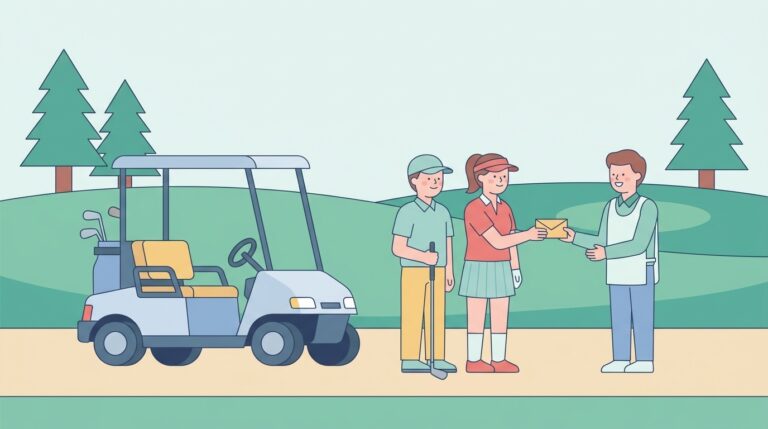
- The Two-Handed Cash Rule: Never pull crumpled bills out of your pocket. Korean golfers prepare crisp, clean cash in an envelope beforehand and hand it over using both hands (양손) with a slight bow at the end of the round.
- Reading the Group Tempo (Pace of Play): Korean courses run on tight 7-to-8 minute intervals. If your ball lands in the deep rough, do not spend 5 minutes searching for it. Check your caddie’s eye cues; if they prepare another ball with a smile, take the drop smoothly. That is peak golf nunchi.
- Stepping on Putting Lines: Never step on a fellow player’s line between their ball and the hole cup. If you accidentally do, apologize quickly with a light nod.
4-2. The Cultural Code: Screen Golf to Green Networking
In Korea, golf is deeply linked to professional socialization (golpeu jeopdae, 골프 접대). As seen in many modern K-Dramas, executive decisions and relationship-building often happen at screen golf cafes (screengolf) and on 18-hole courses. Treating the caddie with utmost respect is considered a direct reflection of a golfer’s personal character, business integrity, and emotional maturity (in-seong, 인성).
Phase 5: Real-Life Roleplay Scenario
Setting: Hole 18 green at a picturesque golf club in Gapyeong. The round is concluding smoothly, and you are getting ready to settle the caddie fee and offer a well-deserved tip.
- 캐디 박혜진 (Caddie Park Hye-jin): 오늘 마지막 퍼팅까지 정말 깔끔하셨어요! 수고하셨습니다.
(Oneul majimak peotingkkaji jeongmal kkalkkeumhasyeosseoyo! Sugohasyeossumnida.)
🎭 Wiping the golf balls with a bright towel and smiling.
“Your final putt was so clean today! Great job everyone.” -
학습자 (Learner): 캐디님 덕분이죠. 오늘 라이를 너무 잘 봐주셨어요.
(Caddie-nim deokbun-ijyo. Oneul rai-reul neomu jal bwajusyeosseoyo.)
🎭 Lowering your putter and smiling warmly in appreciation.
“It was all thanks to you, Caddie-nim. You read the lines so well for us today.” -
캐디 박혜진 (Caddie Park Hye-jin): 동반자분들이 매너가 너무 좋으셔서 저도 오늘 라운딩 내내 즐거웠습니다.
(Dongbanjabun-deuri maeneoga neomu joeusyeoseo jeodo oneul raunding naenae jeulgeowosseoyo.)
🎭 Organizing the club headcovers carefully in the cart bag.
“Your group had such wonderful manners that I truly enjoyed the entire round as well.” -
학습자 (Learner): 오늘 카트 운전하시고 클럽 챙겨주시느라 고생 많으셨어요.
(Oneul kateu unjeonhasigo keulleop chaenggyeojusineura gosaeng maneusyeosseoyo.)
🎭 Taking out a prepared envelope with cash from your bag.
“You worked so hard driving the cart and managing our clubs today.” -
캐디 박혜진 (Caddie Park Hye-jin): 아니에요, 다들 샷이 좋으셔서 제가 편하게 따라다녔는걸요!
(Anieyo, dadeul syasi joeusyeoseo jega pyeonhage ttaradanyeonneungeollyo!)
🎭 Bowing modestly with hands clasped in front.
“Not at all! Everyone’s shots were great, so it was an easy walk for me!” -
학습자 (Learner): 여기 오늘 캐디피랑, 저희가 정말 고마워서 드리는 작은 보답이에요.
(Yeogi oneul caddie-pi-rang, jeohuiga jeongmal gomawo-seo deurineun jageun bodap-ieyo.)
🎭 Holding the envelope with both hands and bowing 15 degrees.
“Here is today’s caddie fee, along with a small token of gratitude from our group.” -
캐디 박혜진 (Caddie Park Hye-jin): 어머, 팁까지 챙겨주시다니 정말 감사합니다! 다음에도 꼭 또 봬요!
(Eomeo, tip-kkaji chaenggyeojusidani jeongmal gamsahamnida! Daeumedo kkok tto bwaeyo!)
🎭 Receiving the envelope with both hands and expressing sincere appreciation.
“Oh my, thank you so much for including a tip! I really hope to assist your group again next time!” -
학습자 (Learner): 네! 오늘 덕분에 좋은 추억 만들고 갑니다. 조심히 들어가세요!
(Ne! Oneul deokbune joeun chueok mandeulgo gamnida. Josimhi deureogaseyo!)
🎭 Waving goodbye as the cart parks at the clubhouse entrance.
“Yes! Thanks to you, we made great memories today. Have a safe rest of your day!”
🔀 Interactive Choice Point
After making an incredible eagle on Hole 14 thanks to the caddie’s advice, what should you say?
- Option A: “캐디님 최고! 진짜 정확했어요. 감사합니다!” (Caddie-nim choego! Jinjja jeonghwakhaesseoyo. Gamsahamnida!)
- Option B: “야, 봤지? 내 실력이야!” (Ya, bwatji? Nae sillyeogiya!)
- Option C: “돈 줬으니까 당연히 이 정도는 봐줘야죠.” (Don jwosseunikka dangyeonhi i jeongdoneun bwajwayojyo.)
🔍 Click to see the Feedback
- Option A (Best!): Perfect! Crediting the caddie boosts group morale and builds an unbeatable team dynamic.
- Option B (Bad): Overly arrogant and ignores the caddie’s precise reading of the slope.
- Option C (Risk – Cultural Red Flag!): Rude and condescending. Belittles service staff and ruins the atmosphere for all players.
Phase 6: 10-Second Emotion Shadowing Drill
Practice these lines with matching intonation and pause points (/):
[😊 Energetic & Polite]
오늘 / 잘 부탁드립니다! / 신나게 쳐볼게요!
(Oneul / jal butakdeurimnida! / Sinnage chyeobolgeyo!)
“Looking forward to playing today! / Let’s make it a fun round!”-
[🤔 Curious & Gentle]
캐디님, / 이번 홀은 / 오른쪽을 보는 게 낫겠죠?
(Caddie-nim, / ibeon horeun / oreunjjogeul boneun ge natgetjyo?)
“Caddie-nim, / for this hole, / is it better to aim toward the right?” -
[🙏 Heartfelt & Grateful]
오늘 너무 고생하셨어요. / 덕분에 / 인생 최고 스코어 나왔어요!
(Oneul neomu gosaenghasyeosseoyo. / Deokbune / insaeng choego seukoeo nawasseoyo!)
“Thank you for all your hard work today. / Thanks to you, / I shot my personal best score!”
Phase 7: K-Culture Mini Dictionary
- 캐디피 (Caddie-pi) | Noun: Caddie Fee
The standard set fee paid in cash directly to the caddie after the round (usually split equally among the four players). - 그늘집 (Geuneul-jip) | Noun: Halfway House / Golf Course Rest Stop
Literally meaning “shade house,” this is the club restaurant between the 9th and 10th hole where players stop for draft beer, boiled tofu with kimchi, or pancakes. - 오잘공 (O-jal-gong) | Slang: Best Shot of the Day
Short for ‘오늘 제일 잘 맞은 공’ (The best-struck ball of today). A great compliment to cheer on your playing partners. - 멀리건 (Meolligeon) | Noun: Mulligan
Giving a free redo shot. In Korean golf culture, granting a generous mulligan on the first tee is standard hospitality for guests.
Phase 8: Traveler’s Survival Kit
Survival Expressions TOP 3
- 핀까지 몇 미터 남았어요? (Pin-kkaji myeot miteo namasseoyo?)
How many meters left to the pin?
Pro Tip: Korea uses meters instead of yards on golf courses. 100 meters is roughly 110 yards. - 공 하나 더 칠게요! (Gong hana deo chilgeyo!)
I’ll hit one more ball! (Taking a mulligan or provisional ball).
Pro Tip: Always ask politely before hitting a second ball so the caddie can track both. - 앞 팀 빠지면 칠게요 (Ap tim ppajimyeon chilgeyo)
I’ll hit after the group ahead clears out.
Pro Tip: Safety is paramount. This phrase proves you are a responsible, safety-first golfer.
Editor’s Travel Note
- Before your round, download the 스마트스코어 앱 다운로드 (SmartScore App) which is used across 90% of Korean golf courses to automatically sync your scorecards and caddie photos via tablet.
- To easily reserve tee times and arrange golf taxi vans, check the 카카오 T 골프 예약 가이드 (Kakao T Golf Booking Guide).
Phase 9: Think Deeper (한 발 더 깊이)
In Korean society, language is never purely transactional; it is deeply communal. Addressing your caddie as Caddie-nim (attaching the honorific suffix -nim) rather than just “caddie” reflects the egalitarian respect embedded in modern Korean manners. When players and caddies share a round, they are considered dongbanja (동반자, companions on a journey). By expressing gratitude with sincerity and honoring the shared effort behind every shot, you tap directly into Jeong (정, emotional connection)—the heart of Korean hospitality.
💬 Your Turn: What is the tipping and caddie culture like in your country? Have you ever experienced a golf round where team harmony felt more important than the individual score? Share your thoughts below!
Phase 10: FAQ & Common Mistakes
Q: Is tipping mandatory for caddies in Korea on top of the regular caddie fee?
A: The standard caddie fee (캐디피, usually 140,000–160,000 KRW per team) is mandatory and paid in cash. An extra tip (usually 10,000–30,000 KRW per player or team) is customary if the caddie provided exceptional service, helped you find lost balls in rough weather, or helped you achieve an eagle or hole-in-one.
Q: Can I pay the caddie fee with a credit card at the front desk?
A: In most Korean golf clubs, caddie fees must be paid in cash directly to the caddie right after the round. Always withdraw clean cash at the clubhouse ATM before teeing off.
Q: What should I call my caddie during the round?
A: Always call them 캐디님 (Caddie-nim) or 선생님 (Seonsaeng-nim). Never yell “여기요” (yeogiyo) or “저기요” (jeogiyo) on the fairway.
🚨 Common Mistakes Alert Board
- ❌ Mistake 1: Tossing cash directly onto the cart dashboard.
👉 Correct Action: Place the cash in an envelope or fold it neatly and hand it over with both hands. - ❌ Mistake 2: Walking ahead of the person about to hit without checking.
👉 Correct Action: Always stay behind the ball line for safety and etiquette. - ❌ Mistake 3: Shouting loudly in celebration when neighboring tee boxes are driving.
👉 Correct Action: Keep celebratory cheers respectful to protect the focus of adjacent groups.
Phase 11: Action Mission & Engagement
- 🥉 Bronze Mission (Solo): Practice saying “오늘 잘 부탁드립니다” and “오늘 고생 많으셨습니다” out loud three times while bowing slightly.
- 🥈 Silver Mission (Social): Share your favorite Korean golf slang (like 오잘공 or 나이스 샷) on your Instagram story with
#DailyHangul! - 🥇 Gold Mission (Real Life): On your next visit to a Korean screen golf cafe or field course, address the staff strictly as Caddie-nim and hand your payment using both hands.
- 🎮 K-Culture Media Mission: Watch an episode of a Korean golf reality show (such as Golf King or Star Golf Big League) and spot how players cheer each other after a great drive!
Phase 12: Interactive Quiz Challenge
Question 1: Situation Judgment
At the end of an 18-hole round, you want to hand over the caddie fee. What is the most appropriate action?
1. Put the bills on the grass and wave goodbye.
2. Hand the cash envelope over with both hands while saying “오늘 고생 많으셨습니다.”
3. Leave the money inside the golf bag without saying anything.
👀 Show Answer & Explanation
Answer: 2
Explanation: Handing money with two hands along with a warm expression of gratitude is the cornerstone of Korean golf etiquette.
Question 2: Fill-in-the-Blank
Fill in the missing word used to ask the caddie to read the slope on the green:
“캐디님, ______ 좀 봐주시겠어요?” (Caddie-nim, could you read the line for me?)
👀 Show Answer & Explanation
Answer: 라이 (Rai / Lie / Putting line)
Explanation: In Korean golf terminology, 라이 (rai) specifically refers to the break and slope of the putting green.
Question 3: True / False Cultural Check
(True / False) Korean golf courses measure distance in yards just like in the United States.
👀 Show Answer & Explanation
Answer: False
Explanation: Korean golf courses strictly use the metric system (meters). When asking for distance, always expect the answer in meters (미터)!







