

Phase 1: Empathy (Story-Driven Opening)
안녕하세요! 매일한글 에디터입니다. (Hello! This is your Daily Hangul editor.)
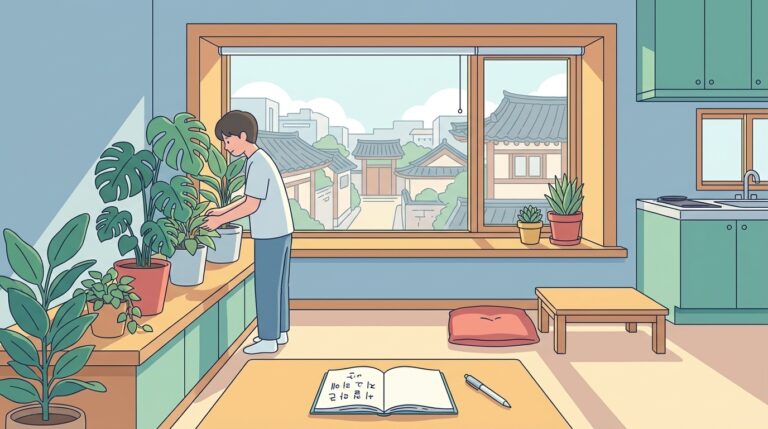
Picture this: You are sitting in a compact studio apartment in Seoul after a grueling ten-hour workday. The relentless pace of ppalli-ppalli (빨리빨리, hurry-hurry) culture has drained your cognitive reserves. You gaze across the room, and there on the windowsill stands a single Monstera deliciosa, unfurling a pristine new split leaf. In that quiet moment, you aren’t just observing botany; you are experiencing the quintessential Korean phenomenon of emotional rejuvenation through your companion plant.
Over the past few years, the concept of 식집사 (Sikjipsa – Plant Butler) has evolved from a quirky pandemic-era pastime into a profound psychological anchor for modern Koreans. For C2-level Korean learners, discussing hobbies can no longer rely on elementary tropes like “제 취미는 독서입니다” (My hobby is reading). To converse like a true cultural insider, you must navigate the nuanced lexicon of mental wellness, anthropomorphic attachment, and mindfulness that surrounds urban gardening in Korea. This guide synthesizes authentic discourse from botanical influencers, horticultural therapists, and real learner feedback to elevate your advanced communicative repertoire.
Phase 2: Core Expressions Deep-Dive
1. 식집사 (Sik-jip-sa)
- Pronunciation: [Sik-jip-sa] (Sounds like seek-jeep-sah)
- Meaning: Literal: Plant (식물) + Butler (집사) | Real Nuance: A devoted plant parent who meticulously caters to their flora just as a cat butler serves a feline.
- K-Culture Moment: Frequently featured on variety shows like I Live Alone (나 혼자 산다), where celebrities introduce their living room jungles and assign human-like personalities to rare variegated aroids.
- Editor’s Insight: The suffix -jipsa (집사) reflects a humble, service-oriented affection. It subverts the traditional power dynamic of “owner” and “possession,” replacing it with mutual companionship and emotional co-existence.
- Situation Spectrum: Casual: ✅ | Semi-formal: ✅ | Formal: ⚠️ (Use 반려식물 애호가 in formal essays or academic discourse)
- 🤔 Think About It: How does personifying non-human entities as companions reflect contemporary Korean urban solitude and the yearning for uncritical emotional bonds?
2. 풀멍 때리다 (Pul-meong ttae-ri-da)
- Pronunciation: [Pul-meong ttae-ri-da] (pool-mung ttae-ree-da)
- Meaning: Literal: Plant (풀) + Spacing out (멍 때리다) | Real Nuance: The meditative practice of completely clearing one’s mind while silently zoning out and gazing at lush greenery.
- K-Culture Moment: A dominant trend in Korean slow-living vlogs, where ASMR watering sounds accompany long, uninterrupted shots of sunlight filtering through foliage.
- Editor’s Insight: Derived from the Korean “spacing out” lexicon (bul-meong for campfires, mul-meong for water), pul-meong represents an active state of cognitive detox in high-stress urban environments.
- Situation Spectrum: Casual: ✅ | Semi-formal: ✅ | Formal: 🚫
- 🤔 Think About It: Why does Korean have specialized compound nouns for meditative daydreaming across different elements of nature?
3. 분갈이하며 마음을 다잡다 (Bun-gal-i-ha-myeo ma-eum-eul da-jap-da)
- Pronunciation: [Bun-ga-ri-ha-myeo ma-eu-meul da-jap-da] (boon-gah-ree-hah-myeo mah-eum-eul dah-jahp-dah)
- Meaning: Literal: Repotting plants while steadying one’s heart | Real Nuance: Resetting one’s mental state, organizing unresolved thoughts, and regaining inner peace through the physical labor of repotting.
- K-Culture Moment: Healing K-Dramas often feature a protagonist quietly working with soil, untangling root-bound plants to metaphorically symbolize resolving their own chaotic life challenges.
- Editor’s Insight: Mameul dajapda signifies restoring emotional equilibrium. Combining this with bungari creates an idiomatic somatic metaphor: clearing root decay as a means to purge psychological baggage.
- Situation Spectrum: Casual: ✅ | Semi-formal: ✅ | Formal: ✅
- 🤔 Think About It: In your native tongue, do tactile hobbies like gardening carry the same profound metaphorical weight for personal transformation?
Phase 3: Textbook Korean vs. Real Native Korean
Situation 1: Describing the therapeutic benefits of indoor plants
- 📖 교과서 한국어 (Textbook): 식물을 기르면 스트레스가 해소되고 정서적으로 안정이 됩니다. (Sikmureul gireumyeon seuteureseuga haesodoego jeongseojeogeoro anjeongi doemnida. – Growing plants relieves stress and provides emotional stability.)
- 🗣️ 진짜 한국어 (Native C2): 반려식물 들여놓고 초록이들 보면서 풀멍 때리다 보면, 복잡했던 머릿속이 싹 비워지면서 힐링 제대로 돼요. (Ballyeosikmul deuryeonoko chorogideul bomyeonseo pulmeong ttaerida bomyeon, bokjaphaetdeon meoritsogi ssak biwojimyeonseo hilling jedaero dwaeyo. – Since bringing in companion plants and zoning out over my green babies, my cluttered mind clears right out and gives me pure healing.)
- 💡 왜 다를까? (Why the difference?): Native Korean speakers utilize affective affectionate terms like 초록이들 (greenies/green babies) and dynamic onomatopoeic adverbs like 싹 (cleanly/completely) instead of sterile Sino-Korean clinical jargon.
Situation 2: Expressing the need to care for root-bound plants over the weekend
- 📖 교과서 한국어 (Textbook): 화분의 크기가 작아져서 흙을 교체하고 큰 화분으로 옮겨 심어야 합니다. (Hwabunui keugiga jagajyeoseo heulgeul gyochoehago keun hwabuneuro olmgyeo simeoya hamnida. – The pot has become small, so I must change the soil and transplant it into a larger pot.)
- 🗣️ 진짜 한국어 (Native C2): 뿌리가 화분에 꽉 찬 것 같아서 이번 주말에 날 잡고 분갈이 한 바퀴 싹 돌리려고요. (Ppuriga hwabune kkwak chan geot gataseo ibeon jumare nal japgo bungari han bakwi ssak dolliryeogoyo. – Looks like the roots are bound, so I’m setting aside time this weekend to do a full round of repotting.)
- 💡 왜 다를까? (Why the difference?): Idiomatic expressions like 날 잡고 (setting a dedicated date) and 한 바퀴 돌리다 (running a complete cycle/round of a chore) convey authentic daily cadence and proactive intent.
Phase 4: K-Culture Deep Dive & Non-Verbal Manners
4-1. 눈치 (Nunchi) & Tactile Etiquette in Plant Culture
When visiting a Korean friend’s home or a specialized botanical showroom in areas like Seongsu-dong, respecting living plants requires sophisticated non-verbal awareness (Nunchi):
* Hands-Off Reverence: Never touch delicate new growth (신엽, sin-yeop) or powdery leaf coatings without explicit permission. Koreans view touching someone’s prized plant without asking as an invasion of personal boundaries.
* Reading the Room: If your host points out a recovering plant, acknowledge the labor involved with an admiring nod and a soft compliment like “정성을 정말 많이 쏟으셨네요” (You’ve poured so much devotion into this).
4-2. Cultural Code: The Rise of the “Plandemic” & Single-Person Households
With over 35% of Korean residences registered as single-person households (1인 가구), the structural isolation of high-density apartment living sparked the Sikjipsa explosion. In spaces where pets are strictly prohibited by lease agreements, plants serve as sentient, living housemates that respond directly to care. This cultural evolution has sparked high-stakes plant propagating trends (식테크, plant technology/investing) where rare mutant variations become high-value status symbols among young urban professionals.
Phase 5: Real-World Interactive Roleplay Scenario
Setting: A boutique urban plant atelier tucked away in the backstreets of Yeonhui-dong. Soft ambient jazz plays while rare tropical foliage gleams under specialized horticultural LEDs.
Characters:
* You: An experienced expat professional seeking a resilient, mood-lifting companion plant for a north-facing studio.
* Min-jun (민준): The perceptive 30-something plant curator with an encyclopedic botanical knowledge.
민준: 어서 오세요! 찬 바람이 부는데 들어오시느라 고생 많으셨어요. 편하게 둘러보세요.
(Eoseo oseyo! Chan barami buneunde deureoosineura gosaeng maneusyeosseoyo. Pyeonhage dulleoboseyo.)
[Welcome! It’s chilly outside; thank you for making the trek. Feel free to browse.]
🎭 Warm eye contact with a gentle, inviting bow.

당신: 실례지만, 제가 원룸에서 식물을 키우고 있는데, 빛이 잘 안 들어서 자꾸 웃자라거나 시들하더라고요.
(Sillyejiman, jega wonrumeseo sikmureul kiugo inneunde, bichi jal an deureoseo jakku utjarageona sideulhadeoragoyo.)
[Excuse me, but I'm keeping plants in a studio flat; because of low light, they keep getting leggy or listless.]
🎭 Expressing genuine, slightly self-deprecating concern.

민준: 아, 북향이나 해가 덜 드는 공간에서는 아무래도 '과습'이랑 '통풍'이 가장 큰 복병이죠.
(A, bukhyang-ina haega deol deuneun gonggan-eseoneun amuraedo 'gwaseup'irang 'tongpung'i gajang keun bokbyeong-ijyo.)
[Ah, for north-facing or low-light spaces, overwatering and poor air circulation are definitely the biggest hidden pitfalls.]
🎭 Nodding empathetically while gesturing toward a humidity monitor.

당신: 맞아요. 매일 야근하고 돌아와서 초록이들 보며 풀멍 때리는 게 유일한 낙인데, 마음이 쓰여요.
(Majayo. Maeil yageunhago dorawaseo chorogideul bomyeo pulmeong ttaerineun ge yuilhan nagingde, maeumi sseuyeoyo.)
[Exactly. Coming home after daily overtime to zone out looking at my greenery is my only joy, so it weighs on my heart.]
🎭 Leaning in slightly, showing authentic emotional investment.

민준: 그 마음 백번 이해해요. 그렇다면 음지에서도 순둥순둥하게 잘 자라는 '스킨답서스'나 '필로덴드론' 계열은 어떠세요?
(Geu maeum baekbeon ihaehaeyo. Geureotdamyeon eumjieseodo sundungsundunghage jal jaraneun 'seukindapseoseu'na 'pillodendeuron' gyeyeoreun eotteoseyo?)
[I understand that completely. In that case, how about something from the Scindapsus or Philodendron families that grows docilely even in shade?]
🎭 Smiling gently and guiding you toward a warm wood display table.

당신: 잎맥이 정말 영롱하네요! 이 화분으로 데려가면 제 삭막한 퇴근길이 훨씬 포근해질 것 같아요.
(Ipmmaegi jeongmal yeongnonghaneyo! I hwabuneuro deryeogamyeon je sangmakhan toegeungiri hwolssin pogeunhaejil geot gatayo.)
[The leaf veins are truly luminous! Bringing this potted baby home will make my bleak commute home feel much warmer.]
🎭 Admiring the foliage without directly pinching or pressing the delicate leaf.

민준: 탁월한 안목이세요. 물주기는 겉흙뿐만 아니라 속흙까지 보송하게 말랐을 때 듬뿍 주시면 됩니다.
(Tagwolhan anmogi-seyo. Muljugineun geotheukppunman anira sokheukkkaji bosonghage mallasseul ttae deumpuk jusimyeon doemnida.)
[Excellent taste! As for watering, soak it thoroughly only when not just the topsoil, but the inner soil is completely dry.]
🎭 Demonstrating soil-moisture checking with a subtle hand gesture.

당신: 흙 배합도 완벽해 보이네요. 정성껏 키워서 다음엔 분갈이 팁도 여쭤보러 올게요!
(Heuk baehapdo wanbyeokhae boineyyo. Jeongseongkkeot kiwoseo daeumen bungari tipdo yeojjwoboreo olgeyo!)
[The soil blend looks immaculate, too. I'll raise it with devotion and return later to consult on repotting tips!]
🎭 Expressing long-term rapport with a gracious smile.
🔀 Interactive Branching Moment
How would you ask the curator for a specialized potting mix tailored to prevent root rot?
- Option A: “배수 잘되게 펄라이트랑 바크 넉넉히 섞어서 분갈이 흙 좀 소분해 주실 수 있나요?” (Could you pack a small portion of potting mix blended with plenty of perlite and bark for optimal drainage?)
- Option B: “물 빠짐 좋은 흙 아무거나 제일 싼 걸로 대충 주세요.” (Give me whatever cheap well-draining soil roughly.)
- Option C: “이 식물은 흙 없이 물속에 그냥 영원히 담가두면 안 되나요?” (Can’t I just submerge this plant in water forever without soil?)
Decision Feedback:
* Choice A (Best): 🌟 Displays expert vocabulary (배수, 펄라이트, 바크, 소분) and natural politeness. Instantly earns the florist’s professional respect.
* Choice B (Bad): ❌ Overly blunt (대충) and transactional; dismisses the craft and etiquette of specialty plant curators.
* Choice C (Risk): ⚠️ Grammatically sound, but indicates a total disregard for species-specific horticulture, potentially confusing the curator.
Phase 6: 10-Second Emotion Shadowing Drill
Practice reading these cadence-marked sentences aloud to internalize natural Korean intonation and emotional prosody:
[🌿 차분하고 깊은 위로의 어조 / Soothing & Meditative]- 퇴근길에 / 지친 몸을 이끌고 들어와 / 초록 잎을 가만히 바라보고 있으면, / 온갖 복잡했던 마음이 / 스르르 녹아내려요.
- Toegungire / jichin momeul ikkeulgo deureowa / chorok ipeul gamanhi barabogo isseumyeon, / ongak bokjaphaetdeon maeumi / seureureu noganaeryeoyo.
[✨ 벅차오르고 뿌듯한 감정 / Thrilled & Proud]- 죽어가던 몬스테라에서 / 새순이 뾰족하게 돋아나는 순간, / 말로는 다 못 할 / 벅찬 생명력이 느껴져요!
- Jugeogadeon monseutera-eseo / saesuni ppyojokhage dodananeun sungan, / malloneun da mot hal / beokchan saengmyeongnyeogi neukkyeojyeoyo!
[🤝 정중하면서도 유대감을 담아 / Warm & Respectful Connection]- 이 작은 화분 하나가 / 삭막했던 제 일상에 / 이토록 다정한 온기를 / 불어넣어 줄 줄은 몰랐습니다.
- I jageun hwabun hanaga / sangmakhaetdeon je ilsange / itorok dajeonghan ongireul / bureoneoheo jul jureun mollatseumnida.
Phase 7: K-Culture Mini Dictionary
- 반려식물 (Ballyeosikmul) | Companion Plant
- Usage: Modeled after 반려동물 (companion animal), this word elevates flora from simple home decor (화초) to respected life companions that provide reciprocal emotional comfort.
- 식테크 (Siktekeu) | Plant-Tech / Plant Investing
- Usage: A portmanteau of 식물 (plant) and 재테크 (financial investing). Refers to the lucrative Korean trend of propagating and selling rare genetic foliage cuttings (like Monstera Albo).
- 새순 / 신엽 (Saesun / Sin-yeop) | New Sprout / Fresh Foliage
- Usage: Native Korean 새순 and Sino-Korean 신엽 signify personal growth and hope in wellness and lifestyle communities.
- 과습 (Gwaseup) | Overwatering / Root Saturation
- Usage: The number-one cause of plant mortality in high-rise apartments; frequently used metaphorically to describe sensory or emotional burnout.
Phase 8: Survival Kit for Travelers & Expats
Top 3 Market Survival Phrases
- “분갈이 몸살 안 나게 배수층 신경 써서 심어주세요.”
- Romanization: Bungari momsul an nage baesucheung singyeong sseoseo simeojuseyo.
- Pro Tip: Use this at plant markets like Yangjae when purchasing a repotted plant to ensure they lay proper drainage pumice, preventing transplant shock (몸살).
- “실내 반음지에서도 웃자람 없이 버틸 만한 수종 추천해 주실 수 있나요?”
- Romanization: Silnae baneumjieseodo utjaram eopsi beotil manhan sujong chucheonhae jusil su innayo?
- Pro Tip: Advanced way to ask for shade-tolerant species that will not grow spindly (웃자람).
- “식물 생장등이랑 통풍 서큘레이터도 같이 세팅해야 할까요?”
- Romanization: Sikmul saengjangdeung-irang tongpung seokyulleiteodo gachi setinghaeya halkkayo?
- Pro Tip: Shows comprehensive understanding of indoor plant habitat requirements.
Editor’s Travel Note
- Top Destination: Visit the Yangjae Flower Market Underground & Greenhouse (양재꽃시장) for rare plants, or explore upscale lifestyle plant studios in Seongsu and Hannam-dong.
- App Recommendation: Install the Naver Map App for Android and iOS and search keywords like
희귀식물 카페(rare plant cafe) or식물 편집숍(curated botanical shop). - Local Expat Tip: If ordering live plants online within Korea, use KakaoPay or local courier apps with the delivery note:
생물 배송: 파손 주의 및 문 앞 배송 부탁드립니다(Live organism: handle with care and deliver to door).
Phase 9: A Step Deeper (Reflective Essay)
In traditional Korean Confucian philosophy, nature was never an object to be conquered; rather, humans sought 물아일체 (Mura-ilche)—a transcendent state where the self and the external natural world harmonize as one. Today’s Sikjipsa movement is the high-tech, urbanized descendant of this philosophical heritage. In an ultra-connected yet emotionally isolated society, nurturing an entity that demands slow, deliberate, silent patience becomes an act of quiet rebellion against digital burnout.
💬 Your Turn: What is your personal anchor for emotional grounding? Do you keep a plant or item at home that helps you decompress after a long day? Share your story in Korean below! (여러분의 마음을 편안하게 해주는 반려식물이나 힐링 루틴이 있다면 댓글로 알려주세요!)
Phase 10: FAQ & Common Mistakes
Q: Can I use the term ‘식집사’ in professional or academic contexts?
A: 식집사 is an informal neologism popular in media and casual discourse. In formal contexts, presentations, or business reports, opt for 반려식물 애호가 (companion plant enthusiast) or 원예 재배자 (horticultural cultivator).
Q: What is the exact difference between ‘분갈이’ and ‘이식’?
A: 분갈이 specifically refers to replacing the soil or container for potted flora, loaded with domestic and lifestyle connotations. 이식 (transplantation) is a scientific or agricultural term used for relocating trees, crops, or medical tissues.
Q: How do I affectionately refer to my plants without sounding childish?
A: Use terms like 저희 집 초록이 (the green one in our house) or refer to the plant’s species affectionately (e.g., 우리 집 몬스테라). Advanced speakers avoid overusing diminutive baby talk while maintaining genuine warmth.
🚨 Common Mistakes Warning Board
- Mistake: Confusing 웃자라다 (to grow spindly/leggy due to lack of light) with normal growth (잘 자라다).
- Correction: If a plant is stretching thin and weak, say: “빛이 부족해서 식물이 웃자랐어요.”
- Mistake: Saying “화분에 밥을 주다” for watering or fertilizing.
- Correction: Say “물을 주다” (water) or “영양제를 주다/시비하다” (fertilize).
- Mistake: Using 죽이다 (to kill) blithely when talking to a passionate Korean plant owner.
- Correction: Soften the blow with “초록별로 보냈어요” (Sent it to the green planet / crossed the plant rainbow bridge) or “과습으로 무름병이 와서 떠나보냈어요” (It passed away from root rot due to overwatering).
Phase 11: Action Mission
- 🥉 Bronze Level (Solo Drill): Stand in front of a mirror or open your voice recorder. Deliver a 30-second monologue describing your ideal indoor garden using 초록이, 풀멍, and 정서적 안정.
- 🥈 Silver Level (Social Practice): Find a Korean plant-curator account on Instagram (search hashtag
#식집사or#반려식물) and leave a natural, advanced comment such as: “초록이 수형이 정말 예술이네요! 정성이 느껴집니다.” - 🥇 Gold Level (Real-World Execution): Visit a local Korean-run flower shop or botanical cafe and inquire directly about soil drainage blends (배수성) and light requirements using today’s C2 lexicon.
- 🎮 K-Culture Mission: Watch an episode of a slice-of-life K-Drama (e.g., Summer Strike or Little Forest) and spot three instances where nature is used as a metaphor for mental recovery.
Phase 12: Interactive Quiz Challenge
1. Situation Judgment Quiz:
Your Korean friend shows you their rare aroid with slightly yellowing bottom leaves. What is the most culturally empathetic and linguistically sophisticated response?
* A) “식물이 다 죽었네요. 그냥 버리세요.”
* B) “하엽이 지는 걸 보니 자연스러운 세대교체 같네요. 과습만 조심하면 새순 금방 내어줄 거예요!”
* C) “물을 매일 3리터씩 주면 살아납니다.”
👉 Click to Reveal Answer & Analysis
Correct Answer: B
* Explanation: C2-level plant discourse differentiates between natural lower leaf decay (하엽/세대교체) and systemic rot. Option B displays botanical literacy and polite encouragement. Option A is tactless, and Option C contains flawed plant advice.
2. Fill-in-the-Blank Quiz:
복잡한 도시 생활에서 벗어나 집에서 화분을 가꾸며 생각을 비우는 시간을 요즘 사람들은 ‘_____ 때린다’고 부릅니다.
(In modern slang, taking time to clear one’s thoughts while gazing at plants at home is called ‘_____ ttae-rin-da’.)
👉 Click to Reveal Answer
Correct Answer: 풀멍 (Pul-meong)
* Explanation: 풀 (plant/grass) + 멍 때리다 (spacing out) combines into 풀멍.
3. True or False Culture Check:
In Korea, the phrase “초록별로 보냈다” (Sent to the green star) means propagating a rare plant to export overseas.
* [ True / False ]
👉 Click to Reveal Answer
Correct Answer: False
* Explanation: It is an empathetic euphemism meaning a companion plant has withered and died (akin to a pet crossing the rainbow bridge).






