

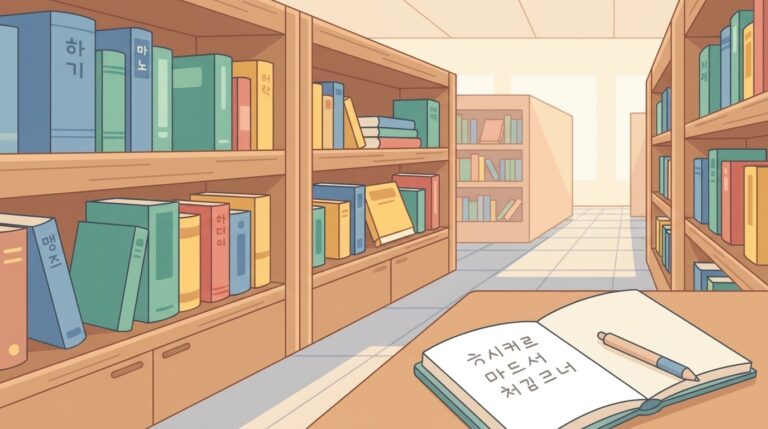
How to Buy Korean Workbooks at Kyobo Bookstore: Easy A1 Guide
Phase 1: Empathy (Story-Driven Opening)
안녕하세요! (Annyeonghaseyo!) I’m your Daily Hangul editor and cultural navigator.
Picture this: You are standing in the middle of Kyobo Bookstore in Gwanghwamun—a massive, labyrinthine wonderland of millions of books. You want to take your Korean skills to the next level by buying a real Korean workbook (munjejib). But as you walk down the towering aisles, panic sets in. Everything is in Korean, the staff looks busy stacking bestselling novels, and you freeze. How do you ask for a beginner Korean workbook without stumbling over difficult vocabulary?
Don’t worry at all! We have all been there. Based on real feedback from hundreds of beginner students, this guide breaks down essential phrases with easy pronunciation metaphors and cultural know-how. By the end of this 5-minute read, you will step into any Korean bookstore with absolute confidence!
Phase 2: Top 3 Core Expressions Deep Dive
1. 한국어 문제집 있어요? (Hangugeo munjejib isseoyo?)
- Pronunciation: Hahn-goo-guh moon-jeh-jeeb ees-saw-yo? (Rhymes with: “Han-goo-guh” like hangout, “moon-jeh-jeeb” like moon jet jeep without the ‘t’).
- Meaning: “Do you have Korean workbooks?” (Literal: Korean + workbook + exists/have?)
- K-Culture Moment: Think of high school K-Dramas like Twenty-Five Twenty-One where students scour bookshops before exam season.
- Editor’s Insight: Munje means “problem/question,” and jib means “collection/house.” So munjejib is literally a collection of practice questions!
- Situation Spectrum: Casual: ⚠️ (Only to friends: 한국어 문제집 있어?) | Semi-formal: ✅ (있어요?) | Formal: ✅ (있습니까?)
- 🤔 Think About It: In English, you might ask “Where can I find…?”, but in Korean, asking “Does it exist?” (있어요?) is the most polite and natural way to start.
2. 초보자용 책 추천해 주세요. (Chobojayong chaek chucheonhae juseyo.)
- Pronunciation: Cho-bo-jah-yong chek choo-chun-heh joo-seh-yo.
- Meaning: “Please recommend a book for beginners.”
- K-Culture Moment: Asking bookstore staff for curated picks is common among Korean readers searching for hobby guides.
- Editor’s Insight: Chobo means beginner. Adding ~yong means “for the use of.” Combining it with chucheon (recommendation) and juseyo (please give) makes you sound instantly natural!
- Situation Spectrum: Casual: 🚫 | Semi-formal: ✅ (추천해 주세요) | Formal: ✅ (추천 부탁드립니다)
- 🤔 Think About It: Notice how Korean creates functional words by tacking on suffixes like ~yong (for) instead of using long prepositions.
3. 이거 얼마예요? (Igeo eolmayeyo?)
- Pronunciation: Ee-guh ull-mah-yeh-yo? (Think “Eagle” without ‘l’ + “All-my-yeah-yo”).
- Meaning: “How much is this?”
- K-Culture Moment: The universal Korean survival line heard in street markets, convenience stores, and stationery shops.
- Editor’s Insight: Even if books have prices on the back cover, discounts or set prices might apply at the register. Keep this handy!
- Situation Spectrum: Casual: ⚠️ (이거 얼마야?) | Semi-formal: ✅ (얼마예요?) | Formal: ✅ (얼마입니까?)
- 🤔 Think About It: In Korean, pointing with Igeo (this thing) while asking the price is direct yet polite when paired with ~yo.
Phase 3: Textbook Korean vs. Real Korean
- Situation 1: Asking where the study section is
- 📖 Textbook Korean: 외국인을 위한 한국어 교재 코너가 어디에 위치합니까? (Where is the foreign Korean textbook corner located?)
- 🗣️ Real Korean: 한국어 책 어디 있어요? (Hangugeo chaek eodi isseoyo? – Where are Korean books?)
- 💡 Why is it different? Real natives shorten complex descriptive clauses into punchy, direct questions.
- Situation 2: Asking for a receipt
- 📖 Textbook Korean: 영수증을 저에게 교부하여 주십시오. (Please issue a receipt to me.)
- 🗣️ Real Korean: 영수증 주세요. (Yeongsujeung juseyo. – Receipt, please.)
- 💡 Why is it different? Everyday service interactions favor speed and polite brevity.
Phase 4: K-Culture Deep Dive & Non-Verbal Manners
- 4-1. Nunchi & Gestures: When asking a clerk for help in a bookstore, make soft eye contact and give a slight head nod (15-degree bow). Never yell across the store! Approach quietly, hold your phone or notes with two hands, and say 저기요… (Jeogiyo… / Excuse me).
- 4-2. Cultural Code (Stationery & Bookstore Culture): Korean mega-bookstores like Kyobo or Youngpoong are lifestyle cultural spaces. They combine study materials with Hottracks (cute K-stationery, planners, and pens). It is completely normal to sit on reading benches and inspect study books before purchasing!
Phase 5: Interactive Role-play Scenario
Setting: Kyobo Bookstore Gwanghwamun branch. Min-ji (Staff) is sorting TOPIK books.
- Turn 1 (Learner): 저기요, 한국어 문제집 있어요? (Jeogiyo, hangugeo munjejib isseoyo?)
🎭 Politeness bow - Turn 2 (Staff): 네! 외국어 코너 안쪽에 있어요. 어떤 레벨 찾으세요? (Ne! Oegugeo koneo anjjoge isseoyo. Eotteon lebel chajeuseyo?)
- Turn 3 (Learner): 초보자용 책 추천해 주세요. (Chobojayong chaek chucheonhae juseyo.)
🎭 Smiles and shows level 1 on fingers - Turn 4 (Staff): 이 책이 제일 인기 많아요. 설명이 쉬워요. (I chaegi jeil ingi manayo. Seolmyeongi swiwoyo.)
🎭 Hands over a colorful book - Turn 5 (Learner): 와, 좋아요! 이거 얼마예요? (Wa, joayo! Igeo eolmayeyo?)
- Turn 6 (Staff): 만 오천 원이에요. (Man o-cheon won-ieyo.)
- Turn 7 (Learner): 이거 주세요. (Igeo juseyo.)
🎭 Hands credit card with both hands - Turn 8 (Staff): 네, 결제 도와드리겠습니다! (Ne, gyeolje dowadeurigessseumnida!)
🔀 Interactive Choice Branch:
At Turn 5, what would you say if you want to find an English-explained book?
* A. 영어로 된 거 있어요? (Yeongeoro doen geo isseoyo? – Do you have one in English?)
* B. 영어 책 줘. (Yeongeo chaek jwo. – Give English book.)
* C. 이거 싫어요. (Igeo sileoyo. – I hate this.)
- Feedback:
- Choice A (Best!): Polite, natural, and clear! The clerk will gladly show bilingual books.
- Choice B (Risk): Rude informal tone (Banmal) without polite endings.
- Choice C (Bad): Too harsh and blunt for Korean retail etiquette.
Phase 6: 10-Second Emotion Shadowing Drill
[😊 Friendly & Inquiring]저기요, / 한국어 문제집 / 있어요? (Jeogiyo, / hangugeo munjejib / isseoyo?)[💡 Curious & Polite]초보자용 책 / 추천해 주세요! (Chobojayong chaek / chucheonhae juseyo!)[💳 Confident & Cheerful]이거 / 얼마예요? (Igeo / eolmayeyo?)
Phase 7: K-Culture Mini Dictionary
- 문제집 (Munjejib): Workbook / Practice test book. Essential for studying TOPIK or grammar drills.
- 초보자 (Choboja): Beginner. Frequently used for language learners, novice drivers, or new gamers.
- 영수증 (Yeongsujeung): Receipt. You will be asked “영수증 드릴까요?” (Would you like a receipt?) at checkout.
- 베스트셀러 (Beseuteuselleo): Bestseller. Look for this sign in Korean bookstores to spot trending study books.
Phase 8: Traveler’s Survival Kit
- Top 3 Survival Lines:
- 어디에 있어요? (Eodie isseoyo? / Where is it?)
- 카드 돼요? (Kadeu dwaeyo? / Can I pay with card?)
- 봉투 주세요. (Bongtu juseyo. / Please give me a shopping bag.)
- Editor’s Travel Note: Finding major bookstores is super easy when you search in local navigation apps. We recommend setting up the Naver Map App to search for nearby “서점” (bookstore) rather than general search engines.
Phase 9: A Step Deeper (Reflection)
In Korea, buying a munjejib represents self-development and respect for lifelong learning (Yeol-gong culture). Notice how clerks handle your books with two hands—this reflects the cultural reverence placed on educational materials and mutual respect between customer and merchant.
💬 Your Turn: Have you ever visited a Korean bookstore, or what Korean book do you want to buy first? Share your thoughts below!
Phase 10: FAQ & Common Mistakes
Q: Can I pay with foreign credit cards at Korean bookstores?
A: Yes! Most major bookstores like Kyobo, Youngpoong, and Aladdin accept Visa and Mastercard without issues.
Q: What is the difference between 교재 (Gyojae) and 문제집 (Munjejib)?
A: Gyojae refers to general textbooks focusing on theory, while munjejib specifically contains problem sets and practice exercises.
Q: How do I say I just want to look around?
A: You can smile and say “그냥 구경할게요” (Geunyang gugyeonghalgeyo – Just looking around).
🚨 Common Mistakes Alert:
- Mistake: Pointing aggressively with one finger at a clerk. -> Correct Action: Open palm gesture or gentle verbal greeting.
- Mistake: Forgetting the polite ending ~yo (이거 얼마?). -> Correct Action: Always say 이거 얼마예요?.
- Mistake: Shouting across the quiet aisles. -> Correct Action: Walk up close before speaking in a calm tone.
Phase 11: Action Missions
- 🥉 Bronze Mission: Practice saying “한국어 문제집 있어요?” out loud 5 times using our pronunciation guide.
- 🥈 Silver Mission: Open your social media or study journal and write down 3 Korean words you learned today.
- 🥇 Gold Mission: Next time you visit a Korean bookstore or website, locate the 초보자 (Beginner) section on your own!
- 🎮 K-Culture Mission: Watch an episode of your favorite slice-of-life K-drama and spot whenever characters hold a munjejib!
Phase 12: Interactive Quiz Challenge
Question 1: You want to ask for beginner recommendations. Which sentence is correct?
* A) 초보자용 책 추천해 주세요.
* B) 문제집 싫어요.
* C) 영어 주세요.
Question 2: Fill in the blank:
* 저기요, 이거 ______예요? (Excuse me, how much is this?)
Question 3 (True/False): In Korea, it is considered rude to browse books before buying them in a bookstore.
👉 Click to view Answers & Explanations
- Answer: A (초보자용 책 추천해 주세요 is the natural and polite expression).
- Answer: 얼마 (eolma) -> 이거 얼마예요?
- Answer: False! Korean bookstores encourage browsing and reading seated in designated areas as long as you treat the books gently.







