

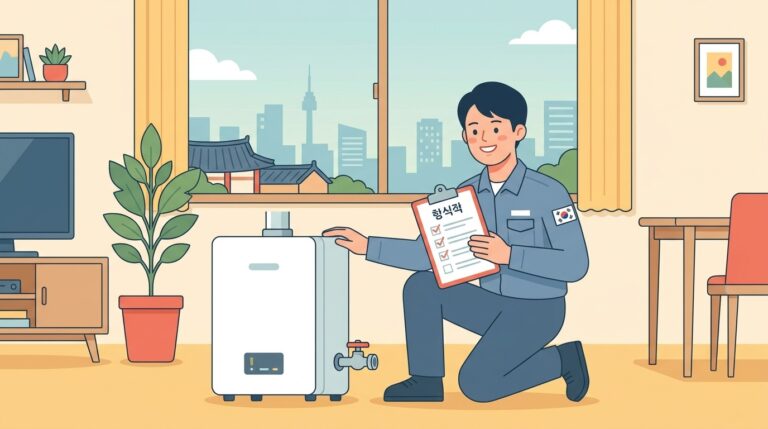
Setting Up City Gas in Korea: Easy A2 Guide for Your New Home
Phase 1: Empathy & Story Opening
안녕하세요! 매일한글 에디터입니다. (Hello! I’m your Daily Hangul editor.)
Imagine this: you finally signed the lease on your dream studio apartment in Seoul. You unpacked your favorite K-pop posters, placed your luggage by the door, and got ready to take a refreshing hot shower. You turn on the faucet, wait two minutes, and… ice water! You head to the stove to brew some ramen, and no flame appears. Welcome to Korea’s classic move-in rite of passage: city gas setup!
Unlike electricity, which is often running automatically, Korean city gas (도시가스) requires an official activation appointment for safety checks and meter reading. Many expats freeze on their first night simply because they didn’t know how to call the local gas center. This step-by-step survival guide is built on real feedback from dozens of international students and expats. By the end of this article, you will comfortably book your gas appointment in beginner-friendly Korean (A2 level) and ensure your new home is cozy and warm!
Phase 2: 3 Core Expressions Deep Dive
1. 도시가스 연결해 주세요 (Dosi-gaseu yeon-gyeol-hae ju-se-yo)
- Pronunciation: doh-shee-gah-seu yuhn-gyuhl-hae joo-seh-yoh (Sounds like ‘Dough-she-gas yawn-gyull-hae joo-say-yo’)
- Meaning: Literal: “Please connect city gas.” / Natural: “I would like to turn on/set up the gas service in my apartment.”
- K-Culture Moment: In realistic slice-of-life dramas like Because This Is My First Life, characters immediately make this phone call the morning after signing their rental contract.
- Editor’s Insight: ‘연결’ (yeon-gyeol) means connection. Adding ‘해 주세요’ (hae ju-se-yo) creates a polite request suitable for speaking with customer service reps.
- Situation Spectrum: Casual (🚫) | Semi-formal (✅) | Formal (✅)
- 🤔 Think About It: In English, you might say “start my utility account,” but Koreans say “connect the gas.” Notice how Korean directly visualizes physical piping connection.
2. 기사님 언제 오실 수 있나요? (Gisanim eonje osil su innayo?)
- Pronunciation: gee-sah-neem uhn-jeh oh-sheel soo een-nah-yoh?
- Meaning: Literal: “When can the technician honorably come?” / Natural: “When can the technician visit?”
- K-Culture Moment: You will hear this phrase in almost every variety show where celebrities move into a new house and coordinate installation visits.
- Editor’s Insight: ‘기사님’ (Gisanim) is a respectful title for skilled service engineers, drivers, and technicians. Always use ‘님’ (nim) to maintain warm Korean politeness.
- Situation Spectrum: Casual (🚫) | Semi-formal (✅) | Formal (✅)
- 🤔 Think About It: Why do Koreans add honorifics (-님, -시-) when asking about service visits? It builds immediate goodwill and gets you faster, friendlier service!
3. 이번 주 금요일에 방문해 주세요 (Ibeon ju geum-yo-il-e bang-mun-hae ju-se-yo)
- Pronunciation: ee-buhn joo geum-yoh-eel-eh bahng-moon-hae joo-seh-yoh
- Meaning: Literal: “Please visit this Friday.” / Natural: “Please schedule the visit for this Friday.”
- K-Culture Moment: When apartment coordinators in Korean vlogs arrange maintenance checkups, this exact date-setting pattern is used.
- Editor’s Insight: ‘방문’ (bang-mun) means “visit/on-site check.” You can swap ‘이번 주 금요일’ with any day like ‘내일’ (tomorrow) or ‘토요일’ (Saturday).
- Situation Spectrum: Casual (⚠️) | Semi-formal (✅) | Formal (✅)
- 🤔 Think About It: Time words in Korean usually come at the very beginning of the sentence followed by the particle ‘에’ (at/on).
Phase 3: Textbook Korean vs Real Korean
Situation 1: Asking to schedule a setup appointment
- 📖 교과서 한국어 (Textbook Korean): 도시가스 개통 예약을 요청하고 싶습니다. (Dosi-gaseu gaetong yeyag-eul yocheonghago sipsumnida. – I wish to request a city gas opening reservation.)
- 🗣️ 진짜 한국어 (Real Korean): 이사 왔는데, 가스 연결 예약하려고요. (Isa wanneunde, gaseu yeon-gyeol yeyakharyeogoyo. – I just moved in, and I want to book a gas connection.)
- 💡 왜 다를까? (Why is it different?): Native speakers prefer casual-polite ending ‘-려고요’ (-ryeogoyo, intending to do) rather than rigid Sino-Korean nouns like ‘개통’ and ‘요청’.
Situation 2: Asking if someone must be home during the visit
- 📖 교과서 한국어 (Textbook Korean): 제가 반드시 재실해야 합니까? (Jega bandeusi jaesilhaeya hamnikka? – Must I strictly be present inside the room?)
- 🗣️ 진짜 한국어 (Real Korean): 집에 사람이 꼭 있어야 하나요? (Jib-e saram-i kkok isseoya hanayo? – Does someone have to be at home?)
- 💡 왜 다를까? (Why is it different?): Real conversational Korean replaces heavy vocabulary like ‘재실’ (being in room) with the simple, friendly ‘집에 사람이 있다’ (a person is at home).
Phase 4: K-Culture Deep Dive & Non-Verbal Manners
4-1. 눈치 (Nunchi) & Gas Setup Etiquette
When the gas technician (기사님) visits your studio, there are a few unspoken Korean manners:
1. Provide Slippers or Space: Technicians bring their own shoe covers, but standing aside and offering a tidy entryway shows great nunchi (social intuition).
2. Small Courtesy Beverage: Offering a small bottle of cold water, canned iced coffee (캔커피), or Vita500 drink is a heartwarming custom in Korea when technicians finish their work.
3. Clear the Boiler Area: Keep the space around your boiler cabinet or kitchen gas valve clear before they arrive so the inspection takes less than 5 minutes.
4-2. K-Culture Code: Ondol Heating & Modern Gas Bills
In Korean culture, winter comfort revolves around 온돌 (Ondol)—the traditional underfloor radiant heating system now powered by city gas boilers. Understanding how your gas is metered will save you from surprise heating bills in January!
Phase 5: Real-Life Roleplay Scenario
Setting: You just moved into a cozy one-room studio in Mapo-gu, Seoul. You are calling the local Seoul City Gas customer service center.
Characters:
* Customer Rep (상담원): Friendly call-center specialist.
* You (나 / 학습자): New foreign resident in Korea.
- Turn 1 (상담원): 서울도시가스입니다. 무엇을 도와드릴까요? (Seoul dosi-gaseu-imnida. Mueos-eul dowa-deurilkkayo?)
🎭 [상냥하고 빠른 목소리로 전화 받음] - Turn 2 (나): 안녕하세요! 이사 왔는데, 가스 연결 신청하려고요. (Annyeonghaseyo! Isa wanneunde, gaseu yeon-gyeol sincheongharyeogoyo.)
🎭 [차분하고 또박또박하게] - Turn 3 (상담원): 네, 고객님. 주소가 어떻게 되시나요? (Ne, gogaeknim. Jusoga eotteoke doesinayo?)
🎭 [키보드를 두드리며 묻기] - Turn 4 (나): 마포구 서교동 123번지 201호예요. (Mapo-gu Seogyo-dong baek-isib-sam-beonji i-baek-il-hoyeyo.)
🎭 [주소 메모를 보며 읽기] - Turn 5 (상담원): 확인되었습니다. 방문 예약은 언제가 편하세요? (Hwagindoeeossseumnida. Bangmun yeyag-eun eonjega pyeonhaseyo?)
🎭 [일정표 확인 톤] - Turn 6 (나): 내일 오후 2시에 가능할까요? (Naeil ohu du-si-e ganeunghalkkayo?)
🎭 [조심스럽게 질문하기] - Turn 7 (상담원): 네, 내일 2시에 기사님 방문하도록 접수해 드릴게요. (Ne, naeil du-si-e gisanim bangmunhadorok jeopsuhae deurilgeyo.)
🎭 [밝은 확인 톤] - Turn 8 (나): 감사합니다! 내일 뵐게요. (Gamsahamnida! Naeil boelgeyo.)
🎭 [안도하며 기쁘게 인사]
🔀 Interactive Choice Point
What should you reply if the customer rep says tomorrow at 2 PM is fully booked? Choose your response:
* A: 안 돼요. 지금 당장 와주세요! (An dwaeyo. Jigeum dangjang wajuseyo!)
* B: 그럼 가능한 다른 시간 알려주세요. (Geureom ganeunghan dareun sigan allyeojuseyo.)
* C: 알겠습니다. 그냥 가스 안 쓸게요. (Algesseumnida. Geunyang gaseu an sseulgeyo.)
- Feedback A (Bad): ❌ Demanding immediate arrival breaks Korean polite phone etiquette and cannot override full scheduling.
- Feedback B (Best): ✅ Polite, flexible, and practical! Asking for alternative available slots will resolve the booking instantly.
- Feedback C (Risk): ⚠️ If you don’t connect the gas, you won’t have hot water or floor heating!
Phase 6: 10-Second Emotion Shadowing Drill
Practice reading these rhythmically with the pause markers (/) and emotional tone directions!
[😊 친절하고 자신감 있게]
안녕하세요! / 이사 왔는데, / 가스 연결 예약하려고요.
(An-nyeong-ha-se-yo! / I-sa wan-neun-de, / ga-seu yeon-gyeol ye-yak-ha-ryeo-go-yo.)-
[🤔 일정 물어보며 정중하게]
혹시 / 내일 오후에 / 기사님 오실 수 있나요?
(Hok-si / nae-il o-hu-e / gi-sa-nim o-sil su in-na-yo?) -
[🙏 감사하고 안도하며]
네, 알겠습니다! / 그때 집에 있을게요.
(Ne, al-get-seum-ni-da! / geu-ttae jib-e is-seul-ge-yo.)
Phase 7: K-Culture Mini Dictionary
- 도시가스 (Dosi-gaseu): City Gas. The municipal natural gas supply piped into residential buildings for cooking and ondol floor heating.
- 기사님 (Gisanim): Respected Technician / Driver. The universal respectful title for field specialists and technicians visiting your house.
- 계량기 (Gyeryanggi): Gas Meter. The small digital or analog meter located near your front door or utility balcony showing your gas usage number.
- 출장비 (Chuljangbi): Call-out / Service Visit Fee. The small connection service fee (around 10,000–20,000 KRW) added to your first gas bill for initial activation.
Phase 8: Survival Kit for Expats
Top 3 Survival Phrases
- 가스 밸브가 잠겨 있어요. (Gaseu baelbeuga jamgyeo isseoyo.) – The gas valve is locked/closed. (Pro Tip: Tell this to your landlord if the yellow valve won’t turn).
- 자동이체 신청하고 싶어요. (Jadong-iche sincheonghago sipeoyo.) – I’d like to apply for automatic bank transfer payment. (Pro Tip: Avoid missing bills by linking your Korean bank account).
- 명의 변경 해 주세요. (Myeong-ui byeongyeong hae ju-se-yo.) – Please change the account holder name. (Pro Tip: Use this to switch the gas bill from the previous tenant to your name).
Editor’s Travel & Move-in Note
To find your regional gas supplier (e.g., Seoul City Gas, Kiturami, or Samchully), check the yellow emergency sticker on the boiler unit in your kitchen or utility room. You can also search your neighborhood office on the Naver Map app by typing 도시가스 고객센터 (City Gas Customer Center).
Phase 9: One Step Deeper
In many Western countries, setting up utilities is completely contactless and handled online. However, in Korea, natural gas safety is strictly regulated by law because high-rise apartments share joint piping systems. Having a certified Gisanim step inside your home to test for micro-leaks with a digital sensor reflects Korea’s collective safety consciousness—protecting not just your unit, but your whole building neighbor community.
💬 Your Turn: What utility setup process surprised you most when moving to a new country? Have you ever had to survive without hot water for a night? Share your story in the comments below!
Phase 10: FAQ & Common Mistakes
Q: Can I set up city gas entirely through an English mobile app?
A: Most regional Korean gas providers (like Seoul City Gas via the ‘Gas App’ 가스앱) offer smartphone registration, but foreigner identity verification (ARC) is often required. Calling customer service or asking your real estate agent to assist with a 3-minute phone call is frequently the fastest method for newcomers.
Q: Do I have to pay the technician in cash on the spot?
A: No, in almost all districts, the connection service fee (출장비) is automatically billed into your first monthly statement. You do not need to hand cash to the technician.
Q: How long does the gas connection visit take?
A: The technician usually completes the safety check, valve unsealing, and digital registration within 5 to 10 minutes.
🚨 Common Mistakes & Fixes
- Mistake: Forgetting to record the initial gas meter reading on move-in day.
- Correct Action: Take a clear photo of the meter (계량기) numbers the day you receive the house keys to avoid paying the previous tenant’s gas bill.
- Mistake: Thinking electricity and gas are the same company in Korea.
- Correct Action: Electricity is handled by KEPCO (한국전력), while city gas is managed by regional private distributors (e.g., Seoul City Gas, Yesco).
- Mistake: Not being home at the reserved time slot.
- Correct Action: If you are not home, the technician cannot enter and must cancel the appointment. Always be present or have a roommate wait at home.
Phase 11: Action Missions
- 🥉 Bronze Mission (Solo Practice): Read the 8-turn roleplay aloud 3 times and practice saying your Korean address fluently.
- 🥈 Silver Mission (Social Connection): Take a photo of your apartment boiler control panel and label ‘전원’ (Power), ‘온수’ (Hot Water), and ‘난방’ (Floor Heating) in your study notes.
- 🥇 Gold Mission (Real Life): Check your gas meter right now, write down the 4-digit number, and locate your local gas company’s phone number!
- 🎮 K-Culture Mission: Next time you watch a modern K-drama, spot the boiler controller on the wall near the living room or kitchen!
Phase 12: Interactive Quiz Challenge
1. Situation Judgment Quiz
You just called the gas center. Which sentence politely asks if the technician can visit tomorrow morning?
* A) 내일 아침에 무조건 와라. (Naeil achime mu-jogeon wara.)
* B) 내일 오전에 기사님 오실 수 있나요? (Naeil ojeone gisanim osil su innayo?)
* C) 기사님이 내일 오고 싶어해요. (Gisanim-i naeil ogo sipeohaeyo.)
👉 Click to view Answer & Explanation
Answer: B
Explanation: Option B uses the respectful title ‘기사님’ and the polite question ending ‘-실 수 있나요?’. Option A is rude informal speech, and Option C incorrectly guesses the technician’s personal desire.
2. Fill-in-the-Blank
이사 왔는데, 도시가스 [ ________ ] 신청하려고요. (I just moved in, and I want to apply for a city gas connection.)
* Hint: Starts with ‘연’ (Starts with ‘Yeon-‘)
👉 Click to view Answer & Explanation
Answer: 연결 (Yeon-gyeol)
Explanation: ‘가스 연결’ means “gas connection/setup.”
3. True / False Cultural Check
Statement: Gas technicians in Korea will always charge you 50,000 KRW cash directly on site for turning the valve.
* (True / False)
👉 Click to view Answer & Explanation
Answer: False
Explanation: Safety inspection and opening fees are modest (usually 10,000–20,000 KRW) and are charged on your monthly bill, not collected as on-the-spot cash.






