

Why Are Men’s and Women’s Korean Saunas So Different? The Ultimate Jjimjilbang Survival Guide
Phase 1: Empathy (Story-Driven Opening)
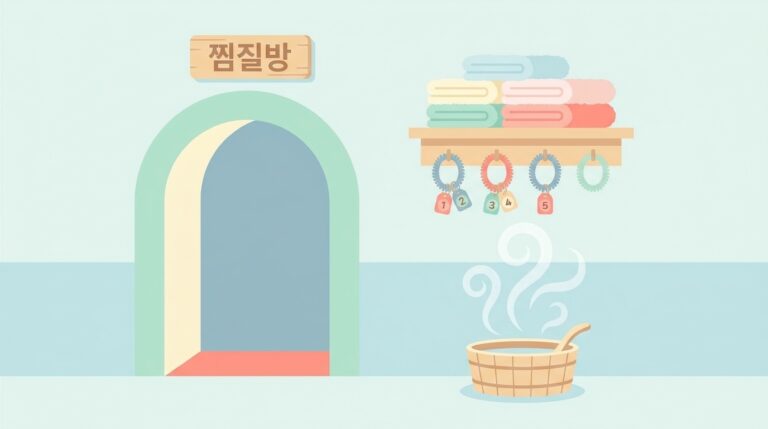
안녕하세요! (Annyeonghaseyo!) It is your trusted Daily Hangul editor and cultural navigator. Picture this: You and your travel buddy finally make it to a famous Seoul jjimjilbang (찜질방) after walking 20,000 steps around Hongdae. You split up at the entrance—one heading towards the 남탕 (namtang, Men’s Bath) and the other to the 여탕 (yeotang, Women’s Bath)—promising to meet in the shared unisex sauna area in 30 minutes.
Forty minutes later, the male traveler walks out relaxed, hair perfectly styled. The female traveler walks out slightly frazzled, damp hair tied in a messy bun, clutching two damp towels. Why? In the men’s bath, towels were stacked high by the dozens and hairdryers blew warm air freely. In the women’s bath, exactly two towels were handed over at check-in, and the hairdryer blinked menacingly: 100 KRW for 2 minutes.
“Wait, is this real? Did I do something wrong?” Don’t worry! You did nothing wrong. It is one of modern Korea’s most fascinating cultural phenomena. Today, we are breaking down the nuanced vocabulary, intermediate (B2) communicative phrasing, and cultural backstory behind the curious contrasts of Korean bathhouses so you can stride in like a seasoned local.
Phase 2: Core Expressions Deep Dive
1. 남탕이랑 여탕이랑 시스템이 달라요? (Nam-tang-i-rang yeo-tang-i-rang si-seu-tem-i dal-la-yo?)
- Pronunciation: [Nam-tang-ee-rahng yuh-tang-ee-rahng she-soo-tem-ee dahl-lah-yo?] (Think: “Nahm-tahng” rolling smoothly into “yeo-tahng” like contrasting musical beats)
- Meaning: Literal: “Is the system different between the men’s bath and women’s bath?” | Nuance: “Could you clarify why the amenities or rules differ depending on gender?”
- K-Culture Moment: Heard frequently on Korean entertainment variety shows like I Live Alone (나 혼자 산다) when foreign cast members visit traditional public baths for the first time.
- Editor’s Insight: Using ~이랑/랑 (-irang/rang) gives your inquiry an organic, conversational feel, while 시스템 (siseutem) shows sophisticated B2 context handling without sounding overly academic.
- Situation Spectrum: Casual: ✅ | Semi-formal: ✅ | Formal: ⚠️
- 🤔 Think About It: In many Western communal spas, facilities maintain identical equipment standardisation. How does the Korean pragmatic approach reflect operational realities vs. universal service norms?
2. 드라이기 쓰려면 동전 필요해요? (Deu-ra-i-gi sseu-ryeo-myeon dong-jeon pil-yo-hae-yo?)
- Pronunciation: [Deu-rah-ee-gee ssuh-ryuh-myuhn dong-juhn peel-yoh-heh-yo?]
- Meaning: Literal: “If I want to use the hairdryer, do I need coins?” | Nuance: “Is the blow-dryer coin-operated in this facility?”
- K-Culture Moment: An iconic plot point in K-dramas where a female lead realizes she left her locker key or loose change behind and has to frantically barter for a 100-won coin while wrapped in a towel.
- Editor’s Insight: The conditional ~(으)려면 (-(eu)ryeomyeon) marks natural intermediate grammar signaling goal-oriented intention (“in order to do X…”).
- Situation Spectrum: Casual: ✅ | Semi-formal: ✅ | Formal: ✅
- 🤔 Think About It: Why does Korea—the world capital of cashless payments—still preserve coin-operated hairdryers exclusively in women’s saunas?
3. 수건 한 장만 더 주실 수 있나요? (Su-geon han jang-man deo ju-sil su it-na-yo?)
- Pronunciation: [Soo-guhn hahn jahng-mahn duh joo-sheel soo eet-nah-yo?]
- Meaning: Literal: “Could you please give me just one more towel?” | Nuance: “Excuse me, may I get an extra towel, please?”
- K-Culture Moment: Seen at counter desks when travelers prepare for an extended sauna session and realize two towels won’t suffice for both bathing and sauna sweat sessions.
- Editor’s Insight: Combining the limiter ~만 (-man, only) with the polite honorific ~(으)실 수 있나요 (-(eu)sil su itnayo) softens the request dramatically, preventing you from sounding demanding.
- Situation Spectrum: Casual: ⚠️ | Semi-formal: ✅ | Formal: ✅
- 🤔 Think About It: How does polite counter phrasing in Korean differ from English when requesting complimentary vs. surcharge items?
Phase 3: Textbook Korean vs. Real Native Korean
Situation 1: Asking if you can get more towels
- 📖 Textbook Korean: 수건을 더 주십시오. (Su-geon-eul deo ju-sip-si-o.)
- 🗣️ Real Native Korean: 저기요, 혹시 수건 한 장 더 챙겨주실 수 있어요? (Jeo-gi-yo, hok-si su-geon han jang deo chaeng-gyeo-ju-sil su it-eo-yo?)
- 💡 Why the difference? The textbook phrase sounds like an imperative military command. Real Koreans use soften markers like 혹시 (hoksi, by any chance) and 챙겨주다 (chaeng-gyeo-juda, to look after / provide kindly).
Situation 2: Asking where to exchange cash for hairdryer coins
- 📖 Textbook Korean: 동전을 어디에서 교환합니까? (Dong-jeon-eul eo-di-e-seo gyo-hwan-ham-ni-ka?)
- 🗣️ Real Native Korean: 이모님, 드라이기 동전 어디서 바꿔요? (I-mo-nim, deu-ra-i-gi dong-jeon eo-di-seo bak-kwo-yo?)
- 💡 Why the difference? In sauna environments, addressing front-desk staff warmly as 이모님 (imonim, auntie) builds instant rapport, and 바꾸다 (bakkuda) replaces the stiff formal 교환하다 (gyohwanhada).
Phase 4: K-Culture Deep Dive & Non-Verbal Manners
4-1. Nunchi (눈치) & Body Language
- The Locker Key Wristband Tap: When paying for snacks or services, don’t pull out a credit card inside the sauna. Simply extend your electronic key bracelet (키/밴드) with your right hand, supported lightly at the wrist by your left hand—a subtle B2-level demonstration of Korean two-handed respect.
- The Hairdryer Coin Queue: In the 여탕, if hairdryers are occupied, avoid hovering directly behind someone’s mirror reflection. Stand a step back with your 100 KRW coin visibly resting in your open palm. This signals you are ready without creating stressful pressure.
4-2. The Real Cultural Code: The Towel Mystery
Why do men get limitless towel mountains while women get two rationed towels? Decades ago, sauna industry statistics revealed an intriguing pattern: in the 남탕, guests rarely took towels home, while in the 여탕, a staggering percentage of towels accidentally disappeared into gym bags or purses! While contemporary Korean society enjoys immense high-trust safety, this legacy operational habit turned into a permanent standard fixture across Korean bathhouses.
Phase 5: Real-Life Roleplay Scenario
Setting: The front desk of a traditional 24-hour Jjimjilbang in Insadong.
Characters: Alex (Intermediate Korean Learner) & Imonim (Friendly Counter Manager).
- 이모님 (Imonim): 어서 오세요! 찜질복 포함해서 만 오천 원이에요. (Eo-seo o-se-yo! Jjim-jil-bok po-ham-hae-seo man o-cheon won-i-e-yo.)
🎭 Smiles brightly and hands over a key band and a pair of spa clothes.
(Welcome! It is 15,000 KRW including the sauna outfit.) - Alex: 감사합니다. 그런데 혹시 수건은 몇 장 제공되나요? (Gam-sa-ham-ni-da. Geu-reon-de hok-si su-geon-eun myeot jang je-gong-doe-na-yo?)
🎭 Tilts head politely while tapping the counter.
(Thank you. By any chance, how many towels are provided?) - 이모님 (Imonim): 여탕은 기본 두 장 나가요. 더 필요하면 장당 오백 원 추가예요. (Yeo-tang-eun gi-bon du jang na-ga-yo. Deo pil-yo-ha-myeon jang-dang o-baek won chu-ga-ye-yo.)
🎭 Gestures toward the locker entrance behind the curtain.
(In the women’s bath, two are provided by default. If you need more, it’s 500 KRW per extra towel.) - Alex: 아, 그렇군요! 드라이기 쓰려면 동전도 챙겨가야 하죠? (A, geu-reot-gun-yo! Deu-ra-i-gi sseu-ryeo-myeon dong-jeon-do chaeng-gyeo-ga-ya ha-jyo?)
🎭 Shows an understanding nod.
(Ah, I see! If I want to use the hairdryer, I should bring coins too, right?) - 이모님 (Imonim): 맞아요. 안쪽에 동전 교환기 있으니까 천 원짜리 넣고 바꾸면 돼요. (Maj-a-yo. An-jjok-e dong-jeon gyo-hwan-gi it-seu-ni-kka cheon won-jja-ri neo-ko bak-ku-myeon dwae-yo.)
🎭 Points toward the hallway leading to the dressing room.
(That’s right. There is a coin changer inside, so you can insert a 1,000 KRW bill to change it.) - Alex: 친절하게 설명해 주셔서 감사해요. 잘 쉬다 올게요! (Chin-jeol-ha-ge seol-myeong-hae ju-syeo-seo gam-sa-hae-yo. Jal swi-da ol-ge-yo!)
🎭 Slightly bows upper torso at a 15-degree angle.
(Thank you for explaining so kindly. I’ll enjoy my rest!) - 이모님 (Imonim): 푹 쉬어요! 땀 빼고 식혜 꼭 사 먹고! (Puk swi-eo-yo! Ttam bpae-go sik-hye kkok sa meok-go!)
🎭 Waves hand playfully.
(Rest well! Sweat it out and be sure to drink some sweet rice punch!) - Alex: 네, 식혜랑 구운 달걀 꼭 먹어볼게요! (Ne, sik-hye-rang gu-un dal-gyal kkok meok-eo-bol-ge-yo!)
🎭 Smiles and walks toward the shoe locker area.
(Yes, I will definitely try the sikhye and baked eggs!)
🔀 Interactive Decision Branch
What would you say if you got inside the locker room and realized you only had a 10,000 KRW bill and need coins for the hairdryer?
- Option A: “야, 이거 잔돈으로 바꿔줘.” (Ya, igeo jandon-euro bakkwo-jwo.)
- 👉 Feedback: 🚫 Bad! Extremely blunt banmal (informal speech). Staff will feel insulted.
- Option B: “저기 죄송한데요, 만 원짜리 천 원짜리로 교환 가능할까요?” (Jeogi joesonghandeyo, man-won-jjari cheon-won-jjariro gyohwan ganeunghalkkayo?)
- 👉 Feedback: ✅ Best! Impeccably polite, natural, and crystal clear B2 formulation.
- Option C: “돈 없어요. 드라이기 무료로 해줘요.” (Don eopseoyo. Deuraigi muryoro haejwoyo.)
- 👉 Feedback: ⚠️ Risk! Sounds childishly entitled and creates an awkward silence.
Phase 6: 10-Second Emotion Shadowing Drill
Repeat these aloud with vocal inflections:
[😮 살짝 놀라며 호기심 가득하게]
“어? / 남탕은 수건이 무제한이에요? / 여탕은 두 장인데!”
(Eo? / Nam-tang-eun su-geon-i mu-je-han-i-e-yo? / Yeo-tang-eun du jang-in-de!)-
[💡 깨달음을 얻고 기분 좋게]
“아~ / 동전 교환기가 / 탈의실 입구 쪽에 있구나!”
(A~ / Dong-jeon gyo-hwan-gi-ga / tal-ui-sil ip-gu jjok-e it-gu-na!) -
[😋 찜질방 힐링을 기대하며]
“얼른 씻고 나가서 / 시원한 식혜 한 잔 / 마셔야지!”
(Eol-leun ssit-go na-ga-seo / si-won-han sik-hye han jan / ma-syeo-ya-ji!)
Phase 7: K-Culture Mini Dictionary
- 세신 (Sesin / Traditional Body Scrub):
Professional exfoliating scrub service performed by dedicated bathhouse masters (Sesinsa). Highly recommended if you want the softest skin of your life. - 양머리 (Yang-meori / Towel Sheep Head):
The iconic K-drama style of folding a small bath towel into a cute double-bun hat to wear in heated clay rooms. - 탈의실 (Tal-ui-sil / Changing Room & Locker Area):
The transition zone between the entrance and bathing zones where keys, vanity mirrors, and coin changers reside. - 식혜와 구운 달걀 (Sikhye & Gu-un Dal-gyal):
The timeless gastronomic pairing of icy, sweet fermented rice drink and brown sauna-baked eggs.
Phase 8: Traveler’s Survival Kit
Top 3 Survival Expressions
- “키 번호 몇 번이에요?” (Ki beon-ho myeot beon-i-e-yo? – Which locker number is this?)
- Pro Tip: Locker numbers match your shoe cubby number exactly!
- “세신 받으려면 어디서 예약해요?” (Sesin bad-eu-ryeo-myeon eo-di-seo ye-yak-hae-yo? – Where do I book a scrub service?)
- Pro Tip: Walk directly to the scrub tables inside the wet bath zone and write your locker number down.
- “찜질복 사이즈 교환되나요?” (Jjim-jil-bok sa-i-jeu gyo-hwan-doe-na-yo? – Can I exchange my sauna clothes size?)
- Pro Tip: Ask right away at the counter if shirts feel snug before entering.
Editor’s Travel Note
- Install the Naver Map App Download to search for “24시 찜질방” (24-hour Jjimjilbang) nearby.
- Keep three 100 KRW coins in your pouch before heading into female bathhouses to skip the changer line during peak weekend hours.
Phase 9: Think Deeper (Cultural Perspective)
Korean bathhouses reflect a profound tension between 공동체 문화 (communal trust) and 현실적 합리성 (practical operational reality). While visiting foreigners might initially perceive the equipment differences between male and female baths as unfair, locals view it as a humorous cultural relic that spawned countless comedy skits and shared cultural jokes.
💬 Your Turn: Does your home country have public bathing facilities or thermal spas? How do amenity rules compare across genders there? Share your thoughts below!
Phase 10: FAQ & Common Mistakes
Q: Can I wear a swimsuit inside the bathing area?
A: No. The actual bathing tubs (tang) are strictly nude zones. Swimsuits are only permitted in specialized water park spas (like Caribbean Bay), whereas standard neighborhood jjimjilbangs require complete nudity in the segregated baths and the provided unified clothes in the communal sauna area.
Q: How do I pay for food and snacks inside?
A: You don’t carry wallets. Simply scan your electronic locker key bracelet at the food bar, and settle the consolidated bill when checking out at the front desk.
Q: What if I have tattoos?
A: Most modern urban saunas allow small discreet tattoos, but extremely large full-body traditional Japanese-style irezumi tattoos may still face admission restrictions at traditional neighborhood establishments.
🚨 Common Mistakes Alert Board
- ❌ Mistake 1: Stepping into the hot tubs without showering first.
- ✅ Action: Always sit at the wash stations and complete a full body wash before stepping into any communal pool.
- ❌ Mistake 2: Dipping your personal towel into the hot tub water.
- ✅ Action: Rest your folded towel on top of your head or on the dry ledges outside the bath.
- ❌ Mistake 3: Forgetting to bring 100-won coins into the 여탕 for hair drying.
- ✅ Action: Verify if the facility uses coin or key-tag dryers before undressing!
Phase 11: Action Mission & Engagement
- 🥉 Bronze Mission: Practice saying “수건 한 장만 더 챙겨주세요” aloud 3 times in front of your mirror.
- 🥈 Silver Mission: Share this guide on your Instagram Stories tagging a friend you want to visit a Seoul sauna with!
- 🥇 Gold Mission: Walk into a local Jjimjilbang in Korea and order 식혜와 계란 (sweet rice drink and eggs) using only Korean!
- 🎮 K-Culture Mission: Watch Episode 1 of any classic slice-of-life K-drama and spot whether characters fold their towels into Yang-meori (sheep heads)!
Phase 12: Interactive Quiz Challenge
Q1. Which of the following statements about Korean Jjimjilbang is TRUE?
1. Men and women bath sections share the exact same shower stalls together.
2. In traditional female baths (여탕), hairdryers are commonly coin-operated.
3. Towels in the men’s bath must always be purchased with cash at the door.
🔍 Click to Reveal Answer & Explanation
Correct Answer: 2
Explanation: Female baths (여탕) traditionally operate coin-metered hairdryers (usually 100 KRW for 2-3 minutes), while male baths typically provide open hair appliances and unlimited towel stacks.
Q2. Fill in the blank with the most natural intermediate Korean particle/expression:
“저기요, 드라이기 쓰_____ 동전이 필요한가요?”
1. -려고 (ryeo-go)
2. -려면 (ryeo-myeon)
3. -거나 (geo-na)
🔍 Click to Reveal Answer & Explanation
Correct Answer: 2 (-려면)
Explanation: -(으)려면 is the intermediate conditional grammar meaning ‘if one intends to do / in order to do’, making 드라이기 쓰려면 the most idiomatic phrasing.







