

The Ultimate C2 Guide to Korean High-End Streetwear Discourse: From Seongsu Pop-ups to Luxury Collabs
Phase 1: Empathy & Immersion (The Seongsu Runway)
안녕하세요! 매일한글 에디터입니다. (Hello! This is your Daily Hangul editor.)
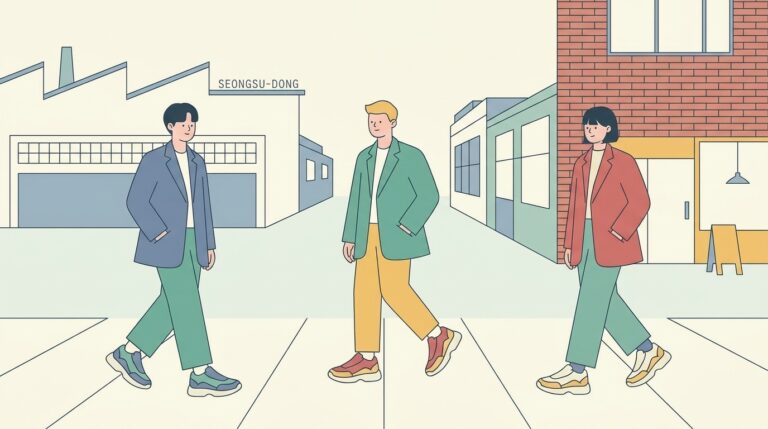
Imagine walking down the industrial back alleys of Seongsu-dong or strolling along the gleaming avenues of Apgujeong Rodeo. You spot a high-profile fashion creative wearing an oversized distressed hoodie layered under a tailored Saint Laurent overcoat, effortlessly waiting in line for a limited sneaker drop. As an advanced Korean speaker aiming for true native mastery (C2), you want to dissect this phenomenon with local industry insiders, art directors, and trendsetters. Yet, when you try to discuss how youth subcultures disrupted heritage fashion houses, do you find yourself defaulting to simple phrases like “스트릿 패션이 인기 많아요” (Street fashion is popular)?
Expressing the conceptual collision between counterculture aesthetics and couture luxury requires intellectual nuance, precise vocabulary, and an instinctive grasp of contemporary Korean trend terminology. Drawing directly from our advanced learners’ real-world debates with Seoul fashion curators, this guide will elevate your Korean to a level where you can critique industry shifts, dissect marketing paradigms, and hold sophisticated salon-style conversations without missing a beat.
Phase 2: Deep-Dive into 3 Core High-End Expressions
1. 하이엔드와 스트릿의 경계가 완전히 허물어지다 (Haiendeuwa seuteuris-ui gyeonggaega wanjeonhi heomuleojida)
- Pronunciation: [Hai-en-deu-wa seu-teu-rit-ui gyeong-gye-ga wan-jeon-hi heo-mul-eo-ji-da] (Sounds like “high-end-wah street-ui gyung-gye-gah wahn-jeon-hee huh-mool-uh-jee-dah”)
- Meaning: Literal: “The boundary between high-end and street has completely collapsed.” | Nuance: Used in cultural critiques to articulate the total erasure of traditional class and stylistic distinctions between luxury houses and underground streetwear.
- K-Culture Moment: Heard on fashion documentary podcasts or during Seoul Fashion Week panel discussions when analyzing collaborations like Dior x Jordan or Louis Vuitton x Supreme.
- Editor’s Insight: The verb ‘허물어지다’ (to crumble / to collapse) carries a dynamic weight—implying that rigid, historic walls built by classical haute couture have dissolved under cultural forces.
- Situation Spectrum: Casual ⚠️ | Semi-formal ✅ | Formal ✅
- 🤔 Think About It: In your native language, do you describe fashion shifts as a “blurring” or a “demolition” of boundaries? Notice how Korean favors the visceral ‘허물어지다’ (physical collapse of a wall).
2. 힙(Hip)한 감성이 럭셔리 시장의 판도를 뒤흔들다 (Hiphan gamseong-i reokseori sijang-ui pandoreul dwiheundeulda)
- Pronunciation: [Hip-han gam-seong-i reok-syeo-ri si-jang-ui pan-do-reul dwi-heun-deul-da] (Think of ‘Hip-hahn gahm-sung-ee lux-shuh-ree she-jahng-ui pahn-doh-reul dwee-hoon-deul-dah’)
- Meaning: Literal: “The ‘hip’ sensibility is violently shaking the playing field of the luxury market.” | Nuance: Conveys how youth-driven, unconventional aesthetics have fundamentally disrupted traditional luxury business dynamics.
- K-Culture Moment: Frequently featured in headlines of publications like GQ Korea, Vogue Korea, and financial press covering Gen-Z consumption shifts.
- Editor’s Insight: ‘판도’ (game layout/sphere of influence) coupled with ‘뒤흔들다’ (to shake up drastically) is a quintessential C2 power collocation used when an underdog culture overturns established authority.
- Situation Spectrum: Casual ⚠️ | Semi-formal ✅ | Formal ✅
- 🤔 Think About It: How does the loanword ‘힙하다’ (to be hip) function differently in Korean compared to English? In Korean, it signifies a raw, untouchable, curated authenticity rather than mere trendy popularity.
3. 희소성을 극대화한 드롭(Drop) 마케팅에 열광하다 (Huixososeong-eul geukdaehwahan deulop maketing-e yeol-gwanghada)
- Pronunciation: [Hui-so-seong-eul geuk-dae-hwa-han deu-rop ma-ke-ting-e yeol-gwang-ha-da] (Pronounce ‘Hee-so-sung-ool gook-dae-hwah-hahn drop mah-keh-ting-eh yuhl-gwahng-hah-dah’)
- Meaning: Literal: “To go wild over drop marketing that maximizes scarcity.” | Nuance: Highlights the obsessive consumer frenzy surrounding unannounced, ultra-limited product releases.
- K-Culture Moment: Used by collectors queuing overnight outside flagship stores in Dosan Park or participating in online raffle lotteries (래플).
- Editor’s Insight: ‘열광하다’ (to be intensely passionate/enthusiastic) captures both emotional fervor and cultural madness, essential for describing hypebeast culture.
- Situation Spectrum: Casual ✅ | Semi-formal ✅ | Formal ✅
- 🤔 Think About It: Scarcity marketing is global, but the word ‘열광’ highlights communal, collective adrenaline. Does your native tongue frame this as craze or devotion?
Phase 3: Textbook Korean vs. Native In-the-Know Korean
Situation 1: Discussing an avant-garde runway style combining sweatpants with tailored blazers
- 📖 Textbook Korean: 편안한 옷과 비싼 옷을 함께 입는 것이 유행입니다. (Pyeon-an-han ot-gwa bi-ssan ot-eul hamk-ke ip-neun geot-i yu-haeng-im-ni-da.) – “Wearing comfortable clothes and expensive clothes together is popular.”
- 🗣️ Real Native Korean: 믹스앤매치로 포멀함에 스트릿 무드를 한 끗 얹은 룩이 완전 대세죠. (Mikseu-aen-mae-chi-ro po-meol-ham-e seu-teu-rit mu-deu-reul han kkeut eon-jeun ruk-i wan-jeon dae-se-jyo.) – “A mix-and-match look that adds that subtle street edge onto formality is absolutely dominating.”
- 💡 Why the Difference? C2 discourse avoids elementary descriptors like ‘편안한/비싼’. Instead, expressions like ‘한 끗 얹다’ (to subtly add an artistic nuance) and ‘대세’ (the prevailing trend) communicate refined stylistic discernment.
Situation 2: Explaining why a heritage luxury house collaborated with a skateboarding brand
- 📖 Textbook Korean: 명품 브랜드가 젊은 사람들에게 팔기 위해 협업했습니다. (Myeong-pum beu-raen-deu-ga jeolm-eun sa-ram-deul-e-ge pal-gi wi-hae hyeop-eop-haess-eum-ni-da.) – “The luxury brand collaborated to sell to young people.”
- 🗣️ Real Native Korean: 올드한 이미지를 탈피하고 서브컬처의 헤리티지를 수혈받으려는 전략적 행보죠. (Ol-deu-han i-mi-ji-reul tal-pi-ha-go seo-beu-keol-cheo-ui he-ri-ti-ji-reul su-hyeol-bad-eu-ryeo-neun jeon-ryak-jeok haeng-bo-jyo.) – “It’s a strategic maneuver to break free from an aged image and receive a transfusion of subculture heritage.”
- 💡 Why the Difference? Native creatives employ evocative metaphors like ‘수혈받다’ (receive a blood transfusion) and ‘탈피하다’ (shed an old skin) when critiquing corporate branding shifts.
Phase 4: K-Culture Deep Dive & Non-Verbal Manners
4-1. Nunchi & Demeanor in the Seoul Fashion Sphere
When discussing high-ticket streetwear inside conceptual multi-brand showrooms (such as Boon The Shop or 10 Corso Como Seoul), maintain an understated, composed poise—referred to as ‘무심한 듯 시크하게’ (effortlessly chic). Avoid overly wide gestures or pointing directly at items. Instead, use a subtle chin nod or open-palm gesture toward the curated display. Nunchi in this realm means respecting the visual silence of the space while speaking in measured, confident tones that signal insider expertise.
4-2. Cultural Code Analysis: The K-Pop & Street-Luxury Synergy
Seoul’s ascendancy as a global fashion capital is inseparable from K-Pop artists acting as global ambassadors who freely subvert haute couture codes. When idols like BTS, BLACKPINK, or NewJeans pair archival tracksuits with Chanel tweeds or customized Balenciaga silhouettes, they validate street aesthetic legitimacy across East Asia. The domestic concept of ‘꾸안꾸’ (effortlessly styled) has evolved into ‘하이프(Hype)한 꾸안꾸’—where astronomical price points hide beneath intentionally unpretentious streetwear silhouettes.
Phase 5: Real-World Roleplay Scenario
Setting: A minimalist design café in Seongsu-dong. You are conversing with Min-jae (민재), a senior fashion director for a prominent Seoul creative agency.
- 민재: 솔직히 이번 파리 패션위크 보면서 명품 브랜드들이 스트릿 웨어에 지나치게 잠식당한 게 아닌가 싶더라고요. (Sol-jik-hi i-beon Pa-ri pae-syeon-wi-keu bo-myeon-seo myeong-pum beu-raen-deu-deul-i seu-teu-rit we-eo-e ji-na-chi-ge jam-sik-dang-han ge a-nin-ga sip-deo-ra-go-yo.)
- 🎭 Action: Sips his pour-over coffee, furrowing his brow thoughtfully.
- Translation: “To be honest, watching this Paris Fashion Week, I wondered if luxury houses have been overly swallowed up by streetwear.”
- You: 저도 동감해요. 하지만 단순한 유행을 넘어 서브컬처가 주류 문화를 재정의하는 필연적인 흐름 아닐까요? (Jeo-do dong-gam-hae-yo. Ha-ji-man dan-sun-han yu-haeng-eul neom-eo seo-beu-keol-cheo-ga ju-ryu mun-hwa-reul jae-jeong-ui-ha-neun pil-yeon-jeok-in heu-reum a-nil-kka-yo?)
- 🎭 Action: Leaning in slightly, maintaining confident eye contact.
- Translation: “I agree. But beyond a passing trend, isn’t it an inevitable movement where subcultures redefine mainstream culture?”
- 민재: 일리 있는 지적이네요. 그런데 하이엔드의 본질인 장인정신이 퇴색되고 로고 플레이만 남았다는 비판도 거세잖아요. (Il-ri it-neun ji-jeok-i-ne-yo. Geu-reon-de hai-en-deu-ui bon-jil-in jang-in-jeong-sin-i toe-saek-doe-go ro-go peul-le-i-man nam-at-da-neun bi-pan-do geo-se-jan-a-yo.)
- 🎭 Action: Taps his tablet pen on the table.
- Translation: “Fair point. Yet, there is fierce criticism that the essence of high-end—craftsmanship—is fading, leaving only hype logo-play.”
- You: 바로 그 지점에서 브랜드의 지속 가능성이 갈리는 것 같아요. 헤리티지와의 조화가 관건이죠. (Ba-ro geu ji-jeom-e-seo beu-raen-deu-ui ji-sok ga-neung-seong-i gal-li-neun geot gat-a-yo. He-ri-ti-ji-wa-ui jo-hwa-ga gwan-geon-i-jyo.)
- 🎭 Action: Nodding calmly with a reflective tone.
- Translation: “That exact junction seems to determine a brand’s long-term sustainability. Harmonizing with heritage is key.”
- 민재: 맞아요. 서울 스트릿 씬만 봐도 무조건 럭셔리를 좇기보단 독자적인 내러티브를 가진 브랜드가 오래가더라고요. (Maj-a-yo. Seo-ul seu-teu-rit ssin-man bwa-do mu-jo-geon reok-syeo-ri-reul jot-gi-bo-dan dok-ja-jeok-in nae-reo-ti-beu-reul ga-jin beu-raen-deu-ga o-rae-ga-deo-ra-go-yo.)
- 🎭 Action: Smiling with genuine appreciation for your perspective.
- Translation: “Exactly. Even looking at the Seoul street scene, brands with their own distinctive narratives last longer than those blindly chasing luxury.”
- You: 결국 소비자들이 원하는 건 겉포장된 럭셔리가 아니라 진정성 있는 스토리텔링이니까요. (Gyeol-guk so-bi-ja-deul-i won-ha-neun geon geot-po-jang-doen reok-syeo-ri-ga a-ni-ra jin-jeong-seong it-neun seu-to-ri-tel-ling-i-nik-ka-yo.)
- 🎭 Action: Expressing calm conviction.
- Translation: “After all, what consumers crave isn’t superficially packaged luxury, but authentic storytelling.”
- 민재: 완벽한 정리네요! 이번 컬렉션 리뷰 아티클 쓸 때 그 통찰을 꼭 인용해야겠습니다. (Wan-byeok-han jeong-ri-ne-yo! I-beon keol-lek-syeon ri-byu a-ti-keul sseul ttae geu tong-chal-eul kkok in-yong-hae-ya-get-seum-ni-da.)
- 🎭 Action: Jots a quick note in his sketchbook.
- Translation: “A flawless summary! I must quote that insight when writing my review article for this collection.”
- You: 영광입니다. 디렉터님의 날카로운 관점 덕분에 저도 시야가 훨씬 넓어졌어요. (Yeong-gwang-im-ni-da. Di-rek-teo-nim-ui nal-ka-ro-un gwan-jeom deok-bun-e jeo-do si-ya-ga hwol-ssin neolb-eo-jyeoss-eo-yo.)
- 🎭 Action: Bowing head slightly with professional warmth.
- Translation: “I’m honored. Thanks to your sharp perspective, my outlook has broadened significantly.”
🔀 Interactive Choice Point
How would you transition the discussion to emerging domestic Korean designer brands?
- Option A: “최근 한국 신진 디자이너들도 스트릿 무드에 하이엔드 테일러링을 접목해서 해외 바이어들의 이목을 끌고 있더군요.” (Recently, emerging Korean designers are also integrating streetwear moods with high-end tailoring, capturing global buyers’ attention.)
- Option B: “한국 옷이 요즘 예뻐서 외국 사람들도 인스타그램에서 엄청 많이 사요.” (Korean clothes are pretty these days, so foreigners buy them a lot on Instagram.)
- Option C: “명품은 비싸기만 하니까 요즘 젊은 애들은 그냥 동대문 스트릿 브랜드만 입어요.” (Luxury is just overpriced, so kids these days only wear Dongdaemun street brands.)
Option Feedback:
* Option A (Best): Demonstrates sophisticated C2 analytical vocabulary (‘신진 디자이너’, ‘테일러링을 접목하다’, ‘이목을 끌다’) suited for industry discourse.
* Option B (Bad): Regresses to rudimentary A2/B1 grammar (‘예뻐서’, ‘엄청 많이 사요’), losing the intellectual authority built in the dialogue.
* Option C (Risk): Employs overly blunt generalizations (‘그냥 동대문 스트릿’) and dismissive slang (‘젊은 애들’), which can come across as unprofessional and culturally misinformed in an industry networking setting.
Phase 6: 10-Second Emotion Shadowing Drill
Practice matching the cadence, subtle pauses (/), and emotional intent of each line:
[🧐 Analytical & Discerning]
“단순한 협업을 넘어, / 브랜드의 헤리티지와 서브컬처가 / 유기적으로 맞물린 결과물입니다.”
(Dan-sun-han hyeop-eop-eul neom-eo, / beu-raen-deu-ui he-ri-ti-ji-wa seo-beu-keol-cheo-ga / yu-gi-jeok-eu-ro mat-mul-rin gyeol-gwa-mul-im-ni-da.)-
[🔥 Emphatic & Passionate]
“이건 단순한 유행이 아니에요. / 기존 럭셔리 시장의 패러다임을 / 완전히 뒤집어엎은 일대 사건이죠!”
(I-geon dan-sun-han yu-haeng-i a-ni-e-yo. / gi-jon reok-syeo-ri si-jang-ui pae-reo-da-im-eul / wan-jeon-hi dwi-jib-eo-eop-eun il-dae sa-geon-i-jyo!) -
[😌 Understated & Savvy]
“과하게 힘주지 않고, / 믹스앤매치로 툭 걸쳐 입는 게 / 요즘 서울의 힙스터 감성이죠.”
(Gwa-ha-ge him-ju-ji an-ko, / mik-seu-aen-mae-chi-ro tuk geol-chyeo ip-neun ge / yo-jeum Seo-ul-ui hip-seu-teo gam-seong-i-jyo.)
Phase 7: K-Culture Mini Dictionary
-
오픈런 (O-peun-reon | Open Run)
- Meaning: The act of sprinting into a department store or pop-up the exact second doors open to purchase hyper-limited luxury/streetwear items.
- Usage: “이번 한정판 스니커즈 사려고 새벽 5시부터 오픈런 뛰었어요.” (I did an open-run from 5 AM to snag these limited-edition sneakers.)
- 디깅 (Di-ging | Digging)
- Meaning: Deep-diving into obscure archives, subcultural music, or vintage fashion pieces to discover rare items before they trend.
- Usage: “성수동 빈티지 샵에서 아카이브 피스 디깅하는 재미가 쏠쏠해요.” (Digging for archive pieces in Seongsu vintage boutiques is deeply satisfying.)
- 드롭 (Deu-rop | Drop)
- Meaning: The timed release of limited inventory, eschewing traditional seasonal calendars.
- Usage: “이번 주 금요일 기습 드롭 일정 떴으니까 알림 꼭 켜두세요.” (The surprise drop schedule was announced for this Friday, so definitely keep notifications on.)
- 착장 (Chak-jang | Outfit / Fit)
- Meaning: The complete styled ensemble worn by an individual; formal fashion term adopted into daily high-end slang.
- Usage: “오늘 브랜드 쇼케이스에 참석한 셀럽들의 착장이 SNS에서 화제네요.” (The fits worn by celebrities attending today’s brand showcase are trending across social media.)
Phase 8: The Traveler’s High-Fashion Survival Kit
Survival Expressions TOP 3
- “이 제품 이번 시즌 캡슐 컬렉션 한정 라인인가요?” (I je-pum i-beon si-jeun kaep-syul keol-lek-syeon han-jeong ra-in-in-ga-yo?)
- Pro Tip: Use when inquiring in high-end streetwear concept stores in Hannam-dong or Dosan Park to immediately sound like an industry insider.
- “온라인 래플 당첨자만 현장 수령 가능한가요?” (On-ra-in rae-peul dang-cheom-ja-man hyeon-jang su-ryeong ga-neung-han-ga-yo?)
- Pro Tip: Essential when entering pop-up launches to verify whether items are open for general purchase or restricted to lottery winners.
- “피팅룸에서 레이어드해서 착용해 봐도 될까요?” (Pi-ting-rum-e-seo re-i-eo-deu-hae-seo chak-yong-hae bwa-do doel-kka-yo?)
- Pro Tip: Politely clarifies whether you can try on multiple outerwear layers together.
Editor’s Travel Note
When hunting for exclusive drops in Seoul, relying on Google Maps often yields delayed store relocation data. Make sure you refer to your Naver Map app download guide to pinpoint hidden showroom locations in Seongsu-dong (성수동) and Hannam-dong (한남동). In Korea, high-end concept boutiques rarely accept cash; carry a contactless credit card or ensure your domestic transit T-Money card is topped up for seamless metro hopping between Garosu-gil and Apgujeong.
Phase 9: A Step Deeper (한 발 더 깊이)
In Korean society, fashion is not merely an individualist aesthetic pursuit; it is a high-speed barometer of collective cultural literacy and social agility. The explosive embrace of street culture by Korea’s luxury market mirrors the country’s broader modernization trajectory: dismantling hierarchical legacies and replacing them with agile, youth-driven digital dynamism. When you converse about streetwear conquering high fashion in Korean, you are fundamentally participating in a dialogue about how contemporary Korea asserts its autonomy over traditional Western status symbols.
💬 Your Turn: Do you believe streetwear elevates luxury houses by infusing raw cultural vitality, or does it dilute heritage craftsmanship? Share your perspective in advanced Korean in the comments below! (여러분의 생각을 한국어로 들려주세요!)
Phase 10: FAQ & Common Mistakes
Q: Can I use the word ‘스트릿’ (Street) in formal academic or business presentations in Korea?
A: Yes. ‘스트릿 패션’ (Street Fashion) and ‘스트릿 무드’ (Street Mood) are fully codified industry terms in Korea, recognized in business reports, fashion journalism, and university lectures.
Q: What is the exact difference between ‘명품’ (Myeong-pum) and ‘하이엔드’ (High-End)?
A: ‘명품’ traditionally implies legacy luxury brands associated with heritage and social prestige (e.g., Chanel, Hermès), whereas ‘하이엔드’ is a broader descriptor referring to top-tier technical quality, price point, or progressive design across both couture and modern avant-garde street labels.
Q: How do I avoid sounding overly pretentious when critiquing fashion trends in Korean?
A: Balance complex terminology with polite, humble sentence endings such as ~인 것 같습니다 (It seems to be…) or ~라는 생각이 듭니다 (I am led to think that…). This grounds your high-level vocabulary in traditional Korean conversational etiquette.
🚨 Common Mistakes Alert Board
- ❌ Mistake 1: Translating “This design is so dope” literally as “이 디자인 마약 같아요” (Dangerous and inappropriate!).
- ✅ Correct Action: Say “이 디자인 핏(Fit)이랑 감성이 제대로 살아있네요.” (This design’s fit and vibe are truly on point.)
- ❌ Mistake 2: Using informal banmal like “이거 완전 힙해” with shop owners or senior industry contacts.
- ✅ Correct Action: Say “트렌디하면서도 고유의 개성이 돋보이네요.” (It’s trendy while highlighting distinct individuality.)
- ❌ Mistake 3: Confusing ‘협업’ (Hyeop-eop / collaboration) with generic ‘일’ (Work).
- ✅ Correct Action: Specifically use ‘브랜드 간의 콜라보/협업’ when discussing cross-brand projects.
Phase 11: Action Missions
- 🥉 Bronze Mission (Solo Practice): Stand in front of a mirror and say all 3 shadowing sentences from Phase 6 with correct pauses (
/) within 30 seconds without looking at the romanization. - 🥈 Silver Mission (Social Engagement): Find an Instagram post from a Korean fashion magazine (@voguekorea, @eyesmag) featuring a luxury-street collaboration. Post a one-sentence critique in Korean using the expression
경계가 허물어지다. - 🥇 Gold Mission (Real-World Execution): Next time you visit a fashion boutique or chat with a Korean friend, initiate a 3-minute dialogue analyzing whether luxury streetwear is sustainable using at least two expressions learned today.
- 🎮 K-Culture Mission: Watch a music video or red carpet appearance by an idol group and identify three distinct elements where streetwear is paired with haute couture jewelry or tailoring.
Phase 12: Interactive Quiz Challenge
Question 1: Situation Analysis
You are writing an editorial column about high-end streetwear pop-ups in Hannam-dong. Which phrase best captures the frenzy surrounding limited releases?
* A) 시장 바구니를 채우다
* B) 희소성에 기반한 드롭 마케팅에 열광하다
* C) 백화점에서 세일 행사를 기다리다
🔍 View Answer & Explanation
Correct Answer: B
Explanation: ‘희소성에 기반한 드롭 마케팅에 열광하다’ specifically reflects the cultural phenomenon of high-fashion hype drops. Option A refers to grocery shopping, and Option C refers to generic department store bargain sales.
Question 2: Fill in the Blank
올드한 이미지를 ( )하고 서브컬처의 감성을 수혈받다.
* A) 탈피(Tal-pi)
* B) 포기(Po-gi)
* C) 후퇴(Hu-toe)
🔍 View Answer & Explanation
Correct Answer: A (탈피)
Explanation: ‘탈피하다’ (to shed/break away from an outdated shell) is the correct high-register collocation used when institutions reinvent their brand identity.
Question 3: Cultural True or False
In contemporary Korean fashion terminology, ‘오픈런 (Open Run)’ refers exclusively to Broadway musical ticket sales.
* A) True
* B) False
🔍 View Answer & Explanation
Correct Answer: B (False)
Explanation: While ‘오픈런’ originally described open-ended theater runs, in contemporary Korean lifestyle and fashion vernacular, it predominantly denotes consumers lining up at dawn to dash into boutiques for exclusive drops.







