

Don’t Panic! How to Describe Your Lost Items in Korean Like a Pro
Phase 1: Empathy & Story Opening
안녕하세요! (Annyeonghaseyo!) It is your Daily Hangul editor and Korean bestie here! Imagine this classic K-Drama nightmare: You just spent an unforgettable afternoon strolling along the romantic Cheonggyecheon Stream in Seoul. You stop by a bustling cafe in Hongdae to order an iced Americano, reach into your bag, and your heart skips a beat. Your favorite pouch containing your passport and subway pass is gone! You remember sitting on the green bench at Subway Line 2 just twenty minutes ago.
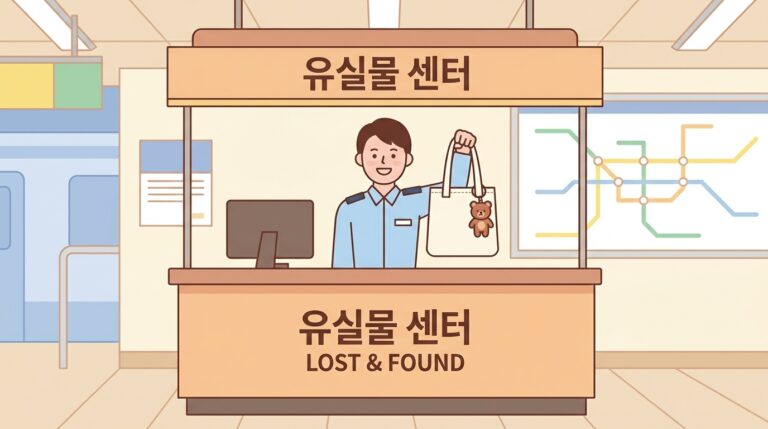
You rush to the station’s Lost and Found center (분실물 센터 – bunsilmul senteo). The station master looks at you kindly and asks, “어떤 물건이에요? (Eotteon mulgeon-ieyo? / What kind of item is it?)” Suddenly, your mind goes completely blank. You know words like “bag” or “wallet,” but how do you say it is “black leather with a cute yellow bear key ring”?
Take a deep breath! You are definitely not alone. Over 85% of beginner Korean learners tell us that describing specific item features (colors, sizes, textures, and attachments) is where panic sets in. In this guide, tailored specifically for A2 beginners, we will equip you with simple yet powerful descriptive patterns so you can explain exactly what your lost item looks like and get it back safely.
Phase 2: Core Expressions Breakdown
Here are 3 essential expressions you need when describing lost belongings:
1. 검은색 가죽 지갑이에요. (Geomeun-saek gajuk jigap-ieyo.)
- Pronunciation: [Geom-eun-saek gah-jook jee-gahp-ee-yeh-yo] (Think “gum-un-sack” for black color + “ga-jook” for leather).
- Meaning: Direct: “It is a black leather wallet.” / Nuance: Clearly identifying the color, material, and item in one crisp A2 sentence.
- K-Culture Moment: Seen in dramas like Business Proposal when a character drops their sleek designer wallet in a luxury taxi.
- Editor’s Insight: Simply stack
[Color-색] + [Material] + [Item] + 이에요/예요. It is the golden formula for lost and found clarity!- Situation Spectrum: Casual (✅ – without -yo) | Semi-formal (✅ – 이에요) | Formal (✅ – 입니다)
- 🤔 Think About It: Notice how Korean adjectives sit directly in front of the noun without needing extra prepositions like “made of” in English.
2. 노란색 곰 인형 키링이 달려 있어요. (Noran-saek gom inhyeong kiring-i dallyeo isseoyo.)
- Pronunciation: [Noh-rahn-saek gohm een-hyeong key-ring-ee dahl-lyeo ee-ssuh-yo] (“dallyeo isseoyo” rhymes closely with “tally-uh ee-so-yo”).
- Meaning: Direct: “A yellow bear doll key ring is attached/hanging on it.”
- K-Culture Moment: Koreans love bag charms and keyrings (키링)! Almost every Gen-Z bag in Seoul has cute plushies attached.
- Editor’s Insight: The verb
달려 있어요 (dallyeo isseoyo)means “is attached/hanging.” Pointing out unique charms is the #1 way staff find your specific item among hundreds of similar black bags!- Situation Spectrum: Casual (⚠️ – use 달려 있어 with friends) | Semi-formal (✅) | Formal (✅ – 달려 있습니다)
- 🤔 Think About It: In English, we say “It has a keychain on it,” but in Korean, the focus is on the state of attachment (
~이 달려 있어요).3. 손잡이에 스티커가 붙어 있어요. (Sonjabi-e seutikeoga buteo isseoyo.)
- Pronunciation: [Sohn-jah-bee-eh seu-tee-kuh-gah boo-tuh ee-ssuh-yo] (“buteo” sounds like the English word “putter” with a soft ‘b’).
- Meaning: Direct: “A sticker is stuck on the handle.”
- K-Culture Moment: Mentioning customized items like idol photo cards in phone cases or character stickers on luggage handles.
- Editor’s Insight:
~에 붙어 있어요 (buteo isseoyo)indicates something is stuck/glued onto a surface. It is perfect for stickers, name tags, or decals.- Situation Spectrum: Casual (⚠️) | Semi-formal (✅) | Formal (✅)
- 🤔 Think About It: Korean uses distinct existential verbs for hanging (
달려 있다) versus sticking flat (붙어 있다).
Phase 3: Textbook Korean vs. Real Korean
Let us look at how textbook lines differ from what native speakers actually say at the counter:
- Situation 1: Explaining what the lost item looks like
- 📖 Textbook Korean: 제 물건은 크기가 작고 파란색입니다. (Je mulgeon-eun keugiga jakgo paransaegimnida. – My item is small in size and blue.)
- 🗣️ Real Korean: 작고 파란색 파우치예요. (Jakgo paransaek pauchi-yeyo. – It’s a small blue pouch.)
- 💡 Why is it different? Real Korean naturally drops redundant words like “my item” or “in size” and jumps straight to the descriptive noun.
- Situation 2: Asking if a similar item has been turned in
- 📖 Textbook Korean: 혹시 그것을 습득하셨습니까? (Hoksi geugeoseul seupdeukhayeossseumnikka? – Did you acquire/obtain it by chance?)
- 🗣️ Real Korean: 혹시 이런 거 들어온 거 있나요? (Hoksi ireon geo deureoon geo innayo? – By any chance, has anything like this come in?)
- 💡 Why is it different? The legal term
습득 (seupdeuk - acquisition)sounds like a police report. Real people say들어온 거 (deureoon geo - things that came in).
Phase 4: K-Culture Deep Dive & Non-Verbal Manners
4-1. Nunchi & Polite Gestures
When describing an item at a Korean service counter:
1. Two-Handed Reference: If you show a reference photo on your smartphone, always hold your phone with both hands or support your right elbow with your left hand. This conveys immense respect.
2. Hand Sizing Gestures: Koreans frequently use both hands to trace a box in the air (요만해요 / yomanhaeyo - It's about this big) to demonstrate dimensions naturally.
4-2. Cultural Code: The Korean Lost and Found Miracle
Foreign travelers are often shocked to see laptops left unattended on cafe tables in Gangnam. Korea has a massive CCTV network and a cultural norm of turning found items into the nearest station office or police box. Subway stations have integrated digital systems where items are logged with photos within hours!
Phase 5: Real-Life Roleplay Scenario
Setting: Lost & Found Center at Hongdae Station (홍대입구역 분실물 센터).
Characters:
* Station Staff (역무원): Friendly, efficient subway officer.
* You (Alex): Looking for your lost tote bag.
- Turn 1 (Staff): 안녕하세요, 무엇을 도와드릴까요?
(Annyeonghaseyo, mueoseul dowadeurilkkayo?)
“Hello, how can I help you?”
🎭 [Smiling with a polite bow behind the desk] -
Turn 2 (You): 지하철에 가방을 두고 내렸어요.
(Jihacheore gabang-eul dugo naeryeosseoyo.)
“I left my bag behind on the subway.”
🎭 [Looking anxious with hands clasped together] -
Turn 3 (Staff): 아, 그래요? 가방이 어떻게 생겼어요?
(A, geuraeyo? Gabang-i eotteoke saenggyeosseoyo?)
“Oh really? What does the bag look like?”
🎭 [Opening the lost-and-found database on monitor] -
Turn 4 (You): 하얀색 에코백이고, 가운데에 빨간 하트가 있어요.
(Hayan-saek ekobaeg-igo, gaundee ppalgan hateuga isseoyo.)
“It is a white canvas tote bag, and there is a red heart in the middle.”
🎭 [Making a square shape with both hands to show size] -
Turn 5 (Staff): 크기는 어느 정도인가요?
(Keugineun eoneu jeongdo-ingayo?)
“About what size is it?”
🎭 [Typing search keywords into the computer] -
Turn 6 (You): 노트북이 들어가는 중간 크기예요. 키링도 달려 있어요.
(Notbeuk-i deureoganeun junggan keugi-yeyo. Kiring-do dallyeo isseoyo.)
“It’s a medium size that fits a laptop. A key ring is attached too.”
🎭 [Pointing to a sample photo on phone] -
Turn 7 (Staff): 잠시만요… 혹시 이 고양이 키링 달린 가방인가요?
(Jamsimanyo… hoksi i goyangi kiring dallin gabang-ingayo?)
“One moment… Is it by any chance this bag with a cat key ring?”
🎭 [Showing a photo on the screen] -
Turn 8 (You): 네, 맞아요! 정말 감사합니다!
(Ne, majayo! Jeongmal gamsahamnida!)
“Yes, that’s right! Thank you so much!”
🎭 [Bowing deeply with a sigh of relief]
🔀 Interactive Choice Point
What if the staff shows a bag that is NOT yours? What do you say?
* Option A: “아니요, 제 것은 검은색 손잡이가 있어요.” (No, mine has black handles.)
👉 Feedback [Best]: Polite, clear, and provides an additional specific feature to narrow down the search.
* Option B: “틀렸어요. 다시 찾으세요.” (Wrong. Look again.)
👉 Feedback [Bad]: Overly blunt and demanding. Will sound rude in Korean.
* Option C: “몰라요.” (I don’t know.)
👉 Feedback [Risk]: Causes confusion because the staff will assume you are unsure of your own belongings.
Phase 6: 10-Second Emotion Shadowing Drill
Practice reading these out loud with natural pauses (/) and emotions!
[🥺 Worried & Earnest]
저기요… / 지갑을 잃어버렸는데 / 혹시 들어왔나요?
(Jeogiyo… / jigap-eul ireobeoryeonneunde / hoksi deureowannayo?)-
[💡 Clear & Descriptive]
검은색 가죽이고 / 앞에 노란 스티커가 / 붙어 있어요.
(Geomeun-saek gajuk-igo / ape noran seutikeoga / buteo isseoyo.) -
[🎉 Relieved & Happy]
네! / 그거 제 거 맞아요! / 정말 감사합니다!
(Ne! / geugeo je geo majayo! / Jeongmal gamsahamnida!)
Phase 7: K-Culture Mini Dictionary
| Word (Hangul + Romanization) | English Meaning | Real-Life Usage Tip |
|---|---|---|
| 분실물 (Bunsilmul) | Lost item / Lost property | Look for signs labeled 분실물 센터 in subways and train stations. |
| 특징 (Teukjing) | Distinct feature / Characteristic | Staff will ask “특징이 뭐예요?” when verifying ownership. |
| 에코백 (Ekobaek) | Canvas tote bag | Derived from “Eco-bag”. Very popular daily bag style in Korea. |
| 보관증 (Bogwanjeung) | Claim ticket / Storage receipt | The paper or digital slip you fill out when retrieving high-value items. |
Phase 8: Traveler’s Survival Kit
Top 3 Survival Phrases
- 사진 보여드릴게요. (Sajin boyeodeurilgeyo. / I’ll show you a photo.)
👉 Pro Tip: If vocabulary fails, show an old photo of your lost item on your smartphone! - 안에 여권이 들어 있어요. (Ane yeogwon-i deureo isseoyo. / My passport is inside.)
👉 Pro Tip: Mentioning essential IDs prioritizes your case immediately. - 연락처 남겨도 될까요? (Yeollakcheo namgyeodo doelkkayo? / May I leave my contact number?)
👉 Pro Tip: If not found immediately, leave your Korean SIM or hotel front desk number.
Editor’s Travel Note
Always bookmark the official LOST112 National Police Lost and Found Portal or check the subway customer center within 24 hours of losing an item. Items found in subway trains are stored at station centers for a few days before being transferred to LOST112!
Phase 9: A Step Deeper (Reflection)
In Korean culture, the phrase 제 것 (je geot - mine) is often balanced with collective responsibility. When you describe an item to station staff, they treat it almost like helping a family member retrieve a precious possession. This cultural value of communal trust (Jeong and civic pride) makes Korea one of the safest places to recover lost property.
💬 Your Turn: Have you ever lost an item while traveling? What was the most distinctive feature on your bag or phone that helped you identify it? Share your story in the comments below!
Phase 10: FAQ & Common Mistakes
Q: What is the difference between 빨간색 and 빨간?
A: 빨간색 (ppalgansaek) is the noun “red color”, while 빨간 (ppalgan) is the adjective “red”. You can say either 빨간 가방 (red bag) or 빨간색 가방 (red-colored bag). Both are completely natural at the A2 level!
Q: Can I just describe the brand name instead of features?
A: Yes, but mentioning features like attachments (키링) or colors alongside the brand name helps staff pinpoint your exact item among hundreds of similar brands.
Q: What if I lost something inside a taxi?
A: If you paid by credit card or T-Money card, check your receipt for the taxi license number and call the 120 Dasan Call Center for multilingual assistance.
🚨 Common Mistakes Alert!
- ❌ Mistake 1: Saying “가방이 죽었어요” (My bag died) instead of “가방을 잃어버렸어요” (I lost my bag).
- ❌ Mistake 2: Using English color terms like “블랙 지갑” when officers prefer standard Korean
검은색 지갑. - ❌ Mistake 3: Forgetting polite endings and shouting “내 지갑!” (Informal: My wallet!). Always use
제 지갑이에요.
Phase 11: Action Missions
- 🥉 Bronze Mission (Solo Practice): Pick 3 items on your desk right now. Say their color and one feature aloud in Korean (e.g.,
파란색 펜이에요). - 🥈 Silver Mission (Social Share): Take a picture of your favorite tote bag, post it on your Instagram Story, and caption it in Korean with its color and attachment!
- 🥇 Gold Mission (Real Action): Practice our Phase 5 roleplay dialogue with your Korean language partner or tutor using your real bag features.
- 🎮 K-Culture Mission: Watch an episode of a Korean reality travel show and spot how travelers ask for lost gear using
혹시... 있나요?.
Phase 12: Interactive Quiz Challenge
1. Situation Judgment: You want to say that a yellow sticker is attached to your black suitcase. Which sentence is correct?
* A) 노란색 스티커가 붙어 있어요.
* B) 노란색 스티커가 달려 있어요.
* C) 노란색 가방이 잃어버렸어요.
2. Fill in the Blank:
“파란색 에코백에 곰 인형 키링이 ______ 있어요.” (A bear doll key ring is hanging on the blue eco-bag.)
3. True or False: In Korea, subway lost and found centers upload photos of recovered items to online databases.
🔍 Click to Reveal Answers & Explanations!
- Answer: A (
붙어 있어요is used for flat stickers stuck on surfaces, whereas달려 있어요is for hanging keychains). - Answer: 달려 (
달려 있어요means ‘is hanging/attached’). - Answer: TRUE (Subway lost-and-found offices and the LOST112 police portal routinely upload photos of registered items!).







