

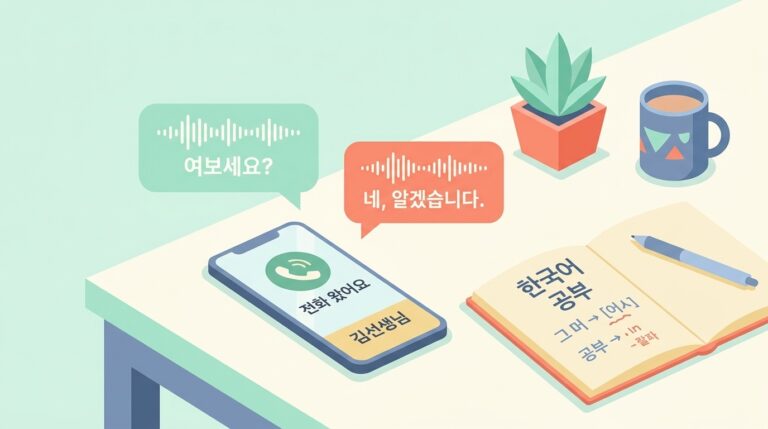
안녕하세요! 매일한글 에디터입니다. Welcome back to Daily Hangul! Have you ever dialed a Korean friend, hotel reception, or office, only to hear an unfamiliar voice pick up and say “Yeoboseyo?” Panic instantly sets in: Wait, who is this? How do I politely ask for the person I actually wanted to talk to without sounding rude or hanging up in fear? You might recall scenes from K-dramas where a character calls an office and stammers nervously before someone gracefully transfers the call. As your friendly cultural navigator, I am here to tell you that asking to put someone on the phone in Korean is far easier than it feels! With just a few staple phrases, you will breeze through phone calls like a confident local.
1. [사람 이름] + 씨 좀 바꿔 주세요 (Saram ireum + ssi jom bakkwo juseyo)
- Pronunciation: [Name]-ssi jom bak-kwo ju-se-yo (Sounds like: shee johm bahk-kwo joo-say-yo — imagine saying “comb” without the c, that’s jom!)
- Meaning: Literally “Please change/swap to [Name] for me” -> Nuance: “Could you please put [Name] on the phone?”
- K-Culture Moment: You’ll hear this in almost every classic K-drama when a friend calls a household landline or an office desk to ask for the main lead.
- Editor’s Insight: The word 바꿔 (bakkwo) comes from 바꾸다 (to change/switch), and 좀 (jom) softens the request so it sounds wonderfully polite rather than demanding.
- Situation Spectrum: Casual ⚠️ (with close peers, say 바꿔줘 bakkwo-jwo) | Semi-formal ✅ | Formal ✅
- 🤔 Think About It: In English, we say “put someone on“, but Koreans visualize switching the person holding the receiver. How does your native language describe passing a call?
2. 지금 [사람 이름] 씨 계신가요? (Jigeum [Name] ssi gyesingayo?)
- Pronunciation: Jee-geum [Name] ssi gye-sin-ga-yo? (gyesin sounds like “gay-sheen” said quickly and softly)
- Meaning: Literally “Is [Name] currently staying/present?” -> Nuance: “Is [Name] available right now?”
- K-Culture Moment: Used whenever you call an office, salon, or community center and want to check if a specific staff member is at their desk before asking them to speak.
- Editor’s Insight: 계시다 (gyesida) is the honorific form of 있다 (itda – to exist/be present). Using this shows immense respect and makes you sound like an A2 super-learner!
- Situation Spectrum: Casual 🚫 | Semi-formal ✅ | Formal ✅
- 🤔 Think About It: Notice how checking availability comes before demanding to speak. Politeness in Korea is all about considerate pacing!
3. [사람/부서]에 연결해 드릴게요 (Yeon-gyeol-hae deurilgeyo)
- Pronunciation: Yeon-gyeol-hae deu-ril-ge-yo (Yeon-gyeol rhymes with “yawn-pure”)
- Meaning: Literally “I will connect you to [person/department]” -> Nuance: “I’ll transfer you right now.”
- K-Culture Moment: What receptionists say right before cheerful hold music starts playing in Korean corporate dramas!
- Editor’s Insight: Even though you might not say this sentence often, training your ears to catch 연결 (connection) and 드릴게요 (I will give/do for you) prevents you from accidentally hanging up when the call goes silent for transfer.
- Situation Spectrum: Casual 🚫 | Semi-formal ✅ | Formal ✅
- 🤔 Think About It: Recognizing inbound service phrases is 50% of phone fluency. Hearing 연결 means success is just a ringtone away!
📖 교과서 한국어 (Textbook Korean)
김철수 씨와 통화하고 싶습니다. (Gimcheolsu ssi-wa tonghwahago sipseumnida.)
Translation: “I desire to engage in a telephone conversation with Mr. Cheolsu Kim.”
🗣️ 진짜 한국어 (Real-Life Korean)
철수 씨 좀 부탁드려요. (Cheolsu ssi jom butakdeuryeoyo.) OR 철수 씨 좀 바꿔 주세요. (Cheolsu ssi jom bakkwo juseyo.)
Translation: “Could I speak with Cheolsu, please?”
💡 Why the Difference?
Textbook Korean often relies on overly literal translations like 통화하고 싶다 (want to talk on the phone). Native speakers prefer relationship-oriented verbs like 부탁하다 (to request a favor) and 바꾸다 (to switch lines).
4-1. Phone Nunchi & Phantom Bowing
Have you ever seen a Korean person repeatedly bowing their head while talking on a smartphone in a subway station? It looks hilarious, but it’s pure instinctive respect! Even through audio lines, your physical posture changes your vocal tone. When asking for a transfer:
* Keep your chin slightly lifted and smile; your voice instantly sounds warmer.
* Avoid dead silence. Sprinkle in gentle acknowledgments like 네~ (Ne~) or 아, 네! (Ah, ne!) while the other person checks the room.
4-2. Decoding Titles on the Phone
In Korean culture, calling someone just by their name without a suffix is a huge faux pas unless you are childhood best friends. Always attach -씨 (-ssi) for equals/colleagues, or use their job title like 선생님 (Seonsaengnim – Teacher/Instructor) or 매니저님 (Maenijeonim – Manager).
- Setting: You are calling Seoul K-Dance Studio to reschedule a class with Instructor Minji, but the front desk receptionist answers.
- Characters: You (Learner) & Receptionist (Jiho)
-
Receptionist: 여보세요, 서울 K-댄스 스튜디오입니다. (Yeoboseyo, Seoul K-daenseu seutyudio-imnida.) 🎭 [Polite, crisp greeting tone] (Hello, this is Seoul K-Dance Studio.)
- You: 안녕하세요! 민지 선생님 계신가요? (Annyeonghaseyo! Minji seonsaengnim gyesingayo?) 🎭 [Bright, friendly tone] (Hello! Is Instructor Minji there?)
- Receptionist: 네, 지금 스튜디오에 계세요. 무슨 일이실까요? (Ne, jigeum seutyudio-e gyeseyo. Museun irisilkkayo?) 🎭 [Attentive tone] (Yes, she is in the studio right now. May I ask what this is regarding?)
- You: 수업 예약 때문에 전화드렸어요. 민지 선생님 좀 바꿔 주세요. (Sueop yeyak ttaemune jeonhwadeuryeosseoyo. Minji seonsaengnim jom bakkwo juseyo.) 🎭 [Clear and relaxed pace] (I called regarding my class reservation. Could you please put Instructor Minji on?)
- Receptionist: 아, 네! 잠시만 기다려 주세요. 연결해 드릴게요. (Ah, ne! Jamsiman gidaryeo juseyo. Yeon-gyeol-hae deurilgeyo.) 🎭 [Helpful customer service voice] (Ah, sure! Please hold on a second. I will transfer you.)
- You: 네, 감사합니다! (Ne, gamsahamnida!) 🎭 [Polite nod tone] (Yes, thank you!)
- Receptionist: [Hold music playing: 🎵 BGM kicks in] 🎭 [Switching the line]
- Minji (Instructor): 여보세요! 민지입니다~ (Yeoboseyo! Minji-imnida~) 🎭 [Energetic entrance] (Hello! This is Minji~)
🔀 Interactive Choice Point
The receptionist asks: “실례지만 누구시라고 전해드릴까요? (May I ask who is calling?)” What do you say?
* Option A: [Your Name]이라고 합니다. (This is [Your Name] speaking.)
* 🏆 Best Choice: Perfectly polite, uses the standard self-introduction form on the phone.
* Option B: 나야! (It’s me!)
* ❌ Bad Choice: Way too informal for a receptionist you have never met.
* Option C: 왜 물어보세요? (Why are you asking?)
* ⚠️ Risk Choice: Extremely defensive and rude in Korean phone etiquette.
Practice reading these out loud with rhythm and intention! Take a pause at every slash (/).
[😊 Polite & Inquiring]안녕하세요! / 민지 선생님 / 계신가요? (Annyeonghaseyo! / Minji seonsaengnim / gyesingayo?)[🙏 Gentle Request]민우 씨 좀 / 바꿔 주세요. (Minu-ssi jom / bakkwo juseyo.)[⏳ Patient & Cheerful]네, / 천천히 하세요 / 감사합니다! (Ne, / cheoncheonhi haseyo / gamsahamnida!)
- 통화 중 (Tonghwajung) | On the other line / Busy line | When the line is occupied: “지금 통화 중이세요” (They are on another call right now).
- 부재중 (Bujaejung) | Away from desk / Missed | Used when someone stepped out: “지금 자리에 안 계세요” (They are not at their seat).
- 내선 번호 (Naeseon beonho) | Extension number | Useful when calling Korean companies or hotels: “내선 번호 3번 눌러주세요” (Press extension 3).
- 메모 (Memo) | Message / Note | Crucial for leaving a callback note: “메모 남겨드릴까요?” (Shall I leave a note for them?).
Survival Phrases TOP 3
- 잠시만 기다려 주세요. (Jamsiman gidaryeo juseyo.) — Please wait a moment.
- Pro Tip: If you need time to translate what the other person said, say this immediately!
- 다시 전화드릴게요. (Dasi jeonhwadeurilgeyo.) — I will call back again.
- Pro Tip: Great escape sentence if the conversation gets too complicated for your current Korean level.
- 잘 안 들려요. (Jal an deullyeoyo.) — I can’t hear you well.
- Pro Tip: Perfect when call quality is poor or background noise is loud.
Editor’s Travel Note
When traveling in South Korea, you might occasionally need to call guesthouses, restaurants for reservations, or rental car centers. Make sure to download the Naver Map app for travel routing which has one-touch calling buttons for almost every Korean local business. If you get nervous, write down [Name] 씨 좀 바꿔 주세요 on your notepad beforehand!
In Western communication, phone calls often prioritize brisk efficiency: “Hi, connect me to John.” In Korea, however, relational warmth and social hierarchy come first. We soften requests with words like 좀 (a little/please) and honorifics like 계시다 because putting someone on the spot without linguistic cushions feels abrupt. Language is not just grammar; it is an emotional shock absorber between people.
💬 Your Turn: What is the most polite way to ask to speak to someone on the phone in your mother tongue? Let’s discuss in the comments below!
Q: Can I use “바꿔줘 (Bakkwo-jwo)” when calling an office?
A: No! 바꿔줘 is 반말 (informal low form). You should only use it with your closest same-age friends or younger siblings. In any public or office context, always stick to 바꿔 주세요 (Bakkwo juseyo) or 부탁드립니다 (Butakdeurimnida).
Q: What should I say if the person isn’t there?
A: You can say: “알겠습니다. 나중에 다시 전화할게요.” (Algesseumnida. Najunge dasi jeonhwahalgeyo. – Understood. I will call back later.)
Q: How do I ask for someone whose name I don’t know (e.g., English speaker)?
A: You can ask: “영어 가능한 분 계신가요?” (Yeongeo ganeunghan bun gyesingayo? – Is there someone who can speak English?)
🚨 Common Mistakes Warning Board
| Mistake | Why it happens | Correct Action |
|---|---|---|
| Saying “너 있어? (Neo isseo?)” | Translating “Are you there?” literally | Use honorifics: “[Name] 씨 계신가요?” |
| Abruptly hanging up when transferred | Thinking the line dropped during silence | Wait 5 seconds for the transfer tone! |
| Forgetting -ssi after names | Western habit of first-name only | Always attach [Name] 씨 or job title |
- 🥉 Bronze: Say “민우 씨 좀 바꿔 주세요” out loud 5 times in front of your mirror with a smile.
- 🥈 Silver: Text a Korean study buddy using “[이름] 계신가요?” as an icebreaker.
- 🥇 Gold: Next time you call a hotel or cafe in Korea, successfully ask to speak to the person in charge in Korean!
🎮 K-Culture Mission: Watch an episode of a modern office drama like Business Proposal or Misaeng. Pause when someone answers a phone and identify if they say “연결해 드릴게요” or “바꿔 드릴게요”!
1. Fill in the blank: You want to ask if Manager Park is in the office.
“박 매니저님 ________?”
(A) 있냐
(B) 계신가요
(C) 가세요
2. True or False: Saying “바꿔 주세요” is considered rude when speaking to a receptionist.
👉 Click to view Answer & Explanation
1. Answer: (B) 계신가요
Explanation: 계시다 is the respectful honorific form of 있다, making it the most natural choice when asking if someone of equal or higher status is present.
2. Answer: False
Explanation: 바꿔 주세요 with the polite 주세요 ending is the standard, perfectly polite phrase to request a line transfer in everyday and semi-formal contexts!







