

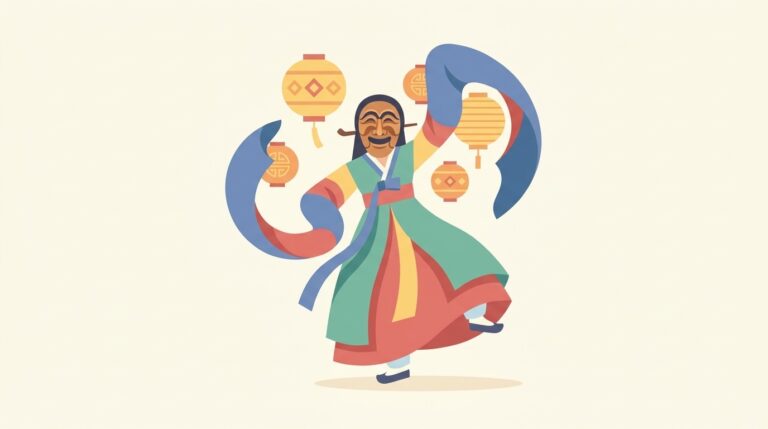
Conquering the Andong Mask Dance Festival: Intermediate Korean for Traditional Festivals
Phase 1: Empathy & Immersion Opening
안녕하세요! It is your editor from Daily Hangul! Have you ever stood in the middle of a massive Korean cultural gathering, heard an energetic rhythm of gongs and drums, and felt completely lost about what to say or how to jump in? Picture this: You are at the world-famous Andong Mask Dance Festival (안동국제탈춤페스티벌). Performers in carved wooden Hahoe masks are spinning in the air, a street performer suddenly points at you shouting exciting chants, and food stall aunties are calling out over sizzling platters of savory Andong Jjimdak.
Many of our intermediate learners tell us: “I know standard textbook Korean, but festival slang and cultural reactions feel like an entirely different language!” At a vibrant traditional festival, standard polite grammar like “이것은 무엇입니까?” sounds way too stiff and immediately breaks the festive vibe. You need dynamic, natural expressions to cheer with the crowd, interact with performers, and order local delicacies like a true local.
This guide is crafted from authentic field experiences and feedback from intermediate Korean learners who went from awkward spectators to festival insiders. By mastering these expressions, you won’t just observe Andong’s iconic celebration—you will actively join the rhythm.
Phase 2: In-Depth Breakdown of 3 Key Expressions
1. 흥이 절로 난다! (Heung-i jeollo nanda!)
- Pronunciation: [Heung-i jeol-lo nan-da] (Sounds like ‘Hung-ee jol-lo nahn-dah’, where heung rhymes with a soft ‘sung’)
- Meaning: Literal: Joy/excitement rises on its own. | Nuance: “The festive rhythm is so infectious, I can’t help but dance/get excited!”
- K-Culture Moment: Common in historical K-dramas (사극) and variety shows when traditional Samulnori or energetic folk performances make everyone start swaying naturally.
- Editor’s Insight: 흥 (Heung) is a foundational Korean cultural concept representing an explosive, collective joy and rhythm. Saying this proves you understand deeper Korean sentiment.
- Situation Spectrum: Casual ✅ | Semi-formal (흥이 절로 나네요!) ✅ | Formal (격식체) ⚠️
- 🤔 Think About It: Is there an untranslatable word in your native language for spontaneous collective joy?
2. 추임새 좀 넣어주세요! (Chuimsae jom neoeojuseyo!)
- Pronunciation: [Chu-im-sae jom neo-eo-ju-se-yo] (Sounds like ‘Choo-eem-seh johm nuh-uh-joo-seh-yo’)
- Meaning: Literal: Please insert some chuimsae. | Nuance: “Give me some hype shouts!” / “Keep the applause and cheer words coming!”
- K-Culture Moment: Performers in Pansori (traditional narrative song) or mask dances pause to demand energy from the audience, shouting classic response cues like “얼씨구!” (Eolssigu!) or “좋다!” (Jota!).
- Editor’s Insight: Chuimsae refers to short interactive verbal cheers between audience and performer. At festivals, asking for or giving chuimsae instantly breaks the fourth wall.
- Situation Spectrum: Casual (추임새 좀 넣어줘!) ✅ | Semi-formal ✅ | Strict Business 🚫
- 🤔 Think About It: How does audience interaction during live street theater differ between your home culture and Korea?
3. 이 집 찜닭 제대로네! (I jip jjimdak jedaerone!)
- Pronunciation: [I jip jjim-dak je-dae-ro-ne] (Sounds like ‘Ee jeep jjeem-dahk jeh-deh-roh-neh’)
- Meaning: Literal: This house’s braised chicken is proper. | Nuance: “This place serves authentic, top-tier Jjimdak!”
- K-Culture Moment: You’ll hear this constantly in food vlogs and travel shows when hosts taste signature regional dishes at historical food alleys.
- Editor’s Insight: 제대로다 (Jedaeroda) means “done right / legitimate”. It’s much more natural and enthusiastic than simply repeating “맛있어요”.
- Situation Spectrum: Casual ✅ | Semi-formal (제대로네요!) ✅ | Formal ⚠️
- 🤔 Think About It: What makes a dish feel “legitimately authentic” to you versus tourist-tailored?
Phase 3: Textbook Korean vs. Real-world Korean
Situation A: Expressing Excitement during the Performance
- 📖 Textbook Korean: 공연이 정말 재미있고 감동적입니다. (Gongyeoni jeongmal jaemiitgo gamdongjeogimnida. – “The performance is very interesting and moving.”)
- 🗣️ Real Korean: 와, 텐션 미쳤다! 흥이 주체가 안 되네! (Wa, tensyeon michyeotda! Heung-i juchega an doene! – “Wow, the energy is insane! I can’t contain the hype!”)
- 💡 Why the difference? Modern Koreans mix loanwords like 텐션 (tension/vibe/energy) with traditional concepts like 흥 to express lively, spontaneous enjoyment.
Situation B: Cheering for an Interactive Performer
- 📖 Textbook Korean: 당신을 계속 응원하겠습니다. (Dangsineul gyesok eungwonhagesseumnida. – “I will continue to support you.”)
- 🗣️ Real Korean: 얼씨구! 잘한다, 지화자 좋다! (Eolssigu! Jalhanda, jihwaja jota! – “Woohoo! Great job, let’s go!”)
- 💡 Why the difference? Festival etiquette relies on historical exclamation words (얼씨구, 지화자) that immediately validate the performer’s rhythm.
Phase 4: K-Culture Deep Dive & Non-Verbal Manners
4-1. Nunchi & Festival Body Language
- Eye Contact & Clapping: When a masked dancer approaches you, do not look down shyly. Maintain smiling eye contact and bob your shoulders up and down to the beat of the drum (장단). It signals that you are game for playful banter.
- Physical Space: In festival dance circles (대동놀이 – communal open-air line dance), participants naturally hold hands or shoulder towels. If an elder offers a hand during the grand finale dance, gladly take it—it represents communal harmony.
4-2. Cultural Code: The Spirit of Talchum (탈춤)
Historically, Mask Dance was the commoners’ satirical vehicle to mock corrupt aristocrats (Yangban) and release accumulated social grief (Han). Hence, cheering energetically isn’t just polite—it is part of the art piece itself!
Phase 5: Live Roleplay Scenario
- Setting: The outdoor arena of Hahoe Folk Village during the Mask Dance climax.
- NPC: Master Park (탈춤꾼 박 명인), an energetic performer wearing the mischievous Choraengi (servant) mask.
-
Turn 1 (Master Park): 🎭 Jumps right in front of your seat, waving long white sleeves.
“거기 구경하는 양반! 박수 소리가 왜 이리 작소?” (Geogi gugyeonghaneun yangban! Baksu soriga wae iri jakso?)
“Hey you spectator noble! Why is the clapping so weak?” -
Turn 2 (You): 🎭 Clapping hands with big rhythmic shoulder bounces.
“아이쿠, 흥이 절로 나서 넋을 놓고 보고 있었네요!” (Aiku, heung-i jeollo naseo neogseul noko bogo isseotneyo!)
“Oops, I was so swept away by the rhythm that I was entranced!” -
Turn 3 (Master Park): 🎭 Tilts head comically.
“그렇다면 어디 한번 제대로 놀아보겠소?” (Geureotdamyeon eodi hanbeon jedaero norabogesso?)
“Then shall we play and dance properly together?” -
Turn 4 (You): 🎭 Cheering loudly with open arms.
“좋습니다! 얼씨구 좋다! 추임새 제대로 넣어드릴게요!” (Joseumnida! Eolssigu jota! Chuimsae jedaero neoeodeurilgeyo!)
“Sounds great! Eolssigu! I’ll give you proper hype shouts!” -
Turn 5 (Master Park): 🎭 Twirls around and invites you onto the sandy arena floor.
“얼쑤! 다 함께 한바탕 뛰어보자꾸나!” (Eolssu! Da hamkke hanbatang ttwieobojakkuna!)
“Eolssu! Let us all jump and dance together!” -
Turn 6 (You): 🎭 Stepping onto the arena floor, copying the footwork.
“장단에 맞춰서 신나게 흔들어 볼게요!” (Jangdane matchwoseo sinnage heundeureo bolgeyo!)
“I’ll shake it excitingly to the traditional beat!” -
Turn 7 (Master Park): 🎭 Applauds with exaggerated praise.
“하하! 외국인 손님 솜씨가 아주 일품이로다!” (Haha! Oegukin sonnim somssiga aju ilpumiroda!)
“Haha! This guest’s dancing skills are absolute top notch!” -
Turn 8 (You): 🎭 Bowing with two hands on belly in folk theatrical style.
“덕분에 오늘 스트레스 다 풀고 갑니다!” (Deokbune oneul seuteureseu da pulgo gamnida!)
“Thanks to you, all my stress melted away today!”
🔀 Interactive Choice Point
The master performer asks you to lead the crowd chant: “어디 한번 외쳐보시오!”
* Choice A: “얼씨구! 지화자 좋다!” (Eolssigu! Jihwaja jota!)
* Choice B: “조용히 감상하겠습니다.” (Joyonghi gamsanghagesseumnida.)
* Choice C: “저는 외국인이라 잘 모릅니다.” (Jeoneun oegukin-ira jal moreumnida.)
- Feedback Breakdown:
- Choice A (Best! 🎉): The crowd roars in response, and the musicians speed up the drum tempo. You are now the hero of the festival!
- Choice B (Risk ⚠️): Politely kills the collective mood (갑분싸). The performer might pretend to wipe fake tears and move to someone else.
- Choice C (Bad 🚫): The performer will be gentle, but you miss out on the once-in-a-lifetime cultural memory.
Phase 6: 10-Second Emotion Shadowing Drill
[😊 기쁘고 신나게 / Joyful & Energetic]
“와! / 장단이 빨라지니까 / 흥이 절로 난다!”
(Wa! / Jangdani ppallajinikka / heung-i jeollo nanda!)-
[🔥 우렁차고 자신감 있게 / Resonant & Confident]
“얼씨구 좋다! / 추임새 / 크게 들어갑니다!”
(Eolssigu jota! / Chuimsae / keuge deureogamnida!) -
[😋 감탄하며 군침 돌게 / Amazed & Savoring]
“이 집 찜닭 / 매콤달콤한 게 / 진짜 제대로네!”
(I jip jjimdak / maekomdalkomhan ge / jinjja jedaerone!)
Phase 7: K-Culture Mini Dictionary
- 탈춤 (Talchum) – Traditional Korean masked dance drama, recognized as UNESCO Intangible Cultural Heritage.
- 추임새 (Chuimsae) – Spontaneous verbal vocalizations by listeners in Korean folk music to encourage the performer.
- 흥 (Heung) – An innate sense of joyful enthusiasm, communal euphoria, and rhythmic groove in Korean culture.
- 뒤풀이 (Dwipuri) – The after-party wrap-up gathering where participants celebrate, drink local brew (like Andong Soju), and share food after an event.
Phase 8: Traveler’s Festival Survival Kit
-
Top 3 Survival Expressions:
- “탈 만들기 체험 어디서 신청해요?” (Tal mandeulgi cheheom eodiseo sincheonghaeyo? – Where do I register for the mask-making workshop?) -> Pro Tip: Register early in the morning near the main entrance plaza!
- “안동 찜닭 반 마리도 주문 가능한가요?” (Andong jjimdak ban marido jumun ganeunghangayo? – Can I order half a portion of Andong Jjimdak?) -> Pro Tip: Perfect if traveling solo or with one friend.
- “셔틀버스 타는 곳이 어디예요?” (Syeoteulbeoseu taneun gosi eodiyeyo? – Where is the shuttle bus stop?)
- Editor’s Travel Note:
- For navigating festival grounds and booking regional train tickets, make sure you complete your Korail KTX reservation schedule and search regional transit routes via Naver Map application install guide.
- Payment Tip: Most Andong food market vendors accept credit cards, but having 10,000 KRW cash bills helps tremendously at small traditional handicraft stalls.
Phase 9: A Step Deeper (Reflective Thought)
In many Western theater traditions, audiences remain quiet observers until the final curtain call. In Korea’s traditional festival culture, silence is actually seen as cold indifference. The boundary between stage and audience is intentionally blurred through 흥 (Heung) and 추임새 (Chuimsae). Participating in the noise is how you show respect to the artists.
💬 Your Turn: Have you ever attended a festival where the audience was expected to be part of the show? How did it feel compared to a traditional concert? Leave your story in the comments below!
Phase 10: FAQ & Common Pitfalls
Q: What is the single best word to shout during a traditional dance performance?
A: Shout “얼씨구!” (Eolssigu!) or “좋다!” (Jota!) during rhythmic pauses or energetic jumps. It instantly warms up the room.
Q: Is it okay to take photos with masked performers?
A: Yes! When they are outside the arena or after the set, simply approach with a light bow and say: “사진 한 장 같이 찍어도 될까요?” (Sajin han jang gachi jjigeodo doelkkayo?).
Q: Can I wear a mask while walking around the festival?
A: Absolutely! In fact, wearing a painted paper or wooden mask is celebrated and earns you high-fives from the staff.
🚨 Common Mistakes Alert (TOP 3)
- Mistake: Shouting modern nightclub cheers like “소리 질러!” (Make some noise!) during solemn ritual portions (제의).
- Correct Action: Stick to traditional cheers like “얼쑤!” or “지화자!”.
- Mistake: Declining invitations to dance in the circle too aggressively.
- Correct Action: If shy, wave your hands gently with a smile: “눈으로 열심히 응원할게요!” (I’ll cheer you on with my eyes!).
- Mistake: Calling the masks “가면 (Gamyeon)” exclusively.
- Correct Action: While Gamyeon is technically correct, traditional Korean masks are culturally called 탈 (Tal).
Phase 11: Action Missions
- 🥉 Bronze Mission: Practice saying “흥이 절로 난다!” three times in front of the mirror with your shoulders grooving.
- 🥈 Silver Mission: Watch a clip of the Andong Mask Dance on YouTube and write “얼씨구 좋다! 추임새 넣고 갑니다!” in the comments.
- 🥇 Gold Mission: Visit a local Korean festival or cultural center and shout a live chuimsae during a folk performance!
🎮 K-Culture Bonus Mission: In your next K-Drama binge, watch for an after-party scene and spot whether someone uses the word 뒤풀이 or 흥.
Phase 12: Interactive Quiz Challenge
Q1. When a mask dancer asks for excitement from the crowd, what should you ask/offer?
* A) 영수증 (Yeongsujeung)
* B) 추임새 (Chuimsae)
* C) 눈치 (Nunchi)
Q2. Fill in the blank:
“음식이 너무 맛있고 전통의 맛이 살아있을 때: 이 집 음식 (________)네!”
* (Hint: Meaning ‘authentic and properly done’)
Q3. [True / False] Traditional Korean Mask Dance requires the audience to sit in absolute silence until the very end.
🔍 Click here to view answers and explanations!
- Q1 Answer: B) 추임새 (Chuimsae) — Chuimsae is the essential interactive cheer.
- Q2 Answer: 제대로 (Jedaero) — “이 집 음식 제대로네!” means “This place does food right!”
- Q3 Answer: False — Talchum is an interactive open-air performance where audience vocal participation is vital!







