

Conquering Korea’s 24-Hour Eateries Like a True Local (C1 Korean Guide)
Phase 1: Empathy (Immersive Storytelling Opening)
안녕하세요! 매일한글 에디터입니다.
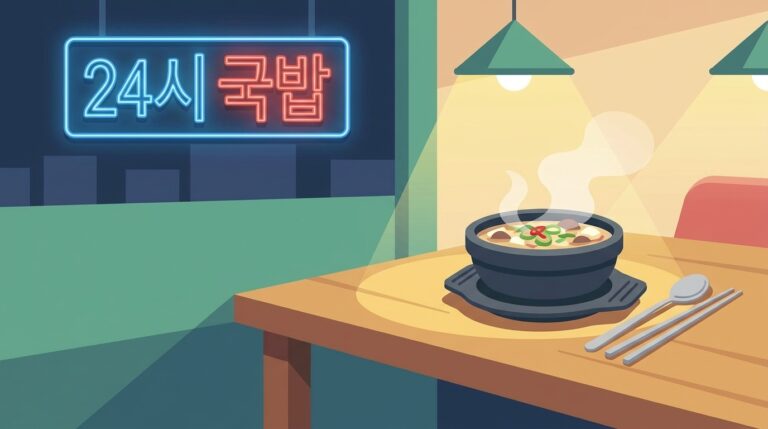
Picture this: It’s 2:45 AM on a chilly Friday night in Euljiro, Seoul. The subway stations have long pulled down their metallic shutters, neon signs reflect against rain-slicked asphalt, and your group has just wrapped up Round 2 (2차) of savory barbecue and soju. Your stomach is sending mixed signals—partially exhausted, partially craving something boiling hot, rich, and restorative. Suddenly, you spot an illuminated red neon sign reading 24시 해장국 (24-Hour Hangover Soup). The glass windows are completely fogged over with steam. You step inside, greeted by the rhythmic clinking of soju glasses, the bubbling roar of heavy stone pots (ttukbaegi), and the brisk steps of experienced restaurant servers affectionately called Imo-nim (이모님).
If you are an advanced (C1) Korean learner, standard textbook phrases like “메뉴판을 주시겠어요?” (May I have the menu?) suddenly feel robotic and painfully out of place in this lively, fast-paced environment. Real late-night dining in Korea operates on unwritten social codes, unspoken non-verbal cues (nunchi), and culturally rich idioms that convey comfort, solidarity, and culinary savvy. Based on years of feedback from our advanced learners, mastering the linguistic nuances of Korea’s 24-hour eatery culture (yasik munhwa) is your ultimate rite of passage to true native fluency.
Phase 2: Core Expressions Deep Dive (3 Advanced Expressions)
1. 속 좀 풀게 얼큰하게 해 주세요
- Pronunciation: [Sok jom pul-ge eol-keun-ha-ge hae ju-se-yo] (Imagine saying soke-jome pool-gay ull-keun-ha-gay hay joo-say-yo)
- Meaning: Literal: “Please make it spicy so my stomach can untie itself.” | Real Nuance: “Could you make the broth extra spicy and revitalizing to help cure my hangover?”
- K-Culture Moment: Frequently heard in gritty K-crime thrillers or slice-of-life dramas (like Hospital Playlist or My Mister) where worn-out detectives or coworkers huddle over boiling sundaeguk at 3 AM.
- Editor’s Insight: The word 속 (sok) literally means “inside” or “stomach,” but culturally represents one’s physical gastrointestinal balance and emotional inner state. “속을 풀다” (to untangle the inside) expresses relief from both alcohol and daily stress.
- Situation Spectrum: Casual ✅ | Semi-formal ✅ | Formal ⚠️ (Slightly colloquial for ultra-formal dining, but perfect for late-night restaurants)
- 🤔 Think About It: In English, we say “soak up the alcohol with greasy food,” whereas Korean focuses on “untangling/clearing the stomach with piping hot broth.” How does this reflect differing concepts of recovery?
2. 이모님, 여기 국물 좀 더 데워주실 수 있나요?
- Pronunciation: [I-mo-nim, yeo-gi gung-mul jom deo de-wo-ju-sil su in-na-yo?]
- Meaning: Literal: “Auntie, could you warm up this broth a bit more here?” | Real Nuance: “Excuse me, ma’am, could you give our soup a quick reheat?”
- K-Culture Moment: Seen in late-night gathering scenes when conversations linger for hours, causing communal stew pots (jeongol or gamjatang) to turn lukewarm.
- Editor’s Insight: Asking for a broth reheat (de-wo-dal-la-go ha-da) or a broth refill (gungmul ripil) shows an advanced understanding of Korean hospitality (jeong), where hot temperature is vital to flavor.
- Situation Spectrum: Casual ✅ | Semi-formal ✅ | Formal 🚫 (In high-end dining, you would address staff as 매니저님 or 직원분)
- 🤔 Think About It: Calling an unrelated female restaurant owner Imo-nim (maternal aunt) establishes immediate pseudo-kinship. Why does Korean culture favor familial terms over generic titles?
3. 든든하게 먹고 들어가야 내일 탈 안 나요
- Pronunciation: [Deun-deun-ha-ge meok-go deu-reo-ga-ya nae-il tal an na-yo]
- Meaning: Literal: “Only if we eat sturdily before going home will no trouble occur tomorrow.” | Real Nuance: “We need to get a hearty, solid meal in us now so we don’t feel terrible/sick tomorrow morning.”
- K-Culture Moment: The iconic closing remark made by a senior colleague (seonbae) or reliable friend standing outside a 24-hour gukbap shop before ordering.
- Editor’s Insight: 든든하다 (deundeunhada) encapsulates feelings of deep physical satiety, warmth, and reassurance. 탈(이) 나다 implies digestive illness or bodily trouble.
- Situation Spectrum: Casual ✅ | Semi-formal ✅ | Formal ⚠️
- 🤔 Think About It: How does this phrase demonstrate the Korean communal duty of care toward fellow drinking companions?
Phase 3: Textbook Korean vs. Real Korean
Situation 1: Inquiring if the restaurant is currently serving food late at night
- 📖 교과서 한국어: 지금 식당 영업을 하고 계십니까? (Ji-geum sik-dang yeong-eo-beul ha-go gye-sim-ni-kka?)
- 🗣️ 진짜 한국어: 이모님, 지금 식사 되나요? (I-mo-nim, ji-geum sik-sa doe-na-yo?)
- 💡 왜 다를까? 24-hour spots often have shift transitions or prep downtimes between 3 AM and 5 AM. Asking “식사 되나요?” (Is a meal possible right now?) sounds considerate and natural.
Situation 2: Asking for extra rice or noodle toppings in a stew
- 📖 교과서 한국어: 밥 한 공기와 면을 추가로 주문할 수 있습니까? (Bap han gong-gi-wa myeon-eul chu-ga-ro ju-mun-hal su it-seum-ni-kka?)
- 🗣️ 진짜 한국어: 사장님, 여기 공깃밥 하나랑 라면 사리 하나 추가해 주세요! (Sa-jang-nim, yeo-gi gong-git-bap ha-na-rang ra-myeon sa-ri ha-na chu-ga-hae ju-se-yo!)
- 💡 왜 다를까? Advanced speakers naturally use specific culinary terms like 사리 (sari) for noodle additions and casual counting counters.
Phase 4: K-Culture Deep Dive & Non-Verbal Manners
4-1. 눈치 (Nunchi) & Body Language at 3:00 AM
- The Subtle Table Call: If there is a call button (calling bell) embedded in the table, press it once. If not, raise your hand at eye level and make brief, soft eye contact while calling out “사장님~” or “이모님~” in a warm, melodious tone. Shouting aggressively breaks the late-night social calm.
- The Water & Side-Dish Protocol: In almost all 24-hour spots, the second serving of banchan (kimchi, kkakdugi) is self-serve (추가 반찬은 셀프입니다). Scan the restaurant perimeter for the stainless steel side-dish station before asking staff.
4-2. Cultural Code: The Philosophy of 해장 (Haejang)
In Korea, haejang is not just about eating food after drinking; it is a ritual of bodily restoration. Unlike Western hangover foods that prioritize heavy grease, Korean haejang revolves around amino-acid-rich broths (containing bean sprouts with asparagine, dried pollack, or beef bones). 24-hour restaurants act as communal sanatoria where tired office workers, late-shift taxi drivers, and young clubbers share steam-filled tables side-by-side without judgment.
Phase 5: Real-World Roleplay Scenario
Setting: 3:15 AM at Wonjo 24시 감자탕 (Original 24-hour Pork Backbone Stew) in Hongdae. Fluorescent lights humming, pots bubbling, savory steam swirling.
Characters: Alex (C1 Korean Learner) & Imo-nim (Veteran Restaurant Owner).
- 이모님: (물병과 컵을 탁자에 툭 내려놓으며) 몇 분이세요? 지금 감자탕만 바로 돼요.
(Mul-byeong-gwa keo-beul tak-ja-e tuk nae-ryeo-no-eu-myeo) Myeot bun-i-se-yo? Ji-geum gam-ja-tang-man ba-ro doe-yo.
🎭 Setting down the water bottle and cups briskly “How many? Only Gamjatang is ready right away.” - Alex: (미소를 지으며 두 손을 모으고) 네, 두 명이에요! 감자탕 소(小)짜 하나 부탁드릴게요.
(Mi-so-reul ji-eu-myeo du son-eul mo-eu-go) Ne, du myeong-i-e-yo! Gam-ja-tang so-jja ha-na bu-tak-deu-ril-ge-yo.
🎭 Smiling politely with hands clasped “Yes, party of two! We’ll take a small Gamjatang, please.” - 이모님: 맵기는 어떻게 해 줄까? 보통 맛도 칼칼한데.
Maep-gi-neun eo-tteo-ke hae jul-kka? Bo-tong mat-do kal-kal-han-de.
🎭 Looking over with a pencil behind her ear “How spicy do you want it? Even the regular is quite zesty.” - Alex: 저희 속 좀 풀게 국물 칼칼하고 얼큰하게 해 주세요!
Jeo-hui sok jom pul-ge gung-mul kal-kal-ha-go eol-keun-ha-ge hae ju-se-yo!
🎭 Expressing natural Korean food nuance “Please make the broth nice, zesty, and spicy so we can settle our stomachs!” - 이모님: (흐뭇하게 웃으며) 아이고, 한국 사람 다 됐네! 들깨가루 팍팍 넣어줄게.
(Heu-mut-ha-ge u-seu-myeo) A-i-go, han-guk sa-ram da dwaen-ne! Deul-kkae-ga-ru pak-pak neo-eo-jul-ge.
🎭 Chuckling warmly “Aigo, you’ve turned completely Korean! I’ll toss in plenty of wild perilla seed powder.” - Alex: 감사합니다! 아, 이모님, 혹시 깍두기 더 필요하면 직접 가져다 먹으면 되나요?
Gam-sa-ham-ni-da! A, i-mo-nim, hok-si kkak-du-gi deo pir-yo-ha-myeon jik-jeop ga-jyeo-da meog-eu-myeon doe-na-yo?
🎭 Checking restaurant protocol respectfully “Thank you! Oh, Imo-nim, if we need extra radish kimchi, should we grab it ourselves from the self-bar?” - 이모님: 그래, 저기 셀프바에서 먹을 만큼만 덜어가요.
Geu-rae, jeo-gi sel-peu-ba-e-seo meog-eul man-keum-man deor-eo-ga-yo.
🎭 Pointing towards the stainless steel station “Yeah, just take as much as you can eat from the self-bar over there.” - Alex: 네, 잘 먹겠습니다! 공깃밥도 두 개 먼저 주세요.
Ne, jal meok-get-seum-ni-da! Gong-git-bap-do du gae meon-jeo ju-se-yo.
🎭 Nodding eagerly “Great, we will enjoy the meal! Please bring two bowls of rice first too.”
🔀 Interactive Choice Point
The stew has arrived, and you need more broth after boiling it down. What do you say to Imo-nim?
* Option A: “이모님, 물을 더 넣고 싶은데 찬물 주시겠어요?”
* Option B: “이모님, 여기 육수 좀 더 부어주실 수 있나요?”
* Option C: “저기요! 수프가 다 말랐는데 어떻게 해요?”
- Selection Breakdown:
- Option A (Risk): Pouring cold drinking water into boiling stew dilutes seasoning and ruins the rich flavor profile.
- Option B (Best ✅): Asking for 육수 (yuksu – base broth) to be added is professional, natural, and culinary correct.
- Option C (Bad): Calling soup “수프 (soup)” and exclaiming that it dried up sounds clumsy and impatient.
Phase 6: 10-Second Emotional Shadowing Drill
Practice matching natural rhythm, breath pauses (/), and emotional registers:
- [🍲 절실하고 얼큰하게 / Desperately craving rich spice]
- “속 좀 풀게 / 국물 칼칼하고 / 얼큰하게 해 주세요!”
- [Sok jom pul-ge / gung-mul kal-kal-ha-go / eol-keun-ha-ge hae ju-se-yo!]
- [😊 정중하면서도 능숙하게 / Polite yet seasoned local tone]
- “이모님, / 여기 육수 리필 좀 / 부탁드릴게요!”
- [I-mo-nim, / yeo-gi yuk-su ri-pil jom / bu-tak-deu-ril-ge-yo!]
- [🤝 든든하고 다정하게 / Hearty and reassuring warmth]
- “든든하게 먹고 들어가야 / 내일 출근할 때 / 탈 안 나요.”
- [Deun-deun-ha-ge meok-go deu-reo-ga-ya / nae-il chul-geun-hal ttae / tal an na-yo.]
Phase 7: K-Culture Mini Dictionary
- 야식 (Yasik / Late-Night Meal)
- Culturally refers to food consumed past midnight, embodying a beloved late-night lifestyle distinct from regular dinner (jeonyeok).
- 해장 (Haejang / Hangover Recovery Food & Ritual)
- Derived from haesangju (loosening the harm of alcohol); refers to eating restorative broths to detoxify and invigorate.
- 이모님 (Imo-nim / Respected Female Restaurant Host)
- Literally “Maternal Aunt + Honorific.” Used universally to express warmth and respect toward middle-aged female restaurateurs.
- 첫차 / 막차 (Cheotcha / Makcha – First Train / Last Train)
- Pivotal late-night landmarks. If you miss the makcha (~midnight), staying at a 24-hour eatery until the cheotcha (~5:30 AM) is a classic Seoul experience.
Phase 8: Survival Kit for Travelers
Top 3 Survival Phrases
- “남은 거 포장되나요?” (Na-meun geo po-jang-doe-na-yo?)
- Pro Tip: Late-night portions in Korea are notoriously generous. Use this to ask for doggy bags.
- “계산 따로따로 가능한가요?” (Gye-san tta-ro-tta-ro ga-neung-han-ga-yo?)
- Pro Tip: While splitting the bill (dutch pay) is common, late-night busy counters prefer one person paying; ask politely first.
- “화장실 열쇠 어디 있어요?” (Hwa-jang-sil yeol-soe eo-di it-seo-yo?)
- Pro Tip: Late-night restaurants often keep external building restrooms locked. The key or passcode is usually on the front counter or written on a wall sign.
Editor’s Travel Note
Always have the Naver Map app download ready on your phone. Filter your restaurant search by selecting the “24시간 영업” (Open 24 Hours) tag to avoid wandering into closed venues.
Phase 9: 한 발 더 깊이 (Think Deeper)
Korea’s 24-hour restaurant culture is a fascinating testament to the country’s collective stamina and deeply ingrained Ppalli-Ppalli (fast-paced) modern history. When post-war industrialization required overnight shifts, late-night eateries emerged as communal safe havens where exhausted citizens gathered warmth over a shared flame. Even in our high-tech era, these steaming soup spots remain one of the few places in Korean society where generational boundaries vanish, social pretenses drop, and everyone bonds over the humble warmth of boiling broth.
💬 Your Turn: Have you ever experienced a late-night meal in Korea or your hometown after midnight? What is your ultimate comfort dish when wandering the streets at 3 AM? Share your stories in the comments below!
Phase 10: FAQ & Common Mistakes
Q: What is the polite distinction between calling staff 사장님, 이모님, and 저기요?
A: 사장님 (Sajangnim – Boss/Owner) is safe, gender-neutral, and respectful everywhere. 이모님 (Imo-nim) is warmer and specifically used for middle-aged women in casual spots (bunsik, gukbap, BBQ). 저기요 (Jeogiyo – Excuse me) is functional, but lacks the warmth of the former two.
Q: Can solo diners eat at 24-hour barbecue or stew spots late at night?
A: Yes, but check the minimum order. Many stew (jeongol) or meat spots require a minimum 2-person portion (2인분 이상). For solo late-night dining (honbap), Gukbap, Haejangguk, and Kimbap Cheonguk locations are the most welcoming.
Q: Is tipping expected if the server is exceptionally kind at 3 AM?
A: No, tipping is strictly not customary in South Korea and can cause polite confusion. Giving sincere verbal gratitude—such as “정말 든든하게 잘 먹었습니다!” (I really enjoyed a satisfying meal!)—is the highest compliment.
🚨 Common Mistakes Warning Board
- ❌ Mistake 1: Grabbing water from the fridge without noticing the self-service sign. (Action: Look for 물은 셀프입니다 first.)
- ❌ Mistake 2: Leaving personal chopsticks stuck vertically in the rice bowl. (Action: Rest your spoon and chopsticks horizontally on the table napkin or holder.)
- ❌ Mistake 3: Saying “안녕히 계세요” to staff when leaving a casual stall without acknowledging the meal. (Action: Say “잘 먹었습니다! 수고하세요!” for authentic local warmth.)
Phase 11: Action Missions
- 🥉 Bronze Level: Stand before a mirror and repeat the phrase “속 좀 풀게 국물 얼큰하게 해 주세요” 5 times smoothly under 10 seconds.
- 🥈 Silver Level: Next time you watch a K-Drama night-out scene, transcribe every term used to describe food temperatures and soup textures (칼칼하다, 뜨끈하다, 시원하다).
- 🥇 Gold Level: Visit a local Korean gukbap or gamjatang restaurant, order in fluent Korean without looking at the English menu, and ask for a broth/side-dish refill using “육수 좀 더 부탁드립니다!”
- 🎮 K-Culture Mission: Watch an episode of Street Alcohol Fighter or Let’s Eat and count how many times the cast mentions the word 해장 (Haejang)!
Phase 12: Interactive Quiz Challenge
1. Context Judgment
Which expression is the most natural when entering a 24-hour restaurant at 4:00 AM to verify if the kitchen is still operating?
* A) 지금 당장 밥을 파나요?
* B) 이모님, 지금 식사 되나요?
* C) 식당의 문이 열려 있습니까?
2. Fill-in-the-Blank
“국물이 너무 식었는데, 이모님 여기 국물 좀 더 ( ) 주실 수 있나요?”
(Hint: Verb meaning ‘to reheat’)
3. Cultural True or False
Statement: In Korean culinary culture, describing a hot, boiling stew as “시원하다 (siwonhada)” means the physical temperature of the broth is cold.
* (True / False)
🔍 Click here to reveal Answers & Explanations
- Answer: B (이모님, 지금 식사 되나요?)
- Explanation: Asking “식사 되나요?” is the standard, polite, and natural idiom used by locals during late-night hours.
- Answer: 데워 (Deweor / from 데우다)
- Explanation: “데워주실 수 있나요?” accurately asks the staff to warm up/reheat soup that has cooled down.
- Answer: False
- Explanation: In Korean, 시원하다 frequently describes the refreshing, deep, unclogging sensation of a boiling, savory broth that clears the stomach, rather than its temperature!
- Explanation: In Korean, 시원하다 frequently describes the refreshing, deep, unclogging sensation of a boiling, savory broth that clears the stomach, rather than its temperature!







