

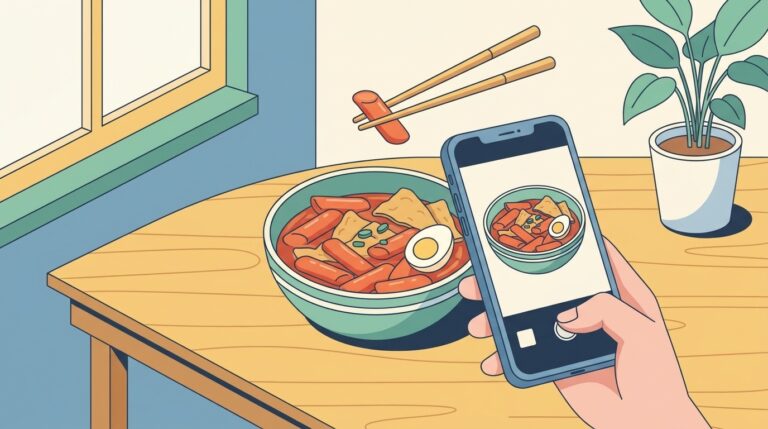
Stop! Don’t Touch that Spoon: The Ultimate Guide to Taking Food Photos in Korea
Phase 1: Empathy (Story-driven Intro)
안녕하세요! It’s your Daily Hangul editor here. Picture this: You’re sitting in a trendy restaurant in Seongsu-dong, the aroma of bubbling dakgalbi fills the air, and a beautifully plated skillet lands right in front of you. Your friend instantly grabs their metal chopsticks, ready to dive in. Panic hits—the lighting is perfect, the cheese pull hasn’t happened yet, and you need that aesthetic food shot for Instagram right now! How do you stop them without sounding rude or killing the mood?
Taking food photos before eating (often called eumsik sajin or food plating photography) is practically a cultural ritual in modern South Korea. But blurting out an awkward literal translation like “Do not eat yet!” can make things stiff. Today, we’re going to master the exact playful, natural B1-level phrases native Koreans use to pause the table, snap the perfect shot, and maintain great dining vibes.
Phase 2: 3 Key Expressions Deep Dive
1. 잠깐만, 사진 한 장만 찍고! (Jamkkanman, sajin han jangman jjikgo!)
- Pronunciation: [Jam-kkan-man, sa-jin han jang-man jjik-go] (Sounds like “Jahm-kahn-mahn, sah-jeen hahn jahng-mahn jeek-go”)
- Meaning: Literal: “Just a moment, let me take just one picture and…!” / Real Nuance: “Hold on a second, let me snap a quick pic first!”
- K-Culture Moment: You’ll hear this constantly in K-Dramas and variety shows like I Live Alone whenever mouthwatering delivery food arrives.
- Editor’s Insight: The trailing connector
-고 (-go)naturally implies “…and then we’ll eat!”, which softens the command into a friendly pause.- Situation Spectrum: Casual ✅ | Semi-formal ⚠️ (Use ‘잠시만요, 사진 먼저 찍어도 될까요?’) | Formal 🚫
- 🤔 Think About It: In Korean culture, phrasing a pause with an open-ended connective ending invites cooperation rather than creating a barrier.
2. 손 대지 마! 아직 안 찍었어! (Son daeji ma! Ahjik an jjigeosseo!)
- Pronunciation: [Son dae-ji ma! A-jik an jji-geo-sseo!] (Sounds like “Sohn deh-jee mah! Ah-jeek ahn jee-gaw-ssaw!”)
- Meaning: Literal: “Don’t put hands on it! I haven’t taken it yet!” / Real Nuance: “Hands off! I haven’t taken the shot yet!”
- K-Culture Moment: Best friends teasing each other dramatically at a cafe when someone tries to cut the soufflé pancake before the camera is ready.
- Editor’s Insight: Use this strictly with close friends (banmal). It carries a playful, dramatic energy rather than real anger.
- Situation Spectrum: Casual ✅ | Semi-formal 🚫 | Formal 🚫
- 🤔 Think About It: Notice how Korean uses “don’t touch with hands” (son daeda) metaphorically to mean “don’t disturb the food arrangement.”
3. 카메라 먼저 먹을게요! (Kamera meonjeo meogeulgeyo!)
- Pronunciation: [Ka-me-ra meon-jeo meo-geul-ge-yo!] (Sounds like “Kah-meh-rah mohn-jaw maw-geul-geh-yoh!”)
- Meaning: Literal: “The camera will eat first!” / Real Nuance: “Let me feed my camera first!”
- K-Culture Moment: A witty, polite way to ask co-workers or acquaintances to wait for a quick snapshot without being awkward.
- Editor’s Insight: This humorous metaphor personifies the camera, turning a potential interruption into a shared laugh.
- Situation Spectrum: Casual ✅ | Semi-formal ✅ | Formal ⚠️
- 🤔 Think About It: Personifying inanimate objects with polite verb forms is a beloved Korean conversational tactic for keeping social balance.
Phase 3: Textbook Korean vs. Real Korean
Situation 1: Stopping someone who is about to pick up chopsticks
* 📖 Textbook Korean: 음식을 먹기 전에 사진을 찍어도 되겠습니까? (Eumsigeul meokgi jeone sajineul jjigeodo doegesseumnikka? – May I take a photo before we eat?)
* 🗣️ Real Korean: 아, 잠시만요! 사진 먼저 빠르게 찍을게요! (Ah, jamsimanyo! Sajin meonjeo ppareuge jjigeulgeyo! – Oh, hold on! Let me grab a quick picture first!)
* 💡 Why it’s different: Textbook Korean sounds like an official press conference. Real Koreans use rapid apologetic markers (jamsimanyo) and emphasize speed (ppareuge) to show respect for everyone’s hunger.
Situation 2: Telling someone the photo session is finished and they can eat
* 📖 Textbook Korean: 이제 사진 촬영이 끝났으니 식사를 시작하십시오. (Ije sajin chwaryeongi kkeutnasseuni siksareul sijakhasipsio. – The photo shoot is over, please commence dining.)
* 🗣️ Real Korean: 다 찍었다! 이제 먹자! (Da jjigeotda! Ije meokja! – Done taking photos! Let’s eat!)
* 💡 Why it’s different: In everyday settings, celebratory and upbeat phrasing creates an exciting kickoff to the meal.
Phase 4: K-Culture Deep Dive & Non-Verbal Manners
4-1. 눈치 (Nunchi) & Dining Gestures
When halting a dining partner in Korea, your non-verbal cues matter as much as your words:
1. The “Stop Sign” Palm: Gently hold up one flat palm at chest height while slightly tilting your head with an apologetic smile.
2. The 30-Second Rule: Taking photos is widely accepted, but dragging the session past a minute—letting hot soup go lukewarm or meat burn on the grill—breaks dining etiquette (nunchi failure!).
3. Angle Assistance: If a friend holds a dish or lifts a piece of food for your photo, show gratitude by saying “오, 각도 좋다!” (Oh, gakdo jota! – “Oh, great angle!”).
4-2. Cultural Code: The ‘Insaeng-shot’ Phenomenon
In Korea, taking an insaeng-shot (the shot of a lifetime) is part of appreciating the chef’s visual craftsmanship. Korean cafe and restaurant culture heavily emphasizes plating (visual presentation), so taking a photo is often perceived as a compliment to the restaurant’s quality.
Phase 5: Real-Life Roleplay Scenario
Setting: A vibrant, sizzling K-BBQ restaurant in Hongdae. You are dining with your Korean friend, Minji (민지).
- 민지 (Minji): 와, 삼겹살 노릇노릇하게 다 익었다! (Wa, samgyeopsal noreut-noreuthage da igeotda!)
🎭 Picks up metal tongs and approaches the glistening pork belly. - You: 아, 잠깐만! 사진 한 장만 찍고 먹자! (Ah, jamkkanman! Sajin han jangman jjikgo meokja!)
🎭 Pulls out smartphone and adjusts the camera angle overhead. - 민지 (Minji): 아 맞다, 너 사진 찍어야지! 쌈 싸는 포즈 해줄까? (Ah matda, neo sajin jjigeoyaji! Ssam ssaneun pojeu haejulkka?)
🎭 Grins and holds up a fresh lettuce leaf with garlic. - You: 완전 좋지! 조금만 위로 들어줘. (Wanjeon joji! Jogeumman wiro deureojwo.)
🎭 Snaps two quick photos in burst mode. - 민지 (Minji): 잘 나왔어? 배고파서 현기증 난단 말이야~ (Jal nawasseo? Baegopaseo hyeongijeung nandan mariya~)
- You: 응, 예술이다! 기다려줘서 고마워. (Eung, yesurida! Gidaryeojwoseo gomawo.)
🎭 Puts phone face down on the napkin. - 민지 (Minji): 그래, 이제 본격적으로 먹어볼까? (Geurae, ije bongyeokjeogeuro meogeobolkka?)
- You: 다 찍었어! 맛있게 먹자! (Da jjigeosseo! Masitge meokja!)
🎭 Raises chopsticks enthusiastically.
🔀 Interactive Branch Point
The stew arrives boiling furiously, creating massive steam that fogs up your phone lens. What do you do?
* Option A: Shout “손 대지 마!” and spend 2 minutes wiping your lens while the soup cools.
* Option B: Say “김 때문에 안 되겠다! 그냥 맛있게 먹자!” and put the phone away.
* Option C: Say “연기 살짝만 불어줘, 딱 한 장만 찍을게!”
Feedback:
* Option A (Bad): Over-controlling! Letting the food get cold ruins the dining experience for your partner.
* Option B (Best): Super high nunchi! Valuing the shared dining experience over an Instagram story makes you an awesome dining buddy.
* Option C (Good / Safe): Friendly teamwork! Asking for a tiny breath to clear the steam keeps things quick and fun.
Phase 6: 10-Second Emotion Shadowing Drill
Practice these natural rhythm pauses (/) and emotional deliveries:
[🚨 Urgently yet cutely]
잠깐만! / 젓가락 잠깐만 스톱!
(Jamkkanman! / Jeotgarak jamkkanman seutop! – Wait! Chopsticks on pause for a sec!)-
[📸 Excited and playful]
카메라 먼저 / 한 입 줄게요!
(Kamera meonjeo / han ip julgeyo! – Let me give the camera a bite first!) -
[🎉 Relieved and cheerful]
인증샷 완료! / 이제 진짜 먹자!
(Injeung-syat wanryo! / Ije jinjja meokja! – Proof shot done! Let’s really dig in now!)
Phase 7: K-Culture Mini Dictionary
- 인증샷 (Injeung-syat)
Literal: Verification shot. The proof photo taken to show where you are or what you ate on social media. - 비주얼 (Bijueol)
Literal: Visual. Used to describe aesthetically pleasing food plating (e.g., “이 카페 비주얼 대박이다!”). - 치즈 늘리기 (Chijeu neulligi)
Literal: Cheese pulling. The classic social media action shot of pulling stretchable cheese on pizza, tteokbokki, or tonkatsu. - 먹스타 (Meokseuta)
Short for: 먹스타그램 (Muk-stagram). Food-centric Instagram accounts and posts across Korea.
Phase 8: Survival Kit for Travelers
Top 3 Survival Expressions
- 사진 한 장만 찍어도 될까요? (Sajin han jangman jjigeodo doelkkayo?)
💡 Pro Tip: Use this with restaurant staff before snapping photos of open kitchens or counter displays. - 음식이 너무 예뻐서 사진 찍었어요! (Eumsigi neomu yeppeoseo sajin jjigeosseoyo!)
💡 Pro Tip: Say this with a warm smile if the restaurant owner (sajangnim) notices you taking lots of pictures. - 사진 진짜 잘 나와요! (Sajin jinjja jal nawayo!)
💡 Pro Tip: Great compliment to say to cafe staff about their lighting or decor.
Editor’s Travel Note
Before embarking on your culinary journey in Seoul, prepare by getting the Naver Map navigation app to bookmark hot spots (matjip). Many trendy restaurants in areas like Ikseon-dong or Yeonnam-dong operate waiting lists via mobile numbers, so be sure to check the entrance kiosks.
Phase 9: One Step Deeper (Reflection)
In Korean culinary heritage, dining has traditionally been a communal act centered around jeong (affectionate bonding) and sharing side dishes (banchan). The modern ritual of taking food photos has blended into this communal dynamic—it’s no longer just individual vanity, but a collaborative activity where friends hold dishes, adjust lighting, and celebrate the meal together.
💬 Your Turn: In your home country, do people take photos before eating, or is it considered bad table manners? Share your culture’s perspective in the comments below!
Phase 10: FAQ & Common Mistakes
Q: Is it considered rude to take photos in traditional Korean restaurants?
A: Not at all! Most restaurant owners appreciate the social media publicity. However, avoid using loud flash photography or pointing your lens at other diners seated nearby.
Q: What is the polite way to ask a senior colleague or elder to wait for a photo?
A: With elders or superiors, avoid direct commands. Instead, gently ask: “사진 한 장만 기념으로 남겨도 괜찮으실까요?” (May I take a picture to commemorate this?).
Q: How long is acceptable for a food photo session?
A: Keep it under 30 to 45 seconds. Korean dishes like stew (jjigae) or grilled meat (gui) lose their ideal taste quickly, so speed is a virtue!
🚨 Common Mistakes Warning Board
- ❌ Mistake 1: Saying “먹지 마세요!” loudly in public.
👉 Correction: Sounds overly strict! Use “잠시만요, 사진 먼저 찍을게요!” - ❌ Mistake 2: Leaving flash enabled in dimly lit bistro bars.
👉 Correction: Turn off flash to respect neighboring tables’ ambience. - ❌ Mistake 3: Letting the grill burn while styling a photo.
👉 Correction: Move meat to the edge of the grill grid before shooting.
Phase 11: Action Missions
- 🥉 Bronze Mission (Solo): Practice saying “잠깐만, 사진 한 장만 찍고!” in front of your mirror in under 3 seconds.
- 🥈 Silver Mission (Social): Next time you eat Korean food, post a photo with the Korean hashtag
#먹스타그램and#인증샷. - 🥇 Gold Mission (Real Life): At your next meal with a friend or Korean speaker, pause them using “카메라 먼저 먹을게요!” and observe their reaction.
- 🎮 K-Culture Mission: Watch any Korean food vlog (like Delicious Guys or Sung Si-kyung’s Meog-eul-tende) and spot when someone pauses to photograph the food.
Phase 12: Interactive Quiz Challenge
1. Situation Check: You are at a trendy bingsu cafe with your Korean classmate. The shaved ice just arrived. What is the most natural sentence to pause them for a photo?
👉 Click to view Answer & Explanation
Answer: “잠깐만, 사진 한 장만 찍고 먹자!”
Explanation: This blends a friendly conversational pause (jamkkanman) with a collective suggestion (meokja), making it natural and warm.
2. Fill in the Blank: Complete the humorous phrase meaning “Let the camera eat first”:
카메라 ________ 먹을게요!
👉 Click to view Answer & Explanation
Answer: 먼저 (meonjeo – first)
Explanation: “카메라 먼저 먹을게요!” translates to “The camera will eat first!”
3. True or False: In Korea, taking a 5-minute photoshoot while hot soup gets cold is considered good dining etiquette as long as the photo looks great.
👉 Click to view Answer & Explanation
Answer: False (X)
Explanation: Korean dining prioritizes optimal food temperature and nunchi (consideration for dining companions). Snapping photos quickly (under 30-45 seconds) is standard etiquette.







