

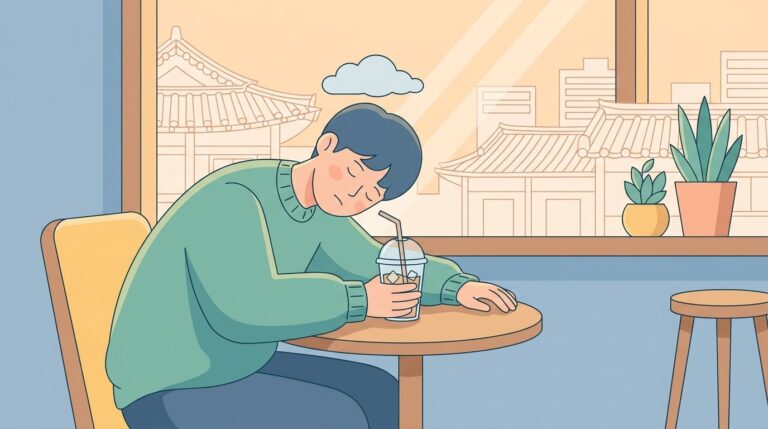
Master the Art of Saying ‘I’m Tired’ in Korean: From Daily Fatigue to K-Drama Drama
Phase 1: Empathy & Storytelling Opening
안녕하세요! 매일한글 에디터입니다. (Hello! I’m your Daily Hangul editor.)
Picture this: You’ve spent the entire afternoon exploring the trendy alleys of Seongsu-dong, climbed the steep steps of Namsan Seoul Tower, and walked over 20,000 steps. Your feet are aching, your eyelids feel like lead weights, and your Korean friend turns to you with glowing energy asking, “우리 2차 갈까?” (Shall we go for round two?). You want to say you are utterly exhausted, but the only thing that comes to your mind is the stiff textbook phrase you memorized: “저는 대단히 피곤합니다.”
Your friend blinks, chuckles gently, and wonders if you’re writing a formal business email rather than just complaining like a real buddy! Expressing fatigue in Korean is not just about translating physical tiredness—it is a shared cultural ritual of bonding, empathy, and comic relief. Today, drawing from years of coaching global learners and real Seoul street interactions, I’ll teach you how to express your tiredness naturally, playfully, and politely at the A2 level. Let’s dive in!
Phase 2: 3 Key Expressions Deep Dive
1. 피곤해요 (Pigonhaeyo)
- Pronunciation: [Pee-gohn-hae-yo] (Think of a *PEEk into a GONE day)*
- Meaning: “I am tired / fatigued.”
- K-Culture Moment: The bread-and-butter phrase heard across every Korean office at 2:00 PM and by college students studying at 24-hour cafes.
- Editor’s Insight: This is your gold-standard, safest phrase. It refers specifically to physical tiredness caused by lack of sleep, heavy work, or travel.
- Situation Spectrum: Casual ✅ (피곤해) | Semi-formal ✅ (피곤해요) | Formal ✅ (피곤합니다)
- 🤔 Think About It: In English, we say “I’m tired” for both physical sleepiness and mental boredom (“I’m tired of this”). In Korean, 피곤해요 is strictly physical fatigue!
2. 지쳤어요 (Jichyeosseoyo)
- Pronunciation: [Jee-chyeo-ssuh-yo] (Sounds like “JEE-cheo-saw-yo”)
- Meaning: “I’m worn out / exhausted / burned out.”
- K-Culture Moment: Frequently featured in emotional K-Drama soundtracks (OSTs) when the main character sits alone at a bus stop after a grueling day.
- Editor’s Insight: 지치다 conveys a deeper, draining sense of depletion—both mental and physical. Use this when you’ve been running on empty for days.
- Situation Spectrum: Casual ✅ (지쳤어) | Semi-formal ✅ (지쳤어요) | Formal ✅ (지쳤습니다)
- 🤔 Think About It: Does your native language distinguish between regular daily tiredness and deep emotional depletion with distinct verbs?
3. 기절할 것 같아요 (Gijeolhal geot gat-ayo)
- Pronunciation: [Gee-jeol-hal geot gah-tah-yo] (Sounds like “Key-jull-hal got got-ah-yo”)
- Meaning: Literal: “I feel like I’m going to faint” / Real: “I am completely wiped out!”
- K-Culture Moment: K-Pop idols during dance practice behind-the-scenes vlogs, dropping onto the practice room floor after 10 hours of choreography.
- Editor’s Insight: Highly expressive and hyperbolic! It’s playful yet very clear. Perfect for casual hangouts when you’re dramatically exhausted.
- Situation Spectrum: Casual ✅ (기절할 것 같아) | Semi-formal ✅ (기절할 것 같아요) | Formal 🚫 (Too dramatic for official meetings)
- 🤔 Think About It: Why do you think Korean conversational culture embraces such vivid physical exaggerations for daily emotions?
Phase 3: Textbook Korean vs. Real Korean
Situation 1: Coming home from a long day of sightseeing
- 📖 교과서 한국어: 저는 오늘 매우 피곤합니다. (Jeoneun oneul maeu pigonhamnida.)
- 🗣️ 진짜 한국어: 아, 오늘 진짜 피곤해 죽겠어요! (A, oneul jinjja pigonhae jukgesseoyo! – “Ah, I’m seriously tired to death today!”)
- 💡 왜 다를까? Koreans frequently attach ~죽겠다 (~jukgetda, dying of / to death) to express sensory overload or intense physical states in a lively, friendly way.
Situation 2: When your eyes are closing at the dinner table
- 📖 교과서 한국어: 저는 지금 잠을 자고 싶습니다. (Jeoneun jigeum jameul jago sipsumnida.)
- 🗣️ 진짜 한국어: 저 지금 눈이 막 감겨요… (Jeo jigeum nuni mak gamgyeoyo… – “My eyes are just closing on their own…”)
- 💡 왜 다를까? Stating “I want to sleep” sounds blunt, whereas describing your eyelids involuntarily shutting creates a cute, relatable visual that softens the mood.
Phase 4: K-Culture Deep Dive & Non-Verbal Etiquette
4-1. 눈치 (Nunchi) & Gestures
When showing fatigue in Korea, body language adds vital context:
* The Gentle Neck Rub: Rubbing the nape of your neck while slightly tilting your head conveys fatigue without sounding demanding or whiny.
* The Empathetic Sigh (한숨): A soft, breathy sigh paired with a gentle smile signals: “I loved hanging out, but my energy bar is at 1%!”
* Respecting Elders: Never slump down dramatically or put your head flat on the table in front of elders or your boss. Instead, say “조금 피곤하지만 괜찮습니다” (I’m a bit tired, but I’m okay) with a polite posture.
4-2. Cultural Code: The ‘Ppalli-Ppalli’ Fuel & Overtime Culture
Korea’s fast-paced 빨리빨리 (Ppalli-ppalli, Hurry-hurry) lifestyle has made fatigue a shared national badge of honor. Koreans survive long workdays (야근, Yageun) with 아이스 아메리카노 (Iced Americano)—often nicknamed 얼죽아 (Eol-juk-ah: Freezing to death but still drinking iced coffee)—and energy recovery drinks from convenience stores. Sharing that you’re tired is not viewed as a weakness; it invites others to cheer you on with “수고했어요!” (You worked hard!).
Phase 5: Real-Life Roleplay Scenario
Setting: A cozy cafe in Hongdae around 9:30 PM. You and your Korean classmate, Min-woo (민우), just finished walking around the night market.
- 민우: 오늘 진짜 많이 걸었다! 이제 어디 갈까? 코인노래방 갈래?
(Oneul jinjja mani georeotda! Ije eodi galkka? Coin-noraebang gallae?)
(🎭 Smiling with excitement, pointing toward the karaoke sign across the street) - You: 민우 씨, 저 오늘 진짜 재밌었는데… 솔직히 지금 좀 피곤해요.
(Min-woo ssi, jeo oneul jinjja jaemisseonneunde… soljiki jigeum jom pigonhaeyo.)
*(🎭 Chuckling softly, rubbing the back of your neck) - 민우: 아, 진짜요? 발 많이 아파요?
(A, jinjjayo? Bal mani apayo?)
(🎭 Looking concerned, pausing in his steps) - You: 네, 아침부터 만 보 넘게 걸어서 기절할 것 같아요!
(Ne, achimbuteo man bo neomge georeoseo gijeolhal geot gat-ayo!)
(🎭 Exaggerating with wide eyes and a tired smile) - 민우: 하하, 맞아요. 오늘 우리 진짜 무리했죠. 당 충전부터 할까요?
(Haha, majayo. Oneul uri jinjja murihaetjyo. Dang chungjeonbuteo halkkayo?)
(🎭 Laughing warmly, pointing inside the cafe) - You: 네, 시원한 음료 마시면서 조금 쉬어요.
(Ne, siwonhan eumryo masimyeonseo jogeum swieoyo.)
*(🎭 Sitting down in a comfortable chair with relief) - 민우: 좋아요! 주문하고 올게요. 푹 쉬고 있어요!
(Joayo! Jumunhago olgeyo. Puk swigo isseoyo!)
(🎭 Heading to the counter with a friendly wave) - You: 고마워요, 민우 씨. 오늘 정말 수고 많았어요.
(Gomawoyo, Min-woo ssi. Oneul jeongmal sugo manasseoyo.)
*(🎭 Smiling gratefully)
🔀 Interactive Branching Point
How would you respond if your senior colleague (선배) asks if you can stay for round two of drinking at 11 PM?
- Option A: “싫어요. 저 피곤해 죽겠어요!” (I dislike it. I’m dying of tiredness!)
- ❌ Bad: Too blunt and rude for a workplace senior. Dropping honorific softeners can cause awkward tension.
- Option B: “오늘 정말 즐거웠는데, 내일 일정이 있어서 먼저 들어가 보겠습니다. 죄송합니다!” (I had so much fun today, but I have early plans tomorrow so I will head home first. I’m sorry!)
- 🏆 Best: Perfectly respectful, acknowledges the fun, gives a clear boundary, and maintains social harmony.
- Option C: “기절할 것 같아서 못 가요.” (I can’t go because I feel like fainting.)
- ⚠️ Risk: A bit too informal. While clear, it sounds slightly overdramatic for a formal dynamic.
Phase 6: 10-Second Emotion Shadowing Drill
Practice these lines out loud! Use the / marks to pause and take a breath.
[😮💨 한숨 쉬며 나른하게 - Sighing gently & drowsily]- 아… / 오늘 진짜 / 피곤하네요. (Ah… / oneul jinjja / pigonhaneyo.)
[🥱 눈을 비비며 졸린 목소리로 - Rubbing eyes with a sleepy voice]- 저 지금 / 눈이 / 막 감겨요… (Jeo jigeum / nuni / mak gamgyeoyo…)
[🤣 과장되게 웃으며 - Laughing dramatically]- 침대에 눕자마자 / 바로 / 기절할 것 같아요! (Chimdaee nupjamaja / baro / gijeolhal geot gat-ayo!)
Phase 7: K-Culture Mini Dictionary
- 방전 (Bangjeon) | Discharged / Battery Dead
- Used playfully to describe a human running at 0% energy: “저 지금 완전 방전됐어요.” (I am completely drained / my battery is dead).
- 야근 (Yageun) | Night Overtime Work
- A standard cultural staple of Korean corporate life: “어제 야근해서 피곤해요.” (I’m tired because I worked overtime yesterday).
- 당 충전 (Dang Chungjeon) | Sugar Recharge / Sugar Rush
- Grabbing a sweet snack, macaron, or bubble tea when energy crashes at 4 PM: “당 충전하러 가자!” (Let’s go get some sugar recharge!).
- 힐링 (Hilling) | Healing / Relaxation
- The ultimate goal after a tiring week—spending peaceful time in nature or at a spa: “주말에 힐링하고 싶어요.” (I want to do some healing over the weekend).
Phase 8: Traveler’s Survival Kit
Survival Expressions TOP 3
- 피로회복제 하나 주세요. (Piro-hoebokje hana juseyo.)
- Meaning: “Please give me a fatigue recovery drink.”
- Pro Tip: Walk into any pharmacy (약국) and say this; the pharmacist will hand you a revitalizing ampoule combo (like Bacchus + Vitamin tonic) for ~$3.
- 조금만 쉬었다가 가요. (Jogeumman swieottaga gayo.)
- Meaning: “Let’s rest for just a little bit before going.”
- Pro Tip: Essential when traveling in groups across hilly Seoul neighborhoods.
- 체력이 다 떨어졌어요. (Chaeryeogi da tteoreojyeosseoyo.)
- Meaning: “My stamina has completely run out.”
- Pro Tip: Great conversational phrase when you need to decline another mountain hike!
Editor’s Travel Note
When your feet give out in Seoul, look for a local 찜질방 (Jjimjilbang – Korean Traditional Sauna) or search for nearby foot-massage cafes using the Naver Map App Download Guide. If you’re too exhausted to walk to a subway station, hail a taxi effortlessly using Kakao T Taxi Calling Guide.
Phase 9: Think Deeper
In Western cultures, complaining about fatigue can sometimes be interpreted as inefficiency or negativity. In Korea, however, openly acknowledging mutual exhaustion often serves as social glue. The ubiquitous greeting “수고하셨습니다” (You suffered/worked hard) elevates daily toil into a collective badge of perseverance. By sharing your fatigue gently, you are not complaining—you are inviting mutual warmth, empathy, and shared humanity.
💬 Your Turn: How does your home culture handle expressing tiredness in social settings? Drop a comment below and share your favorite tired slang in your native language!
Phase 10: FAQ & Common Mistakes
Q: Can I use ‘힘들어요’ (Himdeureoyo) instead of ‘피곤해요’ (Pigonhaeyo)?
A: Yes! While 피곤해요 specifically denotes physical sleepiness or fatigue, 힘들어요 means “It’s tough / difficult / exhausting physically or emotionally.” If the situation itself is draining, 힘들어요 is very natural.
Q: Is ‘피곤해 죽겠어요’ rude to say in public?
A: Not at all among friends, peers, or informal settings! However, avoid saying 죽겠어요 to professors, elderly strangers, or executives in formal meetings, as hyperbolic slang can sound overly emotional.
Q: How do I tell someone else they look tired without offending them?
A: Never say “You look bad!” Instead, say warmly: “오늘 많이 피곤해 보여요. 괜찮아요?” (You look quite tired today. Are you okay?). It shows thoughtful care (Nunchi).
🚨 Common Mistakes Warning Board
- Mistake: Saying “저는 지루해요” when you mean you are sleepy.
- Fix: 지루해요 means “I am bored (by an uninteresting movie/lecture)”. Use 피곤해요 or 졸려요 (Jollyeoyo – I’m sleepy) instead!
- Mistake: Using 기절할 것 같아 to your boss.
- Fix: To superiors, stick to “오늘 조금 피로합니다” or “체력 관리를 잘 하겠습니다.”
- Mistake: Confusing 졸려요 (sleepy) with 피곤해요 (tired).
- Fix: You can be 피곤해요 (physically weary) without being 졸려요 (nodding off). Pick the exact feeling!
Phase 11: Action Missions & Community
- 🥉 Bronze Mission (Solo Practice): Stand in front of the mirror, sigh gently, and repeat “아, 오늘 진짜 피곤해 죽겠어요!” 3 times with authentic facial expressions.
- 🥈 Silver Mission (Social Share): Post a photo of your evening coffee or comfortable bed on Instagram Stories with the caption: “오늘 하루도 방전 완료! #매일한글 #피곤해요”.
- 🥇 Gold Mission (Real Life): Next time you finish a study session or chat with a Korean language partner, end with: “오늘 고생 많았어요, 푹 쉬세요!”.
- 🎮 K-Culture Mission: Watch an episode of a workplace K-Drama (like Misaeng or King the Land) and count how many times characters say 피곤해, 지쳤어, or order an 아이스 아메리카노!
Phase 12: Interactive Quiz Challenge
Q1. Which expression is the MOST natural when you are so exhausted after walking 20,000 steps that you feel like passing out on your bed?
* A) 저는 지루합니다.
* B) 기절할 것 같아요!
* C) 피곤을 싫어해요.
🔍 Click here to check the answer!
Correct Answer: B) 기절할 것 같아요!
Explanation: Option B is the perfect, vivid colloquial expression meaning “I feel like I’m going to pass out from exhaustion!” Option A means “I am bored,” and Option C is grammatically awkward.
Q2. Fill in the blank:
* “너무 졸려서 지금 눈이 막 ________.” (My eyes are closing involuntarily because I’m so sleepy.)
* A) 커져요 (getting bigger)
* B) 감겨요 (closing)
* C) 열려요 (opening)
🔍 Click here to check the answer!
Correct Answer: B) 감겨요
Explanation: The set Korean idiom for heavy eyelids falling shut is 눈이 감기다 (Nuni gamgida).
Q3. [True or False] In Korea, telling your close friend ‘피곤해 죽겠어요’ sounds like a clinical medical emergency.
* A) True
* B) False
🔍 Click here to check the answer!
Correct Answer: B) False
Explanation: ~죽겠다 is a friendly, dramatic hyperbole used daily by native speakers to express intense states (tired, hungry, hot, happy) without any morbid meaning!







