

Phase 1: Welcome & Story Hook
안녕하세요! 매일한글 에디터입니다. (Hello! I’m your Daily Hangul Editor!)
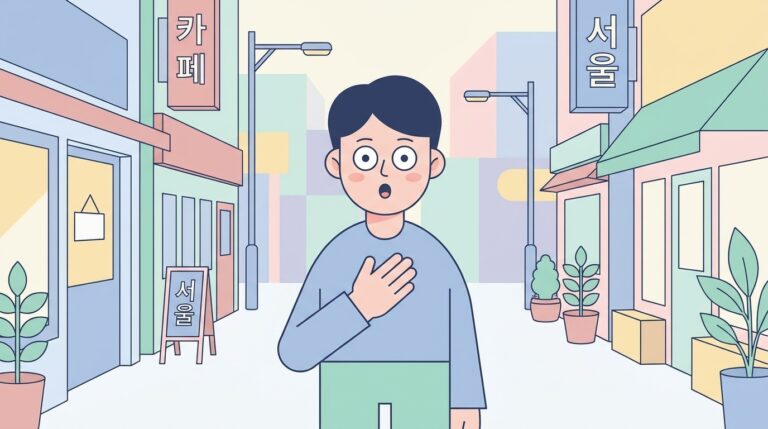
Picture this: You are walking down a bustling street in Hongdae on a vibrant Friday evening. Suddenly, a street performer pops out of nowhere right in front of you with an energetic dance move, or your favorite K-pop idol unexpectedly appears on a live pop-up screen! Your heart jumps into your throat, your eyes widen, and in English, you’d probably gasp, “Oh my gosh! You scared me!” or “Wait, are you serious?!”
However, when speaking Korean, many beginner learners freeze up or awkwardly search their mental dictionaries for robotic phrases like “Jeoneun nollassseumnida” (I am surprised). In reality, real-life Koreans don’t talk like textbook robots when startled! As an educator who has guided hundreds of global K-culture fans from beginner awkwardness to fluent street reactions, I know how frustrating it is when your words can’t match your instant emotions.
Learning natural expressions of surprise is one of the fastest ways to sound genuine, connect deeply with Korean friends, and fully immerse yourself in K-dramas and variety shows. Let’s master the authentic ways Koreans express shock, disbelief, and surprise!
Phase 2: Core 3 Expressions Deep Dive
1. 깜짝이야! (Kkamjjagiya!)
- Pronunciation: kkam-jjak-ee-ya (Sounds like “calm” with a sharp snap, followed by “chalk-ee-ya”)
- Meaning: Literal: “It’s a sudden startle!” | Real Nuance: “Whoa! You scared me!” / “That startled me!”
- K-Culture Moment: When K-pop idols walk into a dark haunted house on a variety show and scream while jumping backwards.
- Editor’s Insight: This is an involuntary reflex exclamation. Use it the exact second something startles you—like a sudden loud noise, a drop of hot coffee, or a friend sneaking up behind you.
- Situation Spectrum: Casual ✅ | Semi-formal ⚠️ (Add 깜짝 놀랐어요) | Formal 🚫
- 🤔 Think About It: Notice how English speakers shout “Jesus!” or “Oh my god!”, while Koreans describe the internal sensation of being startled (kkamjjak). What does this say about emotional reflection in Korean?
2. 진짜요? (Jinjja-yo?)
- Pronunciation: jin-jja-yo (Sounds like “jean-jah-yo” with extra emphasis on the “jj”)
- Meaning: Literal: “Is it the truth?” | Real Nuance: “Really?” / “Are you serious?” / “For real?”
- K-Culture Moment: When a K-drama main character hears a shocking plot revelation over an iced Americano.
- Editor’s Insight: Adding the polite ending -yo makes this safe to use in 90% of everyday situations without sounding rude, whether talking to a barista, a co-worker, or a friend.
- Situation Spectrum: Casual ✅ (진짜?) | Semi-formal ✅ (진짜요?) | Formal ⚠️ (정말입니까?)
- 🤔 Think About It: In Korean, questioning the reality (진짜 = truth) is the most natural way to show active listening and polite astonishment.
3. 헐! (Heol!)
- Pronunciation: heol (Rhymes with English “hull”, pronounced with an open breath)
- Meaning: Literal: [Exclamation sound] | Real Nuance: “OMG!” / “No way…” / “Speechless!”
- K-Culture Moment: A character finds out their concert tickets sold out in 0.1 seconds and stares blankly at the screen.
- Editor’s Insight: Heol expresses a mix of mild shock, disbelief, or slight dismay. It’s ultra-casual and iconic among youth culture.
- Situation Spectrum: Casual ✅ | Semi-formal 🚫 | Formal 🚫
- 🤔 Think About It: Short monosyllabic slang words like 헐 capture complex emotional states instantly without needing full grammar structures.
Phase 3: Textbook Korean vs. Real Korean
Situation 1: When someone suddenly jumps out to surprise you
- 📖 Textbook Korean: 저는 너무 놀랐습니다. (Jeoneun neomu nollassseumnida. – I was very surprised.)
- 🗣️ Real Korean: 깜짝이야! 간 떨어질 뻔했잖아! (Kkamjjagiya! Gan tteoreojil ppeonhaetjana! – Whoa! My liver almost fell out!)
- 💡 Why the difference? Koreans use vivid somatic idioms. Saying your “liver almost dropped” is the classic Korean way of saying you were scared out of your wits!
Situation 2: Hearing unbelievable breaking news
- 📖 Textbook Korean: 그것은 사실입니까? (Geugeoseun sasirimnikka? – Is that a fact?)
- 🗣️ Real Korean: 진짜요?! 대박… 실화예요? (Jinjja-yo?! Daebak… Silhwayeyo? – Really?! That’s crazy… is that for real?)
- 💡 Why the difference? Modern everyday Korean heavily utilizes buzzwords like 실화 (real story) and 대박 (jackpot/unbelievable) to express lively, relatable engagement.
Phase 4: K-Culture Deep Dive & Non-Verbal Manners
4-1. Nunchi & Body Language: The Chest-Clutching Reflex
When Koreans say “깜짝이야!”, you will almost always see them place a flat hand over their chest/heart and gently pat it down (가슴 쓸어내리기). This gesture non-verbally communicates: “Phew, my heart skipped a beat, but I’m calming down.” If an older person or superior startles you, avoid shouting “헐!” (which sounds overly flippant); instead, widen your eyes, place both hands near your chest, and say politely: “어머, 깜짝 놀랐어요!” (Eomeo, kkamjjak nollasseoyo!).
4-2. Cultural Code: The Variety Show “Reaction Culture”
In Korean entertainment—from reality shows to YouTube live streams—reactions (리액션) are an art form. Overreacting with wide eyes, clapping hands, and shouting “진짜요?!” is seen as a sign of respect, warmth, and active engagement. Being too stoic can sometimes be misinterpreted as indifference.
Phase 5: Real-Life Roleplay Scenario
Setting: You and your Korean friend Minho are waiting outside a trendy cafe in Seongsu-dong.
- Turn 1 (Minho): 저기 봐! 저 사람 방탄소년단 정국 아니야? (Jeogi bwa! Jeo saram Bangtansonyeondan Jeongguk aniya?)
🎭 Points eagerly across the street with wide eyes.
(Look over there! Isn’t that BTS Jungkook?) - Turn 2 (You): 헐! 진짜요? 어디요? (Heol! Jinjja-yo? Eodiyo?)
🎭 Turning your head instantly, gasping in excitement.
(OMG! For real? Where?) - Turn 3 (Minho): 저기 검은 모자 쓴 사람! (Jeogi geomeun moja sseun saram!)
🎭 Squinting and waving hand toward the crosswalk.
(The person over there wearing the black cap!) - Turn 4 (You): 와, 대박… 완전 똑같아요! (Wa, daebak… wanjeon ttokgatayo!)
🎭 Placing both hands over your mouth in disbelief.
(Wow, insane… He looks completely identical!) - Turn 5 (Minho): 앗, 뒤돌아보는데… 아니네! 일반인이네. 하하! (At, dwidoraboneunde… anine! Ilban-inine. Haha!)
🎭 Scratching his head with an embarrassed grin.
(Ah, he’s turning around… Never mind! Just a regular guy. Haha!) - Turn 6 (You): 아, 깜짝이야! 진짜인 줄 알았잖아요! (A, kkamjjagiya! Jinjjain jul aratjanayo!)
🎭 Patting your chest while laughing in relief.
(Ah, what a shock! I totally thought it was real!) - Turn 7 (Minho): 미안 미안! 너무 닮아서 나도 속았어. (Mian mian! Neomu dalmaseo nado sogasseo.)
🎭 Handing you an iced drink apologetically.
(Sorry, sorry! He looked so similar that I got fooled too.) - Turn 8 (You): 괜찮아요. 심장이 쿵 내려앉을 뻔했어요. (Gwaenchanayo. Simjang-i kung naeryeoanjeul ppeonhaesseoyo.)
🎭 Taking a refreshing sip with a dramatic sigh.
(It’s okay. My heart almost dropped to my stomach.)
🔀 Interactive Choice Point
When Minho says it was just a false alarm, how do you respond?
* Option A: “깜짝이야! 진짜인 줄 알았잖아요!” (A, kkamjjagiya! Jinjjain jul aratjanayo!)
👉 Feedback [Best]: Natural, playful, and shows genuine emotional reaction with polite warmth.
* Option B: “저는 실망했습니다.” (Jeoneun silmanghaessseumnida.)
👉 Feedback [Bad]: Overly stiff textbook language that kills the playful mood instantly.
* Option C: “야, 헐! 너 미쳤어?” (Ya, heol! Neo michyeosseo?)
👉 Feedback [Risk]: Too harsh unless Minho is your childhood best friend; might sound genuinely angry!
Phase 6: 10-Second Emotional Shadowing Drill
Practice reading these out loud, observing the pause marks (/) and dynamic intonations:
[😱 High startle / Sudden jump]
“헐! / 깜짝이야!”
(Heol! / Kkam-jjak-ee-ya!)
(Short gasp on ‘Heol’, quick explosive snap on ‘Kkamjjak’)-
[👀 Eyes wide / Curious disbelief]
“진짜요? / 정말 실화예요?”
(Jin-jja-yo? / Jeong-mal sil-hwa-ye-yo?)
(Rising pitch at the end of both questions) -
[😮 Dramatic relief / Exhaling]
“휴, / 간 떨어질 뻔했네!”
(Hyu, / Gan tteo-reo-jil ppeon-haen-ne!)
(Exhale on ‘Hyu’, then smooth rolling rhythm)
Phase 7: K-Culture Mini Dictionary
- 심쿵 (Simkung) | Heart flutter / Sudden heart throb
Usage: Used when surprised by something overwhelmingly cute, romantic, or visually stunning. - 멘붕 (Menbung) | Mental breakdown / Brain freeze
Usage: Slang for being utterly stunned and confused by an unexpected crisis. - 대박 (Daebak) | Jackpot / Awesome / Mind-blowing
Usage: The all-purpose reaction word for shock, pleasant surprises, or huge events. - 실화 (Silhwa) | True story / Real life
Usage: Commonly asked as a question (“이거 실화야?”) meaning “Is this for real?”
Phase 8: Traveler’s Survival Kit
Top 3 Survival Phrases
- 깜짝 놀랐어요! (Kkamjjak nollasseoyo!) – “I was so surprised!”
Pro Tip: Polite enough to use with hotel staff, taxi drivers, or restaurant owners. - 진짜 맛있어요! (Jinjja masisseoyo!) – “It is seriously delicious!”
Pro Tip: Expresses pleasant surprise at how good the food tastes. - 헐, 얼마예요? (Heol, eolmayeyo?) – “Whoa, how much is it?”
Pro Tip: Good for market bargaining when seeing surprisingly cheap or steep prices.
Editor’s Travel Note
When navigating Korean subways and streets, unexpected train delays or platform changes can startle you. Make sure you prepare in advance with the Naver Map app download to check real-time notifications and avoid unnecessary panic during your travels.
Phase 9: Think Deeper
In Korean culture, emotions are rarely kept strictly individual; expressing surprise out loud invites others into your emotional reality. When you say “깜짝이야!”, bystanders immediately empathize by giving you a warm smile or checking if you are okay. Language in Korea acts as a social glue of shared experiences.
💬 Your Turn: Have you ever experienced a shocking moment while traveling or watching your favorite Korean media? What was your first reaction?
Phase 10: FAQ & Common Mistakes
Q: Can I say “깜짝이야!” to my boss or teacher?
A: It is better to use the polite past tense: “어머, 깜짝 놀랐습니다!” or “깜짝 놀랐어요!” Shouting “깜짝이야!” by itself is informal banmal (반말) and is best reserved for friends, peers, or solitary reflex reactions.
Q: What is the difference between “진짜” (Jinjja) and “정말” (Jeongmal)?
A: Both mean “really” or “truly.” However, 진짜 is slightly more colloquial, spoken, and energetic, while 정말 feels a bit more earnest, traditional, and polite.
Q: Is “헐” considered rude in public?
A: It is not a swear word, but it is very casual teen/youth slang. Avoid saying it directly to elders, clients, or service staff in formal settings.
🚨 Common Mistakes Alert
- Mistake: Using “I am surprised” (Jeoneun nollapda) in direct conversation.
Correct Action: Use exclamations like 깜짝이야! or 깜짝 놀랐어요! - Mistake: Pronouncing 진짜 like English “gin-jah” without double consonant tension.
Correct Action: Make a sharp, crisp JJ sound by pressing your tongue against your palate. - Mistake: Saying 헐 with an angry aggressive glare.
Correct Action: Keep it lighthearted or accompanied by open, puzzled eyebrows.
Phase 11: Action Missions
- 🥉 Bronze Mission: Look in the mirror and practice saying “깜짝이야!” 5 times while patting your chest.
- 🥈 Silver Mission: Leave a comment below using “진짜요? 대박!” in a sentence.
- 🥇 Gold Mission: Spot an unexpected plot twist in a K-drama and react out loud in Korean before reading the subtitles!
- 🎮 K-Culture Mission: Watch a variety show episode of Running Man and count how many times the cast members shout 헐 or 깜짝이야 in 10 minutes.
Phase 12: Interactive Quiz Challenge
Q1. Which phrase is best when a friend sneaks up behind you at a cafe?
A) 저는 놀랍습니다
B) 깜짝이야!
C) 감사합니다
View Answer & Explanation
Correct Answer: B) 깜짝이야!
Explanation: ‘깜짝이야!’ is the natural reflex phrase for when someone startles or scares you. Option A is unnatural textbook grammar, and Option C means ‘Thank you’.
Q2. Fill in the blank:
“BTS가 우리 동네에 왔다고? ______?! (Really?!)”
View Answer & Explanation
Correct Answer: 진짜요 (or 진짜)
Explanation: ‘진짜요?’ is the quintessential Korean question to express genuine shock and disbelief.
Q3. True or False:
“헐 (Heol)” is a formal honorific expression suitable for business presentations.
View Answer & Explanation
Correct Answer: False
Explanation: ‘헐’ is casual slang meant only for informal settings and friends, never formal business environments.






