

Stop Stressing Over Korean Age! The Friendly Beginner’s Guide to Counting Your Age in Korean
Phase 1: Empathy (Story-Driven Opening)
안녕하세요! (Annyeonghaseyo!) I’m your Daily Hangul editor and Korean culture navigator. Have you ever been watching your favorite K-Drama, seen two characters meet for literally five seconds, and suddenly one asks: “Excuse me, but how old are you?”
If you come from a Western culture, your jaw might drop. Asking someone’s age on day one feels almost taboo! But in Korea, asking age isn’t nosy—it’s actually the ultimate act of politeness. Why? Because the entire Korean language depends on age to decide whether to use polite language (Jondaenmal) or casual talk (Banmal), and whether to call someone Unnie, Oppa, Noona, or Hyeong.
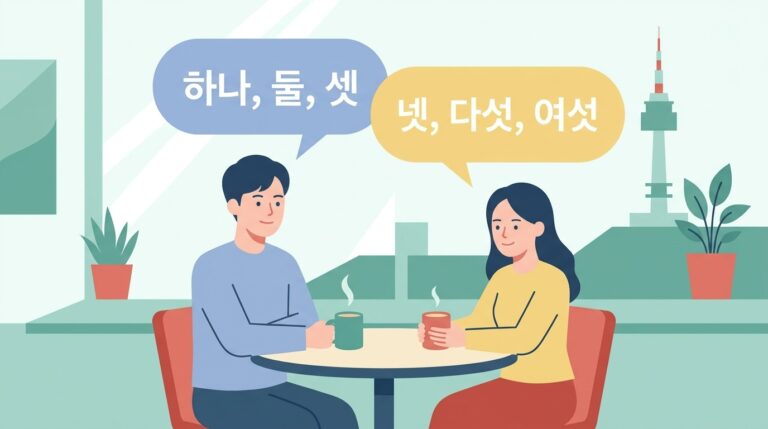
Yet for beginners, stating your age can be terrifying. You scramble in your head: “Wait, do I use the Chinese numbers like ‘Il, I, Sam’ or the Native ones like ‘Hana, Dul, Set’? And why did my friend say ‘Seumu’ instead of ‘Seumul’?” Don’t worry! This guide is built from years of teaching real learners just like you. By the end of this lesson, you will confidently announce your age without freezing up.
Phase 2: Top 3 Core Expressions Deep-Dive
Here are the three golden phrases you need to master age conversations in Korean.
1. 몇 살이에요? (Myeot sarieyo?)
- Pronunciation: [Myeot-sa-ri-e-yo] (Sounds like “Myutt sah-ree-eh-yo”)
- Meaning: Literal: “How many flesh/years?” | Real Nuance: “How old are you?” (Friendly & Polite)
- K-Culture Moment: When college freshmen meet during orientation week and try to figure out who buys the drinks!
- Editor’s Insight: 몇 (myeot) means “how many,” and 살 (sal) is the native Korean counter for age. Always use Native Korean numbers with 살!
- Situation Spectrum: Casual: ⚠️ (Use 몇 살이야?) | Semi-formal: ✅ | Formal: ⚠️
- 🤔 Think About It: In English, we ask “How old are you?” using an adjective (old). Korean counts physical age units (살). How does counting years feel different from asking a state of being?
2. 저는 스무 살이에요. (Jeoneun seumu sarieyo.)
- Pronunciation: [Jeo-neun seu-mu sa-ri-e-yo] (Sounds like “Juh-noon sue-moo sah-ree-eh-yo”)
- Meaning: Literal: “As for me, I am 20 years old.” | Real Nuance: “I am twenty years old.”
- K-Culture Moment: The iconic line celebrated in every coming-of-age K-Pop song when an idol officially turns 20!
- Editor’s Insight: Notice that 20 is 스물 (seumul), but when paired with 살 (sal), the final ㄹ drops and becomes 스무 (seumu). The same happens with 1 (하나 -> 한 살), 2 (둘 -> 두 살), 3 (셋 -> 세 살), and 4 (넷 -> 네 살)!
- Situation Spectrum: Casual: ⚠️ | Semi-formal: ✅ | Formal: ✅
- 🤔 Think About It: Why do you think sounds drop or soften when counting in Korean? (Hint: It makes rapid pronunciation much smoother!)
3. 나이가 어떻게 되세요? (Naiga eotteoke doeseyo?)
- Pronunciation: [Na-i-ga eo-tteo-ke doe-se-yo] (Sounds like “Nah-ee-gah uh-ttuh-keh dweh-seh-yo”)
- Meaning: Literal: “How does your age become?” | Real Nuance: “May I ask how old you are?” (Very respectful)
- K-Culture Moment: A polite professional meeting or an interview on a Korean variety show where the host asks a senior guest their age gracefully.
- Editor’s Insight: 나이 (nai) is the standard word for age. This phrase is much softer and more indirect than 몇 살이에요?, making it perfect for talking to elders, clients, or new acquaintances in formal settings.
- Situation Spectrum: Casual: 🚫 | Semi-formal: ✅ | Formal: ✅
- 🤔 Think About It: Notice how polite Korean phrases use indirect questions rather than direct commands. Does your native language soften personal questions the same way?
Phase 3: Textbook Korean vs. Real Korean
Situation 1: Asking someone’s age casually
- 📖 교과서 한국어 (Textbook): 당신은 몇 살입니까? (Dangsineun myeot sarimnikka? – “How old are you, Thou?”)
- 🗣️ 진짜 한국어 (Real-World): 혹시 몇 년생이세요? (Hoksi myeot nyeonsaeng-iseyo? – “By any chance, what birth year are you?”)
- 💡 Why is it different? In real life, asking for the birth year (년생) is less confrontational and avoids the confusion of different age-counting methods!
Situation 2: Replying with your age
- 📖 교과서 한국어 (Textbook): 저는 스물다섯 살입니다. (Jeoneun seumuldaseot sarimnida. – “I am 25 years old.”)
- 🗣️ 진짜 한국어 (Real-World): 저 99년생이에요! (Jeo gugunyeon-saeng-ieyo! – “I’m a ’99 liner!”) or 저 스물다섯이에요. (Jeo seumuldaseosi-eyo. – omitting 살 naturally).
- 💡 Why is it different? Koreans love grouping people by birth year (년생) to immediately establish peer friendship (동갑).
Phase 4: K-Culture Deep-Dive & Non-Verbal Manners
4-1. 눈치 (Nunchi) & Body Language
When someone asks your age in Korea, don’t cross your arms or look defensive. Keep a relaxed posture and give a warm smile. If the person turns out to be older than you, nodding slightly while listening (고개 끄덕이기) shows respect. If you find out you are the exact same age, your eyes can widen with a joyful “어! 동갑이네요!” (Oh! We are the same age!) to instantly break the ice!
4-2. Cultural Code: The Idol “Maknae” & Age Hierarchy
In K-Pop groups like BTS or TWICE, you will always hear about the 막내 (Maknae – the youngest) and the 맏형/맏언니 (Oldest brother/sister). Age dictates team roles, room assignments, and who pours water at meals. Knowing your age and counting it accurately in Korean is your ticket into this fascinating social dynamic.
Phase 5: Real-World Roleplay Scenario
Setting: A sunlit café in Yeonnam-dong. You are meeting your Korean language exchange partner, Minho (민호), for the first time.
- 민호: 안녕하세요! 만나서 반가워요. (Annyeonghaseyo! Mannaseo bangawoyo.)
🎭 Smiles warmly and hands you an iced Americano. - You: 안녕하세요, 민호 씨! 반가워요. (Annyeonghaseyo, Minho ssi! Bangawoyo.)
🎭 Takes a sip and smiles back. - 민호: 한국어 발음이 정말 좋으시네요! 혹시 몇 살이에요? (Hangugeo baleumi jeongmal joeusineyo! Hoksi myeot sarieyo?)
🎭 Leans forward with genuine curiosity. - You: [Your Turn to Choose! See Branching Point Below]
- 민호: 아, 그러시군요! 그럼 편하게 말 놓을까요? (A, geureosigunyo! Geureom pyeonhage mal noeulkkayo?)
🎭 Laughs and relaxes his posture. - You: 네, 좋아요! 우리 친구해요. (Ne, joayo! Uri chinguhaeyo.)
🎭 Nods happily. - 민호: 좋아요! 오늘 맛있는 떡볶이 먹으러 가요. (Joayo! Oneul masinneun tteokbokki meogeureo gayo.)
🎭 Gives a thumbs up. - You: 와, 신나요! 가요! (Wa, sinnayo! Gayo!)
🎭 Packs up bag excitedly.
🔀 Interactive Choice Point
How will you answer Minho when he asks “몇 살이에요?” (Assuming you are 24):
- Choice A: “저는 이십사 살이에요.” (Jeoneun isipsa sarieyo.)
- Choice B: “저 스물네 살이에요!” (Jeo seumul-ne sarieyo!)
- Choice C: “나이 몰라요.” (Nai mollayo.)
[Feedback]
- Choice A (Risk): '이십사' is a Sino-Korean number. While Minho will understand, it sounds like robot math!
- Choice B (Best!): Spot on! '스물네 살' correctly uses Native Korean number '스물넷' modified to '스물네' before '살'. Natural and clear!
- Choice C (Bad): 'I don't know my age' will make Minho think you didn't understand the question or don't want to talk.
Phase 6: 10-Second Emotional Shadowing Drill
Practice these sentences out loud with the designated emotion and rhythm stops (/).
[😊 Brightly & Confidently]저 / 스물세 살이에요! (Jeo / seumulse sarieyo! – “I’m 23 years old!”)[🤝 Friendly & Curious]혹시 / 몇 년생이세요? (Hoksi / myeot nyeonsaeng-iseyo? – “By the way, what year were you born?”)[🎉 Excited & Friendly]우리 / 동갑이네요! (Uri / donggab-ineyo! – “We are the same age!”)
Phase 7: K-Culture Mini Dictionary
- 동갑 (Donggap) | Same Age | Used exclusively for people born in the same calendar year. Instant qualification to become close friends (친구)!
- 막내 (Maknae) | The Youngest | The baby of any group, family, or K-Pop team who usually receives extra love (and occasional errands!).
- 빠른 년생 (Ppareun nyeonsaeng) | Early Birth Year | People born in Jan/Feb who used to enter school early with the previous year’s kids. A classic Korean debate topic!
- 반말 (Banmal) | Casual Speech | Informal language used strictly between same-age friends, to younger people, or with mutual agreement.
Phase 8: Survival Kit for Travelers
Top 3 Survival Phrases
- 몇 살이에요? (Myeot sarieyo?) – How old are you? (Pro Tip: Use with peers around your age).
- 스무 / 서른 살이에요. (Seumu / Seoreun sarieyo.) – I’m 20 / 30 years old. (Pro Tip: 20 is 스무, 30 is 서른).
- 동갑이에요! (Donggab-ieyo!) – We are the same age! (Pro Tip: Great for instant bonding at guesthouses).
Editor’s Travel Note
When traveling in Korea, keep your passport handy when visiting nightlife districts like Hongdae or Itaewon. Bouncers will check your birth year carefully! Also, make sure you download the Naver Map navigation app download guide to navigate trendy youth hotspots without getting lost.
Phase 9: One Step Deeper (Reflection)
In many Western cultures, asking for someone’s age right away can feel intrusive. But in Korean society, asking your age is actually an effort to show proper respect. It determines the verbal honorifics, body language, and social etiquette needed to treat you with care. It is not about putting you in a box—it is about building a harmonious relational bridge.
💬 Your Turn: How does your home country handle age etiquette when meeting someone new? Share your thoughts in the comments below!
Phase 10: FAQ & Common Mistakes
Q: Do I use Native Korean or Sino-Korean numbers for age?
A: Always use Native Korean numbers (하나, 둘, 셋, 넷…) with the age counter 살 (sal). However, if you state your birth year (e.g., 1998년), use Sino-Korean numbers (일구구팔년).
Q: Why does ‘스물’ (20) turn into ‘스무’ in ‘스무 살’?
A: The numbers 1, 2, 3, 4, and 20 (하나, 둘, 셋, 넷, 스물) drop or modify their final sound before counters like 살 (한 살, 두 살, 세 살, 네 살, 스무 살) for ease of pronunciation.
Q: What should I say if an older person asks my age?
A: Say your age followed by polite endings: e.g., “스물다섯 살입니다” (Jeoneun seumuldaseot sarimnida) or “스물다섯 살이에요” (Jeo seumuldaseot sarieyo).
🚨 Common Mistakes Warning Board
- Mistake: Saying “이십 살이에요” ❌ -> Correct: “스무 살이에요” ✅ (Use Native numbers with 살).
- Mistake: Saying “스물 살이에요” ❌ -> Correct: “스무 살이에요” ✅ (Drop the ㄹ for 20).
- Mistake: Calling someone older 친구 (friend) directly ❌ -> Correct: Call them 언니/오빠/누나/형 or use their name + 씨 (Minho-ssi).
Phase 11: Action Missions
- 🥉 Bronze Mission: Count from 1 to 10 using Native Korean numbers (하나, 둘, 셋, 넷, 다섯, 여섯, 일곱, 여덟, 아홉, 열) out loud in under 10 seconds.
- 🥈 Silver Mission: Write your age in Korean in the comments below using the formula:
[Native Number] + 살이에요! - 🥇 Gold Mission: Next time you watch a K-Drama or K-Pop interview, spot when someone asks “몇 살이에요?” and identify how the other person replies.
- 🎮 K-Culture Mission: Look up the ages of your favorite K-Pop group members and figure out who the 맏이 (oldest) and 막내 (maknae) are in Korean numbers!
Phase 12: Interactive Quiz Challenge
Test your skills below! Click the toggles to check your answers.
Q1. How do you correctly say “I am 21 years old” in Korean?
A) 저 이십일 살이에요.
B) 저 스물한 살이에요.
C) 저 스물하나 살이에요.
👉 Click here for Answer & Explanation
Correct Answer: B) 저 스물한 살이에요.
Explanation: 21 is 스물하나. When followed by the counter 살, 하나 changes to 한. Therefore, 스물한 살 is correct!
Q2. Fill in the blank:
“우리는 같은 해에 태어났어요! 우리는 _________이에요!” (We were born in the same year! We are _______!)
👉 Click here for Answer & Explanation
Correct Answer: 동갑 (Donggap)
Explanation: 동갑 means people of the exact same age / birth year.
Q3. [True or False] In Korea, asking someone’s age upon first meeting is always considered rude.
👉 Click here for Answer & Explanation
Correct Answer: False
Explanation: It is a natural social step to determine the proper level of polite speech (존댓말) and social titles!







