

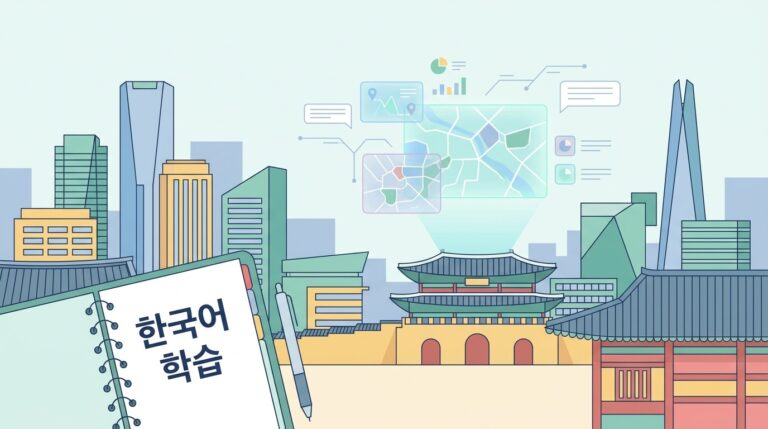
Mastering High-Tech Korean: ICT Integration in Smart Tourism & MICE
Phase 1: Empathy & Storytelling
안녕하세요! Welcome back to Daily Hangul! I’m your resident Seoul insider and culture navigator. Picture this: You are representing a global destination marketing organization at the International MICE Expo held in Songdo Convensia or COEX. The conference hall is buzzing with talk about digital transformation, AI-driven crowd control, and hyper-personalized tourist experiences. You’re in a high-stakes breakout session discussing municipal ICT infrastructure with Korean tourism board executives. Suddenly, someone mentions “빅데이터 기반의 관광 동선 최적화” (big-data-driven tourist movement optimization) and asks for your agency’s perspective on integrating IoT sensors across historical heritage zones.
At the C2 proficiency level, you don’t just need conversational Korean—you need the sophisticated socio-technical lexicon that bridges administrative policy, technological innovation, and Korean cultural hospitality (정, 情). Navigating these multi-stakeholder symposiums without mastering native administrative and tech-forward nuances can leave your groundbreaking proposals sounding generic. This guide draws upon real-world case studies from Seoul’s Smart City initiatives and Suwon’s XR heritage projects to equip you with the authoritative linguistic precision needed to lead high-level Smart Tourism and MICE dialogues with nuance and commanding fluency.
Phase 2: Core Expressions Deep Dive
1. ICT 기술을 접목하여 관광객의 편의성을 제고하다
- Pronunciation: [ICT gisul-eul jeom-mok-hayeo gwangwanggaek-ui pyeon-uiseong-eul jego-hada] (Sounds like: “ICT gee-sool-eul jum-mok-ha-yeo gwan-gwang-gaek-ui pyun-ee-sung-eul jeh-go-ha-da”)
- Meaning: Literal: “To graft ICT technology and heighten tourist convenience.” / Actual Nuance: “To seamlessly integrate smart tech solutions to significantly enhance visitor convenience.”
- K-Culture Moment: Frequently heard in administrative keynote addresses at conferences like the Seoul International Travel Mart or in dramas depicting high-profile city planning meetings such as Start-Up or Agency.
- Editor’s Insight: The verb ‘접목하다’ (literally to graft botanical branches) is a powerful C2 metaphorical term denoting the organic, harmonious fusion of disparate fields—specifically tech and municipal tourism. ‘제고하다’ (enhance/elevate) carries far greater gravitas than the everyday ‘높이다’.
- Situation Spectrum: Casual 🚫 | Semi-formal ⚠️ | Formal ✅
- 🤔 Think About It: Why does Korean administrative discourse favor organic, bio-metaphorical terms like ‘접목’ (grafting) when discussing technological convergence?
2. 실시간 유동인구 데이터를 기반으로 혼잡도를 분산시키다
- Pronunciation: [Silsigan yudong-ingu deiteoreul giban-euro honjapdoreul bunsansikida] (Sounds like: “Sil-she-gan yu-dong-in-gu day-tuh-reul gee-ban-eu-ro hone-jap-doe-reul boon-san-she-key-da”)
- Meaning: Literal: “To disperse congestion based on real-time floating population data.” / Actual Nuance: “To optimize crowd control and alleviate density through real-time geospatial analytics.”
- K-Culture Moment: Deployed in press briefings and MICE logistics discussions regarding mega-festivals in Seoul (e.g., Yeouido Fireworks Festival or BTS World Expo events).
- Editor’s Insight: ‘유동인구’ (floating/pedestrian population) is the cornerstone metric for smart tourism infrastructure in Korea, moving beyond simple ‘방문객 수’ (visitor count) to dynamic spatial analytics.
- Situation Spectrum: Casual 🚫 | Semi-formal ⚠️ | Formal ✅
- 🤔 Think About It: How does South Korea’s hyper-dense urban architecture shape the collective priority placed on real-time crowd distribution over static scheduling?
3. 지속 가능한 스마트 관광 생태계를 구축하다
- Pronunciation: [Jisok ganeunghan seumateu gwangwang saengtae-gyereul guchukhada] (Sounds like: “Jee-soke gah-neung-hahn seu-mah-teu gwan-gwang sang-teh-gyeh-reul goo-chook-ha-da”)
- Meaning: Literal: “To construct a sustainable smart tourism ecosystem.” / Actual Nuance: “To establish a viable, self-sustaining technological framework for long-term tourism innovation.”
- K-Culture Moment: Featured routinely in official white papers published by the Ministry of Culture, Sports and Tourism (MCST) and Korea Tourism Organization (KTO).
- Editor’s Insight: ‘생태계 구축’ (ecosystem building) indicates a holistic public-private partnership (PPP) model involving startups, local merchants, municipal governments, and international tourists.
- Situation Spectrum: Casual 🚫 | Semi-formal ⚠️ | Formal ✅
- 🤔 Think About It: In your home country, is ‘sustainable tourism’ primarily associated with environmental ecology, or does it encompass digital infrastructure resilience as it does in Korea?
Phase 3: Textbook vs. Native C2 Fluency
Situation 1: Proposing an augmented reality (AR) guide system for historic palaces
- 📖 교과서 한국어 (Textbook): 우리는 궁궐에 AR 기술을 써서 외국인들이 관광하기 쉽게 만들 것입니다. (We will use AR technology in palaces to make it easy for foreigners to tour.)
- 🗣️ 진짜 한국어 (Native C2): 궁궐 문화유산에 XR(확장현실) 기술을 접목하여, 시공간을 초월한 몰입형 도슨트 서비스를 구현하고자 합니다. (By integrating extended reality into our palace cultural heritage, we aim to implement an immersive docent service that transcends temporal and spatial boundaries.)
- 💡 왜 다를까? (Why the difference?): Textbook phrasing relies on elementary connective markers (-서, -기 쉽게). Executive-level Korean elevates the conversation using high-register Sino-Korean concepts (몰입형, 초월, 도슨트, 구현) demonstrating domain mastery.
Situation 2: Addressing contactless check-in systems for international MICE delegates
- 📖 교과서 한국어 (Textbook): 앱을 이용하면 호텔과 전시장에 안 기다리고 바로 들어갈 수 있습니다. (If you use the app, you can enter hotels and exhibition halls right away without waiting.)
- 🗣️ 진짜 한국어 (Native C2): 모바일 기반 비대면 통합 패스를 도입함으로써, 대기 동선을 최소화하고 참가자 맞춤형 스마트 모빌리티 연계를 실현할 수 있습니다. (By introducing a mobile-based contactless integrated pass, we can minimize queue congestion and realize customized smart mobility connectivity for attendees.)
- 💡 왜 다를까? (Why the difference?): C2 professionals replace colloquial verbs (‘안 기다리다’) with analytical process descriptions (‘대기 동선 최소화’, ‘스마트 모빌리티 연계’).
Phase 4: K-Culture Deep Dive & Non-Verbal Nuance
4-1. Nunchi & Administrative Body Language
When pitching ICT solutions to Korean government bureaus or MICE consortiums, direct assertive argumentation should be tempered with collective consensus cues. Notice how Korean senior directors nod slightly while saying “네, 일리 있는 말씀입니다만…” (Yes, that point is quite valid, however…). Maintain composed posture, keep hands neatly clustered above the presentation table, and gesture with an open, upward-facing palm rather than pointing fingers when referencing digital dashboards or presentation slides. Eye contact should be inclusive, sweeping across the entire delegation rather than fixating solely on the primary speaker.
4-2. Cultural Code Analysis: The “Digital Bballi-Bballi” Meets Historic Preservation
South Korea presents a unique paradox: it houses 600-year-old Joseon Dynasty fortresses inside ultra-connected 5G smart cities. The phenomenon of “Smart Heritage” (스마트 문화재)—such as using digital twin technology to restore scorched relics or utilizing location-aware audio beacons in Bukchon Hanok Village—stems from the deep cultural aspiration to ensure centuries-old traditions remain accessible to digital natives. In K-Dramas like Memories of the Alhambra, we see an extreme sci-fi spin on this, but in real-world Seoul, ICT is seen as the ultimate steward of cultural hospitality.
Phase 5: Interactive Real-World Roleplay
- Setting: Executive Boardroom at the Seoul Tourism Plaza, Myeongdong.
- Characters:
- Director Kang (강 국장): Senior Director of Smart Tourism Strategy, decisive and analytical.
- You (Participant): Senior MICE Technology Consultant representing an international urban development consortium.
강 국장: 이번 글로벌 MICE 컨벤션 유치를 위해 우리 시가 추진 중인 디지털 트윈 기반 통합 관제 시스템에 대해 어떻게 평가하십니까?
(Ibeon geullobeol MICE keonbensyeon yuchireul wihae uri siga chujin jung-in dijiteol teuwin giban tonghap gwanje siseutem-e daehae eotteoke pyeong-gahasimnikka?)
"How do you evaluate the digital twin-based integrated control system our city is pursuing for hosting this upcoming global MICE convention?"
🎭 안경을 고쳐 쓰며 진지한 눈빛으로 태블릿 모니터를 응시한다.

나 (You): 실시간 유동인구 제어와 비상상황 대응 면에서 매우 고도화된 모델이라고 생각합니다.
(Silsigan yudong-ingu jeeowa bisangsanghwang daeeung myeon-eseo maeu godohwadoen moderirago saenggakhamnida.)
"I consider it an exceptionally sophisticated model in terms of real-time crowd dynamics control and emergency response."
🎭 프리젠테이션 화면의 유동인구 히트맵을 부드럽게 가리키며.

강 국장: 맞습니다. 다만 지역 소상공인과의 상생 플랫폼 연계가 미흡하다는 지적이 지속적으로 제기되고 있어요.
(Masseumnida. Daman jiyeok sosanggong-ingwaui sangsaeng peullaetpom yeon-gyega miheubh Cut-daneun jijeogi jisokjeogeuro jegidoego isseoyo.)
"Indeed. However, concerns are continuously being raised that the integration with local merchant mutual-growth platforms remains insufficient."
🎭 서류철을 넘기며 살짝 난색을 표한다.

나 (You): [Choose your response below]
🔀 Interactive Decision Fork:
- Option A: 소상공인은 기술을 잘 모르니까 정부가 알아서 앱을 깔아주면 됩니다. (Risk: Dismissive tone, lacks understanding of stakeholder buy-in.)
- Option B: 지역 상권 데이터를 오픈 API로 개방하여, 골목상권 맞춤형 디지털 바우처 시스템을 유기적으로 연동하는 방안을 제안합니다. (Best: Exemplary C2 structural vocabulary, addresses mutual growth elegantly.)
- Option C: 기술 도입이 중요하니까 소상공인 문제는 나중에 천천히 생각하시죠. (Bad: Ignores the strategic dilemma, shows low empathy for public policy priorities.)
Director Kang’s Reaction to Option B:
강 국장: 훌륭한 통찰이십니다! 오픈 API 기반의 민관 협력 모델이라면 소상공인의 자발적 참여를 견인할 수 있겠군요.
(Hullyunghan tongcharisimnida! Opeun API giban-ui mingwan hyeopryeok moderiramyeon sosanggong-in-ui jabaljeok cham-yeoreul gyeon-inhal su itgetgunyo.)
"That is a brilliant insight! A public-private partnership model based on open APIs will surely drive voluntary participation among local business owners."
🎭 만족스러운 미소를 지으며 고개를 끄덕인다.
Phase 6: 10-Second Emotional Shadowing Drill
Practice these executive statements with exact pacing and pitch inflection (/ indicates micro-pauses).
[🏛️ 단호하고 전문적인 톤]
빅데이터 분석을 통하여 / 방한 관광객의 소비 패턴을 정밀하게 진단하고, / 맞춤형 MICE 관광 상품을 / 기획해야 합니다.
(Big-data bunseog-eul tonghayeo / banghan gwangwanggaek-ui sobi paeteon-eul jeongmilhage jindanhago, / matchumhyeong MICE gwangwang sangpum-eul / gihoekhaeya hamnida.)-
[🤝 설득력 있고 신뢰감을 주는 톤]
단순한 인프라 구축을 넘어, / 지역 주민과 관광객이 상생하는 / 포용적 스마트 관광 생태계를 / 완성해 나가겠습니다.
(Dansunhan inpeura guchug-eul neomeo, / jiyeok jumin-gwa gwangwanggaegi sangsaenghaneun / poyongjeok seumateu gwangwang saengtae-gyereul / wanseonghae nagagetseumnida.)
Phase 7: K-Culture Mini Dictionary
- 스마트 모빌리티 (Seumateu Mobilriti) | Smart Mobility | Refers to seamless transit integration (MaaS) connecting KTX bullet trains, metropolitan subways, autonomous shuttles, and personal micro-mobility via single-app QR interfaces.
- 디지털 트윈 (Dijiteol Teuwin) | Digital Twin | Virtual replicas of urban destinations used by South Korean metropolitan planning boards to simulate congestion, festival flows, and disaster evacuations in real time.
- 상생 협력 (Sangsaeng Hyeopryeok) | Mutual Growth & Coexistence Cooperation | A paramount socio-economic value in Korean governance emphasizing that technological deployment must economically uplift traditional small businesses alongside major conglomerates.
- 무장애 관광 (Mujang-ae Gwangwang) | Barrier-Free Tourism | ICT-enabled accessibility initiatives leveraging IoT ramps, AI voice navigators, and tactile digital surfaces for elderly and disabled domestic and international travelers.
Phase 8: MICE Traveler’s Survival Kit
Top 3 Executive Survival Phrases
- 한글: 현장 실시간 대기 정보를 확인할 수 있는 대시보드가 마련되어 있습니까?
- Romanization: Hyeonjang silsigan daegi jeongboreul hwag-inhal su inneun daeshibodeuga maryeondoeeo isseumnikka?
- Pro Tip: Use this when inquiring about real-time venue operational infrastructure at international expos.
- 한글: MICE 참가자 전용 디지털 바우처 발급 프로세스를 설명해 주시겠습니까?
- Romanization: MICE chamgaja jeonyong dijiteol baucheo balgeup peuroseseureul seolmyeonghae jusigetseumnikka?
- Pro Tip: Indispensable for clarifying delegate subsidization and per diem redemption systems.
- 한글: 다국어 AI 챗봇 안내 시스템의 데이터 갱신 주기는 어떻게 됩니까?
- Romanization: Daguk-eo AI chaetbot annae siseutem-ui deiteo gaengsin jugineun eotteoke doemnikka?
- Pro Tip: Demonstrates rigorous technical scrutiny when reviewing attendee support software.
Editor’s Tech & Travel Note
For field verification of Korea’s smart city capabilities, download the 네이버 지도 (Naver Map) 공식 앱 to experience live subway carriage congestion metrics, and explore the VISITKOREA 스마트 관광 포털 for up-to-the-minute AI itinerary curation and multilingual assistance.
Phase 9: A Step Deeper (한 발 더 깊이)
In Korean administrative and technological culture, the term ‘스마트’ (Smart) is not merely a synonym for automation; it represents an ethical commitment to relational efficiency and collective safety. Korean society values rapid infrastructural adaptability, yet this dynamism must strictly harmonize with communal equity (상생). When international executives pitch technology without addressing the cultural sentiment of local merchants or accessibility for vulnerable populations, the strategy is perceived as cold and incomplete. True mastery of high-level Korean requires grasping this delicate balance between hyper-digitalization and human warmth (인간미).
💬 Your Turn: How does your local city reconcile cutting-edge urban digitalization with the preservation of vulnerable traditional merchants? Share your thoughts below in Korean!
Phase 10: FAQ & Mistake Prevention
Q: What is the exact difference between ‘구축하다’ and ‘조성하다’ in smart tourism proposals?
A: While both translate to ‘build/create’, ‘구축하다’ (to construct/structure) is used for hard digital systems, networks, and technical frameworks (e.g., 인프라 구축, 시스템 구축). ‘조성하다’ (to develop/foster) is reserved for spatial atmospheres, physical complexes, or cultural environments (e.g., 관광 단지 조성, 상생 분위기 조성).
Q: Can I use conversational endings like ‘-거든요’ in high-level policy presentations?
A: In formal MICE presentations and executive symposiums, avoid ‘-거든요’ or ‘-잖아요’ as they sound overly subjective or conversational. Strictly adhere to formal deferential endings like ‘-ㅂ니다/습니다’, ‘-도록 하겠습니다’, or nominalized bullet-point syntax (e.g., ‘~추진 계획임’).
Q: Why do Korean tourism officials frequently emphasize ‘오픈 API’ in municipal tourism panels?
A: South Korea’s Public Data Act mandates that public institutions provide standardized data to the private sector. Discussing ‘오픈 API 연동’ proves you understand the regulatory landscape governing collaborative tech innovation in Korea.
🚨 Common Mistakes Warning Board
- Incorrect Particle Use with Verbs of Integration: Saying
ICT 기술을 도시로 접목하다❌ instead ofICT 기술을 도시에 접목하다✅ (The target of grafting takes the dative particle ‘-에’). - Confusing ‘제고’ with ‘제거’: Writing
편의성 제거(Elimination of convenience!) ❌ instead of편의성 제고(Enhancement of convenience) ✅. - Overusing Konglish Terms: Saying
인게이지먼트를 업그레이드하다❌ when참여도와 몰입도를 제고하다✅ provides far greater professional impact in administrative settings.
Phase 11: Action Missions
- 🥉 Bronze Mission (Self-Practice): Read Phase 6’s Shadowing sentences aloud 5 times, focusing on natural pauses at
/without dropping pitch at nominal boundaries. - 🥈 Silver Mission (Social Engagement): Write a 2-sentence summary of your home city’s smart tourism strengths using the terms ‘접목하다’ and ‘생태계 구축’ and post it on your study social channels.
- 🥇 Gold Mission (Real-World Execution): Navigate the 공공데이터포털 (data.go.kr) tourism API documentation or review a KTO white paper, identifying 3 practical applications of ‘실시간 유동인구’ analysis in action.
- 🎮 K-Culture Mission: Watch an episode of a modern corporate K-Drama (like Search: WWW or Start-Up) and listen for executive phrases incorporating ‘플랫폼 연동’ or ‘시너지 창출’.
Phase 12: Interactive Quiz Challenge
1. Situational Judgment
Which sentence is most suitable for an official executive proposal to city officials?
* (A) 스마트폰으로 다 볼 수 있게 빨리 만들면 관광객이 좋아합니다.
* (B) ICT 기반의 실시간 다국어 지원 플랫폼을 구축하여 외국인 관광 편의성을 획기적으로 제고해야 합니다.
* (C) 메타버스를 대충 깔아두면 외국인들이 알아서 찾아올 것 같습니다.
🔍 정답 및 해설 보기 (Click to Reveal)
정답: (B)
해설: (B) uses precise high-level vocabulary (‘ICT 기반’, ‘플랫폼 구축’, ‘편의성 획기적 제고’) appropriate for C2 administrative and executive discourse. (A) and (C) feature overly colloquial phrasing, vague reasoning, and improper register.
2. Fill-in-the-Blank
다양한 관광 주체들이 공존할 수 있는 지속 가능한 스마트 관광 ( )를 구축하는 것이 급선무이다.
* (A) 생태계
* (B) 잔류물
* (C) 방해물
🔍 정답 및 해설 보기 (Click to Reveal)
정답: (A) 생태계
해설: ‘스마트 관광 생태계’ (smart tourism ecosystem) is the established socio-technical collocation referring to the integrated environment of businesses, government, technology, and tourists.
3. True / False Cultural Knowledge Quiz
- Statement: In Korean smart city governance, the term ‘상생’ implies prioritizing large tech conglomerates over local traditional district merchants.
🔍 정답 및 해설 보기 (Click to Reveal)
정답: False
해설: ‘상생 (Mutual Growth/Coexistence)’ specifically emphasizes supporting and integrating local small business owners and vulnerable merchant sectors so they are not left behind by rapid technological advancements.







