

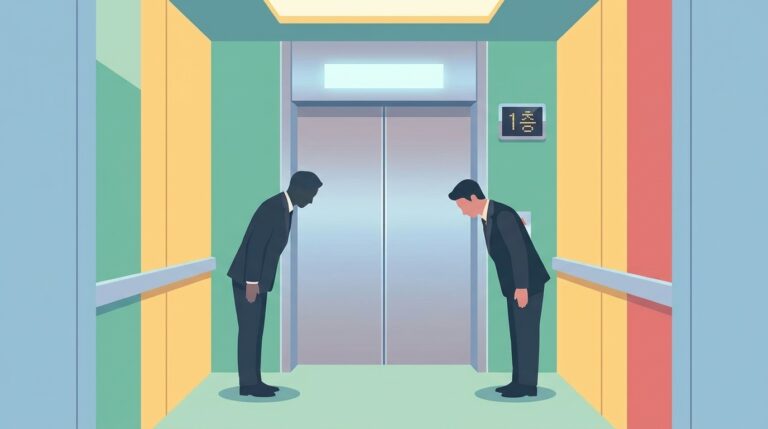
Mastering Elevator Etiquette in Korea: The Art of Subtle Small Talk and Graceful Silence
Phase 1: Empathy (Story-Immersive Opening)
안녕하세요! It is your editor from Daily Hangul here. Imagine this familiar yet nerve-wracking scenario: You step into the sleek, mirror-lined elevator of a bustling Gangnam high-rise. The doors glide shut, trapping you inside with your company’s department director, a couple of quiet colleagues from marketing, and a delivery courier clutching a steaming bag of fried chicken. Suddenly, the silence feels heavier than concrete. You wonder: Should I initiate casual small talk about the weather? Or will talking disrupt everyone’s peace?
If you have ever felt paralyzed between the urge to break an awkward pause and the fear of violating Korean social norms, you are not alone. In Western workplace cultures, elevator silence can feel cold or unapproachable. In Korea, however, an elevator is a delicate liminal space governed by rapid social calculations—hierarchies, nunchi (눈치, situational awareness), and contextual restraint. Navigating these thirty vertical seconds requires advanced socio-pragmatic competence. Based on feedback from hundreds of high-level expatriates and bilingual professionals, this guide breaks down the high-register micro-expressions, tonal modulations, and silent cues that will turn your elevator encounters from awkward hurdles into demonstrations of C2-level Korean cultural finesse.
Phase 2: Deep-Dive Analysis of 3 Key Expressions
1. 오늘 날씨가 참 변덕스럽네요 (Oneul nalssiga cham byeondeokseureopneyo)
- Pronunciation: [Oh-neul nal-ssi-ga cham byeon-deok-seu-reop-ne-yo] (Think byeon-deok sounding like ‘bun-duck’ with a sharp, crisp finish).
- Meaning: Literal: “The weather today is truly fickle.” / Real Nuance: “A neutral, safe social lubricant acknowledging an external shared discomfort without demanding an extensive response.”
- K-Culture Moment: In corporate office dramas like Misaeng or Agency, characters often bridge stiff elevator pauses by remarking on sudden seasonal downpours or freezing cold waves.
- Editor’s Insight: At a C2 proficiency level, avoid pedestrian phrases like 날씨가 좋아요 (The weather is nice). Using nuanced descriptors such as 변덕스럽다 (fickle), 쌀쌀맞다 (chilly/unforgiving), or 후텁지근하다 (sweltering and humid) signals sophisticated observation.
- Situation Spectrum: Casual (⚠️) | Semi-formal (✅) | Formal (✅)
- 🤔 Think About It: Why does Korean culture default to external environmental conditions rather than personal weekend plans when breaking silence in micro-spaces?
2. 식사는 맛있게 하셨습니까? (Siksaneun mas-itge hasyeossseumnikka?)
- Pronunciation: [Shik-sa-neun ma-shi-ge ha-syeot-seum-ni-kka] (Smoothly link the final consonant: mas-itge sounds like ma-shi-ge).
- Meaning: Literal: “Did you have a delicious meal?” / Real Nuance: “A warm, respectful workplace inquiry that establishes solidarity during post-lunch elevator runs.”
- K-Culture Moment: A junior executive bumping into the managing director around 1:15 PM inside a glass-paneled elevator, delivering a respectful greeting before naturally easing into quiet deferral.
- Editor’s Insight: This is the ultimate Korean social check-in. It does not literally demand a critique of the food; a brief “덕분에 잘 먹었습니다” (Thanks to you, I ate well) is all that is expected in return.
- Situation Spectrum: Casual (🚫 – use 밥 먹었어?) | Semi-formal (⚠️) | Formal (✅)
- 🤔 Think About It: How does caring about another person’s nourishment reflect the collective care ethic in Korean corporate culture?
3. 먼저 내려가 보겠습니다 (Meonjeo naeryeoga bogeotseumnida)
- Pronunciation: [Meon-jeo nae-ryeo-ga bo-get-seum-ni-da] (Deliver with a soft downward pitch at the end to signify courteous closure).
- Meaning: Literal: “I will go down/get off first.” / Real Nuance: “Excuse me for exiting ahead of you; thank you for the shared ride.”
- K-Culture Moment: Exiting an elevator ahead of senior staff or building neighbors, coupled with a swift 15-degree bow before the doors close.
- Editor’s Insight: Leaving an enclosed elevator without saying anything can come off as abruptly dismissive. This brief utterance softens your departure while observing hierarchical deference.
- Situation Spectrum: Casual (⚠️ – use 먼저 갈게) | Semi-formal (✅) | Formal (✅)
- 🤔 Think About It: Why is acknowledging your physical departure so essential to maintaining conversational harmony in shared Korean spaces?
Phase 3: Textbook Korean vs. Real Korean
Situation A: Acknowledging a coworker entering a crowded lift
- 📖 교과서 한국어 (Textbook Korean): 안녕하세요, 오늘 기분이 어떠세요? (Annyeonghaseyo, oneul gibuni eotteoseyo? – “Hello, how are you feeling today?”)
- 🗣️ 진짜 한국어 (Real Korean): 어서 오세요, 오늘 외근 다녀오시는 길인가 봐요? (Eoseo oseyo, oneul oegeun danyeoosineun giringa bwayo? – “Welcome in, looks like you just got back from fieldwork outside?”)
- 💡 왜 다를까?: Native Korean speakers rarely ask broad Western-style questions like “How are you feeling?” in compact spaces. They point out observable context (e.g., holding a portfolio, umbrella, or coffee) to show sharp observational awareness.
Situation B: Managing awkward silence with a superior
- 📖 교과서 한국어 (Textbook Korean): 조용하네요. 무슨 말을 해야 할까요? (Joyonghaneyo. Museun mareul haeya halkkayo? – “It is quiet. What should I say?”)
- 🗣️ 진짜 한국어 (Real Korean): (Light nod, holding the door button) 몇 층 눌러드릴까요? (Myeot cheung nulleodeurilkkayo? – “Which floor may I press for you?”)
- 💡 왜 다를까?: Filling silence for the sake of chatter can be perceived as lacking composure. Providing attentive physical support (handling the door button) communicates far higher respect and competence than forced small talk.
Phase 4: K-Culture Deep Dive & Non-Verbal Nuance
4-1. Nunchi (눈치) & The Art of Visual Demeanor
In an elevator in Seoul, non-verbal communication speaks louder than words. When sharing the lift with superiors, business partners, or elders:
* Floor Indicator Gaze: Keep your direct gaze subtly directed toward the digital floor indicator or slightly downward at a neutral angle. Sustained, unblinking eye contact inside close quarters can be interpreted as confrontational.
* The “Door Butler” Position: If you enter first and stand near the control panel, maintain your finger on the 열림 (Open) button until everyone has boarded safely. This unspoken courtesy is valued far more than verbal banter.
4-2. The Dynamics of Modern Korean Spatial Psychology
In fast-paced Korean metropolitan life, public silence is an active form of mutual consideration rather than cold disinterest. Elevators in residential apartments (아파트) or high-density office towers represent brief intermediate zones where people decompress between intense social obligations. Knowing when to offer a warm micro-greeting and when to maintain respectful silence demonstrates true cultural mastery.
Phase 5: Real-Life Roleplay Scenario
Setting: The 1st floor elevator lobby of a tech conglomerate in Pangyo Techno Valley at 8:50 AM. You step in alongside Managing Director Park (박 전무), known for his sharp professional standards.
- Turn 1 (Director Park): (Nods curtly as he steps in) 어, 김 팀장. 일찍 출근했네. (Eo, Kim Timjang. Iljjik chulgeunhaetne.)
- Turn 2 (You): 🎭 [Standing by the panel, pressing the 18th floor] 전무님, 안녕하십니까. 오늘 날씨가 갑자기 쌀쌀해졌습니다. (Jeonmunim, annyeonghasimnikka. Oneul nalssiga gapjagi ssalssalhaejyeotseumnida.)
- Turn 3 (Director Park): 그러게 말이야. 환절기라 감기 조심해야겠어. (Geureoge mariya. Hwanjeolgira gamgi josimhaeyagesseo.)
- Turn 4 (You): 🎭 [Smiling respectfully, head angled slightly] 네, 전무님께서도 건강 유의하십시오. 이번 주 프로젝트 보고 준비는 차질 없이 마쳤습니다. (Ne, jeonmunimkkeseodo geongang yu-uihasipsio. Ibeon ju peurojekteu bogo junbineun chajil eopsi machyeotseumnida.)
- Turn 5 (Director Park): 그래, 10시 회의 때 한번 짚어보지. 식사는 챙겨 먹고 출근했나? (Geurae, yeolsi hoeui ttae hanbeon jipeoboji. Siksaneun chaenggyeo meokgo chulgeunhaetna?)
- Turn 6 (You): 🎭 [Maintaining a humble, warm cadence] 네, 든든하게 챙겨 먹고 나왔습니다. (Ne, deundeunhage chaenggyeo meokgo nawasseumnida.)
- Turn 7 (Director Park): (Elevator dings at the 14th floor) 난 여기서 내려. 수고해. (Nan yeogiseo naeryeo. Sugohae.)
- Turn 8 (You): 🎭 [Holding the door button with a 30-degree bow] 네, 전무님. 좋은 하루 보내십시오! (Ne, jeonmunim. Joeun haru bonaesipsio!)
🔀 Interactive Decision Point
The elevator stops at Floor 10, and an unfamiliar executive from another division enters while looking at their phone. What is your move?
* Option A: Say brightly, “안녕하세요! 어느 부서에서 오셨어요?” (Annyeonghaseyo! Eoneu buseoeseo osyeosseoyo? – “Hello! Which department are you from?”)
* Option B: Maintain the door open button, give a soft single-nod of acknowledgment, and ask: “몇 층 눌러드릴까요?” (Myeot cheung nulleodeurilkkayo? – “Which floor can I press for you?”)
* Option C: Stare directly into your phone and ignore their presence completely.
Feedback Breakdown:
* Option A (Risk): Too intrusive for a stranger in an elevator; feels like an unexpected interrogation.
* Option B (Best): Perfect equilibrium of considerate service, respectful boundary maintenance, and refined social manners.
* Option C (Bad): Misses an opportunity for natural workplace courtesy and risks appearing indifferent.
Phase 6: 10-Second Emotion Shadowing Drill
Practice reading these lines with precise cadence and pitch modulation:
[👔 정중하고 단정한 어조]안녕하십니까 / 전무님, / 편안한 주말 보내셨습니까? (Annyeonghasimnikka / jeonmunim, / pyeon-an-han jumal bonaesyeossseumnikka?)[🤝 배려 깊고 차분하게]먼저 타세요, / 몇 층 눌러드릴까요? (Meonjeo taseyo, / myeot cheung nulleodeurilkkayo?)[🏢 조용히 엘리베이터를 나서며]좋은 하루 보내십시오, / 먼저 내려보겠습니다. (Joeun haru bonaesipsio, / meonjeo naeryeobogetseumnida.)
Phase 7: K-Culture Mini Dictionary
- 스몰 토크 (Seumol Tokeu): Casual conversational chit-chat. In modern Korean workplaces, brief comments on commuting conditions, coffee, or weather are preferred over personal background inquiries.
- 눈치 싸움 (Nunchi Ssaum): The subtle social reading game where individuals quietly observe who should push the button, step back, or enter first based on rank and age.
- 환절기 (Hwanjeolgi): The transitional season between extreme weather shifts. A classic corporate conversation starter to express mutual concern for well-being.
- 배려 (Baeryeo): Active consideration and mindfulness toward others in public shared spaces.
Phase 8: Traveler’s Survival Kit
Survival Expressions TOP 3
- 먼저 타세요 (Meonjeo taseyo – “Please go ahead and board first.”)
- Pro Tip: Use this accompanied by an open palm gesture directing toward the cabin.
- 닫힘 버튼 누를게요 (Dathim beoteun nureulgeyo – “I will press the door close button.”)
- Pro Tip: Say this softly if the cabin is full and you are operating the panel.
- 잠시만 지나가겠습니다 (Jamsiman jinagagetseumnida – “Excuse me for just a moment as I pass through.”)
- Pro Tip: Essential for exiting a packed elevator when standing at the very back.
Editor’s Travel Note
When navigating Korean office buildings, hotels, or subway transfer lifts, consult the Naver Map navigation tool to check accurate exit numbers, elevator locations for heavy luggage, and accessibility details.
Phase 9: A Step Deeper (Reflective Essay)
The brief moments shared inside an elevator capture the core tension of contemporary Korean social life: balancing intense communal harmony with the modern need for personal boundaries. In high-context cultures, speech is never merely informational; silence itself is an active communicative choice. Choosing deliberate, respectful silence over mindless chatter displays consideration for another person’s mental space. The highest standard of Korean social competence lies not in filling every quiet pause, but in holding that silence with calm, polite posture.
💬 Your Turn: How does elevator etiquette in your home country compare to Korea’s balance of silence and micro-courtesy? Share your thoughts below!
Phase 10: FAQ & Common Mistakes
Q: Is it considered rude if I stay completely silent in an elevator with coworkers?
A: Not at all! A simple, silent nod (목례, mongnye) upon boarding and exiting is completely acceptable and often preferred over forced chatter.
Q: Should I press the close button immediately after getting on?
A: Be mindful of your surroundings. Check whether someone behind you is walking toward the elevator before pressing 닫힘 (Close).
Q: How do I address a senior executive from another team whose exact title I do not know?
A: Use the polished neutral greeting “안녕하십니까” accompanied by a polite bow rather than guessing their specific managerial rank.
🚨 Common Mistakes Warning Board
- Mistake: Asking overly personal questions like “주말에 누구 만나셨어요?” (Who did you meet over the weekend?).
- Correct Action: Stick to broad, safe observations like weather or workload context.
- Mistake: Shouting across the elevator to a colleague.
- Correct Action: Use a subdued, clear conversational tone.
- Mistake: Exiting briskly without acknowledging the person holding the door.
- Correct Action: Offer a quick “감사합니다” or a courteous nod.
Phase 11: Action Mission
- 🥉 Bronze: Practice the 10-second shadowing drills until the pacing and pitch feel natural.
- 🥈 Silver: Next time you take an elevator in an international setting, practice observing spatial dynamics using quiet nunchi.
- 🥇 Gold: When taking a lift with Korean speakers, hold the door button and naturally deliver “몇 층 눌러드릴까요?”.
- 🎮 K-Culture Mission: Watch an episode of a workplace K-drama (like Misaeng or My Mister) and note how characters position themselves and manage eye contact inside office elevators.
Phase 12: Interactive Quiz Challenge
- Situational Judgment: You enter an office elevator with your company director at 1:00 PM. What is the most refined opening line?
- A) 주말에 뭐 하셨어요? (Jumare mwo hasyeosseoyo?)
- B) 전무님, 식사는 맛있게 하셨습니까? (Jeonmunim, siksaneun mas-itge hasyeossseumnikka?)
- C) 날씨가 왜 이럴까요? (Nalssiga wae ireolkkayo?)
- Fill-in-the-Blank: When exiting an elevator ahead of others, say: “먼저 ________ 보겠습니다.”
-
True / False: In Korean corporate culture, remaining quietly composed in an elevator is considered rude.
🔍 Click here to reveal answers and explanations!
- Answer: B — Inquiring about their meal with formal honorifics (식사는 맛있게 하셨습니까?) is the gold standard for lunchtime elevator courtesy.
- Answer: 내려가 (or 내려) — 먼저 내려가 보겠습니다 politely announces your exit.
- Answer: False — Respectful silence accompanied by attentive manners is considered refined and considerate.







