

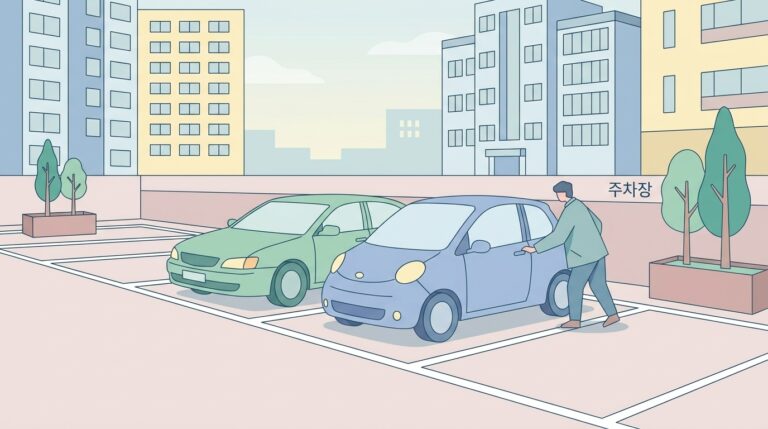
Surviving the Korean Apartment Parking War: The Secret Art of Double Parking
Phase 1: The Morning Drama on Wheels
안녕하세요! This is your Daily Hangul editor. Imagine this: You just woke up in your cozy Seoul apartment, coffee in hand, ready for an important meeting. You rush down to the underground parking lot, only to find another car parked directly behind yours, bumper-to-bumper, blocking your exit completely. In many countries, this would trigger an instant call to a towing company and pure panic. But in Korea? It is just another Tuesday morning.
Over 60% of South Koreans live in high-rise apartment complexes (apateu), where parking space is notoriously scarce. To survive this daily gridlock, Koreans developed an ingenious, unspoken social pact: Double Parking (이중 주차 – Ijung jucha). Cars are left in neutral gear so blocked drivers can physically push them out of the way! As an intermediate (B1) learner, mastering the vocabulary and etiquette of Korean parking wars will transform you from a confused outsider into an ultra-savvy local neighbor who handles tight spots with effortless grace.
Phase 2: 3 Essential Expressions for Parking Peace
1. 차 좀 빼주실 수 있나요? (Cha jom ppaejusil su innayo?)
- Pronunciation: [Cha jom ppae-joo-sil soo in-nah-yo?] (Think of cha like ‘chai’ tea without the ‘i’, and ppae like the ‘pe’ in ‘pepper’ with extra pop)
- Meaning: Literal: “Can you pull out the car a bit?” | Real Nuance: “Could you please move your car so I can get out?”
- K-Culture Moment: The polite phone call made at 7:45 AM when someone forgot to leave their car in neutral gear.
- Editor’s Insight: Adding 좀 (jom – a little/please) softens the request instantly, turning a potentially annoyed demand into a considerate neighborhood favor.
- Situation Spectrum: Casual ⚠️ | Semi-formal ✅ | Formal ✅
- 🤔 Think About It: Why does Korean rely heavily on softening adverbs like jom when making basic requests to strangers?
2. 기어 중립에 놓으셨어요? (Gieo jungnibe no-eusyeosseoyo?)
- Pronunciation: [Gee-eo joong-nip-eh noh-eu-syeo-ssuh-yo?]
- Meaning: Literal: “Did you put the gear in neutral?” | Real Nuance: “Is the handbrake off so I can push your car?”
- K-Culture Moment: Neighbors double-checking before walking up to a parked sedan with their sleeves rolled up.
- Editor’s Insight: Korean automatic cars require pressing a small ‘Shift Lock Release’ button near the gear stick to shift into ‘N’ after turning off the engine. Asking this confirms whether physical pushing is possible.
- Situation Spectrum: Casual ⚠️ | Semi-formal ✅ | Formal ✅
- 🤔 Think About It: How does communal trust play a role in allowing strangers to push your private vehicle?
3. 지금 바로 내려갈게요! (Jigeum baro naeryeogalgeyo!)
- Pronunciation: [Jee-geum bah-roh nae-ryuh-gal-geh-yo!]
- Meaning: Literal: “I will go down right now!” | Real Nuance: “So sorry to block you, I’m rushing down right away to move it!”
- K-Culture Moment: The frantic reply shouted into the phone while slipping on slippers to run to the elevator.
- Editor’s Insight: Using 바로 (baro – right now/immediately) shows high respect for the caller’s time and prevents morning road rage.
- Situation Spectrum: Casual ⚠️ | Semi-formal ✅ | Formal ✅
- 🤔 Think About It: How does the speed of response reflect courtesy in dense Korean urban life?
Phase 3: Textbook Korean vs. Real Korean
Situation 1: Asking someone to move their blocked car on the phone
- 📖 Textbook Korean: 제 차 앞에 주차된 당신의 차를 이동시켜 주십시오. (Je cha ape juchadoen dangsin-ui chareul idongsikyeo jusipsio. – “Please relocate your vehicle parked in front of my car.”)
- 🗣️ Real Korean: 안녕하세요, 죄송한데 차 앞에 막혀 있어서 차 좀 빼주시겠어요? (Annyeonghaseyo, joesonghande cha ape makyeo isseoseo cha jom ppaejusigesseoyo? – “Hello, so sorry, but I’m blocked in. Could you please move your car?”)
- 💡 Why is it different? Real Korean prioritizes politeness and humility (죄송한데) rather than legalistic commands (이동시켜 주십시오).
Situation 2: Telling someone you are on your way down
- 📖 Textbook Korean: 저는 5분 이내에 주차장으로 이동할 것입니다. (Jeoneun obun inaee juchajangeuro idonghal geosimnida. – “I shall move to the parking area within 5 minutes.”)
- 🗣️ Real Korean: 아이고 죄송합니다! 지금 바로 나갈게요! (Aigo joesonghamnida! Jigeum baro nagalgeyo! – “Oh goodness, I am so sorry! I am heading out right now!”)
- 💡 Why is it different? Natural conversation uses emotional interjections (아이고) to convey genuine regret and swift action.
Phase 4: K-Culture Deep Dive & Non-verbal Manners
4-1. Nunchi & Gestures: The Two-Handed Push & Windshield Check
When you need to push a double-parked car in Korea, body language matters:
* Check the Dashboard: Always peer through the driver side windshield first to check for a phone number pad (주차 번호판).
* Check the Wheels: Ensure the front wheels are straight before pushing, or the car will veer sideways into another vehicle!
* The Two-Handed Push: Place flat palms on reinforced metal (pillars or trunk frame), never on fragile headlights or plastic spoilers.
* The Courtesy Bow: If the owner runs out in their pajamas to move the car for you, offer a slight 30-degree bow with a friendly nod of gratitude.
4-2. Cultural Code: The Apartment Ecosystem & Shared Responsibility
In K-Dramas like Sky Castle or Reply 1988, neighborhoods thrive on collective understanding. In modern high-rise life, parking is the ultimate test of community harmony. Leaving your phone number on the dashboard is not just polite—it is considered an inviolable social contract. Failure to leave a contact number or engaging the handbrake during double parking is viewed as a major social faux pas.
Phase 5: Real-Life Roleplay Scenario
Setting: Underground Parking B2 of Mapo Rainbow Apartments, 8:15 AM.
Characters: Alex (Intermediate learner running late) & Min-woo (Friendly neighbor who double-parked).
- Alex: (Calling phone number from windshield) 🎭 Checking watch nervously 여보세요? 안녕하세요, 104동 주민인데요. (Yeoboseyo? Annyeonghaseyo, baeksadong jumindeeyo. – “Hello? Hi, I’m a resident of building 104.”)
- Min-woo: 🎭 Polite voice 네, 안녕하세요! 무슨 일이시죠? (Ne, annyeonghaseyo! Museun irisijyo? – “Yes, hello! What is the matter?”)
- Alex: 🎭 Polite and calm 죄송하지만 차가 막혀 있어서요. 혹시 기어 중립이신가요? (Joesonghajiman chaga makyeo isseoseoyo. Hoksi gieo jungnibisingayo? – “Sorry to bother you, but my car is blocked. Is your gear in neutral by any chance?”)
- Min-woo: 🎭 Gasping in realization 아! 제가 깜빡하고 사이드 브레이크를 채웠네요! (A! Jega kkamppakhago saideu beureikeureul chaewonneyo! – “Ah! I completely forgot and left the handbrake on!”)
- Alex: 🎭 Understanding tone 아, 그러시군요. 지금 출근해야 해서요. (A, geureosigunyo. Jigeum chulgeunhaeya haeseoyo. – “Ah, I see. I have to head to work now.”)
- Min-woo: 🎭 Panting sounds, running down stairs 아이고, 정말 죄송합니다. 지금 바로 내려갈게요! 1분만 기다려주세요! (Aigo, jeongmal joesonghamnida. Jigeum baro naeryeogalgeyo! Ilbunman gidaryeojuseyo! – “Oh dear, I’m so sorry! I’m running down right now! Please give me one minute!”)
- Alex: 🎭 Relieved smile 네, 조심히 내려오세요. 감사합니다. (Ne, josimhi naeryeo-oseyo. Gamsahamnida. – “Okay, take care on your way down. Thank you.”)
- Min-woo: 🎭 Arriving breathlessly in slippers, bowing 죄송합니다! 바로 빼드리겠습니다! (Joesonghamnida! Baro ppaedeurigessumnida! – “Sorry about that! I will pull it out right away!”)
🔀 Interactive Choice Point
You see a double-parked car blocking your path with no driver inside. What do you do?
* Option A: Honk your horn repeatedly until security guards arrive.
* Feedback (Bad): Honking in apartment complexes disrupts everyone and is considered aggressive. Avoid this.
* Option B: Check the gear/wheels, push gently, or call the phone number displayed on the windshield politely.
* Feedback (Best): Perfect Korean etiquette! It resolves the issue smoothly without friction.
* Option C: Try to squeeze your car out through a 10cm gap at high speed.
* Feedback (Risk): High risk of scratching vehicles and massive repair costs. Never risk it!
Phase 6: 10-Second Emotion Shadowing Drill
Practice reading these lines with realistic rhythm and emotion! (/ indicates a natural breath/pause)
[🥺 Courteous & Gentle]- 죄송한데요 / 차 앞에 막혀 있어서 / 조금만 밀어도 될까요? (Joesonghandeyo / cha ape makyeo isseoseo / jogeumman mireodo doelkkayo?)
[🏃 Hurried & Apologetic]- 어머 죄송해요! / 지금 엘리베이터 탔어요 / 바로 빼드릴게요! (Eomeo joesonghaeyo! / jigeum ellibeiteo tasseoyo / baro ppaedeurilgeyo!)
[😊 Relieved & Friendly]- 괜찮습니다 / 바쁘실 텐데 / 빨리 내려와 주셔서 감사해요! (Gwaenchansumnida / bappeusil tende / ppalli naeryeowa jusyeoseo gamsahaeyo!)
Phase 7: K-Culture Mini Dictionary
- 이중 주차 (Ijung jucha): Double parking. Parking in front of existing parking bays when all stalls are full.
- 기어 중립 (Gieo jungnip): Neutral gear (N). The vital setting required for double-parked vehicles so others can push them.
- 주차 번호판 (Jucha beonhopan): Dashboard phone number plate. A card or electronic LED displaying the car owner’s mobile number.
- 문콕 (Munkok): Door ding / door strike. Hitting an adjacent car door when opening; a frequent topic of debate in tight Korean parking slots.
Phase 8: Survival Kit for Drivers
Top 3 Survival Phrases:
- 사이드 브레이크 풀어주셨나요? (Saideu beureikeu pureojusyeonnayo?) – “Did you release the handbrake?”
- Pro Tip: Use this when pushing the car feels unexpectedly stiff.
- 앞에 차 좀 밀어도 되죠? (Ape cha jom mireodo doejo?) – “Is it okay if I push the car in front?”
- Pro Tip: Good phrase when asking security guards (경비 아저씨) for assistance.
- 주차 자리 났어요! (Jucha jari nasseoyo!) – “A parking spot just opened up!”
- Pro Tip: Yell this to your passenger when searching for empty spots at night.
Editor’s Travel Note:
When driving a rental car in Korea, ensure you use the Naver Map Navigation App or Kakao T Parking Service to find designated public parking structures if apartment parking is restricted for guests.
Phase 9: Think Deeper
Living stacked in vertical concrete communities requires a delicate balance of personal privacy and shared responsibility. Double parking reflects Korea’s hyper-dense geography and the cultural resilience known as jeong (communal bond) paired with bbali-bbali (fast pace). You trust your neighbor to move your two-ton metal vehicle safely, and in return, you promise to answer their call in seconds.
💬 Your Turn: How does parking etiquette in your home country compare to Korea’s communal pushing system? Share your thoughts below!
Phase 10: FAQ & Common Mistakes
Q: Can I double-park anywhere in Korea?
A: No. Double parking is only allowed in designated residential zones (like apartment complexes) where management permits it, never on public streets or main roads.
Q: What if I accidentally scratch a car while pushing it?
A: Under Korean law, the person who pushes the car is primarily liable for damages, though the double-parker can share partial negligence. Push with caution!
Q: What if a double-parked car doesn’t have a phone number on it?
A: Contact the apartment security office (경비실 – Gyeongbisil) with the car’s plate number; they have a registry of all resident vehicles.
🚨 Common Mistakes Warning Board:
- Mistake: Leaving the automatic gear in ‘Park’ (P) while blocking someone.
- Correct Action: Shift into ‘Neutral’ (N) using the Shift Lock button.
- Mistake: Forgetting to leave a working phone number on the dashboard.
- Correct Action: Always keep a visible contact plate on the dashboard.
- Mistake: Pushing a car when its front wheels are turned.
- Correct Action: Straighten the wheels before leaving your vehicle in neutral.
Phase 11: Action Missions
- 🥉 Bronze Mission: Practice saying “차 좀 빼주실 수 있나요?” smoothly in front of a mirror three times in 10 seconds.
- 🥈 Silver Mission: Leave a comment using today’s Korean phrases describing a funny parking incident you witnessed.
- 🥇 Gold Mission: Next time you are in Korea or driving with Korean friends, spot a car in ‘N’ gear and explain the 이중 주차 rule to someone!
- 🎮 K-Culture Mission: Watch an episode of a slice-of-life K-Drama (like Hospital Playlist) and spot the dashboard phone number pad in parking scenes!
Phase 12: Interactive Quiz Challenge
1. Situational Quiz: Your car is blocked in the morning and the car in front is in neutral gear (N). What is your best first move?
* A) Call the police
* B) Push the car gently along its lane with two hands
* C) Honk your horn continuously
👉 Click to Reveal Answer & Explanation
Correct Answer: B
Since the car is in neutral (N), it was left unlocked specifically so you can push it safely out of the way!
2. Fill in the blank: “미안하지만 차 앞에 막혀서 차 좀 ( ) 주시겠어요?”
* A) 사 (sa)
* B) 빼 (ppae)
* C) 타 (ta)
👉 Click to Reveal Answer & Explanation
Correct Answer: B (빼 – ppae)
차를 빼다 means ‘to pull out/move a car’.
3. True or False: In Korea, it is acceptable to double-park while pulling up the handbrake tightly.
* [ ] True
* [ ] False
👉 Click to Reveal Answer & Explanation
Correct Answer: False
Pulling up the handbrake locks the wheels, preventing others from pushing the car and trapping your neighbors!







