

Phase 1: Empathy & Storytelling Opening
안녕하세요! It is your friendly Daily Hangul editor and cultural navigator here.
Picture this: It is 1:00 AM in your cozy Seoul studio apartment (officetel). You have had an exhausting day exploring Gwangjang Market or surviving a busy shift. You slide under your duvet, ready for a restful sleep, when suddenly—THUD. THUD. THUMP. It sounds like a bowling championship has kicked off directly above your ceiling. Heavy footsteps, dragging chairs, or maybe even someone practicing K-Pop choreography at midnight!
If you have ever lived or stayed in an apartment, villa, or multi-unit housing in South Korea, this scenario is probably all too familiar. In Korea, this widespread issue has an official name: 층간소음 (Cheung-gan-so-eum / Inter-floor noise). It is one of the most frequent sources of neighborly tension in the country, sparking countless online debates, news segments, and K-Drama slice-of-life scenes.
Directly knocking on your upstairs neighbor’s door in anger can escalate tensions quickly due to unique Korean housing norms. Learning how to express your discomfort politely, clearly, and with proper social etiquette will save you countless sleepless nights while keeping your neighborly relationships intact. This guide was built directly from real expat experiences and local cultural rules—let’s conquer inter-floor noise together!
Phase 2: Core Expressions Deep Dive
Here are the top three essential expressions you need when addressing noise complaints politely yet firmly.
1. 층간 소음 때문에 잠을 못 자겠어요 (Cheung-gan so-eum ttaemune jameul mot jagess-eoyo)
- Pronunciation: Cheung-gan so-eum ttaemune jameul mot jagess-eoyo (Think: Cheung like the start of ‘chunk’, so-eum like ‘sew-um’, ttae-mu-ne like ‘teh-moo-neh’)
- Meaning: Literal: “I cannot sleep because of inter-floor noise.” / Nuance: “The noise from upstairs/between floors is keeping me awake.”
- K-Culture Moment: Heard frequently in realistic dramas like My Liberation Notes or Hospital Playlist, where exhausted characters vent about noisy living conditions.
- Editor’s Insight: Using
~때문에(~because of) points the blame objectively at the “noise” rather than immediately attacking the person, which softens the confrontation.- Situation Spectrum: Casual: ⚠️ (Only with close friends) | Semi-formal: ✅ (Ideal for building managers/security) | Formal: ✅
- 🤔 Think About It: In your home culture, do you directly tell people “You are loud,” or do you blame the environment first like in Korean?
2. 밤늦게 조금만 조용히 해 주실 수 있나요? (Bamneujge jogeumman joyonghi hae jusil su innayo?)
- Pronunciation: Bam-neut-ge jo-geum-man jo-yong-hi hae ju-sil su in-na-yo? (Rhymes gently: Bam like ‘balm’, jog-eum like ‘joe-geum’, joyonghi like ‘joe-yong-hee’)
- Meaning: Literal: “Could you do [things] a little quietly late at night?” / Nuance: “Could you please keep it down a bit during late hours?”
- K-Culture Moment: The standard polite phrase written on sticky notes or conveyed via building security when requesting quiet after 10 PM.
- Editor’s Insight: The word
조금만(just a little bit) acts as an essential Korean politeness cushion (huan-chung-eo). It avoids sounding demanding while making the request very clear.- Situation Spectrum: Casual: 🚫 | Semi-formal: ✅ | Formal: ✅
- 🤔 Think About It: Notice how asking as a question (
~수 있나요?) in Korean gives the other party room to save face.3. 관리사무소에 말씀드려 볼게요 (Gwanri-samuso-e malsseumdeuryeo bolgeyo)
- Pronunciation: Gwal-li-sa-mu-so-e mal-sseum-deu-ryeo bol-ge-yo
- Meaning: Literal: “I will speak to the management office.” / Nuance: “I’ll bring this up with building management / security to handle it.”
- K-Culture Moment: Common roommate dialogue when deciding not to confront the neighbor directly to avoid an awkward face-to-face dispute.
- Editor’s Insight: In South Korea, resolving building disputes through a third party (the management office or security guard) is the recommended social and legal standard.
- Situation Spectrum: Casual: ✅ | Semi-formal: ✅ | Formal: ✅
- 🤔 Think About It: Why does Korean society prefer mediation via community managers over individual confrontation?
Phase 3: Textbook Korean vs. Real Korean
Let’s compare stiff dictionary phrases with how native Koreans actually handle noise issues at the intermediate (B1) level.
Situation 1: Explaining footstep thumping noises
- 📖 Textbook Korean: 위층에서 발소리가 너무 큽니다. (Wicheung-eseo balsoriga neomu keumnida. – “Footstep sounds from the upper floor are very big.”)
- 🗣️ Real Korean: 위층에서 발망치 소리가 너무 심하게 들려요. (Wicheung-eseo balmangchi soriga neomu simhage deullyeoyo. – “The heavy foot-stomping from upstairs is coming through way too loudly.”)
- 💡 Why is it different? Koreans coined the vivid slang term 발망치 (Bal-mang-chi), combining 발 (foot) and 망치 (hammer), to describe heavy heel-walking on hard apartment floors.
Situation 2: Asking someone nicely via a note or message
- 📖 Textbook Korean: 조용히 하십시오. (Joyonghi hasipsio. – “Be quiet.”)
- 🗣️ Real Korean: 늦은 시간이라 조금만 양해 부탁드립니다. (Neujeun sigan-ira jogeumman yanghae butakdeurimnida. – “Since it is late, we kindly ask for your understanding and cooperation.”)
- 💡 Why is it different? Commands sound aggressive. Using 양해 부탁드립니다 (asking for understanding) is the standard, polite, adult Korean phrase for asking people to be considerate.
Phase 4: K-Culture Deep Dive & Non-Verbal Manners
4-1. Nunchi (눈치) & Non-Verbal Etiquette
- Do NOT pound on the ceiling or ring the neighbor’s doorbell directly: In Korean apartment law and culture, direct confrontation is discouraged and can sometimes even lead to trespassing or harassment counter-complaints.
- The Post-It Note Method (포스트잇 쪽지): If you must reach out directly, Koreans frequently leave a courteous sticky note on the neighbor’s front door with a soft beverage (like a can of warm coffee or vitamin drink) attached.
- Soft Tone over Aggression: When speaking to the security officer (Gyeongbi-ajeossi), keep your voice calm and apologetic: “저기, 죄송하지만…” (Excuse me, I’m sorry to bother you, but…). Expressing respect to building staff gets your issue solved twice as fast.
4-2. Cultural Code: The Structure of Korean Homes
Most Koreans live in high-rise apartments (Apateu) or studio villas (Officetel / One-room) built with reinforced concrete and radiant underfloor heating (Ondol, 온돌). Because the heating pipes run directly through the floor slabs, impacts (like heel-walking or dropping objects) vibrate straight into the ceiling of the unit below. This architectural reality makes 층간소음 a national shared trauma and an everyday conversational topic.
Phase 5: Real-Life Roleplay Scenario
Setting: You visit the security office (경비실, Gyeongbi-sil) on the ground floor of your apartment building at 11:30 PM because the unit above you (Room 702) is playing loud music and jumping.
Characters: You (유학생/거주자) & Mr. Park (경비 아저씨 – Friendly Building Security Guard).
- Turn 1 (You): 안녕하세요, 아저씨. 늦은 시간에 죄송합니다. (Annyeonghaseyo, ajeossi. Neujeun sigane joesonghamnida.)
- 🎭 Politely bowing your head with hands folded in front.
- “Hello, sir. I’m sorry to disturb you so late.”
- Turn 2 (Mr. Park): 네, 무슨 일이세요? 학생, 안 자고 왜 내려왔어요? (Ne, museun iriseyo? Haksaeng, an jago wae naeryeowasseoyo?)
- 🎭 Looking up curiously from his desk logbook.
- “Yes, what’s going on? Why are you down here instead of sleeping?”
- Turn 3 (You): 실은 702호 층간 소음 때문에 잠을 못 자겠어요. (Sireun chil-baek-i-ho cheung-gan so-eum ttaemune jameul mot jagess-eoyo.)
- 🎭 Looking tired, speaking in a calm, respectful tone.
- “Actually, I can’t sleep because of the noise from room 702.”
- Turn 4 (Mr. Park): 아이고, 702호가 또 그래요? 무슨 소리가 나는데요? (Aigo, chil-baek-i-hoga tto geuraeyo? Museun soriga naneundeyo?)
- 🎭 Sighing with recognition, adjusting his glasses.
- “Oh dear, is 702 at it again? What kind of noise is it?”
- Turn 5 (You): 음악 소리도 크고, 쿵쿵거리는 발소리가 계속 들려요. (Eum-ak sorido keugo, kung-kung-georineun bal-soriga gyesok deullyeoyo.)
- 🎭 Gently gesturing with your hands to indicate vibrations.
- “The music is loud, and I keep hearing continuous stomping footstep sounds.”
- Turn 6 (Mr. Park): 밤이 늦었는데 너무하네. 내가 바로 인터폰으로 연락해 볼게요. (Bami neujeonneunde neomuhane. Naega baro inteoponeuro yeollakhae bolgeyo.)
- 🎭 Reaching for the wall intercom system.
- “It’s way too late for that. I’ll contact them via intercom right now.”
- Turn 7 (You): 네, 주의 좀 부탁드립니다. 정말 감사합니다! (Ne, ju-ui jom butakdeurimnida. Jeongmal gamsahamnida!)
- 🎭 Bowing slightly with gratitude.
- “Yes, please ask them to be careful. Thank you so much!”
- Turn 8 (Mr. Park): 그래요, 얼른 올라가서 쉬어요. 내가 잘 얘기할게요. (Geuraeyo, eolleun ollagaseo swieoyo. Naega jal yaegihalgeyo.)
- 🎭 Giving a warm nod of reassurance.
- “Alright, head back up and rest. I will handle it properly.”
🔀 Interactive Branching Choice
If the upstairs neighbor continues making loud thuds the next day, what should you do?
- Option A: Walk upstairs, bang aggressively on their door, and yell “너무 시끄러워요!” (Neomu sikkeureowoyo!).
- ❌ Feedback (Bad): High risk! Face-to-face emotional confrontation often causes retaliation and violates Korean community dispute guidelines.
- Option B: Write a polite sticky note with a polite phrase like “밤늦게 조금만 조용히 해 주시면 감사하겠습니다” and attach a small drink to their door.
- ⚠️ Feedback (Risk/Moderate): Acceptable in many modern buildings, but some sensitive neighbors may still react defensively. Keep it super polite!
- Option C: Report the issue again to the 관리사무소 (Management Office) or log it through the building’s official resident app.
- ✅ Feedback (Best): The gold standard in Korea. Official third-party documentation protects your privacy and maintains legal peace.
Phase 6: 10-Second Emotion Shadowing Drill
Practice saying these lines with the exact emotion and rhythm indicated by slashes / (micro-pauses):
[🥺 Exhausted and polite]- Sentence: 실은 / 층간 소음 때문에 / 며칠째 잠을 못 자고 있어요. (Sireun / cheung-gan so-eum ttaemune / myeochiljjae jameul mot jago isseoyo.)
- English: Actually / due to the floor noise / I haven’t been able to sleep for days.
[🙏 Earnest and gentle request]- Sentence: 밤 10시 이후에는 / 조금만 / 조용히 해 주실 수 있나요? (Bam yeol-si i-hue-neun / jogeumman / joyonghi hae jusil su innayo?)
- English: After 10 PM / just a little bit / could you please keep it down?
[🤝 Diplomatic and appreciative]- Sentence: 이웃끼리 / 서로 조금씩만 / 배려하면 좋겠습니다. (Iut-kkiri / seoro jogeum-ssik-man / baeryeohamyeon jokess-seumnida.)
- English: As neighbors / for each other just a little / it would be great if we could be considerate.
Phase 7: K-Culture Mini Dictionary
- 층간소음 (Cheung-gan-so-eum) | Noun: Inter-floor noise in apartment complexes.
- Essential term used in contracts, official complaints, and daily chats.
- 경비실 / 관리사무소 (Gyeongbi-sil / Gwanri-samuso) | Noun: Security Office / Building Management Office.
- The first place you contact for maintenance, parcel questions, or noise dispute mediation.
- 쿵쿵거리다 (Kung-kung-georida) | Verb: To make heavy thudding or stomping sounds.
- Onomatopoeic verb describing footsteps, jumping kids, or dropped heavy items.
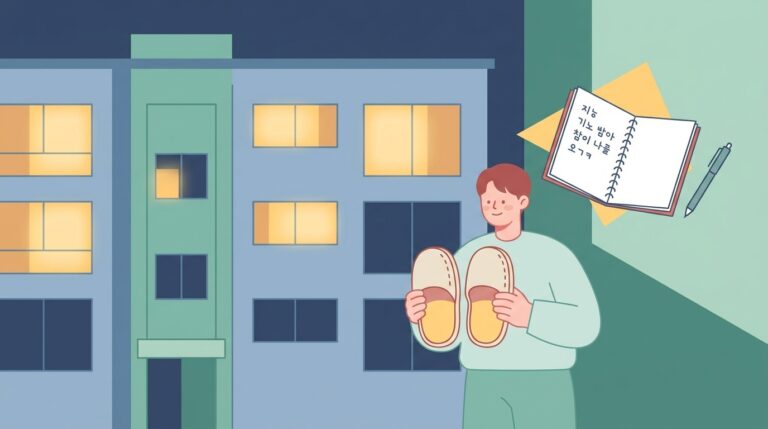
- 실내화 (Sil-nae-hwa) | Noun: Indoor slippers / padded house shoes.
- The number one gift or self-purchase Koreans use to reduce foot-step noise (bal-mang-chi) at home.
Phase 8: Expat & Traveler Survival Kit
Top 3 Survival Phrases
- 소음 때문에 연락드렸어요. (So-eum ttaemune yeollakdeuryeosseoyo.) – “I’m contacting you regarding the noise.”
- Pro Tip: Use this when calling your landlord or messaging building staff.
- 조금만 주의해 주세요. (Jogeumman ju-ui-hae juseyo.) – “Please be a little careful / mindful.”
- Pro Tip: Firm yet formal way to request caution.
- 슬리퍼를 신어 주실 수 있을까요? (Seullipeoreul sineo jusil su isseulkkayo?) – “Could you perhaps wear slippers?”
- Pro Tip: A constructive solution to suggest when the main issue is heavy heel walking.
Editor’s Travel & Living Note
If you reside in South Korea long-term and inter-floor noise becomes unmanageable, you can utilize the government-run public dispute service. Check out the National Inter-floor Noise Neighborhood Center website for free professional mediation and acoustic measurement services.
Phase 9: Think Deeper (Cultural Reflection)
South Korea shifted from horizontal village communities (Hanok villages) to high-density vertical concrete apartments within just a couple of generations. While Koreans deeply value communal harmony (Jeong, 정) and avoiding direct discord, the enclosed nature of modern apartments often creates tension between private freedom and communal duty. Understanding that polite indirectness is an act of consideration—not cowardice—helps you navigate Korean societal dynamics with ease.
💬 Your Turn: How does your home country manage apartment noise? Do people knock directly on doors, call the landlord, or call the police? Share your experiences in the comments below!
Phase 10: FAQ & Common Mistakes
Q: Can I call the police (112) for apartment noise in Korea?
A: In general, the police treat standard residential noise as a civil matter (min-sa) rather than a criminal issue and will usually direct you back to the building security or management office. Reserve 112 calls only for extreme late-night disturbances involving suspected violence or illegal gatherings.
Q: What is the official quiet hours standard in Korean residential buildings?
A: Most apartment complexes recommend keeping noise to a minimum between 10:00 PM and 6:00 AM. Heavy washing machines, vacuuming, and loud music should be avoided during these hours.
Q: Is hitting the ceiling with a stick or broomstick allowed?
A: No. Repeated retaliatory hitting of ceilings or installing intentional retaliatory speaker devices can make you legally liable for civil damages in Korean courts. Always follow proper mediation channels.
🚨 Common Mistakes (흔한 실수 TOP 3)
| Mistake | Why it hurts | Correct Action |
|---|---|---|
| 1. Knocking furiously on the neighbor’s door | Escalates emotional conflict immediately | Contact the 경비실 (Security Office) to mediate politely |
| 2. Saying “조용히 해!” (Casual imperative) | Sounds like an insult to an adult neighbor | Say “조금만 조용히 해 주실 수 있나요?” |
| 3. Vacuuming past 10:00 PM | Hard vibrations carry through Ondol pipes | Complete cleaning chores during daytime or before 9:00 PM |
Phase 11: Action Missions
- 🥉 Bronze Mission (Solo Practice): Practice the Phase 6 Shadowing drill 3 times aloud in front of a mirror with polite facial expressions.
- 🥈 Silver Mission (Community / Social): Share your favorite Korean onomatopoeia (e.g., 쿵쿵 kung-kung) on your Instagram story or language study group with the tag
#DailyHangul. - 🥇 Gold Mission (Real Life / Immersion): Look up where the 관리사무소 (Management Office) or 경비실 is located in your building or Airbnb accommodation.
- 🎮 K-Culture Mission: Watch an episode of a Korean variety show or reality show (like I Live Alone / 나 혼자 산다) and spot what kind of indoor slippers (실내화) celebrities wear at home!
Phase 12: Interactive Quiz Challenge
Test your knowledge with these 3 quick questions!
1. Situational Judgment
It is 11:45 PM and the floor above you is vibrating with heavy foot-thumping. What is the most culturally natural first step in Korea?
* A) Ring their doorbell and shout in Korean.
* B) Call or visit the 경비실 (Security office) / 관리사무소 and politely ask for mediation.
* C) Bang the ceiling repeatedly with a mop handle.
2. Fill-in-the-Blank
Fill in the missing word for polite request cushion:
“밤늦게 ________ 조용히 해 주실 수 있나요?” (Could you please be quiet just a little bit late at night?)
* A) 아주 (Aju)
* B) 조금만 (Jogeumman)
* C) 무조건 (Mujogeon)
3. True or False
Statement: In Korean apartment culture, vacuuming at midnight is completely fine as long as you do it inside your private apartment.
* True / False
👉 Click here to check the answers & explanations!
- Answer: B | Explanation: Contacting the security office (경비실) prevents awkward confrontations and is the standard practice in Korea.
- Answer: B (조금만) | Explanation:
조금만(just a little) softens requests and makes them sound exceptionally polite and reasonable. - Answer: False | Explanation: Underfloor heating (Ondol) conducts motor vibrations straight downstairs. Late-night vacuuming is considered a major breach of neighborly etiquette (Eti-ket).







