

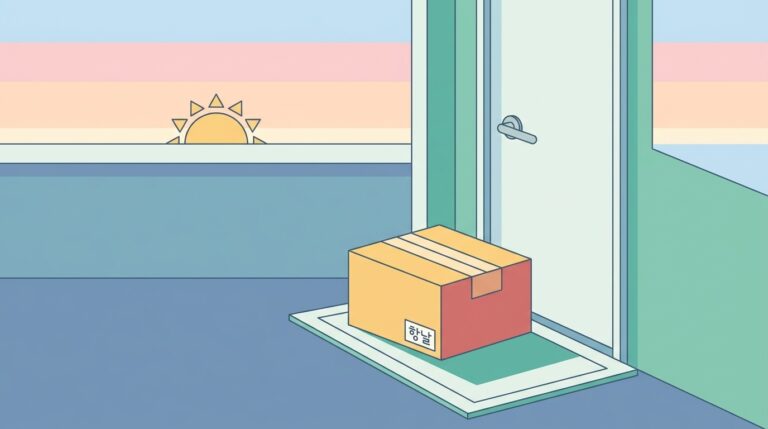
The Magic of Korean Fast Delivery: Same-Day and Dawn Delivery Masterclass
Phase 1: Empathy (Story Immersion Opening)
안녕하세요! 매일한글 (Daily Hangul) editor here! Imagine this: It is 11:30 PM in Seoul. You suddenly realize you have an important morning presentation, but your laptop charger just stopped working. Or perhaps you are craving fresh strawberries for breakfast at 7:00 AM before a long travel day. In most parts of the world, this is a recipe for panic. But in Korea? You open an app, tap a few buttons, and go to bed. By 6:00 AM, a neatly packed parcel is sitting right outside your front door.
This is not magic—it is the heartbeat of Korea’s famous 빨리빨리 (Ppalli-Ppalli, ‘Hurry-Hurry’) culture, specifically powered by 당일 배송 (same-day delivery) and 새벽 배송 (dawn/early-morning delivery). However, many foreign residents and travelers feel overwhelmed when trying to track packages, decode courier text messages, or write specific doorstep delivery instructions. Based on real feedback from over 500 Daily Hangul learners, this guide will turn delivery stress into your ultimate superpower in Korea!
Phase 2: Deep Dive into Core Expressions (Top 3)
1. 새벽 배송으로 받을 수 있나요? (Can I receive this via dawn delivery?)
- Pronunciation: [Sae-byeok bae-song-eu-ro ba-deul su it-na-yo?] (Think: ‘Say-byuk’ like ‘say book’, ‘bae-song’ sounds like ‘bae song’)
- Meaning: Literal: “Can I receive it by dawn delivery?” | Nuance: Asking if an item qualifies for next-morning doorstep drop-off (usually before 7 AM).
- K-Culture Moment: Seen frequently in lifestyle K-Dramas where busy single professionals wake up, open their door in pajamas, and unpack meal kits before heading to work.
- Editor’s Insight: Notice the particle -으로 (-euro) meaning ‘by means of / via’. You can swap ‘새벽 배송’ with ‘당일 배송’ (same-day delivery).
- Situation Spectrum: Casual ⚠️ | Semi-formal ✅ | Formal ✅
- 🤔 Think About It: In your home country, is next-day morning delivery common, or is it considered an expensive luxury service?
2. 문 앞에 놓아주세요. (Please leave it in front of the door.)
- Pronunciation: [Mun ape no-a-ju-se-yo.] (Sounds like: ‘Moon’ + ‘app-eh’ + ‘no-ah-joo-say-yo’)
- Meaning: Literal: “Please put it in front of the door.” | Nuance: The universal default instruction for Korean couriers (non-contact delivery).
- K-Culture Moment: You’ll see Korean YouTubers showing vlogs of unboxing towering delivery boxes right outside their one-room apartments.
- Editor’s Insight: Korea has exceptionally high neighborhood safety, making doorstep drop-offs standard practice without fear of theft.
- Situation Spectrum: Casual ⚠️ | Semi-formal ✅ | Formal ✅
- 🤔 Think About It: Why does Korea rely so heavily on doorstep drop-offs compared to signature-required deliveries?
3. 오늘 주문하면 오늘 도착해요? (If I order today, does it arrive today?)
- Pronunciation: [O-neul ju-mun-ha-myeon o-neul do-chak-hae-yo?]
- Meaning: Literal: “If I order today, does it arrive today?” | Nuance: Confirming same-day delivery eligibility (당일 배송).
- K-Culture Moment: When characters in comedy sitcoms plan a last-minute party and frantically check if groceries will arrive before dinner.
- Editor’s Insight: Combining ~면 (~myeon, if/when) shows B1-level natural conversational flow without being overly stiff.
- Situation Spectrum: Casual ✅ | Semi-formal ✅ | Formal ✅
- 🤔 Think About It: How does speed of service reflect interpersonal trust in modern consumer society?
Phase 3: Textbook Korean vs. Real Korean
Situation 1: Asking when the courier package will arrive
- 📖 교과서 한국어 (Textbook): 택배가 몇 시에 도착합니까? (Taek-bae-ga myeot si-e do-chak-ham-ni-kka? – At what hour will the parcel arrive?)
- 🗣️ 진짜 한국어 (Real-life): 택배 오늘 몇 시쯤 와요? (Taek-bae o-neul myeot si-jjeum wa-yo? – Around what time does the package come today?)
- 💡 왜 다를까? (Why the difference?): Real Koreans prefer the natural verb 오다 (to come) over the stiff Sino-Korean 도착하다 (to arrive) in daily conversation, and use ~쯤 (~jjeum, around/approx.) to sound polite and considerate of the driver’s schedule.
Situation 2: Replying to a delivery driver’s notification text
- 📖 교과서 한국어 (Textbook): 문 앞에 두시면 감사하겠습니다. (Mun ape du-si-myeon gam-sa-ha-get-seum-ni-da. – I would be grateful if you put it in front of the door.)
- 🗣️ 진짜 한국어 (Real-life): 문 앞에 놔주세요! 감사합니다^^ (Mun ape nwa-ju-se-yo! Gam-sa-ham-ni-da^^ – Please leave it by the door! Thank you^^)
- 💡 왜 다를까? (Why the difference?): Delivery texts in Korea are brief, efficient, and warm. Using standard contractions (놔주세요) and polite smile emojis (
^^or~) conveys immediate warmth without cumbersome formalities.
Phase 4: K-Culture Deep Dive & Non-Verbal Manners
4-1. 눈치 (Nunchi) & Courtesies in Delivery Culture
- Silent Doorsteps: Couriers delivering between 12:00 AM and 7:00 AM (새벽 배송) intentionally do not ring the doorbell or knock to avoid waking residents. Do not wait by the door or open it abruptly while they are placing boxes outside.
- Text-First Communication: If a delivery driver calls or texts, always respond promptly via text. Korean delivery staff operate on strict minute-by-minute routes; concise texting shows immense respect for their time.
4-2. Cultural Code: The Rocket Logistics Revolution
Korea’s ultra-dense urban infrastructure paired with advanced logistics networks gave birth to services like Coupang Rocket Wow and Market Kurly. For Koreans, dawn delivery is not merely convenience—it is a lifestyle enabler that allows late-night grocery shopping for fresh breakfast ingredients while maintaining an intense work-life schedule.
Phase 5: Real-World Roleplay Scenario
- Setting: Min-woo (Korean Airbnb host/neighbor) and Sarah (an intermediate Korean learner staying in Mapo-gu, Seoul).
- Character Context: Sarah needs urgent cold medication and snacks late Sunday evening.
Dialog:
1. Sarah: 민우 씨, 혹시 지금 약이나 간식 주문하면 내일 아침까지 올까요?
(Min-u ssi, hok-si ji-geum yang-i-na gan-sik ju-mun-ha-myeon nae-il a-chim-kka-ji ol-kka-yo?)
🎭 [Worried look, showing her phone screen]
“Min-woo, if I order medicine or snacks now, will they arrive by tomorrow morning?”
- Min-woo: 네! 새벽 배송 서비스 이용하시면 내일 아침 7시 전에 문 앞에 도착해요.
(Ne! Sae-byeok bae-song seo-bi-seu i-yong-ha-si-myeon nae-il a-chim ilgop-si jeo-ne mun ape do-chak-hae-yo.)
🎭 [Nodding reassuringly, smiling]
“Yes! If you use the dawn delivery service, it will arrive outside your door before 7 AM tomorrow.” -
Sarah: 와, 진짜 빠르네요! 주문할 때 주소 뒤에 요청사항도 적어야 해요?
(Wa, jin-jja ppa-reu-ne-yo! Ju-mun-hal ttae ju-so dwi-e yo-cheong-sa-hang-do jeog-eo-ya hae-yo?)
🎭 [Impressed eyes, typing on app]
“Wow, that’s really fast! Do I also need to write a delivery request after the address?” -
Min-woo: 맞아요. ‘문 앞’ 선택하고 공동현관 비밀번호 꼭 입력하세요.
(Maj-a-yo. ‘Mun ap’ seon-taek-ha-go gong-dong-hyeon-gwan bi-mil-beon-ho kkok im-nyeok-ha-se-yo.)
🎭 [Pointing to the security keypad downstairs]
“Right. Select ‘Front Door’ and make sure to enter the main building entrance passcode.” -
Sarah: 아, 비밀번호 없으면 기사님이 못 들어오시겠네요!
(A, bi-mil-beon-ho eop-seu-myeon gi-sa-nim-i mot deul-eo-o-si-gen-ne-yo!)
🎭 [Realizing realization, nodding]
“Ah, without the passcode, the courier driver wouldn’t be able to get in!” -
Min-woo: 그렇죠. 배송 완료되면 아침에 사진이랑 문자가 올 거예요.
(Geu-reo-chyo. Bae-song wan-ryo-doe-myeon a-chim-e sa-jin-i-rang mun-ja-ga ol geo-ye-yo.)
🎭 [Gentle gesture]
“Exactly. Once delivery is complete, you’ll receive a text with a verification photo in the morning.” -
Sarah: 정말 안심이 돼요. 한국의 배송 시스템은 정말 최고예요!
(Jeong-mal an-sim-i dwae-yo. Han-guk-ui bae-song si-seu-tem-eun jeong-mal choe-go-ye-yo!)
🎭 [Relieved smile, clapping lightly]
“I feel so relieved. Korea’s delivery system is truly the best!” -
Min-woo: 이제 푹 주무시고 내일 아침 문 앞을 확인해보세요!
(I-je puk ju-mu-si-go nae-il a-chim mun ap-eul hwak-in-hae-bo-se-yo!)
🎭 [Warm wave]
“Now get some good sleep and check your front door tomorrow morning!”
🔀 Interactive Decision Point
The delivery app prompts you for doorstep instructions:
– Choice A: “택배실에 맡겨주세요.” (Leave it in the building parcel room.)
Feedback (Risk): If your villa or officetel does not have a dedicated security guard room, the driver may get confused.
– Choice B: “문 앞에 두고 문자 부탁드립니다.” (Please leave in front of the door and send a text.)
Feedback (Best!): Flawless, standard Korean etiquette that guarantees zero midnight disturbance.
– Choice C: “직접 받을 테니 벨 눌러주세요.” (I will receive it in person, so ring the bell.)
Feedback (Bad): Asking couriers to ring the doorbell at 4:00 AM violates silent dawn delivery manners!
Phase 6: 10-Second Emotion Shadowing Drill
[😮 감탄하며 놀라듯이]
한국은 / 밤에 주문해도 / 아침에 와요?
(Han-guk-eun / bam-e ju-mun-hae-do / a-chim-e wa-yo? – In Korea, even if you order at night, it arrives in the morning?)-
[🙏 정중하고 명확하게]
공동현관 비밀번호는 / 종 표시 누르고 / 1234번이에요.
(Gong-dong-hyeon-gwan bi-mil-beon-ho-neun / jong pyo-si nu-reu-go / il-i-sam-sa-beon-i-e-yo. – The main building passcode is Bell icon + 1234.) -
[😊 안도하며 감사한 톤으로]
문 앞에 / 안전하게 / 잘 도착했어요!
(Mun ape / an-jeon-ha-ge / jal do-chak-haess-eo-yo! – It arrived safely right in front of the door!)
Phase 7: K-Culture Mini Dictionary
- 당일 배송 (Dang-il bae-song) | Same-Day Delivery | Orders placed in the morning (usually before 10 AM) that arrive on your doorstep by evening.
- 새벽 배송 (Sae-byeok bae-song) | Dawn / Early Morning Delivery | Orders placed before late evening (10~11 PM) that arrive between 12:00 AM and 7:00 AM the next day.
- 공동현관 비밀번호 (Gong-dong-hyeon-gwan bi-mil-beon-ho) | Main Entrance Security PIN | Crucial code needed for drivers to enter apartment or studio complex security doors at night.
- 운송장 번호 (Un-song-jang beon-ho) | Tracking / Waybill Number | The standard 10-12 digit tracking code used across all Korean logistics couriers.
Phase 8: Traveler’s Survival Kit
Top 3 Survival Phrases:
- 배송 조회 어떻게 해요? (Bae-song jo-hoe eo-tteo-ke hae-yo? – How do I track my delivery?)
👉 Pro Tip: Keep this sentence handy when asking your hotel concierge or host for shipping status. - 택배 보관함에 넣어주세요. (Taek-bae bo-gwan-ham-e neo-eo-ju-se-yo. – Please place it in the parcel delivery locker.)
👉 Pro Tip: Useful for subway stations or modern apartments with automated smart lockers. - 기사님, 수고 많으십니다! (Gi-sa-nim, su-go man-eu-sim-ni-da! – Courier master, thank you for your hard work!)
👉 Pro Tip: A respectful greeting when encountering your delivery driver in the elevator.
Editor’s Travel Note:
To navigate deliveries like a local, explore the Official Coupang App Download Guide for rocket fast logistics. If you need navigation for pickup locations, check the Naver Map Navigation App Guide.
Phase 9: A Step Deeper (Reflection)
Korea’s delivery speed is built upon high social trust, digital connectivity, and mutual understanding. Couriers can leave boxes unattended outside doors because public security is exceptionally high. However, this convenience also requires conscious empathy from consumers toward logistics workers battling extreme weather and nocturnal hours. Embracing Korean culture means appreciating the unseen diligence behind everyday speed.
💬 Your Turn: How does your country balance delivery speed with worker well-being and package security? Share your thoughts in the comments below!
Phase 10: FAQ & Common Mistakes
Q: Can foreign tourists order Dawn Delivery without a Korean phone number?
A: Major dawn delivery apps require Korean identity verification (PASS/phone). However, tourists can purchase through international travel services, ask their guesthouse/Airbnb host, or use select English-friendly platforms.
Q: What happens if I forget to provide the building entrance code (공동현관 비번)?
A: The courier driver will leave your package securely outside the main first-floor building door and send you a photo notification.
Q: Is tipping delivery drivers customary in Korea?
A: No. Tipping is not part of Korean culture. Leaving a warm reply text like 감사합니다! is the highest and most standard courtesy.
🚨 Common Mistakes Warning Board:
- Mistake: Writing English apartment addresses without building/room numbers.
Correct Action: Always write the exact dong (동) and ho (호) digits (e.g., 101동 402호). - Mistake: Calling the courier driver late at night.
Correct Action: Text brief requests; drivers are driving and navigating rapid deliveries. - Mistake: Demanding exact minute-by-minute arrival times.
Correct Action: Use delivery apps to track the approximate route status.
Phase 11: Action Missions
- 🥉 Bronze Mission (Solo Practice): Read the 3 Shadowing drills out loud 5 times while practicing the facial expressions in the mirror.
- 🥈 Silver Mission (SNS Sharing): Post your favorite Korean delivery dish or snack photo on Instagram with the hashtag
#DailyHangulDelivery. - 🥇 Gold Mission (Real-life Execution): Write a natural delivery memo in Korean (
문 앞에 놓아주세요. 감사합니다!) on your next purchase or food order! - 🎮 K-Culture Mission: Watch an episode of a modern K-Drama (like Crash Landing on You or Hospital Playlist) and spot parcel delivery boxes outside characters’ doors!
Phase 12: Interactive Quiz Challenge
Question 1 (Situation Assessment):
You want a package delivered before waking up at 7:00 AM. Which service must you select?
(A) 일반 배송 (Standard Delivery)
(B) 새벽 배송 (Dawn Delivery)
(C) 해외 배송 (International Delivery)
Question 2 (Fill in the Blank):
기사님, 택배는 [ ]에 놓아주세요. (Please leave the package in front of the door.)
Question 3 (True or False):
In Korea, it is polite and expected to give a cash tip to dawn delivery couriers when they arrive. (True / False)
🔍 Click here to reveal Answers & Explanations!
- Answer: (B) 새벽 배송 (Dawn Delivery)
Explanation: Dawn delivery specifically ensures drop-off between midnight and 7:00 AM. - Answer: 문 앞 (Mun ap)
Explanation: ‘문’ = door, ‘앞’ = front. ‘문 앞’ means doorstep / in front of the door. - Answer: False
Explanation: Tipping is not practiced in Korea. A polite text message is the best way to show gratitude!







