

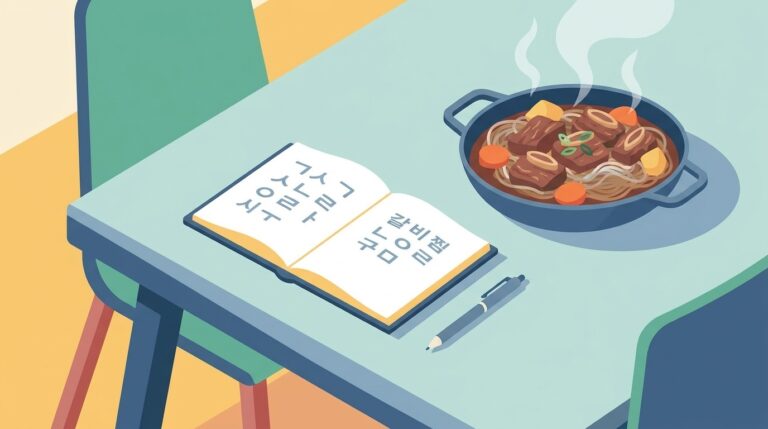
Unlock the Secret to Korean Jjim: How to Cook and Talk Like a Local Braised Dish Master
Phase 1: Empathy (Story Immersion Opening)
안녕하세요! Welcome back to Daily Hangul. Have you ever stood in a Korean kitchen, or sat across from a Korean friend while watching a steaming pot of Galbi-jjim (갈비찜, braised beef short ribs) or Andong Jjimdak (안동찜닭, braised chicken), wanting so badly to ask for their exact family recipe—only to find yourself stuck saying “이거 맛있어요, 어떻게 만들어요?” (This is delicious, how do you make it?)?
We have all been there. In Korean cuisine, Jjim (찜)—the art of gentle braising, steaming, and slow-simmering—is not just cooking; it is considered the ultimate labor of love (정성). The textures are tender, the sauces hit that magical dan-jjan (sweet and savory) balance, and the conversation around the table is rich with vivid sensory vocabulary. If you only know textbook words like 요리하다 (to cook) or 넣다 (to put in), you will miss out on the rich cultural nuances that bring Korean culinary conversations to life.
As a 10-year Korean cultural navigator, I have gathered feedback from hundreds of intermediate learners who craved natural, high-level culinary phrasing. Today, we are taking your Korean to the B2 Intermediate level so you can describe cooking steps, exchange secret culinary tips, and bond with Korean foodies like a true insider!
Phase 2: Top 3 Core Expressions In-Depth
1. 양념이 쏙 배어들다 (Yang-nyeom-i ssok bae-eo-deul-da)
- Pronunciation: [Yang-nyeom-i ssok bae-eo-deul-da] (Think: “ssok” sounds like a smooth “soak” that slides right into place!)
- Meaning: Literal: “The seasoning deeply soaks in.” / Nuance: “The sauce is infused deep into every layer of the meat or vegetables.”
- K-Culture Moment: Seen in almost every episode of K-variety food shows like Three Meals a Day (삼시세끼) when chefs praise braised potatoes or radish that have absorbed all the rich savory broth.
- Editor’s Insight: 쏙 is an onomatopoeic/mimetic word describing something slipping completely and smoothly into a space. Using 배어들다 instead of the simple 들어가다 (to enter) instantly elevates your Korean to intermediate native fluency.
- Situation Spectrum: Casual: ✅ | Semi-formal: ✅ | Formal: ⚠️
- 🤔 Think About It: In English, we often say “marinated well” or “absorbed,” but Korean emphasizes the physical visual of flavor penetrating the core with 쏙. How does your native language describe deep flavor penetration?
2. 약불로 뭉근하게 졸이다 (Yak-bul-lo mung-geun-ha-ge jol-i-da)
- Pronunciation: [Yak-bul-lo mung-geun-ha-ge jol-ee-da] (Pronounce “mung-geun” like a soft, steady hum over low heat)
- Meaning: Literal: “To boil down gently over low heat.” / Nuance: “To slow-simmer steadily until the sauce thickens and the meat turns melt-in-your-mouth tender.”
- K-Culture Moment: The signature instruction mothers give on culinary YouTube channels when demonstrating holiday Galbi-jjim.
- Editor’s Insight: Do not confuse 줄이다 (to reduce/decrease) with 졸이다 (to simmer a liquid until reduced and concentrated). 뭉근하게 describes slow, patient bubbling without scorching.
- Situation Spectrum: Casual: ✅ | Semi-formal: ✅ | Formal: ✅
- 🤔 Think About It: Korean Jjim dishes emphasize patience. Why do you think slow-cooking terms in Korea are frequently associated with maternal warmth (엄마의 손맛)?
3. 입안에서 살살 녹다 (Ib-an-e-seo sal-sal nok-da)
- Pronunciation: [Ib-an-e-seo sal-sal nok-da] (Whisper “sal-sal” softly to capture the melting texture)
- Meaning: Literal: “To softly melt inside the mouth.” / Nuance: “It is unimaginably tender and tenderized to perfection.”
- K-Culture Moment: The iconic reaction expression used by K-Drama protagonists during a celebratory family dinner or fine-dining date.
- Editor’s Insight: While textbook Korean teaches 부드럽다 (soft), native speakers almost always use sensory descriptions with 살살 녹다 to express genuine delight over braised meats or Gyeran-jjim (steamed eggs).
- Situation Spectrum: Casual: ✅ | Semi-formal: ✅ | Formal: ✅
- 🤔 Think About It: Why does melting texture signify premium quality in Korean braised meats compared to textures celebrated in other cultures (such as crispy or chewy)?
Phase 3: Textbook Korean vs. Real Korean
Situation 1: Explaining the seasoning balance
- 📖 Textbook Korean: 간장을 적당히 넣고 맛을 조절하세요. (Put an appropriate amount of soy sauce and adjust the taste.)
- 🗣️ Real Korean: 단짠 밸런스가 생명이니까, 간을 보면서 조절해 보세요. (The sweet-and-savory balance is everything, so taste as you go!)
- 💡 Why is it different? Native speakers rarely say “적당히” when passionate about flavor; they refer directly to 단짠 (sweet-salty synergy) and emphasize tasting dynamically (간을 보다).
Situation 2: Giving tips on meat tenderness
- 📖 Textbook Korean: 고기를 오래 삶으면 부드러워집니다. (If you boil meat for a long time, it becomes soft.)
- 🗣️ Real Korean: 핏물을 잘 빼고 푹 익혀야 육질이 살살 녹아요. (You must drain the blood thoroughly and simmer it completely for the meat to truly melt.)
- 💡 Why is it different? Intermediate Korean cooks know that preparation steps like 핏물 빼기 (draining blood) and intensive simmering (푹 익히다) are essential technical secrets.
Phase 4: K-Culture Deep Dive & Non-Verbal Manners
4-1. Nunchi (눈치) & Kitchen Etiquette
- Passing the Best Piece: In Korean communal dining with shared Jjim pots, picking the juiciest braised rib and placing it in your elder’s or host’s rice bowl is the gold standard of Nunchi and respect.
- The Bone Etiquette: When eating bone-in braised dishes (Galbi-jjim or Jjimdak), never leave bones directly on the dining table surface. Use the communal bone bucket (뼈통) or the designated edge of your side plate discreetly.
4-2. Cultural Code: The Meaning of ‘Jjim’ (찜)
In Korean food culture, grilled meat (Gui) represents quick social gatherings and drinks, while Jjim represents homecoming, celebration, and devotion. Because traditional Galbi-jjim requires trimming fat, soaking out blood for hours, boiling, skimming impurities, and simmering with vegetables carved into round shapes so they don’t break (돌려깎기), serving Jjim is an unspoken statement: “I prepared this dish all day just for you.”
Phase 5: Real-Life Roleplay Scenario
Setting: Cooking studio in Seoul. Ji-won (Korean Home Cooking Instructor) and Alex (Intermediate Learner) are making Andong Jjimdak.
- Ji-won: 알렉스 씨, 닭고기 잡내 잡으려면 우유에 먼저 재워두는 게 팁이에요.
(Alex, to remove the poultry odor, marinating the chicken in milk first is the pro-tip.)
🎭 [미소를 지으며 닭고기 볼을 가리킨다 - Points to the chicken bowl with a warm smile] - Alex: 아, 그렇군요! 양념장은 간장이랑 올리고당 비율이 핵심이죠?
(Ah, I see! For the sauce, the ratio of soy sauce to oligosaccharide syrup is key, right?)
🎭 [양념장 그릇을 조심스럽게 저으며 - Carefully stirring the sauce bowl] - Ji-won: 맞아요. 이제 센 불에서 끓이다가 끓어오르면 약불로 뭉근하게 졸여주세요.
(Exactly. Bring it to a boil over high heat, then simmer gently over low heat.)
🎭 [가스레인지 불을 한 단계 낮추며 시범을 보인다 - Lowers the gas flame to demonstrate] - Alex: 감자랑 당근은 언제 넣는 게 좋아요?
(When is the best time to add the potatoes and carrots?)
🎭 [손질된 채소 접시를 들고 타이밍을 살핀다 - Holds the prepped vegetables, checking the timing] - Ji-won: 고기가 반쯤 익었을 때 넣어야 부서지지 않고 양념이 쏙 배어들어요.
(Add them when the meat is halfway cooked so they don’t crumble and the sauce soaks in deep.)
🎭 [냄비 뚜껑을 살짝 열어 향을 맡는다 - Slightly opens the lid and sniffs the aroma] - Alex: 국물이 자작해졌네요. 불린 당면 사리도 지금 넣을까요?
(The broth has reduced nicely. Should we add the soaked glass noodles now?)
🎭 [집게로 당면을 들어 올리며 - Lifts the glass noodles with tongs] - Ji-won: 네! 당면이 국물을 싹 흡수하니까 2분만 더 끓이면 완성이에요.
(Yes! Glass noodles absorb the broth quickly, so two more minutes and it’s done.)
🎭 [불을 끄고 참깨를 솔솔 뿌린다 - Turns off the heat and sprinkles sesame seeds] - Alex: 와, 고기가 질기지 않고 입안에서 살살 녹네요!
(Wow, the meat isn’t tough at all and literally melts in my mouth!)
🎭 [한 점 맛보고 감탄하며 눈을 크게 뜬다 - Tastes a piece and widens eyes in delight]
🔀 Interactive Decision Point
After tasting the dish together, Ji-won asks if the seasoning feels right. How do you respond?
- Option A: “단짠 밸런스가 딱 맞아서 밥도둑이에요! 레시피 전수해 주셔서 감사해요.”
Feedback: Best! Flattering, uses native food slang (밥도둑 – rice thief/irresistible dish), and shows cultural gratitude. - Option B: “설탕이 너무 많이 들어가서 달아요. 간장 더 넣을까요?”
Feedback: Risk. While honest, stating sugar is excessive abruptly can sound blunt without softening particles (약간 단 것 같아요). - Option C: “그냥 먹을 만해요. 보통이에요.”
Feedback: Bad. Sounds dismissive and indifferent to the effort put into braising.
Phase 6: 10-Second Emotion Shadowing Drill
Practice reading these out loud with the right pauses (/) and emotional tone!
[😊 감탄하며 / Admiringly]
“와, / 양념이 쏙 배어들어서 / 진짜 깊은 맛이 나요!”
(Wa, / yang-nyeom-i ssok bae-eo-deul-eo-seo / jin-jja gip-eun mas-i na-yo!)-
[🧑🍳 진지한 조언 / Instructive & Confident]
“불을 줄이고 / 뭉근하게 졸여야 / 고기가 부드러워져요.”
(Bul-eul jul-i-go / mung-geun-ha-ge jol-yeo-ya / go-gi-ga bu-deu-reo-wo-jyeo-yo.) -
[🤤 황홀하게 / Mesmerized by taste]
“고기가 어쩜 이렇게 / 입안에서 살살 녹죠?”
(Go-gi-ga eo-jjeom i-reoh-ge / ib-an-e-seo sal-sal nok-jyo?)
Phase 7: K-Culture Mini Dictionary
- 단짠 (Dan-jjan) — Sweet and Savory Flavor Harmony
A blend of 달콤하다 (sweet) and 짭짤하다 (salty). The quintessential taste profile of Korean braised soy dishes like Galbijjim and Jjimdak. - 핏물 빼기 (Pit-mul ppae-gi) — Draining Residual Blood
The essential culinary prep step of soaking raw beef or pork ribs in cold water to remove gamey odors before braising. - 당면 사리 (Dang-myeon sa-ri) — Glass Noodle Add-on
Sweet potato noodles added to braised dishes to soak up the condensed savory sauce. - 불 조절 (Bul jo-jeol) — Heat Control
The art of shifting between high heat (센 불), medium heat (중불), and low simmer (약불) throughout the braising process.
Phase 8: Traveler’s Survival Kit
Survival Expressions TOP 3
- “혹시 덜 맵게 해주실 수 있나요?” (Hok-si deol maep-ge hae-ju-sil su in-na-yo?)
— Pro Tip: Essential when ordering Maeun Galbijjim (Spicy Braised Ribs) if your spice tolerance is low. - “남은 국물에 볶음밥 볶아주세요!” (Nam-eun gung-mul-e bok-keum-bap bok-a-ju-se-yo!)
— Pro Tip: After finishing your Jjimdak or Jjim, never leave without getting fried rice made with the leftover sauce in the pan. - “당면 사리 추가해 주세요.” (Dang-myeon sa-ri chu-ga-hae ju-se-yo.)
— Pro Tip: Ask for extra noodles at the very start of your order.
Editor’s Travel Note
When hunting for the best braised dishes in Korea, rely on Naver Map App Download instead of standard global map apps to find traditional local spots labeled 노포 (historic restaurants). If you are looking to take an authentic cooking class in Seoul, check out community hubs and culinary studios near Insadong or Mangwon Market!
Phase 9: A Step Deeper (Reflection)
In Korean culinary culture, the phrase “음식은 정성이다” (Food is devotion) is best exemplified by Jjim dishes. Unlike quick stir-fries, a good braised dish cannot be rushed—it requires trimming meat, adjusting flames, skimming foam, and constant attention. When Koreans cook Jjim for someone, they are offering their patience and time. Sharing recipes in Korea is less about rigid metric measurements and more about sharing 손맛 (the seasoned intuition of one’s hands).
💬 Your Turn: Have you ever cooked a Korean braised dish at home? What is your secret ingredient for balancing sweet and savory flavors? Share with us in the comments below!
Phase 10: FAQ & Common Mistakes
Q: What is the difference between 찜 (Jjim) and 조림 (Jorim)?
A: While both involve simmering in sauce, Jjim traditionally refers to large meat, poultry, or seafood dishes cooked slowly in ample liquid until tender (or steamed in a basket), often served as a centerpiece main dish. Jorim usually refers to compact side dishes (banchan) or fish cooked with concentrated seasoned soy sauce until glazed.
Q: Can I use “삶다” (Samda) instead of “졸이다” (Jorida) when describing Jjim?
A: 삶다 means simply boiling something in plain water (like boiling eggs or plain meat). 졸이다 specifically refers to simmering the ingredients inside a seasoned sauce so the liquid thickens and permeates the meat.
Q: How do I compliment the chef specifically on texture?
A: Instead of just saying 맛있어요 (delicious), say “고기가 하나도 안 질기고 정말 부드러워요!” (The meat is not tough at all and truly tender!).
🚨 Common Mistakes Warning Board
- ❌ “양념을 넣어서 고기가 들어갔어요.” (Grammatically awkward)
👉 Correct Action: Use “양념이 쏙 배어들었어요” to describe flavor absorption. - ❌ Calling glass noodles 스파게티 or just 국수.
👉 Correct Action: Always specify 당면 (Dang-myeon). - ❌ Leaving the fire on high the entire time.
👉 Correct Action: Remember to mention 약불로 뭉근하게 졸이다.
Phase 11: Action Missions
- 🥉 Bronze Mission (Solo Practice): Say out loud the 3 shadowing drill sentences from Phase 6 three times with natural intonation.
- 🥈 Silver Mission (Social Connection): Leave a comment under a Korean recipe video on YouTube saying: “레시피 보고 만들었는데 양념이 쏙 배어들어서 너무 맛있어요!”
- 🥇 Gold Mission (Real Life): Visit a Korean Jjim restaurant or cooking class, order extra 당면 사리, and compliment the cook using “입안에서 살살 녹아요”.
- 🎮 K-Culture Mission: Watch an episode of a Korean cooking variety show and spot when someone uses the word 뭉근하게 or 단짠!
Phase 12: Interactive Quiz Challenge
1. [Context Question] Which expression best describes simmering braised ribs gently on low heat so the flavors blend without burning?
(A) 센 불로 바짝 굽다
(B) 약불로 뭉근하게 졸이다
(C) 찬물에 빠르게 헹구다
2. [Fill in the Blank] 감자에 갈비찜 _________ 쏙 배어들어서 정말 맛있어요!
(The seasoning has seeped deeply into the potatoes, so it’s delicious!)
3. [True / False Cultural Quiz] In Korean dining etiquette, it is customary to immediately leave cleaned bones directly on the table tablecloth.
🔍 Click here to view Answers and Explanations!
- Answer: (B)
Explanation: (B) 약불로 뭉근하게 졸이다 means to simmer gently over low heat. (A) means to grill on high heat, and (C) means to rinse in cold water. - Answer: 양념이 (yang-nyeom-i)
Explanation: The full collocation is 양념이 쏙 배어들다 (the sauce/seasoning seeps in deeply). - Answer: False
Explanation: Bones should always be placed into the dedicated bone canister (뼈통) or neatly on the side of your plate.







