

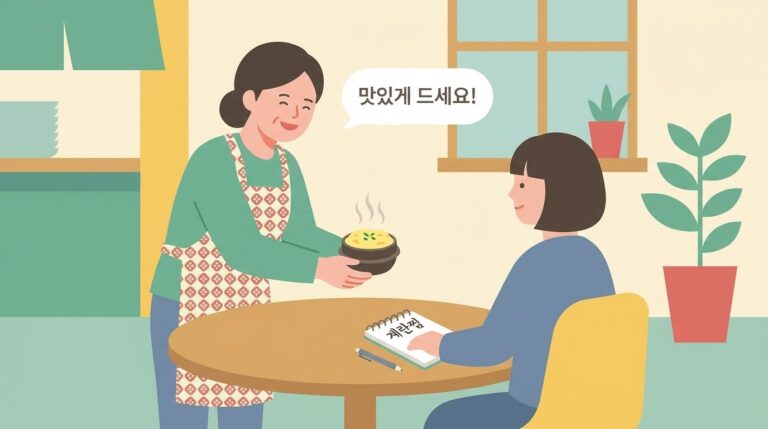
The Secret Behind Free Food in Korea: Master the Art of Jeong and Service
Phase 1: Empathy (Welcome to the Warmth of Jeong)
안녕하세요! 매일한글 에디터입니다.
Picture this: You are sitting at a bustling Korean BBQ restaurant in Seoul, happily grilling pork belly. Suddenly, the restaurant owner (the warmhearted Imo or ‘Auntie’) places a steaming bowl of fluffy steamed egg (gyeran-jjim) or an ice-cold can of soda on your table with a smile. Your heart skips a beat: “Wait, did I accidentally order this? Is my bill going to double?”
Take a deep breath—you haven’t made a mistake! You have just experienced 서비스 (Seobiseu), Korea’s unique culture of giving complimentary food and perks. At the core of this wonderful surprise is 정 (Jeong)—the deep, unspoken bond of warmth, empathy, and hospitality shared between people in Korean society. Many international learners freeze up because they don’t know how to respond politely without sounding confused. Based on real feedback from our beginner students at Daily Hangul, this guide will teach you the exact phrases and manners to embrace Korean Jeong with confidence and gratitude!
Phase 2: Core Expressions Breakdown
1. 서비스예요 (Seobiseu-yeyo)
- Pronunciation: [Seo-bi-seu-ye-yo] (Sounds like “saw-bee-soo-ye-yo”)
- Meaning: Literal: “It is service.” ➔ Actual: “This is on the house! / It’s complimentary!”
- K-Culture Moment: In K-Dramas like Hospital Playlist or Weightlifting Fairy Kim Bok-joo, whenever the main characters visit a neighborhood diner, the owner cheerfully drops off extra fried snacks shouting this phrase.
- Editor’s Insight: “Service” in Konglish specifically refers to free goods or bonus food offered to customers as a gesture of goodwill, not customer support.
- Situation Spectrum: Casual ✅ | Semi-formal ✅ | Formal ⚠️
- 🤔 Think About It: In your home country, do restaurants offer free food unexpected by customers? How does this foster community connection?
2. 어머, 감사해요! 잘 먹겠습니다 (Eomeo, gamsahaeyo! Jal meokkkess-seumnida)
- Pronunciation: [Eo-meo, gam-sa-hae-yo! Jal meok-get-seum-ni-da] (Sounds like “Oh-maw, gahm-sah-hae-yo! Jahl muck-get-seum-nee-dah”)
- Meaning: Literal: “Oh my, thank you! I will eat well.” ➔ Actual: “Oh wow, thank you so much! I will enjoy this complimentary dish!”
- K-Culture Moment: The polite and delighted reaction you hear in Korean variety shows whenever hosts receive unexpected local delicacies from warm street vendors.
- Editor’s Insight: Eomeo (Oh my!) adds an emotional, delighted exclamation that instantly makes the restaurant owner feel appreciated.
- Situation Spectrum: Casual ✅ | Semi-formal ✅ | Formal ✅
- 🤔 Think About It: Notice how Koreans announce Jal meokkkess-seumnida before eating. Why is acknowledging the provider so essential in Korean meal etiquette?
3. 사장님 최고예요! (Sajangnim choegoyeyo!)
- Pronunciation: [Sa-jang-nim choe-go-ye-yo] (Sounds like “Sah-jahng-neem chway-go-yay-yo”)
- Meaning: Literal: “Boss, you are the best!” ➔ Actual: “You’re the best, boss! Thank you!”
- K-Culture Moment: Friends cheering happily together with thumbs up at a late-night pojangmacha (street cart) after getting extra soup refills.
- Editor’s Insight: Sajangnim is the universal, respectful title for any store or eatery owner. Pairing it with choegoyeyo creates instant rapport.
- Situation Spectrum: Casual ✅ | Semi-formal ✅ | Formal ⚠️
- 🤔 Think About It: Calling an owner “Boss” in English might feel either awkward or overly familiar, but in Korea, it is the standard sign of respect. How do title words build friendship across cultures?
Phase 3: Textbook Korean vs. Real Korean
Situation 1: Expressing gratitude for bonus food
- 📖 Textbook Korean: 이것은 무료입니까? 감사합니다. (Igeoseun muryo-imnikka? Gamsahamnida. / Is this free? Thank you.)
- 🗣️ Real Korean: 와, 서비스예요? 정말 감사합니다! (Wa, seobiseu-yeyo? Jeongmal gamsahamnida! / Wow, is this on the house? Thank you so much!)
- 💡 Why is it different? Asking if something is “muryo” (free of charge) sounds dry and bureaucratic. Using the word “서비스” (service) matches the friendly vibe of hospitality.
Situation 2: Asking if a side dish refill is complimentary
- 📖 Textbook Korean: 반찬을 더 주시면 돈을 내야 합니까? (Banchan-eul deo jusimyeon doneul naeya hamnikka? / Do I have to pay if you give more side dishes?)
- 🗣️ Real Korean: 사장님, 반찬 조금만 더 리필해 주세요! (Sajangnim, banchan jogeum-man deo ripil-hae juseyo! / Boss, could we please have a little refill of the side dishes?)
- 💡 Why is it different? In Korea, side dishes (banchan) are virtually always free. Asking if you have to pay sounds unnatural; simply asking for a refill (ripil) is standard.
Phase 4: K-Culture Deep Dive & Non-Verbal Manners
4-1. 눈치 (Nunchi) & Polite Body Language
When an owner serves you a complimentary dish:
1. Two-Handed Receive: Lightly touch your right forearm or wrist with your left hand while bowing your head slightly. This expresses deep appreciation.
2. Eye Contact & Smile: Make warm eye contact, smile, and give a small nod.
3. Do Not Demand Service: Never enter a restaurant expecting free food upfront. Jeong is an unprompted gift of goodwill; asking for seobiseu entitlement ruins the nunchi (social harmony).
4-2. Cultural Code: K-Food and the Spirit of “덤 (Deom)”
In traditional markets and local eateries, Deom refers to adding extra scoops of food or goods without charging extra. In modern dining, this evolved into Seobiseu. It’s not a marketing gimmick; it’s an exchange of human warmth. When an owner gives you seobiseu, they are saying: “I like your energy, thank you for visiting my shop.”
Phase 5: Real-Life Roleplay Scenario
Setting: A cozy Tteokbokki restaurant in Hongdae run by a friendly Auntie (Imo).
- Turn 1 (Imo): 손님, 떡볶이랑 순대 나왔어요! 맛있게 드세요. (Sonnim, tteokbokki-rang sundae nawasseoyo! Mas-itge deuseyo. / Customer, your tteokbokki and blood sausage are served! Enjoy.) 🎭 Places the hot plates down with a warm grin.
- Turn 2 (You): 네, 감사합니다! 잘 먹겠습니다. (Ne, gamsahamnida! Jal meokkkess-seumnida. / Yes, thank you! I will eat well.) 🎭 Bows head lightly with both hands on the table.
- Turn 3 (Imo): 맛있게 먹는 모습 보니까 좋네! 여기 튀김 좀 서비스로 줄게요. (Mas-itge meongneun moseup bonikka jonne! Yeogi twigim jom seobiseu-ro julgeyo. / It’s lovely to see you eating with such joy! Here are some fried treats on the house.) 🎭 Slides a plate of hot dumplings over.
- Turn 4 (You): 헐, 진짜요? 감동이에요! (Heol, jinjjayo? Gamdong-ieyo! / Oh wow, really? I’m so touched!) 🎭 Eyes widen with cheerful surprise.
- Turn 5 (Imo): 학생인 것 같아서 더 챙겨주고 싶었어요. (Haksaeng-in geot gat-aseo deo chaenggyeojugo sipeosseoyo. / You look like a student, so I wanted to take extra care of you.) 🎭 Wipes hands on apron warmly.
- Turn 6 (You): 사장님 최고예요! 정말 맛있어요. (Sajangnim choegoyeyo! Jeongmal mas-isseoyo. / Boss, you are the best! It is really delicious.) 🎭 Gives a joyful thumbs-up.
- Turn 7 (Imo): 고마워요. 부족하면 국물 더 말해요! (Gomawoyo. Bujokhamyeon gungmul deo malhaeyo! / Thank you. Let me know if you need more broth!) 🎭 Waves hand affectionately.
- Turn 8 (You): 네! 다음에 친구들이랑 또 올게요! (Ne! Daeum-e chin-gudeul-irang tto olgeyo! / Yes! I will come back again with my friends next time!) 🎭 Smiles enthusiastically.
🔀 Interactive Decision Point
What do you do right after Imo hands you the free fried dumplings?
- Option A: Put your hands together, smile broadly, and say: “와, 사장님 최고예요! 잘 먹겠습니다!”
- Feedback (Best): Perfect! This acknowledges the gift enthusiastically and validates her kind gesture.
- Option B: Pull out your credit card and say: “얼마예요? 계산해 주세요.” (How much is this? Please charge me.)
- Feedback (Risk): While well-intentioned, this ignores her Jeong and might make the situation awkward.
- Option C: Say nothing, immediately put it in your bag, and leave.
- Feedback (Bad): This comes across as cold and impolite, breaking Korean restaurant etiquette.
Phase 6: 10-Second Emotional Shadowing Drill
Practice matching these rhythm breaks (/) and tones:
[😊 Delighted & Grateful]
와, / 진짜요? / 사장님 / 최고예요!
(Wa, / jinjjayo? / Sajangnim / choegoyeyo!)-
[🙏 Polite & Earnest]
서비스 / 정말 / 감사합니다! / 잘 먹겠습니다.
(Seobiseu / jeongmal / gamsahamnida! / Jal meokkkess-seumnida.) -
[💖 Warm & Friendly]
너무 맛있어요! / 다음에 / 또 올게요.
(Neomu mas-isseoyo! / Daeum-e / tto olgeyo.)
Phase 7: K-Culture Mini Dictionary
- 정 (Jeong): The cultural pillar of Korean human relationships—warmth, emotional attachment, and mutual empathy.
- 서비스 (Seobiseu): Free complimentary food or drinks offered by an establishment as hospitality.
- 덤 (Deom): The traditional practice of adding a small extra bonus portion when selling groceries or food.
- 이모 (Imo): Literally “maternal aunt,” commonly used as a fond nickname for middle-aged female restaurant owners.
Phase 8: Survival Kit for Travelers
Top 3 Survival Phrases
- 이거 서비스예요? (Igeo seobiseu-yeyo? / Is this complimentary?) — Pro Tip: Use this if you want to double-check without offending.
- 반찬 더 주실 수 있나요? (Banchan deo jusil su innayo? / Could I please get more side dishes?) — Pro Tip: Standard polite request for kimchi or banchan refills.
- 너무 맛있게 잘 먹었습니다! (Neomu mas-itge jal meogeoss-seumnida! / I ate so well, it was delicious!) — Pro Tip: Say this when paying at the register to leave a lasting impression.
Editor’s Travel Note
When navigating Korean food hotspots, search for authentic local diners using the Naver Map app download for Korea travel. When paying, standard international credit cards and T-Money transport cards are accepted everywhere, but keeping a little cash for small street stalls will help you experience traditional Deom hospitality firsthand.
Phase 9: A Step Deeper (Reflection)
In a fast-paced modern world driven by instant transactions, Korea’s Jeong culture preserves genuine human connection. Giving seobiseu isn’t about the monetary value of a 500-won soda; it is an invitation to form a temporary bond between host and guest. When you receive seobiseu, you aren’t just a paying customer—you are an appreciated guest in their culinary home.
💬 Your Turn: Have you ever received unexpected kindness or free treats while traveling? Share your story in the comments below!
Phase 10: FAQ & Common Mistakes
Q: Can I directly ask a restaurant owner for free “Service”?
A: No. Asking for seobiseu directly is considered impolite and greedy. It should always be offered freely by the owner.
Q: Are all side dishes (banchan) considered “service”?
A: Basic side dishes like kimchi, pickled radish, and beans are standard and refillable for free. However, main dish extras (like extra meat or noodles) usually have a cost unless the owner explicitly says 서비스예요.
Q: What should I do if I am too full to finish the complimentary food?
A: Eat a few respectful bites, smile, and say: “정말 맛있는데 배가 너무 불러요, 죄송해요!” (It’s delicious, but I’m so full, sorry!). This shows appreciation for their kindness.
🚨 Common Mistakes Board
- ❌ Mistake 1: Refusing the extra food aggressively because you didn’t order it.
- Correct Action: Say “감사합니다!” and accept it happily.
- ❌ Mistake 2: Calling middle-aged restaurant owners “아줌마” (Ajumma) loudly.
- Correct Action: Use the friendlier title “이모” (Imo) or the respectful “사장님” (Sajangnim).
- ❌ Mistake 3: Leaving the restaurant quietly without acknowledging the gift.
- Correct Action: Say “잘 먹었습니다!” at the counter when leaving.
Phase 11: Action Missions
- 🥉 Bronze Mission: Practice saying “사장님 최고예요!” in front of your mirror with a smile and thumbs-up.
- 🥈 Silver Mission: Write a comment below using the phrase “잘 먹겠습니다” in a full sentence.
- 🥇 Gold Mission: Next time you visit a Korean restaurant or K-Town diner, greet the staff with “잘 먹겠습니다!” before your meal.
- 🎮 K-Culture Mission: Watch an episode of a Korean food travel show (like Street Food Fighter) and spot the moment a vendor offers extra deom or seobiseu.
Phase 12: Interactive Quiz Challenge
Q1. Situation Judgment: The owner drops off a free soda and says “서비스예요!”. What is the best response?
1. “얼마예요?” (How much?)
2. “와, 감사합니다! 사장님 최고예요!” (Wow, thank you! Boss, you’re the best!)
3. “주문 안 했어요. 가져가세요.” (I didn’t order this. Take it away.)
Q2. Fill in the blank: Before enjoying a meal or a complimentary treat, Koreans politely say “잘 _________!”
Q3. True or False: In Korea, you should loudly demand free seobiseu as soon as you sit down.
👉 Click here to reveal Answers & Explanations!
- A1: 2 (Expressing genuine delight and gratitude reinforces the warm connection!)
- A2: 먹겠습니다 (meokkkess-seumnida) (Meaning ‘I will eat well / Thank you for the treat’)
- A3: False (Service is a spontaneous gift of Jeong; demanding it breaks social etiquette and good Nunchi.)






