

Phase 1: Empathy (Story-Driven Opening)
안녕하세요! 매일한글 에디터입니다.
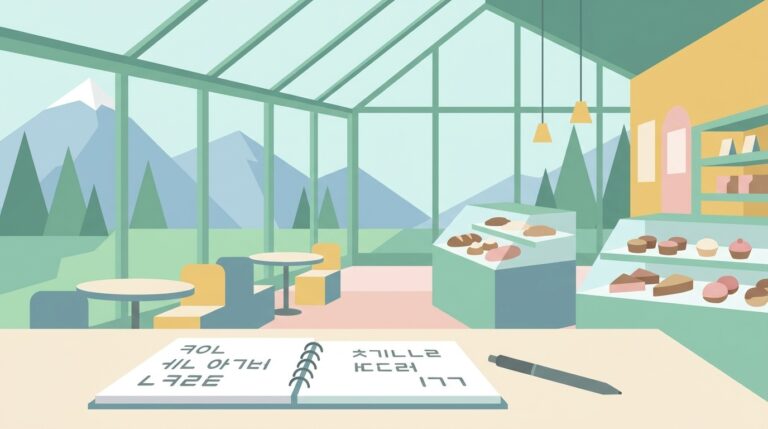
Imagine this: It’s a sunny Saturday afternoon in suburban Seoul, and you’ve just stepped into one of Korea’s legendary multi-story mega bakery cafes (대형 베이커리 카페) in Paju or Yangpyeong. The space looks less like a coffee shop and more like a cathedral dedicated to carbohydrates—soaring glass ceilings, cascading water features, and endless marble counters displaying everything from scallion cream cheese bagels (대파크림치즈베이글) to garlic baguettes shimmering with butter.
Your eyes widen, but your heart rate spikes. The line is moving fast, you’re holding a heavy golden tray with tongs, everyone seems to intuitively know where to grab napkins, how to claim prime rooftop seats, and where the mysterious “self-packaging station” is located. When the barista suddenly asks if you want to warm your pastries or take a pager, textbook Korean like “빵을 하나 주십시오” completely fails you.
Don’t worry! Navigating these expansive wonderland cafes is a modern Korean cultural ritual. Today, we’re unlocking the exact intermediate-level Korean expressions and unspoken social etiquette (눈치) so you can order like an effortless local, snag that scenic window seat, and pack up leftovers without a hint of hesitation.
Phase 2: In-Depth Breakdown of 3 Core Expressions
1. 시그니처 빵 나오는 시간 언제예요? (한글)
- Pronunciation: [Si-geu-ni-cheo ppang na-o-neun si-gan eon-je-ye-yo?] (Think: “See-geu-nee-chuh ppahng nah-oh-neun see-gahn uhn-jeh-yeh-yoh?”)
- Meaning: Literal: “When is the signature bread coming-out time?” | Nuance: “When is the next fresh batch of your specialty baked goods coming out of the oven?”
- K-Culture Moment: In K-Dramas and lifestyle vlogs, characters visiting suburban hotspot cafes always target freshly baked batches (갓 구운 빵) instead of whatever is sitting cold on the shelf.
- Editor’s Insight: Korean bakery lovers prioritize texture and warmth above all. Using 시그니처 (signature) shows you’ve researched the cafe’s standout specialty rather than just asking for generic bread.
- Situation Spectrum: Casual: ⚠️ | Semi-formal (Polite): ✅ | Formal: 🚫
- 🤔 Think About It: In many Western cafes, baked goods are prepped once before opening. Why does Korean cafe culture emphasize exact hourly baking schedules (빵 나오는 시간)?
2. 남은 거 포장해 갈 수 있는 자율 포장대 있나요? (한글)
- Pronunciation: [Nam-eun geo po-jang-hae gal su in-neun ja-yul po-jang-dae in-na-yo?] (Think: “Nahm-eun guh poh-jahng-heh gahl soo een-neun jah-yool poh-jahng-deh een-nah-yoh?”)
- Meaning: Literal: “Is there a self-packaging counter where I can pack leftover things?” | Nuance: “Where can I find the self-service table with bags and boxes for leftovers?”
- K-Culture Moment: Mega bakery cafes in Korea rarely pack your leftover pastries at the counter due to high customer traffic; instead, they provide dedicated 자율 포장대 equipped with sanitary gloves, craft paper bags, ties, and microwave ovens.
- Editor’s Insight: Asking a busy barista to box your single leftover croissant might get you a polite pointer toward the corner. Knowing the term 자율 포장대 saves both you and the staff valuable time.
- Situation Spectrum: Casual: ⚠️ | Semi-formal (Polite): ✅ | Formal: 🚫
- 🤔 Think About It: How does providing self-packing stations reflect Korean consumer independence and the concept of high-speed efficiency (빨리빨리) in large spaces?
3. 뷰 좋은 자리 나면 옮겨도 되나요? (한글)
- Pronunciation: [Byu jo-eun ja-ri na-myeon olm-gyeo-do doe-na-yo?] (Think: “Byoo joh-eun jah-ree nah-myuhn ohlm-gyuh-doh dway-nah-yoh?”)
- Meaning: Literal: “If a seat with a good view opens up, can I move?” | Nuance: “Mind if we switch over to a scenic window or terrace seat once it becomes available?”
- K-Culture Moment: Modern Korean mega cafes are engineered around scenic aesthetics (통창 뷰, 리버 뷰, 마운틴 뷰). Claiming a prime view for photos is half the experience.
- Editor’s Insight: While moving tables freely is common in Korea, asking politely beforehand signals consideration, especially if the staff manages reserved zones or digital seat alerts.
- Situation Spectrum: Casual: ⚠️ | Semi-formal (Polite): ✅ | Formal: 🚫
- 🤔 Think About It: In Korea, cafes are third-place living rooms designed for visual healing (물멍/숲멍—spacing out while looking at water/trees). How does your native language express the desire for aesthetic seating?
Phase 3: Textbook Korean vs. Real Korean
Situation 1: Asking about leftovers
- 📖 교과서 한국어 (Textbook): “남은 빵을 포장해 주십시오.” (Please pack the remaining bread for me.)
- 🗣️ 진짜 한국어 (Real-life): “남은 거 자율 포장대에서 싸갈게요~” (I’ll just pack the leftovers myself at the self-station~)
- 💡 왜 다를까? (Why the difference?): Mega cafes are heavily self-service. Using 싸가다 (colloquial for packaging/taking away) along with the active 자율 포장대 reflects fluent familiarity with how modern Korean establishments operate.
Situation 2: Asking for recommendations
- 📖 교과서 한국어 (Textbook): “어떤 빵이 가장 맛있습니까?” (Which bread is the most delicious?)
- 🗣️ 진짜 한국어 (Real-life): “여기 제일 잘나가는 시그니처가 뭐예요?” (What’s your best-selling signature item here?)
- 💡 왜 다를까? (Why the difference?): 잘나가다 literally means “goes out well” and is the natural Korean idiomatic way to describe bestsellers and trending hot items.
Phase 4: K-Culture Deep Dive & Non-Verbal Manners
4-1. 눈치 (Nunchi) & Gestures in Mega Bakery Cafes
- The Tray & Tongs Protocol: Before touching any pastry, always pick up a fresh sheet of wax paper (유산지) and lay it flat on your tray. Never touch bread directly with bare hands or return an item once it touches your tray.
- Table Reservation Etiquette (자리의 룰): In crowded weekend mega cafes, send one companion to secure a table before picking bread and ordering drinks. Leaving a jacket, tumbler, or even an umbrella on a table is universally recognized in Korea as a valid claim on that seat (no one will steal it, but don’t leave your passport!).
4-2. Cultural Code: The Rise of the “Suburban Mega Bakery”
Why are Koreans driving 1 to 2 hours outside city centers just for bread? In a densely populated urban society with compact apartments, these massive architectural spaces—often converted from factories or built into forest hillsides—serve as micro-vacations (소확행 / 근교 드라이브). Koreans go there not merely for caffeine, but for 대형 카페 투어 (large cafe hopping) to decompress, photograph architectural designs, and savor artisanal gourmet baking.
Phase 5: Real-Life Roleplay Scenario
Setting: A breathtaking 4-story glasshouse bakery cafe in Gyeonggi-do overlooking a lake. The aroma of freshly glazed pastries fills the air.
Characters:
* 민지 (Minji): An enthusiastic barista/staff member wearing a stylish linen apron.
* You (학습자): A savvy visitor holding a pastry tray with salt bread (소금빵) and a cruffin.
- 민지: 어서 오세요! 빵 골라오셨으면 음료 주문 도와드릴게요. (Welcome! If you’ve picked your pastries, I can help you with your drink order.)
- You: 네! 따뜻한 아메리카노 두 잔이랑, 이 시그니처 소금빵 데워주실 수 있나요? (Yes! Two hot Americanos, and could you please warm up this signature salt bread?) 🎭 [Politely placing the tray on the checkout counter]
- 민지: 소금빵은 뒤편 자율 포장대에 있는 미니 오븐으로 1분만 데우시면 훨씬 바삭해요! (For the salt bread, if you warm it for 1 minute in the mini oven at the self-station behind you, it’ll be much crispier!)
- You: 아, 그렇군요! 혹시 남은 빵 포장도 거기서 직접 하면 되나요? (Ah, I see! Can I also pack any leftovers myself over there?)
- 민지: 네, 맞아요. 종이봉투랑 스티커 다 준비되어 있어요. 진동벨 울리면 음료 픽업대로 와주세요. (Yes, exactly. Paper bags and stickers are all prepared there. Please come to the pickup counter when the buzzer rings.) 🎭 [Hands over a vibrating pager]
- You: 감사합니다. 그런데 3층 테라스에 자리 나면 자리 이동해도 괜찮을까요? (Thank you. By the way, if a seat opens up on the 3rd-floor terrace, is it okay to switch tables?)
- 민지: 네, 물론이죠! 편하신 자리로 자유롭게 앉으시면 됩니다. (Yes, of course! Feel free to sit wherever you’re comfortable.)
- You: 친절하게 알려주셔서 감사해요. 맛있게 먹을게요! (Thank you for kindly letting me know. I’ll enjoy it!) 🎭 [Slight bow and taking the pager]
🔀 Interactive Branching Decision
You realize you over-ordered and have two whole cream croissants left on your plate. What do you do?
- Option A: Walk up to the busy counter with your plate and ask the cashier, “이거 봉투에 넣어주세요.” (Put this in a bag for me.)
- ❌ Feedback [Risk]: While understandable, the barista will have to redirect you to the self-station during peak rush hour, causing awkward delays.
- Option B: Head directly to the 자율 포장대, select a food-safe paper bag, wrap your pastries neatly with tongs, and fasten it with the provided logo sticker.
- 🏆 Feedback [Best]: 100% natural local behavior! You save time and feel completely integrated into modern Korean cafe culture.
- Option C: Leave the uneaten premium pastries on the return tray (퇴식구) to be thrown away.
- ⚠️ Feedback [Bad]: A painful waste of delicious and expensive artisanal bread! Koreans almost always take their remaining bakery treats home.
Phase 6: 10-Second Emotion Shadowing Drill
Practice these lines out loud, matching the emotional cues and natural breathing pauses (/):
[😊 호기심 가득하고 밝게 / Bright & Curious]- “여기 제일 잘나가는 / 시그니처 빵이 / 뭐예요?”
- (Yeo-gi je-il jal-na-ga-neun / si-geu-ni-cheo ppang-i / mwo-ye-yo?)
[☕ 상냥하고 정중하게 / Soft & Polite]- “혹시 / 남은 빵은 / 자율 포장대에서 / 싸가면 될까요?”
- (Hok-si / nam-eun ppang-eun / ja-yul po-jang-dae-e-seo / ssa-ga-myeon doel-kka-yo?)
[✨ 기대감 넘치며 조심스럽게 / Hopeful & Inquiring]- “창가 쪽에 / 뷰 좋은 자리 나면 / 옮겨도 괜찮죠?”
- (Chang-ga jjo-ge / byu jo-eun ja-ri na-myeon / olm-gyeo-do gwaen-chan-cho?)
Phase 7: K-Culture Mini Dictionary
- 소금빵 (So-geum-ppang) | Salt Bread
- Definition: A buttery, crescent-shaped roll topped with coarse sea salt; the undisputed reigning champion of Korean bakery trends with crispy bottoms and airy interiors.
- 자율 포장대 (Ja-yul Po-jang-dae) | Self-Packaging Station
- Definition: A designated station in large cafes containing napkins, to-go bags, plastic gloves, ties, and mini toaster ovens (like Balmuda).
- 대형 베이커리 (Dae-hyeong Be-i-keo-ri) | Mega Suburban Bakery
- Definition: Multi-story or warehouse-sized architectural destination cafes located outside downtown areas offering scenic outdoor views and expansive menus.
- 퇴식구 (Toe-sik-gu) | Return Station
- Definition: The drop-off counter where customers return used trays, glasses, and utensils after finishing their meals.
Phase 8: Survival Kit for Travelers
Top 3 Survival Expressions
- 1. “진동벨 울리면 가지러 갈게요.” (Jin-dong-bel ul-li-myeon ga-ji-reo gal-ge-yo.)
- Pro Tip: Confirms you received your buzzer pager and understand you need to pick up your drinks when it vibrates.
- 2. “빵 데우는 발뮤다 토스터기 있나요?” (Ppang de-u-neun bal-myu-da to-seu-teo-gi in-na-yo?)
- Pro Tip: Many high-end cafes provide luxury toaster ovens; ask this to know if you can warm up savory pastries.
- 3. “남은 음료 테이크아웃 잔에 옮겨 담아주실 수 있나요?” (Nam-eun eum-ryo te-i-keu-a-ut jan-e olm-gyeo dam-a-ju-sil su in-na-yo?)
- Pro Tip: Inside Korean cafes, single-use plastic cups are banned for dine-in. Use this when ready to leave to convert your mug to a to-go cup.
Editor’s Travel Note
- Navigating to Mega Cafes: Public transit can be tricky for remote suburban hotspots. Use 네이버 지도 앱 다운로드 to check express bus routes or calculate taxi fares.
- Payment Manners: Most suburban mega cafes are strictly cashless. Keep your foreign international credit card or T-Money ready for kiosk ordering.
Phase 9: “한 발 더 깊이” (One Step Deeper)
Korean mega bakery cafes are not just about food; they are modern cultural sanctuaries designed to solve the spatial compression of high-density city life. In Korean architecture and psychology, the concept of 공간감 (sense of expansive space) is intimately linked to mental wellness and rest. Sharing gigantic tables, operating on self-reliant packaging systems, and respecting communal etiquette reflect how contemporary Koreans balance radical independence with civic consideration in massive shared spaces.
💬 Your Turn: Does your home country have large destination cafes, or is cafe culture focused on small, intimate neighborhood spots? Share your favorite pastry style in the comments below!
Phase 10: FAQ & Common Mistakes
Q: Can I take photos of the bakery displays and interior?
A: Absolutely! Korean bakery cafes are built intentionally for social media (인스타 감성). Just be mindful not to photograph customers’ faces directly or block the flow of the ordering line.
Q: Are we required to order one drink per person if we buy multiple expensive breads?
A: In 95% of Korean mega cafes, the “1인 1음료” (one drink per person) rule applies regardless of how many bakery items you purchase. Always order one beverage per adult.
Q: What should I do if a pastry requires cutting?
A: Head to the 자율 포장대 or cutlery station next to the pickup counter. You will find self-service mini tongs, knives, and scissors (가위) to portion out your pastries.
🚨 Common Mistakes Warning Board
- Mistake: Throwing away uneaten bread in trash bins at the return counter.
- Correct Action: Pack them using the self-packaging station (자율 포장대)—it’s free and encouraged!
- Mistake: Leaving dirty trays on empty tables when leaving.
- Correct Action: Always bring your entire tray back to the counter marked 퇴식구 (Return Station).
- Mistake: Taking dine-in glass cups outside the cafe premises.
- Correct Action: Ask the counter to transfer the leftover drink to a disposable cup (테이크아웃 잔에 옮겨주세요).
Phase 11: Action Missions
- 🥉 Bronze Mission (Solo Drill): Stand in front of a mirror with a tray and practice saying: “여기 시그니처 빵 나오는 시간 언제예요?” with natural intonation.
- 🥈 Silver Mission (Social Sharing): Post a photo of your favorite bakery treat on Instagram or Threads and caption it using Korean hashtags:
#대형카페 #소금빵맛집 #카페투어. - 🥇 Gold Mission (Real-World Field Test): Visit a Korean-style bakery or mega cafe, locate the 자율 포장대, and successfully pack up an item using only Korean phrases!
- 🎮 K-Culture Mission: Watch an episode of a recent slice-of-life K-Drama (like King the Land or Crash Course in Romance) and spot how characters behave and interact at dessert cafes!
Phase 12: Interactive Quiz Challenge
1. [Situation Judgment] You ordered 3 pastries and 2 drinks at a massive suburban cafe. When your drinks are ready, you want to warm up your garlic bread. What is the most appropriate action?
* A) Yell across the counter for the barista to microwave it for you.
* B) Look for the 자율 포장대 where mini toaster ovens are provided for self-service.
* C) Eat it cold because heating bread after purchasing is forbidden in Korea.
🔍 Click to reveal the answer & explanation!
Correct Answer: B
* Explanation: Korean mega bakery cafes empower customers with self-service stations (자율 포장대) featuring mini ovens, scissors, and paper wraps. Baristas at the counter typically only handle drink brewing and order intake!
2. [Fill-in-the-Blank] Complete the sentence to ask where to pack leftovers politely:
“남은 거 싸갈 수 있는 ______________ 어디에 있어요?”
🔍 Click to reveal the answer & explanation!
Correct Answer: 자율 포장대 (Self-packaging station)
* Full Sentence: “남은 거 싸갈 수 있는 자율 포장대 어디에 있어요?” (Where is the self-packaging station where I can pack leftovers?)
3. [True / False Cultural Check]
Statement: In Korean mega cafes, buying 5 gourmet pastries allows a group of 3 people to order just 1 iced coffee without violating cafe rules.
🔍 Click to reveal the answer & explanation!
Correct Answer: False (F)
* Explanation: Most Korean cafes strictly enforce the 1인 1음료 (one drink per person) policy regardless of the number of bakery items bought. Each person in your party should order their own beverage!







