

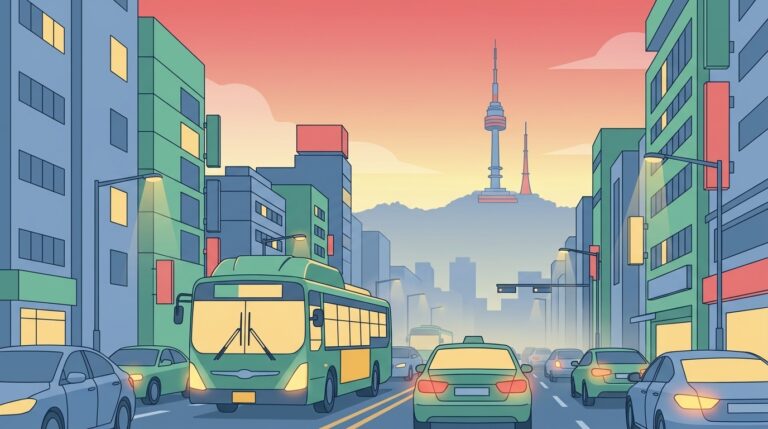
Running Late in Seoul? Master Guessing and Hesitation Like a Local!
Phase 1: Empathy (Story-Driven Opening)
안녕하세요! 매일한글 에디터입니다. (Hello! This is your Daily Hangul editor.)
Picture this: It is 6:40 PM on a Friday evening in Gangnam. You are sitting in a taxi on your way to meet your Korean friends at a famous K-BBQ restaurant in Hongdae. You promised to be there by 7:00 PM. But as you look out the window, all you see is an endless river of red taillights stretched across the Mapo Bridge. Your taxi meter is ticking, the clock is racing, and your phone buzzes with a KakaoTalk notification: “Where are you? We just got a table!”
Panic sets in. You open a translator, but translating word-for-word sounds either way too robotic (“Traffic is heavy, therefore arrival at the appointed time might be impossible”) or overly blunt (“I am not coming on time”). How do you convey that polite sense of cautious uncertainty—the subtle nuance of “I really want to get there, but because of this crazy traffic, I might not make it on time”?
Expressing educated guesses and gentle warnings is an essential B1 milestone in Korean. It protects your relationships, shows high social intelligence (눈치, nunchi), and saves you from sounding careless or rude. Today, based on real feedback from hundreds of intermediate learners, we will break down how to express speculation, softened excuses, and realistic expectations like a true Seoulite.
Phase 2: Deep Dive into 3 Key Expressions
1. 차가 막혀서 제시간에 못 올지도 몰라요
- Pronunciation: [Cha-ga ma-kyeo-seo je-si-gan-e mot ol-ji-do mol-la-yo] (Think: “Cha-ga mock-yeo-saw jay-she-gahn-eh mote ole-jee-doh mole-lah-yo”)
- Meaning: Literal: “Traffic is blocked, so I might not be able to come on time.” | Real Nuance: “Traffic is pretty bad, so there’s a real chance I won’t make it right on time.”
- K-Culture Moment: In countless K-dramas, the protagonist is frantically trapped in a bus or cab before an important date or job interview, holding their phone and speaking this exact sentence with worried eyes.
- Editor’s Insight: The grammar pattern -(으)ㄹ지도 모르다 translates to “might / may / there is a possibility that…”. It adds a cushion of uncertainty, softening what would otherwise be a harsh “I won’t make it.”
- Situation Spectrum:
- Casual: 차 막혀서 제시간에 못 갈지도 몰라 (✅)
- Semi-formal: 차가 막혀서 제시간에 못 갈지도 몰라요 (✅)
- Formal: 도로 정체로 인해 정시에 도착하지 못할지도 모릅니다 (⚠️ / For announcements)
- 🤔 Think About It: Why does Korean rely heavily on indefinite endings like ~지도 모르다 instead of direct statements when discussing personal delays?
2. 퇴근 시간이라 길이 꽤 밀릴 것 같아요
- Pronunciation: [Toe-geun si-gan-i-ra gir-i kkwae mil-lil geot ga-ta-yo] (Sounds like: “Tweh-geun she-gahn-ee-rah geel-ee kkeh meel-leel got got-tah-yo”)
- Meaning: Literal: “It is off-work time, so the road seems likely to be quite pushed.” | Real Nuance: “Since it’s rush hour, I anticipate the road will be pretty jammed.”
- K-Culture Moment: Coworkers stepping out of the office in Yeouido checking navigation apps and warning teammates before heading to a team dinner (회식).
- Editor’s Insight: While 막히다 means blocked/clogged, 밀리다 literally means “pushed/backed up.” Koreans use 길이 밀리다 constantly to describe sluggish, bumper-to-bumper movement. Combining it with -(으)ㄹ 것 같다 shows an intuitive, observational guess.
- Situation Spectrum:
- Casual: 퇴근 시간이라 길 밀릴 것 같아 (✅)
- Semi-formal: 퇴근 시간이라 길이 꽤 밀릴 것 같아요 (✅)
- Formal: 퇴근 시간대라 정체가 예상됩니다 (✅ / Navigation voice/News)
- 🤔 Think About It: Notice how -(으)ㄹ 것 같다 (“it feels/looks like”) is used even when the speaker is almost 100% sure. How does this humility compare to your native language?
3. 조금 늦어질 수도 있으니까 먼저 시켜서 먹고 있어
- Pronunciation: [Jo-geum neu-jeo-jil su-do i-sseu-ni-kka meon-jeo si-kyeo-seo meok-go i-sseo]
- Meaning: Literal: “Because it might get a bit late, order first and be eating.” | Real Nuance: “I might run a bit late, so please don’t wait for me—go ahead and start eating!”
- K-Culture Moment: Friends gathering at a popular Samgyeopsal spot where tables have time limits and grilling meat takes time.
- Editor’s Insight: -(으)ㄹ 수도 있다 expresses “could also happen / there is also a possibility.” By proactively telling others to order (먼저 시켜), you relieve them of the awkward burden of sitting in front of empty grill plates waiting for you.
- Situation Spectrum:
- Casual: 조금 늦어질 수도 있으니까 먼저 먹고 있어 (✅)
- Semi-formal: 조금 늦어질 수도 있으니 먼저 드시고 계세요 (✅)
- Formal: 도착이 다소 지연될 수 있으니 행사를 먼저 진행해 주십시오 (✅)
- 🤔 Think About It: Food etiquette in Korea values communal dining. Why is offering permission to eat first considered such a thoughtful gesture?
Phase 3: Textbook Korean vs Real Korean
Situation 1: Giving a live heads-up about unexpected road delay
- 📖 Textbook Korean: “교통 정체로 인하여 약속 시각에 도착할 수 없습니다.” (Due to traffic congestion, I cannot arrive at the promised time.)
- 🗣️ Real Korean: “차 넘 막혀서 10분 정도 늦을 것 같아!ㅠㅠ” (Traffic is crazy backed up, think I’ll be about 10 mins late! T_T)
- 💡 Why is it different? Textbook phrasing sounds like an automated subway delay broadcast. Real Koreans shorten 너무 to 넘 in chat, specify estimated minutes, and soften the blow with cute distress emojis (ㅠㅠ or ㅜㅜ).
Situation 2: Suggesting the other person start ordering cafe drinks/food
- 📖 Textbook Korean: “제가 늦으니 당신이 먼저 음료를 주문하십시오.” (Since I am late, you must order beverages first.)
- 🗣️ Real Korean: “나 좀 걸릴지도 모르니까 먼저 들어가서 마시고 있어!” (I might take a while, so go inside first and grab your drink!)
- 💡 Why is it different? Imperative grammar forms (-하십시오) feel demanding. Using ~고 있어 with a softened supposition (~ㄹ지도 모르니까) makes it an affectionate consideration.
Phase 4: K-Culture Deep Dive & Non-Verbal Manners
4-1. 눈치 (Nunchi) & Digital Etiquette for Being Late
In Korea, punctuality is deeply tied to respect (신뢰, trust). However, Seoul’s notorious rush hour is universally understood. If you are going to be late:
* The Golden 15-Minute Rule: Never text after the meeting time has already passed. Send your speculative heads-up at least 15–20 minutes in advance using -(으)ㄹ 것 같다 or -(으)ㄹ지도 모르다.
* The Screenshot Courtesy: Send a quick capture of your real-time navigation screen (e.g., from KakaoMap showing the red congestion bar and ETA). It non-verbally communicates: “I’m not being lazy; I’m genuinely stuck!”
* Body Language Upon Arrival: When you finally reach the venue, walk in with a slight bow, both palms open facing inward near your chest, giving a light apologetic nod while saying “미안해! 많이 기다렸지?” (I’m so sorry! Have you been waiting long?).
4-2. The Anatomy of Seoul’s “퇴근길” (Toegil / Evening Commute)
Seoul is one of the most densely populated metropolitan areas in the world. Between 6:00 PM and 7:30 PM, the subway lines (especially Line 9 and Line 2) turn into 지옥철 (“hell-subway”), and the bridges across the Han River become parking lots. When a Korean says “불금이라 차가 장난 아니게 밀려” (Because it’s ‘Burning Friday’, traffic is no joke), it’s not an excuse—it’s an undeniable meteorological fact of Seoul life.
Phase 5: Real-Life Roleplay Scenario
- Setting: Friday, 7:10 PM. You are in a green bus stuck near Sinsa Station. Your Korean friend Minho is already at a pub in Gangnam.
- Characters: Minho (민호), You (당신)
- 민호: “혹시 지금 어디쯤이야? 우리 벌써 자리 잡았어!”
(Hok-si ji-geum eo-di-jjeum-i-ya? U-ri beol-sseo ja-ri ja-ba-sseo!)
“Whereabouts are you right now? We already got a table!” - 당신: 🎭 (checking the bus route map with a sigh) “나 지금 신사역 근처인데, 차가 막혀서 제시간에 못 갈지도 몰라.”
(Na ji-geum Sin-sa-yeok geun-cheo-in-de, cha-ga ma-kyeo-seo je-si-gan-e mot gal-ji-do mol-la.)
“I’m near Sinsa Station right now, but traffic is so jammed I might not make it on time.” - 민호: “아, 진짜? 오늘 불금이라 그쪽 길 완전 주차장이지?”
(A, jin-jja? O-neul bul-geum-i-ra geu-jjok gil wan-jeon ju-cha-jang-i-ji?)
“Ah, really? Since it’s Friday, that road is a complete parking lot, right?” - 당신: 🎭 (typing quickly while biting your lip) “응, 버스가 거의 안 움직여. 한 20분은 더 걸릴 것 같아.”
(Eung, beo-seu-ga geo-ui an um-ji-gyeo. Han i-sip-bun-eun deo geol-ril geot ga-ta.)
“Yeah, the bus is barely moving. Looks like it’ll take at least 20 more minutes.” - 민호: “배고픈데 안주 먼저 시켜둘까? 너 뭐 먹고 싶어?”
(Bae-go-peun-de an-ju meon-jeo si-kyeo-dul-kka? Neo mwo meok-go si-peo?)
“We’re hungry, should we order some snacks first? What do you want to eat?” - 당신: 🎭 (sending a playful pleading sticker) “조금 늦어질 수도 있으니까 너희 먼저 시켜서 먹고 있어!”
(Jo-geum neu-jeo-jil su-do i-sseu-ni-kka neo-hui meon-jeo si-kyeo-seo meok-go i-sseo!)
“I might be delayed, so go ahead and order to eat first!” - 민호: “알겠어! 천천히 조심히 와. 도착하면 카톡해~”
(Al-ge-sseo! Cheon-cheon-hi jo-sim-hi wa. Do-chak-ha-myeon ka-tok-hae~)
“Got it! Take your time and come safely. KakaoTalk us when you get here~” - 당신: 🎭 (relieved) “고마워! 최대한 빨리 갈게!”
(Go-ma-wo! Choe-dae-han ppal-li gal-ge!)
“Thanks! I’ll get there as fast as I can!”
🔀 Interactive Choice Point
Imagine Minho asks: “Can you get off and take the subway instead?” How do you reply?
* Option A: “지하철역이 멀어서 그냥 버스 타고 가는 게 빠를지도 몰라.” (The subway station is far, so taking the bus might still be faster.)
* 👉 Feedback [BEST]: Natural use of ~ㄹ지도 몰라 showing polite reasoning and realistic estimation!
* Option B: “싫어. 안 갈 거야.” (No. I’m not going.)
* 👉 Feedback [BAD]: Extremely blunt and offensive; sounds like you are canceling out of anger.
* Option C: “지하철을 타는 것이 불가능하다고 사료됩니다.” (I consider that boarding the subway is impossible.)
* 👉 Feedback [RISK]: Far too hyper-formal and archaic for a casual chat with friends.
Phase 6: 10-Second Emotion Shadowing Drill
Practice these lines out loud with feeling! Pay attention to the pauses (/) and intonation flow:
[🥺 아쉽고 미안하게 / Apologetic & Anxious]
“차가 너무 막혀서 / 제시간에 못 갈지도 몰라요… ㅠㅠ”
(Cha-ga neo-mu ma-kyeo-seo / je-si-gan-e mot gal-ji-do mol-la-yo…)-
[🤔 상황을 예측하며 / Realistic & Thoughtful]
“지금 퇴근 시간이라 / 길이 꽤 밀릴 것 같아요.”
(Ji-geum toe-geun si-gan-i-ra / gir-i kkwae mil-lil geot ga-ta-yo.) -
[😊 배려심 넘치게 / Caring & Warm]
“저 조금 늦어질 수도 있으니까 / 먼저 주문해서 드시고 계세요!”
(Jeo jo-geum neu-jeo-jil su-do i-sseu-ni-kka / meon-jeo ju-mun-hae-seo deu-si-go gye-se-yo!)
Phase 7: K-Culture Mini Dictionary
- 퇴근길 (Toe-geun-gil) | The commute home from work
- Usage: Refers to both the actual physical path and the rush hour chaos happening between 5:30 PM and 7:30 PM across Korean cities.
- 러시 아워 (Leo-si A-wo) | Rush Hour
- Usage: Loanword universally understood and interchangeable with 혼잡 시간대 (peak congestion hours).
- 칼퇴 (Kal-twae) | Leaving work right on the dot (Knife-like departure)
- Usage: Short for 칼퇴근. If someone successfully does 칼퇴, they might avoid the worst of the traffic jam!
- 약속 (Yak-sok) | Appointment / Plans / Social Engagement
- Usage: Unlike the English “promise,” in Korean, having 약속 simply means having plans with friends, dinner dates, or meetings.
Phase 8: Travelers’ Survival Kit
Top 3 On-the-Go Emergency Lines
- 1. 기사님, 여기서 지하철역까지 얼마나 걸릴까요?
(Gi-sa-nim, yeo-gi-seo ji-ha-cheol-yeok-kka-ji eol-ma-na geol-ril-kka-yo?)
Pro Tip: Ask your taxi driver this if you’re debating whether to abandon the cab and jump on the subway. - 2. 생각보다 길이 많이 막히네요.
(Saeng-gak-bo-da gir-i man-i ma-ki-ne-yo.)
Pro Tip: Great small talk phrase in a taxi when stuck in traffic—drivers will often explain the local detours. - 3. 늦어서 정말 죄송합니다!
(Neu-jeo-seo jeong-mal joe-song-ham-ni-da!)
Pro Tip: The polite, go-to apology upon finally arriving at your destination.
Editor’s Travel Note
When traveling in Korea, never rely solely on international map apps for public transit. Make sure to complete your Naver Map App Download or use the Kakao T Taxi Calling Guide before heading out. These local services show real-time bus arrivals and color-coded road traffic (Red = heavy jam, Yellow = slow, Green = clear) with pinpoint accuracy.
Phase 9: “One Step Deeper” (Cultural Reflection)
In Western communication, clarity and direct facts (“I will be 15 minutes late because of traffic”) are prized. In Korean culture, however, stating an absolute certainty when you are failing an obligation can sometimes feel uncomfortably blunt, as if you don’t regret the disruption. By wrapping your statement in speculative language like ~ㄹ지도 모르다 (I might not…) or ~ㄹ 것 같다 (It seems that…), you express humility and deference to the other person’s time. You are acknowledging that external factors have created an unfortunate uncertainty, while actively maintaining relational harmony (화합).
💬 Your Turn: Have you ever experienced Seoul’s rush hour traffic, or do you have a similar “rush hour culture” in your hometown? Drop a comment below using today’s grammar pattern!
Phase 10: FAQ & Common Mistakes
Q: What is the exact difference between -(으)ㄹ지도 모르다 and -(으)ㄹ 것 같다?
A: -(으)ㄹ 것 같다 implies an educated guess based on direct observation or strong probability (around 70–80% confidence: “It looks like it will happen”). -(으)ㄹ지도 모르다 expresses a lower probability or cautious uncertainty (around 30–50% confidence: “There is a possibility / I may or may not”).
Q: Can I use 못 갈 것 같아요 and 못 갈지도 몰라요 interchangeably when late?
A: Yes! Both are natural. 못 갈 것 같아요 sounds slightly more confident that you won’t make it, whereas 못 갈지도 몰라요 emphasizes the unpredictability of the road condition.
Q: Why do Koreans say 차 막혀 instead of 자동차가 정체되다?
A: 자동차가 정체되다 is news broadcast language. In real spoken Korean, 차 (car/traffic) and 막히다 (to be blocked) is the gold standard everyday combination.
🚨 Common Mistakes Alert
- Mistake: Saying “차 막혀서 제시간에 안 와요.” (I don’t come on time.)
- ❌ Why it’s wrong: Using 안 implies deliberate refusal not to come.
- ✅ Correct Action: Use 못 갈 것 같아요 or 못 갈지도 몰라요 (cannot come due to circumstance).
- Mistake: Confusing 오다 (come) and 가다 (go) from the listener’s perspective.
- ❌ Why it’s wrong: In Korean, movement toward the appointment venue is usually stated as 가다 (I go to where you are), e.g., 제시간에 못 갈지도 몰라요.
- Mistake: Using formal 합쇼체 with close friends (“도착이 늦어질 것으로 사료됩니다”).
- ❌ Why it’s wrong: Sounds overly sarcastic or like a corporate email.
- ✅ Correct Action: Keep it at 해요체 (늦을 것 같아요) or 반말 (늦을 것 같아).
Phase 11: Action Missions
- 🥉 Bronze Mission (Solo Practice): Look at your watch right now. Form a sentence guessing what traffic will be like in 2 hours: “2시간 뒤에는 길이 (밀릴 것 같아요 / 안 밀릴 것 같아요).”
- 🥈 Silver Mission (Social Share): Post a story of your commute or a photo of a road on Instagram or Threads with the caption: “차 막혀서 늦을지도 몰라요! 🚗💨 #DailyHangul #KoreanStudy”
- 🥇 Gold Mission (Real Life Application): The next time you are running even 3 minutes behind with a Korean language partner, text them: “조금 늦어질 수도 있으니까 먼저 들어가 계세요!”
- 🎮 K-Culture Mission: Watch an episode of a modern K-drama (like Hospital Playlist or Business Proposal). Listen for characters texting or calling while stuck in transit—spot the phrase 막히다 or 늦을 것 같아!
Phase 12: Interactive Quiz Challenge
Test your knowledge below! Click to reveal the answers and explanations.
1. Situational Judgment
You are riding the subway, but a signal issue stops the train between stations. You want to message your friend politely that you might not arrive by 6:00 PM. Which sentence is best?
* (A) 6시까지 못 갈지도 몰라, 미안해!
* (B) 6시에 안 갈 거야.
* (C) 6시에 도착하지 않는 것을 추천해.
🔍 Click to reveal the Answer & Explanation
Correct Answer: (A)
* Explanation: (A) correctly uses 못 갈지도 몰라 (might not be able to go) to gently signal an unpredictable delay. (B) means “I refuse to go at 6,” and (C) means “I recommend not arriving at 6,” both of which are unnatural and rude.
2. Fill-in-the-Blank
Complete the sentence using the grammar for “might / may”:
* “비가 와서 길이 꽤 _______________ (밀리다 + -(으)ㄹ지도 몰라요).”
🔍 Click to reveal the Answer & Explanation
Correct Answer: 밀릴지도 몰라요
* Explanation: Since the verb stem 밀리- ends in a vowel, you attach -ㄹ지도 몰라요 to form 밀릴지도 몰라요 (it might be backed up).
3. True or False Cultural Quiz
- Statement: In Korea, if you are stuck in bad traffic, it is considered polite etiquette to wait until after the agreed meeting time has passed before contacting your friend so you don’t worry them unnecessarily. (True / False)
🔍 Click to reveal the Answer & Explanation
Correct Answer: False
* Explanation: Korean nunchi etiquette requires proactive communication! You should send an estimation (~ㄹ 것 같다 / ~ㄹ지도 모르다) 15 to 20 minutes before the scheduled time so the other party can adjust their plans or find a comfortable place to wait.







