

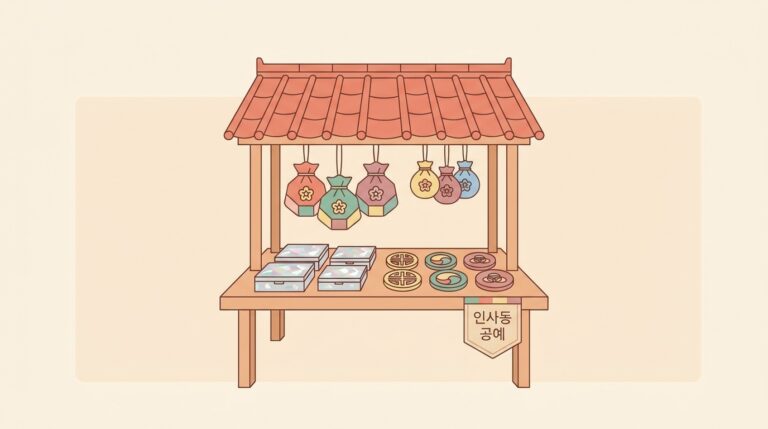
Conquering Korea’s Traditional Markets: The Ultimate Souvenir Hunting Guide
Phase 1: Empathy & Cultural Storytelling
안녕하세요! 매일한글 에디터입니다. (Hello! This is your Daily Hangul editor.)
Picture this: You step into the bustling alleys of Seoul’s Gwangjang Market or Insadong’s Ssamziegil. The warm aroma of fresh hotteok fills the air, colorful silk norigae tassels sway in the breeze, and handcrafted mother-of-pearl (Najeonchilgi) compact mirrors catch your eye. You want to buy authentic gifts for your friends back home, but suddenly your mind freezes. How do you ask for gift wrapping without sounding like a robotic translation app? How do you ask if there is a discount when buying in bulk without offending the friendly market vendor (Imo or Sajangnim)? Many intermediate Korean learners struggle right here: textbook phrases like “이것을 포장해 주시겠습니까?” feel stiff and create distance, while overly casual slang feels rude. This guide is crafted from real student feedback and a decade of market-hopping experience. Master these expressions, and you’ll charm local vendors, get genuine souvenir recommendations, and navigate traditional markets with true local flair!
Phase 2: 3 Core Expressions Deep-Dive
1. 선물용으로 드릴 건데, 포장도 되나요? (Seonmulyong-euro deuril geonde, pojangdo doenayo?)
- Pronunciation: Sun-mool-yong-eu-ro deu-ril gun-deh, po-jang-do dweh-na-yo? (Rhymes with sun + mule, ending with a soft upward question tilt)
- Meaning: Literal: “I’m going to give this as a gift, is wrapping also possible?” / Actual Nuance: “This is for a gift—could you wrap it nicely for me?”
- K-Culture Moment: Seen in K-Dramas whenever the protagonist visits an artisan boutique in Bukchon Hanok Village to buy an elegant craft gift for their in-laws.
- Editor’s Insight: Using “선물용” (gift purpose) immediately signals to the seller that presentation matters, prompting them to offer decorative boxes, traditional bokjumeoni (lucky pouches), or bojagi wrapping.
- Situation Spectrum: Casual ⚠️ | Semi-formal ✅ | Formal ✅
- 🤔 Think About It: In Korean culture, the presentation of a gift (Jeongseong) is just as significant as the item itself. How does gift packaging reflect etiquette in your home culture?
2. 외국인 친구한테 선물하려는데, 뭐가 제일 잘 나가요? (Oegugin chingu-hante seonmulharyeoneunde, mwo-ga jeil jal nagayo?)
- Pronunciation: Weh-gook-in chin-goo-han-teh sun-mool-ha-ryuh-neun-deh, mwo-ga jeh-il jal na-ga-yo? (Say jal na-ga-yo smoothly like jahl-nah-gah-yo)
- Meaning: Literal: “I intend to gift this to a foreign friend, what goes out the best?” / Actual Nuance: “I’m shopping for a foreign friend—what’s your best-selling souvenir?”
- K-Culture Moment: Food and travel vloggers entering Insadong artisan shops asking vendors for the trendiest K-souvenirs.
- Editor’s Insight: “잘 나가다” literally means “to go out well,” an authentic idiom for “best-seller.” Market merchants take immense pride in steering visitors toward proven crowd-pleasers like bookmark sets, traditional tea, or stylish soju cups.
- Situation Spectrum: Casual ✅ | Semi-formal ✅ | Formal ⚠️
- 🤔 Think About It: Asking the seller for recommendations acknowledges their expertise and builds instant rapport (Jeong).
3. 여러 개 사면 조금 깎아주실 수 있나요? (Yeoreo gae samyeon jogeum kkakka-jusil su innayo?)
- Pronunciation: Yuh-ruh geh sah-myun jo-geum kkahk-kah-joo-shil soo eent-nah-yo? (The double kk in kkakka is a crisp, popping sound like c in cat)
- Meaning: Literal: “If I buy several pieces, can you cut the price a little?” / Actual Nuance: “Could I get a small discount if I buy a bundle?”
- K-Culture Moment: Variety shows where cast members buy sets of souvenirs at traditional night markets and playfully haggle with the shop owners.
- Editor’s Insight: Straight haggling on a single low-cost item can come across as stingy, but requesting a discount on bulk purchases (Deombang) is completely accepted in traditional markets.
- Situation Spectrum: Casual ✅ | Semi-formal ✅ | Formal 🚫
- 🤔 Think About It: Korean bargaining is less about winning a dispute and more of an affectionate social dance between buyer and seller.
Phase 3: Textbook Korean vs. Real Korean
Scenario 1: Asking what is popular
- 📖 Textbook Korean: “가장 인기 있는 기념품은 무엇입니까?” (Gajang ingi inneun ginyeompumeun mueosimnikka?)
- 🗣️ Real Korean: “요즘 외국인들한테 어떤 게 반응 좋아요?” (Yojeum oegugindeul-hante eotteon ge baneung joayo?)
- 💡 Why the difference? Textbook phrasing sounds like an official written survey. Real Koreans use “반응 좋아요?” (Does it get a good reaction/feedback?) to ask what people genuinely enjoy.
Scenario 2: Asking for extra freebies when buying sets
- 📖 Textbook Korean: “무료 상품을 하나 더 주실 수 있습니까?” (Muryo sangpumeul hana deo jusil su isseumnikka?)
- 🗣️ Real Korean: “사장님, 이거 5개 사면 덤 하나 챙겨주세요~” (Sajangnim, igeo daseot-gae samyeon deom hana chaenggyeojuseyo~)
- 💡 Why the difference? Directly asking for “무료 상품” (free merchandise) feels clinical. Using the traditional market concept of “덤” (an affectionate extra bonus) with friendly aegyo creates warmth.
Phase 4: K-Culture Deep Dive & Non-Verbal Manners
4-1. Nunchi & Polite Gestures at the Market Stall
When admiring handmade crafts (like woodblock stamps, celadon ceramics, or mother-of-pearl bookmarks), avoid pointing with a single index finger; instead, gesture with an open palm. When handing over your credit card or receiving wrapped packages, support your right forearm or wrist with your left hand. This classic two-handed gesture (Duson yejeol) instantly communicates high cultural literacy.
4-2. Cultural Code: The Evolution of K-Souvenirs
Gone are the days when Korea souvenirs were limited to generic plastic keychains. Today’s hottest traditional market finds blend heritage with K-Drama aesthetic: modernized hanbok aprons, traditional liquor sampling sets (Yakju/Makgeolli), Hangul calligraphy name seals (Dojang), and artisanal brassware cutlery (Bangjja Yugi). When you express appreciation for the craftsmanship, merchants frequently share the story behind the art.
Phase 5: Real-World Roleplay Scenario
- Setting: Insadong Traditional Craft Alley, inside a cozy artisan shop full of lacquerware and embroidered pouches.
- NPC: Kim Sajangnim (Shop Owner) – A warm, 50-something craft master who loves curious international travelers.
- You: 안녕하세요 사장님! 외국인 친구들 선물 좀 보려고요.
(Annyeonghaseyo sajangnim! Oegugin chingudeul seonmul jom boryeogoyo.)
“Hello boss! I’m looking for some souvenirs for my friends back home.”
🎭 (Smiling warmly, bowing slightly at a 15-degree angle) - Sajangnim: 어서 와요! 어떤 스타일 찾아요? 아기자기한 거?
(Eoseo wayo! Eotteon seutail chajayo? Agijagihan geo?)
“Welcome! What style are you looking for? Something cute and charming?” - You: 네! 가격대 부담 없으면서 한국적인 게 좋을 것 같아요.
(Ne! Gagyeokdae budam eopseumyeonseo hangukjeogin ge joeul geot gatayo.)
“Yes! Something affordable yet distinctly Korean would be great.”
🎭 (Glancing across the display table with curious eyes) - Sajangnim: 그러면 이 자개 책갈피랑 손거울 세트 어때요? 요즘 최고 인기 상품이에요.
(Geureomyeon i jagae chaekgalpirang son-geoul seteueo ddaeyo? Yojeum choego ingi sangpum-ieyo.)
“Then how about this mother-of-pearl bookmark and hand mirror set? It’s our absolute top seller lately.” - You: 와, 빛깔이 진짜 영롱하네요! 이거 4개 사면 조금 할인되나요?
(Wa, bitkkari jinjja yeongronghaneyo! Igeo ne-gae samyeon jogeum harindoenayo?)
“Wow, the luster is truly gorgeous! If I buy four of these, is there a small discount?”
🎭 (Admiring the mother-of-pearl shimmer closely in the light) - Sajangnim: 아이고, 학생인 것 같으니까 4개 사면 하나당 천 원씩 빼줄게요!
(Aigo, haksaengin geot gateunikka ne-gae samyeon hanadang cheon-wonssik bbaejulgeyo!)
“Aww, since you seem like a student, I’ll take 1,000 won off each if you buy four!” - You: 정말요? 감사합니다! 다 개별 선물용이라 따로 포장도 가능할까요?
(Jeongmalyo? Gamsahamnida! Da gaebyeol seonmulyong-ira ttaro pojangdo ganeunghalkkayo?)
“Really? Thank you so much! Since they’re all separate gifts, could you wrap them individually?”
🎭 (Clapping hands softly in delight and handing over payment with both hands) - Sajangnim: 당연하죠! 예쁜 전통 복주머니에 각각 담아줄게요.
(Dangyeonhajyo! Yeppeun jeontong bokjumeonie gakgak dama-julgeyo.)
“Of course! I’ll put each one in a pretty traditional lucky pouch.”
🔀 Interactive Choice Point
You see a delicate ceramic soju cup set you also want to buy. How do you ask the owner to wrap it extra safely for international luggage?
- Choice A: “비행기 타고 가져갈 거라 뽁뽁이로 꼼꼼하게 싸주실 수 있나요?” (Can you wrap it tightly in bubble wrap since I will take it on an airplane?)
- Feedback (Best!): Perfect! Using the natural onomatopoeic word Bbokbbogi (bubble wrap) and explaining the flight context ensures heavy-duty protection.
- Choice B: “이거 안 깨지게 깨끗하게 만드세요.” (Make this clean so it won’t break.)
- Feedback (Bad): Grammatically awkward and sounds demanding or borderline rude to the merchant.
- Choice C: “그냥 쇼핑백에 던져주세요.” (Just toss it in a shopping bag.)
- Feedback (Risk): High risk of your fragile porcelain breaking in your luggage, plus it sounds dismissive of the handmade craft.
Phase 6: 10-Second Emotion Shadowing Drill
[😊 Friendly & Enthusiastic]
선물용으로 드릴 건데 / 예쁘게 포장해 주실 수 있나요?
(Seonmulyong-euro deuril geonde / yeppeuge pojanghae jusil su innayo?)-
[🤔 Curious & Inquiring]
외국인 친구한테 선물하려는데 / 요즘 뭐가 제일 반응 좋아요?
(Oegugin chingu-hante seonmulharyeoneunde / yojeum mwo-ga jeil baneung joayo?) -
[🥺 Playful & Polite Bargaining]
세트로 여러 개 사면 / 덤 하나 챙겨주실 수 있나요~?
(Seteuro yeoreo gae samyeon / deom hana chaenggyeojusil su innayo~?)
Phase 7: K-Culture Mini Dictionary
- 자개 (Jagae / Mother-of-pearl): Iridescent sea-shell inlay used on traditional mirrors, boxes, and modern phone cases.
- 복주머니 (Bokjumeoni / Lucky Pouch): Colorful silk drawstring pouch believed to bring good fortune, widely used for gifting.
- 덤 (Deom / Extra Bonus): Free additional item given by market merchants as a gesture of affection and generous service.
- 손거울 (Son-geoul / Compact Hand Mirror): A timeless, lightweight traditional souvenir decorated with embroidery or traditional paintings.
Phase 8: Traveler’s Survival Kit
Top 3 Survival Phrases
- “깨지기 쉬운 물건인데 에어캡(뽁뽁이) 있나요?” (Kkaejigi swiun mulgeoninde eeokaep(bbokbbogi) innayo?)
Pro Tip: Essential when buying ceramic dishware or glass soju sets to prevent in-flight breakage. - “현금영수증이나 간이영수증 끊어주실 수 있나요?” (Hyeongeum-yeongsujeung-ina gani-yeongsujeung kkeuneo-jusil su innayo?)
Pro Tip: Useful if you need receipts for travel reimbursements or duty-free records. - “친구들이랑 나눠 먹을 건데 낱개 포장되어 있나요?” (Chingudeurirang nanwo meogeul geonde natgae pojangdoe-eo innayo?)
Pro Tip: Crucial when buying Korean traditional snacks (Hangwa, Yakgwa) for office colleagues.
Editor’s Travel Note
- Install the Naver Map navigation app to pinpoint traditional souvenir hidden gems around Tongin Market, Gwangjang Market, and Insadong.
- While major stalls accept credit cards, keep 20,000–30,000 KRW cash handy for small family-run handicraft booths to easily unlock cash discounts or extra Deom.
Phase 9: A Step Deeper (Reflection)
Shopping in a Korean traditional market is never a purely financial transaction—it is a communal experience rooted in Jeong (warm emotional attachment). When you treat a vendor as an artisan and show interest in Korean heritage through courteous speech, the transaction transforms into human connection.
💬 Your Turn: What is the most memorable souvenir you have ever bought abroad, and what Korean traditional item are you most excited to hunt down on your next trip? Drop your thoughts in the comments below!
Phase 10: FAQ & Common Mistakes
Q: Can I haggle prices at all Korean traditional souvenir shops?
A: While light, polite bargaining is welcomed at open market stalls when purchasing multiple items, fixed-price artisan galleries, museum shops, and department store pop-ups operate on strictly non-negotiable prices.
Q: What is the most universally loved Korean souvenir for colleagues?
A: Individually wrapped premium Yakgwa (honey pastry) sets, traditional tea samplers (Omija/Jeju Tangerine), and mother-of-pearl bookmarks are lightweight, beautiful, and culturally resonant.
Q: Is it rude to ask for separate gift bags?
A: Not at all! Simply say: “선물용 쇼핑백 몇 장만 더 챙겨주실 수 있나요?” (Can you spare a few extra gift shopping bags?). Korean merchants will happily provide them.
🚨 Common Mistakes Warning Board
- Mistake: Shouting “깎아주세요!” (Discount this!) immediately without greeting.
Correct Action: Greet first with a warm “안녕하세요!” and show appreciation for the goods before asking about set discounts. - Mistake: Handing cash or credit cards with one hand while looking away.
Correct Action: Hand payment over with two hands or right hand supported at the wrist, maintaining friendly eye contact. - Mistake: Demanding free gifts aggressively.
Correct Action: Treat Deom as a pleasant surprise rather than an entitlement by asking with a cheerful, smiling tone.
Phase 11: Action Mission
- 🥉 Bronze Mission: Read the 3 core expressions aloud 5 times using proper pauses and emotional intonation.
- 🥈 Silver Mission: Share your favorite Korean souvenir photo on Instagram or Threads tagging #DailyHangul with the sentence: “외국인 친구한테 선물하기 딱 좋아요!”
- 🥇 Gold Mission: Next time you visit a traditional market or Korean online craft mall, ask the merchant “외국인 친구 선물로 어떤 게 제일 잘 나가요?” in natural Korean!
- 🎮 K-Culture Mission: Spot a scene in a travel show or K-Drama where someone buys traditional gifts in Insadong and note their body language.
Phase 12: Interactive Quiz Challenge
1. Situation Judgment: You want to buy 5 sets of Korean metal chopsticks for your family. How do you politely ask for a bundle discount?
* A) 비싸니까 깎아줘.
* B) 5개 세트로 사면 조금 에누리(할인) 가능한가요?
* C) 돈이 없으니까 그냥 공짜로 주세요.
🔍 Click to Reveal Answer & Explanation
Correct Answer: B
Explanation: Option B uses polite honorifics and appropriately contextualizes the discount request around purchasing a 5-item bundle.
2. Fill in the Blank:
“다 다른 사람한테 줄 거라 각각 따로 [ ]해 주실 수 있나요?” (Since I’m giving these to different people, can you wrap them individually?)
🔍 Click to Reveal Answer & Explanation
Correct Answer: 포장 (Pojang – Wrapping)
Explanation: “포장하다” is the verb for packing or wrapping items.
3. True or False: In Korea, asking for Deom (덤) in a harsh, demanding tone is considered traditional market etiquette.
🔍 Click to Reveal Answer & Explanation
Correct Answer: False
Explanation: Deom is an expression of goodwill and mutual affection (Jeong). It should always be approached playfully and politely!







