

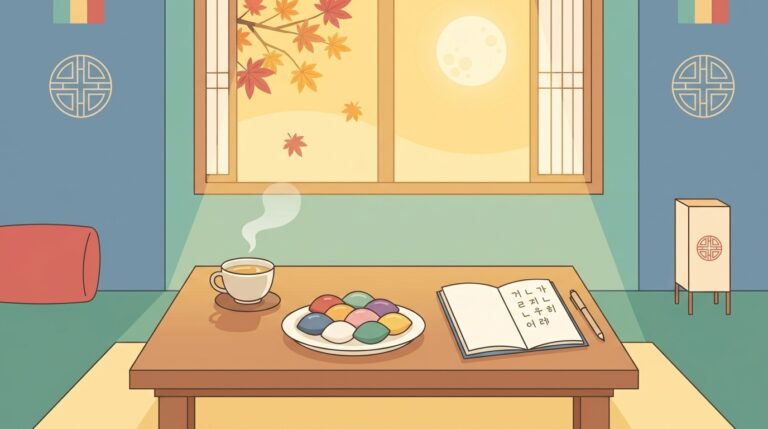
Phase 1: Empathy (Story-Driven Opening)
안녕하세요! 매일한글 에디터입니다. (Hello! This is your Daily Hangul editor.)
Imagine this: It is the eve of Chuseok (추석), Korea’s biggest harvest thanksgiving festival. As you walk down the usually bustling streets of Seoul or Busan, a strange silence settles in. Neon signs flicker off, your favorite cozy neighborhood kimbap spot has a handwritten note reading ‘Happy Chuseok, closed for family visits’, and the subway stations are flooded with people carrying beautifully wrapped gift sets. Meanwhile, you head back to your studio apartment alone, scrolling through social media feeds filled with friends having giant family feasts.
Being far away from family during a massive national holiday is deeply bittersweet. You might want to share your feelings with Korean coworkers, friends, or neighbors without sounding overly dramatic or awkward. In this guide, tailored specifically for intermediate (B1) learners, you will master natural, warm, and culturally nuanced expressions to talk about staying behind during holidays, express solitude gently, and connect with locals on a deeper emotional level.
Phase 2: Deep Dive into 3 Essential Expressions
1. 이번 추석에는 고향에 못 내려가요 (I can’t go down to my hometown this Chuseok)
- Pronunciation: [I-beon Chu-seog-e-neun go-hyang-e mot nae-ryeo-ga-yo] (Sounds like: ‘ee-beon choo-seok-eh-neun go-hyang-eh mote neh-ryuh-gah-yo’)
- Meaning: Literal: “This Chuseok, to hometown cannot go down” | Nuance: “I am unable to visit home/family this holiday season.”
- K-Culture Moment: Frequently heard in K-dramas like Reply 1988 or My Liberation Notes when young professionals working in Seoul explain why they are working holiday overtime.
- Editor’s Insight: Notice the verb 내려가다 (to go down). In Korea, Seoul is culturally viewed as ‘up’ (상경), so visiting provinces or hometowns is traditionally called ‘going down’ (내려가다), regardless of actual geographical elevation.
- Situation Spectrum: Casual: ✅ | Semi-formal: ✅ | Formal: ⚠️ (Use ‘고향에 내려가지 못합니다’ for formal announcements)
- 🤔 Think About It: In your culture, do you use directional verbs like ‘go down’ or ‘go home’ to describe visiting family?
2. 혼자 있으니까 마음이 좀 쓸쓸하네요 (Since I’m alone, my heart feels a bit lonely/wistful)
- Pronunciation: [Hon-ja iss-eu-ni-kka ma-eum-i jom sseul-sseul-ha-ne-yo] (Pronounce ‘sseul-sseul’ softly like the rustling sound of autumn leaves)
- Meaning: Literal: “Being alone, my mind is a bit bleak” | Nuance: “Spending it alone leaves me with a gentle, wistful loneliness.”
- K-Culture Moment: Used in slow-paced healing variety shows like Three Meals a Day or I Live Alone when guests reflect on quiet holiday evenings.
- Editor’s Insight: Unlike 외롭다 (to feel actively lonely/abandoned), 쓸쓸하다 describes a melancholic, poetic solitude—perfect for autumn Chuseok vibes without burdening the listener.
- Situation Spectrum: Casual: ✅ | Semi-formal: ✅ | Formal: 🚫
- 🤔 Think About It: Why does Korean distinguish between active loneliness (외로움) and atmospheric melancholy (쓸쓸함)?
3. 이번 연휴는 그냥 집에서 푹 쉬려고요 (I plan to just get plenty of rest at home this long weekend)
- Pronunciation: [I-beon yeon-hyu-neun geu-nyang jib-e-seo puk swi-ryeo-go-yo] (Emphasize ‘puk’ like a soft sigh of relief)
- Meaning: Literal: “This holiday, just at home deeply intend to rest” | Nuance: “I’m taking this long break to just recharge peacefully at home.”
- K-Culture Moment: A modern catchphrase for single professionals and students known as the ‘Hon-chuseok’ (혼추족) generation.
- Editor’s Insight: The adverb 푹 (completely, deeply, thoroughly) softens the answer, turning an otherwise sad situation (“I have nowhere to go”) into a positive self-care decision.
- Situation Spectrum: Casual: ✅ | Semi-formal: ✅ | Formal: ⚠️
- 🤔 Think About It: How has the concept of holiday vacation shifted from mandatory family duty to personal relaxation in your society?
Phase 3: Textbook Korean vs. Real Native Korean
Situation 1: When a coworker asks if you have big travel plans
- 📖 교과서 한국어 (Textbook): “저는 가족이 멀리 있어서 추석에 아무 데도 가지 않습니다.” (Because my family is far away, I am not going anywhere on Chuseok.)
- 🗣️ 진짜 한국어 (Real Native): “비행기 표도 비싸고 해서 이번엔 그냥 서울에 있기로 했어요.” (Plane tickets are pricey and all, so I just decided to stay in Seoul this time.)
- 💡 왜 다를까? (Why the difference?): Native speakers rarely say “I am doing nothing” flatly. Adding a light, practical context like ticket prices (
~고 해서) sounds far more natural and relatable.
Situation 2: When someone expresses sympathy that you’re staying behind
- 📖 교과서 한국어 (Textbook): “저는 괜찮으니 걱정하지 마십시오.” (I am fine, so do not worry.)
- 🗣️ 진짜 한국어 (Real Native): “괜찮아요! 맛있는 거 시켜 먹으면서 밀린 드라마 몰아보려고요.” (I’m good! I’m planning to order good food and binge-watch the dramas I’ve missed.)
- 💡 왜 다를까? (Why the difference?): Koreans love sharing comfort food and media plans to signal that solitude is relaxing rather than isolating.
Phase 4: K-Culture Deep Dive & Non-Verbal Manners
4-1. 눈치 (Nunchi) & Gestures
- The Empathetic Nod: When Korean colleagues say they dread the 8-hour traffic jam (귀성길), nod with a slight sigh and say, “길이 진짜 많이 막히겠어요” (Traffic must be terrible). It validates their struggle while contrasting with your quiet city stay.
- Softening Tone Particles: End sentences with
~고요or~네요rather than blunt declarative endings (~다). This gives warmth and invites conversational comfort.
4-2. Cultural Code: The ‘Hon-chuseok’ (혼추족) Trend
In the past, spending Chuseok away from home was considered tragic. Today, young Koreans embrace 혼추족 (people spending Chuseok alone). Convenience stores like CU and GS25 release gourmet holiday bento boxes (Chuseok Dosirak) featuring traditional items like Jeon (pan-fried battered delicacies) and Galbijjim (braised short ribs). Knowing this allows you to celebrate independently with dignity and pride!
Phase 5: Real-Life Roleplay Scenario
- Setting: A sunlit office lounge on the Friday before the 4-day Chuseok break.
- Characters: You (B1 Learner) & Minji (민지 – friendly Korean teammate holding a holiday gift box).
- 민지: 이제 곧 연휴네요! 이번 추석에 고향 내려가세요?
(I-je got yeon-hyu-ne-yo! I-beon chu-seog-e go-hyang nae-ryeo-ga-se-yo?)
“The holiday is starting! Are you heading down to your hometown this Chuseok?”
🎭 Leans against the counter with a warm smile. -
You: 아니요, 거리가 너무 멀어서 이번엔 못 내려가요.
(A-ni-yo, geo-ri-ga neo-mu meor-eo-seo i-beon-en mot nae-ryeo-ga-yo.)
“No, it’s too far away, so I can’t go down this time.”
🎭 Smiles gently with an understanding shoulder shrug. -
민지: 아, 진짜요? 명절인데 혼자 계시면 좀 쓸쓸하시겠어요.
(A, jin-jja-yo? Myeong-jeor-in-de hon-ja gye-si-myeon jom sseul-sseul-ha-si-gess-eo-yo.)
“Oh really? Since it’s a holiday, it might feel a bit lonely spending it alone.”
🎭 Looks at you with genuine, comforting empathy. -
You: 처음엔 좀 그랬는데, 이번엔 집에서 푹 쉬면서 맛있는 거 먹으려고요.
(Cheo-eum-en jom geu-raess-neun-de, i-beon-en jib-e-seo puk swi-myeon-seo mas-iss-neun geo meog-eu-ryeo-go-yo.)
“It felt like that at first, but this time I plan to rest deeply at home and eat good food.”
🎭 Brightens tone to reassure Minji. -
민지: 오, 그것도 좋네요! 명절 음식은 챙겨 드실 수 있어요?
(O, geu-geot-do joh-ne-yo! Myeong-jeol eum-sig-eun chaeng-gyeo deu-sil su iss-eo-yo?)
“Oh, that sounds nice too! Will you be able to enjoy some holiday food?”
🎭 Tilts head curiously. -
You: 네! 편의점 명절 도시락도 잘 나오고 송편도 사 먹으려고요.
(Ne! Pyeon-ui-jeom myeong-jeol do-si-rak-do jal na-o-go song-pyeon-do sa meog-eu-ryeo-go-yo.)
“Yes! Convenience stores have great holiday lunchboxes, and I plan to buy some songpyeon too.”
🎭 Chuckles enthusiastically. -
민지: 다행이에요. 그래도 연휴 동안 심심하면 언제든 단톡방에 연락해요!
(Da-haeng-i-e-yo. Geu-rae-do yeon-hyu dong-an sim-sim-ha-myeon eon-je-deun dan-tok-bang-e yeon-rak-hae-yo!)
“What a relief. Still, if you get bored during the holidays, message our group chat anytime!”
🎭 Handing you a traditional snack from her desk. -
You: 고마워요, 민지 씨. 가족분들이랑 따뜻한 추석 보내세요!
(Go-ma-wo-yo, Min-ji ssi. Ga-jok-bun-deul-i-rang tta-tteut-han Chu-seok bo-nae-se-yo!)
“Thank you, Minji. Have a warm Chuseok with your family!”
🎭 Bows lightly with both hands together.
🔀 Interactive Decision Point
If Minji asks, “혼자 계시면 쓸쓸해서 어떡해요?” (What if you’re lonely alone?), how would you respond?
- Option A: “그냥 혼자 있는 게 제일 편해요. 신경 쓰지 마세요.” (Being alone is most comfortable. Don’t mind me.)
- 👉 Feedback [Bad]: A bit too cold and defensive. It might make Minji feel that her polite concern was rejected.
- Option B: “조금 허전하긴 하지만, 이번 기회에 밀린 잠도 푹 자고 혼자만의 힐링 시간을 보내려고요!” (It does feel slightly empty, but I take this as a chance to catch up on sleep and enjoy some healing time!)
- 👉 Feedback [Best]: Perfectly balances honesty (acknowledging holiday loneliness) with positive, culturally polished energy.
- Option C: “너무 외로워서 눈물이 날 것 같아요…” (I’m so lonely I think I might cry…)
- 👉 Feedback [Risk]: Unless Minji is your best friend, this burden of emotional weight may create severe conversational awkwardness.
Phase 6: 10-Second Emotional Shadowing Drill
Follow the pause markers (/) and embody the emotional stage cues:
[🥺 아쉽고 쓸쓸하게 / Wistful & gentle]- 이번 추석에는 / 고향에 못 내려가서 / 마음이 좀 쓸쓸해요.
(I-beon Chu-seog-e-neun / go-hyang-e mot nae-ryeo-ga-seo / ma-eum-i jom sseul-sseul-hae-yo.)
- 이번 추석에는 / 고향에 못 내려가서 / 마음이 좀 쓸쓸해요.
[😌 편안하고 산뜻하게 / Relaxed & bright]- 그래도 이번 연휴에는 / 집에서 푹 쉬면서 / 힐링하려고요.
(Geu-rae-do i-beon yeon-hyu-e-neun / jib-e-seo puk swi-myeon-seo / hil-ling-ha-ryeo-go-yo.)
- 그래도 이번 연휴에는 / 집에서 푹 쉬면서 / 힐링하려고요.
[🥰 따뜻하고 정중하게 / Warm & polite blessing]- 가족분들과 함께 / 풍성하고 따뜻한 한가위 / 보내세요!
(Ga-jok-bun-deul-gwa ham-kke / pung-seong-ha-go tta-tteut-han han-ga-wi / bo-nae-se-yo!)
- 가족분들과 함께 / 풍성하고 따뜻한 한가위 / 보내세요!
Phase 7: K-Culture Mini Dictionary
- 혼추족 (Hon-chu-jok) | N. Solo Chuseok Spender
- A modern blend of ‘혼자’ (alone) and ‘추석’ (Chuseok). Used in news articles and conversations to describe people spending the holiday independently.
- 귀성길 (Gwi-seong-gil) | N. The homeward journey / Road trip to hometown
- Refers specifically to the mass migration of people leaving major metropolitan areas to visit family during national holidays.
- 한가위 (Han-ga-wi) | N. Traditional native Korean name for Chuseok
- Derived from ancient Korean meaning ‘great middle of autumn’. Used extensively in formal holiday greetings like “풍성한 한가위 되세요”.
- 송편 (Song-pyeon) | N. Half-moon shaped rice cake steamed on pine needles
- The quintessential food of Chuseok. Legend says making pretty songpyeon means you will meet a good partner or have a beautiful child.
Phase 8: Survival Kit for Holiday Solitude
Survival Expressions TOP 3
- 추석 당일에도 영업하나요? (Are you open on the actual day of Chuseok?)
- Pronunciation: [Chu-seok dang-il-e-do yeong-eop-ha-na-yo?]
- Pro Tip: Many small indie cafes close on Chuseok Day, while major franchises remain open.
- 명절 선물 세트 추천해 주실 수 있나요? (Could you recommend a holiday gift set?)
- Pronunciation: [Myeong-jeol seon-mul se-teu chu-cheon-hae ju-sil su iss-na-yo?]
- Pro Tip: Perfect for picking up gift sets (fruit, Spam, luxury ginseng) for Korean landlords or mentors.
- 남은 연휴 잘 보내세요! (Have a great rest of your holiday break!)
- Pronunciation: [Nam-eun yeon-hyu jal bo-nae-se-yo!]
- Pro Tip: The most versatile greeting to tell shopkeepers or acquaintances in the middle of holiday week.
Editor’s Travel Note
- Navigation Tip: Check business holiday schedules on the Naver Map service app. Stores actively update their holiday operating hours under their detail tabs.
- Public Transport Bonus: Subways and major buses in Seoul often extend late-night operations on the day before and the day of Chuseok to accommodate late arrivals.
Phase 9: “One Step Deeper” (Humanities Essay)
In Korean culture, the word 고향 (Gohyang – hometown) is not just a geographical coordinate; it is a repository of collective nostalgia, communal warmth (Jeong / 정), and shared identity. When Koreans ask you if you are “going down to your hometown,” they are not merely inquiring about your itinerary—they are asking if your spirit has a safe harbor to return to for rejuvenation. When you answer with gentle self-compassion, you build an emotional bridge across cultures, expressing shared humanity in an urbanizing world.
💬 Your Turn: Have you ever spent a major cultural holiday far from home? How do you say “I’m spending the holidays peacefully alone” in your native language? Share your thoughts below!
Phase 10: Structured FAQ & Common Mistakes
Q: Is Seoul completely shut down during Chuseok?
A: Not anymore! While smaller family-run restaurants and traditional markets close for 1–2 days (especially on the day of Chuseok), large shopping malls, movie theaters, palace grounds, theme parks, and major convenience stores remain bustling and open.
Q: What is the difference between ‘외로워요’ and ‘쓸쓸해요’?
A: 외로워요 points to personal, direct loneliness caused by isolation from people. 쓸쓸해요 incorporates the surrounding atmosphere (e.g., quiet autumn winds, empty streets), sounding softer and more reflective.
Q: Can I use “해피 추석 (Happy Chuseok)” with elders?
A: It is better to use the proper polite phrase “풍성한 한가위 보내세요” or “따뜻한 명절 보내세요”. “해피 추석” is considered very informal internet slang among young peers.
🚨 Common Mistakes Board
- ❌ Mistake 1: Saying “추석 축하해요” (Congratulations on Chuseok).
- 👉 Correct Action: Chuseok is not a birthday or personal milestone. Say “즐거운 추석 보내세요” (Have an enjoyable Chuseok).
- ❌ Mistake 2: Translating “I miss my family” literally as “가족을 놓쳤어요” (which means “I physically missed the bus/family”).
- 👉 Correct Action: Say “가족들이 보고 싶어요”.
- ❌ Mistake 3: Saying “추석에 집에 가요” when talking about staying in your Seoul room.
- 👉 Correct Action: Say “집에 있어요” (I stay at home) or “방콕해요” (slang: staying in my room).
Phase 11: Action Missions
- 🥉 Bronze Mission (Solo Practice): Stand before a mirror and practice saying: “이번 추석엔 집에서 푹 쉬려고요!” with a relaxed smile.
- 🥈 Silver Mission (Social Sharing): Post a photo of your holiday meal or quiet street on Instagram or threads with the hashtag
#혼추족and#추석연휴. - 🥇 Gold Mission (Real Life): Visit your local convenience store or cafe, order a holiday snack, and warmly tell the clerk: “명절 잘 보내세요!”
🎮 K-Culture Mission: Watch an episode of a Korean variety show (like Hangout with Yoo or Home Alone) released during Chuseok week and spot how many times people mention 귀성길 or 송편!
Phase 12: Interactive Quiz Challenge
Q1. Fill in the blank:
“이번 추석에는 비행기 표가 없어서 고향에 못 ( ).”
(a) 올라가요 (b) 내려가요 (c) 들어가요
🔍 Click to reveal the answer & explanation
Correct Answer: (b) 내려가요
Explanation: In Korean spatial perception, traveling from the capital to hometowns/provinces is expressed with the verb 내려가다 (to go down).
Q2. True or False:
Saying “추석 축하합니다” is the most natural greeting to your Korean professor.
🔍 Click to reveal the answer & explanation
Correct Answer: False
Explanation: Holidays use “보내세요” (spend/have), so “풍성한 한가위 보내세요” is the polite and correct expression.







