

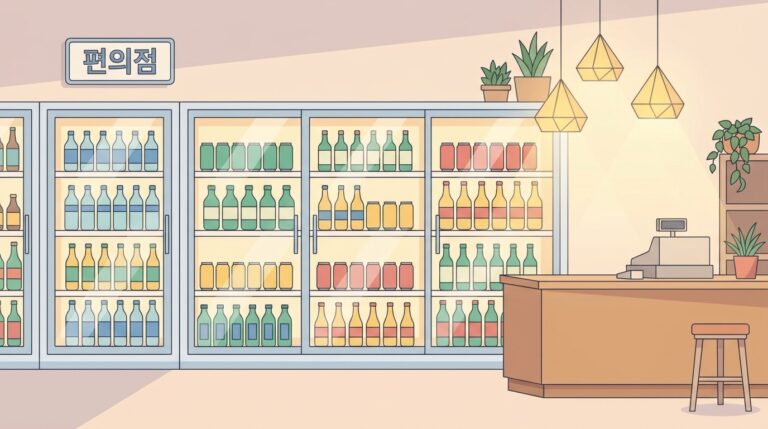
Finding Drinks in a Korean Convenience Store: A Beginner’s Survival Guide
Phase 1: Empathy (Story-Driven Opening)
안녕하세요! (Annyeonghaseyo!) I’m your Daily Hangul editor and Korean culture navigator. Picture this: You’ve just stepped off an evening flight into the dazzling neon lights of Seoul. You walk straight into a bright CU or GS25 convenience store, thirsty for that viral Banana Milk (바나나맛 우유) you’ve seen in every K-Drama. But as you stand in the buzzing aisles surrounded by hundreds of colorful bottles and snack packs, freeze hits you. Where are the drinks kept? You want to ask the clerk, but your mind goes completely blank. Don’t worry! Every Korean learner has frozen in front of a convenience store counter at least once. Based on feedback from hundreds of our A1 beginner students, mastering just one simple phrase can transform your late-night snack run from nerve-wracking to delightfully fun. Let’s unlock the exact words you need today!
Phase 2: Top 3 Core Expressions
1. 음료수 어디에 있어요? (Eumryosu eodie isseoyo?)
- Pronunciation: Eum-ryo-su eo-di-e it-seo-yo? (Sounds like: Oom-ryo-soo uh-dee-eh ees-suh-yo?)
- Meaning: Literal: “Where does drink exist?” / Real Nuance: “Excuse me, where can I find the drinks?”
- K-Culture Moment: Seen in countless youth K-dramas where a thirsty student enters a shop after cram school and asks the part-timer for a cold beverage.
- Editor’s Insight: 음료수 (eumryosu) means any non-alcoholic drink or beverage. Adding 어디에 있어요? (Where is it?) makes this the #1 most useful pattern for shopping in Korea.
- Situation Spectrum: Casual: ⚠️ (Use with close friends: 음료수 어디 있어?) | Semi-formal (Polite): ✅ (음료수 어디에 있어요?) | Formal: 🚫 (음료수 어디에 있습니까? – too stiff for a small shop)
- 🤔 Think About It: Notice how Korean places the question word 어디 (where) in the middle of the sentence rather than at the very beginning like in English. How does this shift your focus to the item first?
2. 저기요, 물 어디 있어요? (Jeogiyo, mul eodi isseoyo?)
- Pronunciation: Jeo-gi-yo, mul eo-di it-seo-yo? (Sounds like: Juh-gee-yo, mool uh-dee ees-suh-yo?)
- Meaning: Literal: “Over there (excuse me), where is water?” / Real Nuance: “Pardon me, where is the bottled water?”
- K-Culture Moment: When tourists or locals enter a convenience store on a sweltering summer day after hiking Namsan Tower and need quick hydration.
- Editor’s Insight: 저기요 (jeogiyo) literally means “over there,” but it functions as a polite attention-grabber like “excuse me.” 물 (mul) is one of the easiest 1-syllable Korean words to remember.
- Situation Spectrum: Casual: ⚠️ | Semi-formal: ✅ | Formal: 🚫
- 🤔 Think About It: Why do Koreans use a spatial word (“over there”) to politely call someone instead of saying “I am sorry”?
3. 이거 어디에 있어요? (Igeo eodie isseoyo?)
- Pronunciation: I-geo eo-di-e it-seo-yo? (Sounds like: Ee-guh uh-dee-eh ees-suh-yo?)
- Meaning: Literal: “Where is this thing?” / Real Nuance: “Where can I find this? (showing phone screen/photo)”
- K-Culture Moment: Holding up a screenshot of the trending pouch drink and ice cup on Instagram to show the store clerk.
- Editor’s Insight: 이거 (igeo) means “this thing.” If you can’t pronounce a specific drink name, just point to a photo on your smartphone and say this sentence!
- Situation Spectrum: Casual: ⚠️ | Semi-formal: ✅ | Formal: 🚫
- 🤔 Think About It: Combining visual cues (pointing to your screen) with a simple Korean phrase is universally understood and instantly lowers language barriers.
Phase 3: Textbook Korean vs. Real Korean
Situation A: Asking for the drink refrigerator
- 📖 Textbook Korean: 음료수가 어느 위치에 위치하고 있습니까? (Eumryosuga eoneu wichie wichi-hago itseumnikka? – “In which location are the beverages located?”)
- 🗣️ Real Korean: 저기요, 음료수 어디 있어요? (Jeogiyo, eumryosu eodi isseoyo? – “Excuse me, where are the drinks?”)
- 💡 Why is it different? Real-life convenience store interactions are fast and friendly. Dropping redundant formal nouns like 위치 (location) sounds infinitely more natural.
Situation B: Asking where the ice cups are located
- 📖 Textbook Korean: 얼음 컵을 어디에서 찾을 수 있습니까? (Eoreum keobeul eodieseo chajeul su itseumnikka? – “Where may I find ice cups?”)
- 🗣️ Real Korean: 얼음 컵 어디에 있어요? (Eoreum keop eodie isseoyo? – “Where are the ice cups?”)
- 💡 Why is it different? Koreans cut complex grammar like “can I find” (~ㄹ 수 있습니까) when a simple “is it here?” (있어요?) does the job perfectly.
Phase 4: K-Culture Deep Dive & Non-verbal Manners
4-1. Nunchi & Gestures (눈치와 제스처)
When approaching a convenience store staff member (알바생 – albasang):
* The Soft Nod: Make brief eye contact and do a slight 15-degree bow when saying 저기요 (Jeogiyo).
* Two-Handed Phone Holding: If showing a photo of a drink, hold your phone with both hands or support your right wrist with your left hand. This subtle sign of respect makes clerks super eager to help you.
* Avoid Snapping or Waving Violently: Never snap your fingers or whistle to get attention.
4-2. Cultural Code: The Korean Pouch Drink Culture (파우치 음료)
If you visit any Korean convenience store between May and October, you will notice a huge freezer packed with plastic cups filled with ice (얼음 컵) right next to racks of sealed liquid pouches containing iced Americano, peach iced tea, or blue lemonade. Buying a pouch and pouring it into an ice cup yourself is a beloved K-convenience store ritual!
Phase 5: Real-Life Roleplay Scenario
- Setting: A brightly lit GS25 store near Hongdae Station on a Friday night.
- Characters: You (Thirsty traveler) & Min-jun (Friendly college student working part-time).
- You: 저기요! (Jeogiyo!) – 🎭 (Lightly bowing and making eye contact) – “Excuse me!”
- Min-jun: 네, 어서오세요! (Ne, eoseo-oseyo!) – 🎭 (Smiling from behind the counter) – “Yes, welcome!”
- You: 음료수 어디에 있어요? (Eumryosu eodie isseoyo?) – 🎭 (Looking around with an inquiring face) – “Where are the drinks?”
- Min-jun: 음료수는 저쪽 안쪽 냉장고에 있어요. (Eumryosuneun jeojjok anjjok naengjanggo-e isseoyo.) – 🎭 (Pointing toward the far back wall) – “The drinks are in that refrigerator at the back.”
- You: 바나나 우유도 거기에 있어요? (Banana uyudo geogie isseoyo?) – 🎭 (Asking with a hopeful sparkle in your eye) – “Is banana milk there too?”
- Min-jun: 네! 유제품 코너에 있어요. (Ne! Yuje-pum koneo-e isseoyo.) – 🎭 (Nodding cheerfully) – “Yes! It’s in the dairy section.”
- You: 감사합니다! (Gamsahamnida!) – 🎭 (Giving a thankful bow) – “Thank you!”
- Min-jun: 네, 천천히 보세요! (Ne, cheoncheonhi boseyo!) – 🎭 (Waving politely) – “Sure, take your time!”
🔀 Interactive Branching Moment
You reach the fridge, but the specific brand of milk you want is not visible. What do you do?
* Option A: Walk back to the counter, show your phone screen, and ask: “이거 있어요?” (Igeo isseoyo? – Do you have this?)
* Option B: Shout loudly across the store: “Hey, where is the yellow milk?”
* Option C: Leave the store empty-handed and sad.
- Feedback:
- Option A [BEST]: Perfect! Combining 이거 있어요? with a photo is the most natural and polite way to ask if an item is in stock.
- Option B [BAD]: Shouting breaks the calm atmosphere of Korean convenience stores and may cause embarrassment.
- Option C [RISK]: Don’t give up! Korean convenience store clerks are always happy to check their back stock room for you.
Phase 6: 10-Second Emotion Shadowing Drill
Practice reading these out loud with emotional intent. Pause briefly at the / marks!
[😊 Politeness & Gentle Curiosity]
저기요, / 음료수 / 어디에 있어요?
(Jeogiyo, / eumryosu / eodie isseoyo?)-
[🤩 Excited Discovery]
우와! / 바나나 우유 / 여기 있다!
(Uwa! / banana uyu / yeogi itda! / “Wow! Banana milk is right here!”) -
[🙏 Sincere Gratitude]
도와주셔서 / 정말 감사합니다!
(Dowajusyeoseo / jeongmal gamsahamnida! / “Thank you so much for helping me!”)
Phase 7: K-Culture Mini Dictionary
- 편의점 (Pyeon-ui-jeom): Convenience Store. In Korea, this is not just a shop, but a complete food, banking, parcel, and lifestyle hub.
- 원플러스원 (Won-peul-leo-seu-won / 1+1): Buy-One-Get-One-Free. Look out for the “1+1” tags on drink shelves!
- 얼음 컵 (Eol-eum keop): Ice cup. Sold separately in clear plastic cups for pouch coffee and juices.
- 알바생 (Al-ba-saeng): Part-time worker / Clerk. Short for Arbeit student, representing the friendly youth powering Korea’s 24/7 service culture.
Phase 8: Traveler’s Survival Kit
Top 3 Survival Phrases
- 물 어디 있어요? (Mul eodi isseoyo?) – Pro Tip: Say this when looking for plain mineral water (생수 – saengsu).
- 빨대 있어요? (Ppaldae isseoyo?) – Pro Tip: “Do you have a straw?” Most stores keep straws behind the counter.
- 봉투 필요 없어요. (Bongtu piryo eopseoyo.) – Pro Tip: “I don’t need a plastic bag.” Saves you 100 KRW and helps the planet!
Editor’s Travel Note
Before roaming around Seoul, make sure to read the Naver Map English App Download and Navigation Guide to locate nearby 24-hour convenience stores instantly. Also, always remember that all major Korean convenience stores accept foreign credit cards (Visa/Mastercard) and T-Money transit cards seamlessly at checkout!
Phase 9: Think Deeper (한 발 더 깊이)
In Korea, asking for help in a shop is viewed through the lens of Jeong (정) and mutual social consideration. Unlike Western shopping environments where clerks might linger and ask “How can I help you today?”, Korean convenience store clerks deliberately give you space unless you explicitly call them with a polite 저기요. It is not aloofness; it is Korean politeness that respects your privacy until needed.
💬 Your Turn: What is your favorite Korean beverage you want to try first in Seoul? Leave a comment below and practice writing “[Drink Name] 어디에 있어요?” in Korean!
Phase 10: FAQ & Common Mistakes
Q: Can I just say ‘음료수 어디?’ to the clerk?
A: No, omitting the polite ending ~요 turns it into Banmal (informal talk), which can sound rude to a stranger. Always add ~있어요? to stay polite!
Q: What is the difference between 물 (mul) and 음료수 (eumryosu)?
A: 물 (mul) refers strictly to drinking water, while 음료수 (eumryosu) covers sodas, juices, teas, and canned coffees.
Q: How do I ask for cold drinks specifically?
A: Most drinks on shelves are already refrigerated, but you can ask: “시원한 거 어디 있어요?” (Siwonhan geo eodi isseoyo? – Where are the cold ones?)
🚨 Common Mistakes Alert Board
- ❌ Mistake 1: Calling the clerk “여기요” loudly across the room.
- 👉 Correct Action: Make eye contact near the counter and say “저기요” in a gentle tone.
- ❌ Mistake 2: Taking a drink bottle and trying to drink it before paying.
- 👉 Correct Action: In Korea, always pay at the counter (계산대) first before opening the seal.
- ❌ Mistake 3: Forgetting to grab your receipt or card immediately.
- 👉 Correct Action: Take your card with both hands when returned by the clerk.
Phase 11: Action Missions
- 🥉 Bronze Mission (Solo Practice): Stand in front of your home fridge, point to a drink, and say “음료수 어디에 있어요?” 3 times out loud.
- 🥈 Silver Mission (Social Share): Post a picture of your favorite drink on Instagram or Twitter with the caption: “[Drink name] 어디에 있어요? #DailyHangul”.
- 🥇 Gold Mission (Real Life): Visit a local Korean supermarket or a convenience store in Korea, locate the drinks aisle, and thank the clerk with “감사합니다!”.
- 🎮 K-Culture Mission: Watch any episode of a contemporary K-Drama (like Hospital Playlist or Twenty-Five Twenty-One) and spot the convenience store scene!
Phase 12: Interactive Quiz Challenge
Question 1: Which phrase is the most natural way to ask where the drinks are in a convenience store?
A) 음료수 어디에 있습니까?
B) 저기요, 음료수 어디에 있어요?
C) 야, 음료수 어디야?
Question 2: Fill in the blank:
저기요, 얼음 컵 ______ 있어요? (Excuse me, where are the ice cups?)
A) 언제 (Eonje)
B) 누구 (Nugu)
C) 어디에 (Eodie)
Question 3 (True/False):
In Korean convenience stores, it is polite to address the part-time worker with informal Banmal (반말) because they are young. (True / False)
👉 Click here to reveal Answers & Explanations!
- Question 1 Answer: B (Semi-formal polite speech 저기요, 음료수 어디에 있어요? is the gold standard for daily retail shopping in Korea.)
- Question 2 Answer: C (어디에 means “where / at which place”).
- Question 3 Answer: FALSE! (Regardless of age, you should always speak politely with Jondaenmal (존댓말) using ~요 endings to service workers in Korea.)







