

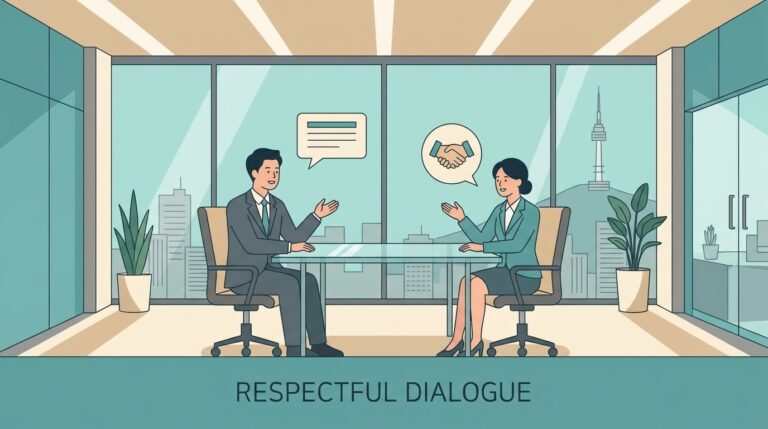
Master the Art of Reading Needs: Advanced Korean Negotiation Psychology
Phase 1: Empathy & Immersion Opening
안녕하세요! 매일한글 에디터입니다.
Have you ever watched a high-stakes K-Drama like Misaeng (Incomplete Life) or Reborn Rich and wondered how Korean corporate negotiators seal impossible deals without ever raising their voices or making blunt demands? In Western negotiation culture, clarity and direct assertion of terms are celebrated. But when negotiating in Korean business and high-level social environments, pushing directly with questions like “What do you want?” often triggers immediate defense mechanisms.
Many advanced C1 Korean learners hit an invisible ceiling here. You know complex grammar, but during real-world negotiations, high-stakes freelance contracts, or workplace discussions in Seoul, you might feel like your counterpart is hiding their true intent—their soknae (속내). This guide is built on authentic corporate coaching data and insider cultural nuances to help you unlock what the other party truly values beneath surface-level demands. Mastering these persuasive inquiries will transform you from a competent speaker into an influential cultural strategist.
Phase 2: Top 3 High-Impact Expressions for Uncovering Needs
1. 가장 염두에 두고 계신 부분이 어떤 점인지 여쭤봐도 될까요?
- Pronunciation: [Gajang yeom-du-e du-go gye-sin bu-bun-i eo-tteon jeom-in-ji yeo-jjwo-bwa-do doel-kka-yo?] (Think: ‘Yum-doo-eh’ like keeping something planted softly in mind)
- Meaning: Literal: “May I ask what part you are keeping most in mind?” | Real Nuance: “What is your top underlying priority or core concern?”
- K-Culture Moment: Used by seasoned team leads in corporate dramas right before breaking a deadlock, showing immense respect while nudging the client to reveal their ultimate dealbreaker.
- Editor’s Insight: 염두 (Yeomdu) refers to the mental space where thoughts settle. Asking what someone keeps in their 염두 is exponentially more polite and tactful than asking what their “demands” are.
- Situation Spectrum: Casual 🚫 | Semi-formal ⚠️ | Formal ✅
- 🤔 Think About It: How does phrasing a demand as “something kept gently in mind” alter the emotional temperature of a tense business meeting?
2. 혹시 이번 건에서 절대 양보하기 어려운 핵심 기준이 있으실까요?
- Pronunciation: [Hok-si i-beon geon-e-seo jeol-dae yang-bo-ha-gi eo-ryeo-un haek-sim gi-jun-i is-seu-sil-kka-yo?]
- Meaning: Literal: “By any chance, is there a core criterion in this matter that is hard to concede?” | Real Nuance: “What is your non-negotiable bottom line?”
- K-Culture Moment: The moment an entertainment agency executive negotiates an exclusive contract renewal with an artist without breaking the working relationship.
- Editor’s Insight: Using 혹시 (by any chance) and 양보하기 어려운 (difficult to concede) softens the boundary while allowing the counterparty to save face while disclosing their red lines.
- Situation Spectrum: Casual 🚫 | Semi-formal ⚠️ | Formal ✅
- 🤔 Think About It: Why is asking about the “criterion for concession” psychologically easier to answer than asking “What is your minimum price?”
3. 표면적인 조건 외에 실질적으로 더 중요하게 보시는 가치가 무엇인가요?
- Pronunciation: [Pyo-myeon-jeok-in jo-geon oe-e sil-jil-jeok-eu-ro deo jung-yo-ha-ge bo-si-neun ga-chi-ga mu-eot-in-ga-yo?]
- Meaning: Literal: “Besides surface-level terms, what value do you practically view as more important?” | Real Nuance: “What is the hidden, qualitative payoff you care about most? (e.g., reputation, speed, long-term trust)”
- K-Culture Moment: Classic tech-startup pitch scenes in Gangnam where investors look past revenue forecasts to assess mutual vision and synergy.
- Editor’s Insight: Korean business culture weighs 명분 (justifiable cause/reputation) equally with 실리 (practical profit). This question touches upon their emotional and strategic motivations.
- Situation Spectrum: Casual ⚠️ | Semi-formal ✅ | Formal ✅
- 🤔 Think About It: Is business negotiation in your culture strictly transactional, or does qualitative ‘face’ (체면) carry financial weight?
Phase 3: Textbook Korean vs. Real Native Korean
Situation 1: Asking what the client wants during contract review
- 📖 교과서 한국어 (Textbook): “당신의 요구 사항이 무엇입니까?” (What are your demands? – Too blunt, sounds like an interrogation)
- 🗣️ 진짜 한국어 (Native C1): “이번 프로젝트에서 어떤 방향을 가장 우선순위로 두고 계실까요?”
- 💡 왜 다를까?: In Korean business communication, framing someone’s desires as 우선순위 (priorities) rather than 요구 사항 (demands) maintains professional courtesy and builds psychological safety.
Situation 2: Probing for ideal delivery timelines and scope
- 📖 교과서 한국어 (Textbook): “원하는 일정과 가격을 말씀해 주세요.” (Tell me the schedule and price you want.)
- 🗣️ 진짜 한국어 (Native C1): “대표님께서 생각하시는 가장 이상적인 그림을 편하게 말씀해 주시면 맞춰보겠습니다.”
- 💡 왜 다를까?: Using the metaphor 이상적인 그림 (ideal picture/vision) invites the speaker to share their dreams without feeling pressured into a rigid commitment.
Phase 4: K-Culture Deep Dive & Non-Verbal Manners
4-1. Nunchi & Reading the Atmosphere
In Korean negotiations, the real answers exist in the pauses. When a Korean counterpart pauses, touches their chin, and says, “아… 그 부분은 조금 검토가 필요할 것 같습니다” (Ah… that part might require some review), it almost always means “No, unless you alter the underlying terms.” Maintain soft eye contact, nod slowly, and avoid interrupting their silence. Leaning slightly forward with both hands resting lightly on the table demonstrates attentiveness and sincerity (진정성).
4-2. The Dynamics of Myeongbun (명분) vs. Silli (실리)
In Korean negotiation psychology, one rarely wins by cornering an opponent with sheer data. You must supply your counterpart with 명분 (a respectable rationale) that they can present to their own executives or team. When you figure out their real need, formulate your offer so it looks like a victory for their organization’s long-term reputation.
Phase 5: High-Stakes Interactive Roleplay
- Setting: A high-end meeting room in Teheran-ro, Gangnam. Rain taps against the window.
- Characters:
- Team Lead Han (한 팀장): Pragmatic, guarded, evaluating your cross-border partnership proposal.
- You (글로벌 파트너십 담당자): C1-level negotiator looking to align long-term incentives.
[Turn 1] 한 팀장: 저희 쪽 내부에서도 이번 제안서 검토를 많이 했습니다만… 단가와 납기 면에서 다소 부담스러운 게 사실입니다. (🎭 Arms crossed, tone measured and diplomatic)
(Our internal team reviewed your proposal thoroughly, but to be frank, the unit price and delivery timeline are somewhat burdensome.)
[Turn 2] You: 솔직하게 말씀해 주셔서 감사합니다. 저희도 양사의 시너지를 최우선으로 고려하고 있습니다.
(Thank you for your candor. We also prioritize the synergy between both our companies above all.)
[Turn 3] 한 팀장: 시너지도 중요하지만, 당장 다음 분기 KPI 실적에 반영되어야 하는 사안이라서요.
(Synergy is important, but this matter must directly reflect in next quarter’s KPI performance.)
[Turn 4] You: 그렇군요. 혹시 단가 조정 외에 실질적으로 이번 분기 성과를 위해 가장 염두에 두고 계신 부분이 어떤 점인지 여쭤봐도 될까요? (🎭 Leans forward gently, open palm gesture)
(I see. Aside from price adjustments, may I ask what specific factors you are keeping most in mind for this quarter’s targets?)
[Turn 5] 한 팀장: 음… 사실 가격도 가격이지만, 초기 런칭 시 마케팅 지원 규모가 가시적으로 나와야 임원진 결재가 원활합니다.
(Well… price matters, but honestly, having visible co-marketing support scale is what will ensure smooth approval from executive management.)
[Turn 6] You: 결국 임원진 분들께 제시할 확실한 명분과 가시적인 마케팅 임팩트가 핵심이셨군요.
(So the core factor was indeed clear rationale and visible marketing impact for your executive team.)
[Turn 7] 한 팀장: 네, 바로 그 점입니다. 그게 충족된다면 기본 공급가는 기존 제안대로 갈 여지가 있습니다.
(Yes, precisely. If that is met, there is room to keep the base unit price as originally proposed.)
[Turn 8] You: [Branch Point: What will you say next?]
🔀 Interactive Decision Point:
- Choice A: “그러면 마케팅 패키지를 추가할 테니 단가는 10% 더 올려주시겠습니까?”
- Choice B: “그렇다면 단가는 유지하되, 임원진 보고용 공동 마케팅 지원안을 패키지로 구성해 드리는 건 어떨까요?”
- Choice C: “임원진 결재가 그렇게 까다로우시면 계약을 다음 분기로 미루는 게 낫겠습니다.”
Feedback:
* Choice A (Risk ⚠️): Prematurely hiking the price after discovering their pain point will appear opportunistic and erode goodwill.
* Choice B (Best ✅): Directly addresses their underlying need (명분 for executives) while protecting your original core term (unit price).
* Choice C (Bad 🚫): Destroys rapport and ignores the counterpart’s willingness to close within this quarter.
Phase 6: 10-Second Emotion Shadowing Drill
- Drill 1: Probing for hidden desires [💼 차분하고 신뢰감 있게]
가장 염두에 두고 계신 / 핵심 기준이 / 어떤 부분인지 / 편하게 말씀해 주실 수 있을까요?
- Drill 2: Acknowledging unspoken hesitation [🤝 공감하며 부드럽게]
표면적인 일정 조율 외에도 / 혹시 마음에 걸리시는 부분이 / 더 있으신지요?
- Drill 3: Proposing mutual alignment [✨ 확신에 차고 설득력 있게]
상대측의 이상적인 그림에 맞춰 / 상호 윈윈할 수 있는 / 절충안을 찾아보겠습니다.
Phase 7: K-Culture Mini Dictionary
- 속내 (Soknae) [Sok-nae]: Innermost feelings or true hidden intentions. Essential in strategic meetings when someone isn’t saying “no” outright.
- 타협점 (Tahyeopjeom) [Ta-hyeop-jeom]: Compromise / Common ground. The psychological sweet spot reached when both parties’ covert needs are satisfied.
- 명분 (Myeongbun) [Myeong-bun]: Justifiable cause, moral duty, or face-saving reason required to justify an agreement to superiors.
- 복안 (Bogan) [Bok-an]: A well-conceived secret plan or alternative scheme kept in mind before entering a formal negotiation.
Phase 8: Strategic Survival Kit for Negotiators & Travelers
Top 3 On-the-Ground Phrases
- “혹시 예산 범위 내에서 맞춰볼 수 있는 대안이 있을까요?” (Is there an alternative we could align within budget limits?) — Pro Tip: Perfect when bargaining for group tours, high-end beauty packages, or custom design services in Korea.
- “제가 어떤 부분을 더 보완해 드리면 결정에 도움이 되실까요?” (What part can I supplement further to assist your decision?) — Pro Tip: Shifts you from an adversary to a supportive partner.
- “서로 부담 없는 선에서 조율해 보면 좋겠습니다.” (I hope we can adjust terms within a mutually comfortable threshold.) — Pro Tip: Calms high-tension negotiations instantly.
Editor’s Business Travel Note
When coordinating meetings in Seoul, punctuality and seamless logistics signal professional readiness. Prepare your route via 네이버 지도 앱 다운로드 to calculate accurate transit times across business hubs like Yeouido and Teheran-ro. For secure digital contract reviews or signing on the go, ensure you have your mobile enterprise apps verified before domestic business meetings.
Phase 9: Think Deeper (Humanities & Cultural Strategy)
In classical Western rhetoric, persuasion is often framed as a battle of logic where the superior argument wins. In Korean discourse, deeply rooted in high-context relational dynamics, persuasion is an exercise in mutual face-saving (체면) and harmony (조화). To discover what someone wants in Korea, you do not pull it out of them; you create an environment where sharing it becomes honorable and safe.
💬 Your Turn: Have you ever experienced a situation where someone meant “no” or had a hidden demand that they didn’t explicitly verbalize? How did you identify their true needs? Share your story below!
Phase 10: FAQ & Common Mistakes
Q: Can I use “무엇을 원하세요?” with Korean clients?
A: Avoid this. While grammatically correct, “무엇을 원하세요?” sounds demanding and confrontational in Korean business culture. Use “어떤 방향을 가장 우선적으로 고려하고 계실까요?” instead.
Q: What should I do if a Korean negotiator remains completely silent?
A: Do not immediately drop your price or rush to fill the silence. Acknowledge the gravity of their consideration by saying, “충분히 고민되실 만한 사안입니다. 가장 고민되시는 지점을 짚어주시면 함께 풀어나가겠습니다.”
Q: How do I distinguish between polite refusal and genuine negotiation room?
A: If they say “어렵습니다” (It’s difficult) with a vague conclusion, it is often a soft ‘no’. If they add “~면에서 조금 조율이 필요합니다” (Adjustment is needed regarding X), it is an active invitation to discover their underlying criteria.
🚨 Common Mistakes Board
- ❌ Mistake 1: Using 당신 (Dangsin) when asking about the other party’s needs. -> Correction: Use their job title with -님 (e.g., 팀장님, 대표님) or omit the subject naturally.
- ❌ Mistake 2: Demanding instant answers with “지금 바로 말씀해 주세요”. -> Correction: Use “편하게 말씀해 주시면 참고하겠습니다” to provide cognitive breathing room.
- ❌ Mistake 3: Treating non-committal phrases (글쎄요, 검토해 보겠습니다) as an affirmative signal. -> Correction: Dig gently into the underlying condition using “혹시 마음에 걸리시는 조건이 있으실까요?”.
Phase 11: Action Missions
- 🥉 Bronze Mission (Solo Mastery): Practice saying the 3 core expressions in Phase 2 out loud 5 times each using the pronunciation and intonation markers.
- 🥈 Silver Mission (Social Share): Write your own hypothetical negotiation response to Team Lead Han in the comments using at least two terms from the Phase 7 Mini Dictionary.
- 🥇 Gold Mission (Real-World Application): In your next Korean interaction, swap out a direct demand question for “가장 염두에 두고 계신 부분이 어떤 점인지…” and observe the difference in rapport!
- 🎮 K-Culture Mission: Watch an episode of a Korean legal/corporate drama (Suits Korea, Stranger, or Agency) and note down how characters ask for concessions without being blunt.
Phase 12: Interactive Quiz Challenge
Q1. Which of the following is the most tactful C1-level way to ask a client for their hidden priority?
1. 당신의 진짜 속셈이 무엇입니까?
2. 이번 안건에서 가장 염두에 두고 계신 우선순위가 무엇인지 여쭤봐도 될까요?
3. 원하는 조건을 당장 말하십시오.
👉 Click to Reveal Answer & Analysis
Correct Answer: 2
* Analysis: Option 2 utilizes honorable honorifics (여쭤보다), the subtle concept of 염두에 두다, and respect. Option 1 is offensive (속셈 means ‘sinister hidden scheme’), and Option 3 is aggressively demanding.
Q2. Fill in the blank with the appropriate strategic term:
* “상대방의 마음을 얻으려면 단순한 이익뿐만 아니라, 임원진에 보고할 명확한 (____)을/를 마련해 주어야 한다.”
👉 Click to Reveal Answer & Analysis
Correct Answer: 명분 (Myeongbun – Justifiable cause/rationale)
* Analysis: 명분 provides the structural and cultural legitimacy necessary for stakeholders to validate an agreement internally.
Q3. True or False: In high-stakes Korean negotiation, a counterpart saying “검토해 보겠습니다” (We will review it) always means the deal is finalized.
👉 Click to Reveal Answer & Analysis
Correct Answer: False
* Analysis: “검토해 보겠습니다” is often a polite buffer to pause the discussion, reflect, or indirectly signal reservation without open confrontation.







