

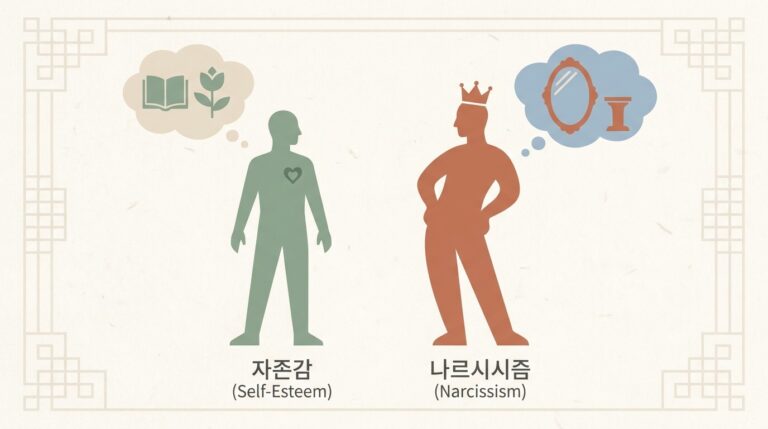
Distinguishing Self-Esteem from Narcissism in Korean Psychology
Phase 1: Empathy (Story-Driven Opening)
안녕하세요! 매일한글 에디터입니다. (Hello! I’m your Daily Hangul editor.)
Have you ever watched a K-Drama like It’s Okay to Not Be Okay (사이코지만 괜찮아) or Queen of Tears (눈물의 여왕) and felt captivated by the psychological tug-of-war between profound inner resilience and dazzling, yet brittle grandiosity? In Korean society, where interpersonal harmony (눈치, 관계 중심) constantly intersects with individual ambition, distinguishing genuine self-worth from toxic narcissism is not just textbook psychology—it is an everyday social skill.
Many advanced C2 Korean learners tell me: “Editor, I know words like 자존감 (self-esteem) and 자기애 (narcissism / self-love), but when native speakers analyze emotional toxicity versus healthy confidence in podcasts or deep counseling sessions, I struggle to grasp the subtle linguistic boundaries!”
Understanding these sophisticated psychological distinctions will elevate your Korean from merely functional to intellectual, nuanced, and emotionally resonant. This masterclass is crafted from extensive feedback from advanced learners and clinical psychology discourse in Korea, giving you native-tier mastery over psychological nuance.
Phase 2: Top 3 Core Psychological Expressions
1. 자존감과 자기애의 본질적 괴리 (Jajon-gam-gwa jagi-ae-ui bonjil-jeok goeri)
- Pronunciation: [Ja-jon-gam-gwa ja-gi-ae-eui bon-jil-jjeok goe-ri] (Sounds like: ‘Jah-zone-gahm-gwa jah-gee-ae-ui bone-jeel-juck gweh-ree’)
- Meaning: Literal: The fundamental discrepancy between self-esteem and narcissism / Nuance: The intrinsic psychological rift separating grounded self-worth from self-absorbed grandiosity.
- K-Culture Moment: Used in thought-provoking talk shows like Golden Clinic (오은영의 금쪽상담소) when Dr. Oh Eun-young differentiates between someone who truly values themselves versus someone compensating for deep fragility through overinflated self-love.
- Editor’s Insight: While ‘자기애’ literally translates to ‘self-love’, in modern psychological Korean it often translates directly to Narcissism (자기애성 성격장애 = Narcissistic Personality Disorder). Expressing the ‘괴리’ (discrepancy/rift) elevates your conversational register to an academic yet poignant level.
- Situation Spectrum: Casual ⚠️ | Semi-formal ✅ | Formal ✅
- 🤔 Think About It: In English, “self-love” is overwhelmingly positive, but in Korean, context determines whether 자기애 is self-care or clinical narcissism. How does your culture linguistically frame healthy vs. excessive self-regard?
2. 타인의 인정에 목매는 취약성 (Tain-ui injeong-e mongmaeneun chwiyak-seong)
- Pronunciation: [Ta-in-eui in-jeong-e mong-mae-neun chwi-yak-seong] (Sounds like: ‘Tah-een-ui een-jung-eh mong-mae-neun chwee-yahk-sung’)
- Meaning: Literal: Vulnerability of hanging onto others’ validation / Nuance: The hyper-fragility of living solely for external validation (characteristic of covert or vulnerable narcissism).
- K-Culture Moment: Often cited in psychological commentary reviewing characters who construct elaborate false facades on Instagram, desperate for 하트 (likes) and societal envy.
- Editor’s Insight: ‘목매다’ (literally ‘to hang by the neck’) is an evocative, highly natural idiom meaning to be obsessed with or desperate for something. Pair it with the formal ‘취약성’ (vulnerability) to critique narcissistic fragility sharply.
- Situation Spectrum: Casual ✅ | Semi-formal ✅ | Formal ✅
- 🤔 Think About It: Why do you think relational validation (남의 시선) plays such a magnified role in collective high-density societies like Seoul?
3. 건강한 자기수용과 내적 단단함 (Geon-gang-han jagi-suyong-gwa naejeok dandam-ham)
- Pronunciation: [Geon-gang-han ja-gi-su-yong-gwa nae-jjeok dan-dan-ham] (Sounds like: ‘Gun-gahng-hahn jah-gee-soo-yong-gwa nae-juck dahn-dahn-hahm’)
- Meaning: Literal: Healthy self-acceptance and internal solidness / Nuance: Authentic, grounded self-esteem that remains unshakable during failure.
- K-Culture Moment: Heard frequently in healing reality series like I Live Alone or BTS RM’s introspective UN speeches emphasizing self-compassion (나 자신을 온전히 받아들이는 태도).
- Editor’s Insight: ‘내적 단단함’ is a trendy yet profound phrase in modern Korean wellness and philosophy. It emphasizes that real confidence is quiet, centered, and self-sufficient rather than boastful.
- Situation Spectrum: Casual ✅ | Semi-formal ✅ | Formal ✅
- 🤔 Think About It: Is strength conceived in your language as an unyielding wall, or an internal core of flexibility like Korean 단단함?
Phase 3: Textbook Korean vs. Real Native Korean
Situation 1: Describing someone who acts confident but is actually a fragile narcissist
- 📖 Textbook Korean: 그 사람은 겉으로는 자신감이 있어 보이지만 실제로는 자기애가 심하고 마음이 약합니다. (That person looks confident on the surface, but in reality, has severe narcissism and a weak heart.)
- 🗣️ Real Native Korean: 겉만 번지르르하지 실은 근자감에 기생하는 심각한 유리멘탈이에요. 남 깎아내리며 자존감 채우는 나르시시스트 유형이죠.
- 💡 Why the difference?: C2 natives replace elementary adjectives with vivid sociological idioms: 겉만 번지르르하다 (all style, no substance), 근자감 (unfounded confidence), and 유리멘탈 (glass mentality/extreme fragility).
Situation 2: Explaining why true self-esteem accepts flaws without shame
- 📖 Textbook Korean: 자존감이 높은 사람은 자신의 결점을 쉽게 인정하고 스트레스를 받지 않습니다. (A person with high self-esteem easily admits their flaws and doesn’t get stressed.)
- 🗣️ Real Native Korean: 자존감이 바로 선 사람은 자기 밑바닥이나 허물까지 담담하게 품어낼 줄 알아요. 남 눈치 보느라 방어기제부터 세우지 않거든요.
- 💡 Why the difference?: Advanced native speech uses layered verbs such as 바로 서다 (to stand firm/upright), 허물을 품다 (to embrace one’s imperfections), and psychological phrasing like 방어기제를 세우다 (to raise defensive mechanisms).
Phase 4: K-Culture Deep Dive & Non-Verbal Manners
4-1. Nunchi (눈치) & Non-Verbal Psychological Demeanor
When discussing deep psychological themes like ego, self-worth, and character flaws in Korean:
* Lowered Tone & Calibrated Eye Contact: Avoid aggressive pointing or rapid eye shifts when addressing narcissistic behavior. Use a measured, steady gaze (차분한 눈빛) and a warm, slightly modulated pitch to convey emotional maturity rather than gossip.
* Open Palm Gestures (손바닥 펴기): When illustrating 자기수용 (self-acceptance), native speakers often rest one hand near the upper chest or keep both palms loosely open on the table, symbolizing transparency and emotional safety.
4-2. Cultural Code: The Rise of Counseling Culture in K-Media
In contemporary Korea, the stigma around mental health has transformed into an intellectual renaissance. Shows like Dr. Oh’s Golden Clinic (금쪽상담소) and best-selling essay culture (e.g., 죽고 싶지만 떡볶이는 먹고 싶어) celebrate psychological articulation. Koreans love to dissect whether a person’s behavior stems from genuine 자존감 or an overcompensating 자기애성 방어기제 (narcissistic defense mechanism). Mastering these terms allows you to partake in Korea’s most intellectually vibrant social conversations.
Phase 5: Interactive Real-World Roleplay
Setting: A quiet indie café in Yeonnam-dong, Seoul. You and your psychologist friend, Min-seo (민서), are discussing a mutual colleague who constantly undermines team members to elevate himself.
Min-seo (민서): 그 동료는 늘 자신이 완벽한 리더인 척하지만, 팀원들의 사소한 지적에도 지나치게 공격적으로 돌변하더라고요. (Geu dongnyoneun neul jasini wanbyeokhan rideoin cheokhajiman, timwondeurui sasohan jijeogedo jinachige gonggyeokjeogeuro dolbyeonhadeoragoyo. / That colleague always pretends to be a flawless leader, but at even the slightest critique from team members, he turns overly aggressive.) 🎭 [따뜻한 차를 홀짝이며 걱정스러운 눈빛으로 바라본다]
You (당신): 전형적인 나르시시즘의 특성이죠. 자존감이 아니라 취약한 자기애로 뭉쳐진 사람 같아요. (Jeonhyeongjeogin nareusisisseum-ui teukseong-ijyo. Jajon-gami anira chwiyakhan jagi-aero mungchyeojin saram gat-ayo. / That’s a textbook narcissistic trait. He seems to be formed of vulnerable narcissism rather than genuine self-esteem.) 🎭 [고개를 끄덕이며 진지하게 공감한다]
Min-seo (민서): 맞아요. 건강한 자존감은 타인의 비판을 흡수할 여유가 있는데, 그분은 자기방어에만 급급해요. (Majayo. Geon-gang-han jajon-gameun tain-ui bipaneul heubsuhal yeoyuga inneunde, geubuneun jagi-bangeo-eman geupgeuphaeyo. / Exactly. Healthy self-esteem has the room to absorb criticism, but he is solely occupied with self-defense.) 🎭 [노트를 펼쳐 메모하며 한숨을 쉰다]
You (당신): 결국 외부의 찬사에만 자아를 의존하다 보니 내적 단단함이 결여된 탓이겠죠. (Gyeolguk oebu-ui chansae-man ja-areul uijonhada boni naejeok dandam-hami gyeolyeo-doen tasi-getjyo. / In the end, because his ego depends only on external praise, he lacks internal solidness.) 🎭 [차분한 톤으로 핵심을 짚는다]
Min-seo (민서): 명쾌하네요! 그렇다면 그런 사람과 함께 일할 때는 우리가 어떤 심리적 거리를 두는 게 좋을까요? (Myeongkwaehane-yo! Geureotamyeon geureon saramgwa hamkke ilhal ttaeneun uriga eotteon simrijeok georireul duneun ge joeulkkayo? / Insightful! In that case, what kind of psychological boundary should we maintain when working with someone like that?) 🎭 [호기심 어린 표정으로 질문을 던진다]
🔀 Interactive Decision Point: How do you respond?
- Option A (Best – C2 Master): “감정적으로 휘말리지 않도록 건강한 심리적 경계선을 긋고, 인정 욕구를 자극하지 않는 단호한 태도가 필요해요.” (Feedback: Outstanding! Eloquent, psychologically accurate, and natural C2 delivery.)
- Option B (Bad – Too Rude & Vague): “그냥 무시하고 말 섞지 마세요. 성격 이상한 사람이니까요.” (Feedback: Too blunt, colloquial, and dismisses the professional psychological tone of the discussion.)
- Option C (Risk – Overly Theoretical/Awkward): “그의 프로이트적 나르시시즘 리비도를 차단하기 위하여 초자아적 반응을 삼가야 합니다.” (Feedback: Psychologically pedantic and sounds like an outdated textbook translation.)
Phase 6: 10-Second Emotional Shadowing Drill
Practice matching rhythm, pauses (/), and emotional milestones:
[🧐 통찰력 있고 차분하게]
“자존감은 / 자기 자신을 있는 그대로 품는 힘이지만, / 나르시시즘은 / 타인의 시선에 갇힌 허상에 불과해요.”
(Jajon-gameun / jagi jasineul inneun geudaero pumneun him-ijiman, / nareusisisseum-eun / tain-ui siseone gathin heosang-e bulgwahaeyo. / Self-esteem is the power to embrace oneself as one is, whereas narcissism is merely an illusion trapped in the eyes of others.)-
[💡 단호하고 지적인 어조로]
“진짜 내적 단단함이 있는 사람은 / 남을 깎아내려 자신을 증명할 필요가 전혀 없죠.”
(Jinjja naejeok dandam-hami inneun sarameun / nameul kkakkanoeryeo jasineul jeungmyeonghal piryoga jeonhyeo eopjyo. / A person with true internal resilience has zero need to belittle others to validate themselves.)
Phase 7: K-Culture Mini Dictionary
- 자기애성 성격 경향 (Jagi-aeseong Seong-gyeok Gyeong-hyang) | Narcissistic personality tendency | Used in psychiatric consults and intellectual conversations to describe narcissistic patterns without sounding overly hostile or derogatory.
- 심리적 안전감 (Simrijeok Anjeon-gam) | Psychological safety | Frequently used in modern Korean tech corporate cultures (like Kakao and Naver) to describe a team atmosphere free of toxic ego threats.
- 가스라이팅 (Gaseu-raiting) | Gaslighting / Psychological manipulation | Extremely prevalent in K-media when describing toxic interpersonal power dynamics where one manipulates another’s sense of reality.
- 자존감 도둑 (Jajon-gam Doduk) | Self-esteem thief (energy vampire) | A popular native slang term for people whose chronic negativity, superiority complex, or backhanded compliments drain your self-worth.
Phase 8: Traveler & Expat Survival Kit
- Survival Expression 1: “이건 제 개인적인 심리적 경계선이에요.” (Igeon je gaeinjeogin simrijeok gyeonggyeseon-ieyo. – This is my personal psychological boundary.) – Pro Tip: Use when firmly repelling overbearing acquaintances.
- Survival Expression 2: “남의 평가에 연연하지 않으려고 마인드 컨트롤 중이에요.” (Nam-ui pyeong-ga-e yeon-yeonhaji aneuryeogo maindeu konteorol jung-ieyo. – I’m practicing mind control not to obsess over others’ evaluation.) – Pro Tip: Great for gracefully deflecting intrusive comments about your appearance or career.
- Survival Expression 3: “건강한 관계를 위해 서로 존중하는 태도가 우선이죠.” (Geon-gang-han gwan-gyereul wihae seoro jonjunghaneun taedoga useon-ijyo. – For a healthy relationship, mutual respect must come first.) – Pro Tip: Perfect diplomatic mediator sentence in group disputes.
✈️ Editor’s Travel Note: When living in Korea or navigating intense cultural exchanges, use 네이버 지도 앱 다운로드 to find tranquil healing spots like templestays or quiet book cafes in Insadong and Hannam-dong to recharge your psychological reserves.
Phase 9: A Step Deeper (Reflection)
In traditional Korean culture, the boundary between the collective self (우리) and individual identity (나) is uniquely porous. When self-worth relies heavily on collective standing, vulnerable narcissism often manifests as hyper-sensitivity to social status and comparison. True healing in Korea today involves redefining 자존감 not as outperforming your peers, but as cultivating a quiet sanctuary within yourself.
💬 Your Turn: How does your native culture balance collective expectations with healthy individual self-esteem? Share your thoughts below in Korean!
Phase 10: FAQ & Common Mistakes
Q: Is ‘자기애’ (Jagi-ae) always used negatively in Korean?
A: Not inherently. In poetic or psychological wellness contexts, it can mean legitimate self-love (자기애를 기르다). However, in conversational analysis of personality, it almost universally connotes narcissistic traits or self-centered obsession unless specifically prefixed with ‘건강한’ (healthy).
Q: What is the exact distinction between ‘자존감’ (Jajon-gam) and ‘자신감’ (Jasin-gam)?
A: 자신감 (self-confidence) is task-oriented trust in your abilities (“I can do this presentation well”), which can fluctuate based on success and failure. 자존감 (self-esteem) is unconditional respect for your existence (“Even if I fail this presentation, I am fundamentally worthy”).
Q: How can I describe a ‘covert narcissist’ naturally in Korean?
A: You can use the precise term ‘취약한 나르시시스트’ (vulnerable narcissist) or colloquially ‘은근히 남 깎아내리며 피해자 코스프레하는 사람’ (someone who subtly tears others down while playing the victim).
🚨 Common Mistakes Board
- ❌ Mistake 1: Saying “그는 자존심이 너무 높아서 나르시시스트예요.” (Confusing 자존심 with 자존감)
- 💡 Correct Action: 자존심 means pride/ego. Use “그는 병적인 자기애와 쓸데없는 자존심에 사로잡혀 있어요.”
- ❌ Mistake 2: Translating “You are so narcissistic” as “너는 너무 자기 사랑이야.”
- 💡 Correct Action: Say “너 너무 자기중심적이고 자기애적이야.”
- ❌ Mistake 3: Mispronouncing ‘괴리’ as ‘게리’ or ‘구에리’.
- 💡 Correct Action: Pronounce with a soft diphthong: [Goe-ri].
Phase 11: Action Missions
- 🥉 Bronze Mission (Solo Mastery): Record a 15-second voice memo contrasting 자존감 and 자기애 using Phase 6 Shadowing sentences.
- 🥈 Silver Mission (Social Connection): Comment on a Korean psychology YouTube video or podcast using the phrase “내적 단단함을 기르는 것이 진정한 자기수용이네요.”
- 🥇 Gold Mission (Real Life Application): In your next Korean conversation or diary entry, analyze a drama character’s psychological motivation using at least 3 keywords from Phase 7.
- 🎮 K-Culture Mission: Watch an episode of Doctor Slump (닥터슬럼프) or My Mister (나의 아저씨) and spot how characters heal their damaged self-esteem.
Phase 12: Interactive Quiz Challenge
1. Situational Judgment: When a friend is obsessed with buying luxury goods solely to show off on social media and feels depressed without comments, what psychological trait are they exhibiting?
🔍 Click to reveal answer & explanation
Answer: 타인의 인정에 목매는 취약한 자기애 (Vulnerable narcissism dependent on others’ validation).
Explanation: This reflects external dependency and status overcompensation rather than grounded internal self-esteem (건강한 자존감).
2. Fill-in-the-Blank:
“진정한 자존감은 자신의 부족함까지 품어내는 (________)에서 시작된다.”
🔍 Click to reveal answer & explanation
Answer: 자기수용 (Self-acceptance)
Explanation: Healthy self-worth starts with embracing one’s imperfect self without harsh defenses.
3. True or False:
In Korean, 자존심 (Jajonsim) and 자존감 (Jajongam) mean the exact same thing and can be interchanged freely.
🔍 Click to reveal answer & explanation
Answer: False (X)
Explanation: 자존심 refers to competitive pride or ego (which gets easily hurt), whereas 자존감 refers to foundational, resilient self-esteem.







