

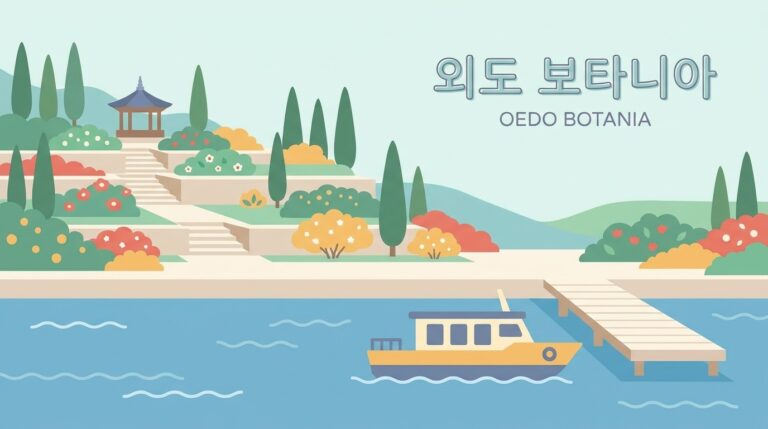
Mastering Oedo Botania: Advanced Korean for Navigating Geoje Island’s Marine Paradise
Phase 1: Empathy & Immersion
안녕하세요! Welcome back to Daily Hangul. I’m your local culture navigator and Korean best friend!
Picture this: You are standing on the sun-drenched deck of a ferry gliding across the cobalt waters of the South Sea toward Geoje Island’s crown jewel—Oedo Botania (외도 보타니아). If you’re a classic K-Drama fan, you instantly recognize this botanical wonderland as the filming location for the legendary finale of Winter Sonata. The Mediterranean-style sculptures and subtropical gardens look breathtaking, but navigating island travel in Korea can test even advanced learners.
Island itineraries in Korea require high situational awareness. Boarding the right passenger vessel among multiple piers (Yuramseon vs. Doseon), managing strict disembarkation boarding deadlines, and parsing the rapid Gyeongsang-do coastal dialect can overwhelm anyone relying purely on textbook phrasing. This comprehensive C1 guide is built directly from real-life traveler feedback to help you articulate subtle preferences, decipher local maritime nuances, and command advanced Korean with natural confidence.
Phase 2: Top 3 Core Advanced Expressions
1. 배편이 결항될 가능성이 있나요? (Bae-pyeon-i gyeol-hang-doel ga-neung-seong-i in-na-yo?)
- Pronunciation: [Bae-pyeon-i gyeol-hang-dwel ga-neung-seong-i in-na-yo] (Sounds like Bae-pyun-ee gyull-hang-dwel gah-neung-sung-ee een-nah-yo)
- Meaning: Literal: “Is there a possibility of the boat schedule being cancelled?” | Nuance: Inquiring politely about potential cancellations due to maritime weather/swell conditions.
- K-Culture Moment: Often heard in travel variety shows like 2 Days & 1 Night (1박 2일) whenever unpredictable sea fog (haemu) threatens an island mission.
- Editor’s Insight: At a C1 level, asking “배 안 떠요?” sounds too abrupt. Using “결항 (cancellation of transport due to weather)” paired with nominalization “-ㄹ 가능성이 있나요?” demonstrates sophisticated command.
- Situation Spectrum: Casual ⚠️ | Semi-formal ✅ | Formal ✅
- 🤔 Think About It: In English, we often ask “Will the ferry run?”, whereas Korean bureaucratic communication favors checking the probability of systemic status (결항 여부).
2. 승선 마감 시간까지 복귀해야 하죠? (Seung-seon ma-gam si-gan-kka-ji bok-gwi-hae-ya ha-jyo?)
- Pronunciation: [Seung-seon ma-gam shi-gan-gga-ji bok-gwi-hae-ya ha-jyo]
- Meaning: Literal: “I must return by the boarding cutoff time, right?” | Nuance: Confirming the exact departure window for your chartered ferry at Oedo.
- K-Culture Moment: Crucial when visiting Oedo Botania, where visitors are allocated a strict 2-hour window before their designated boat returns.
- Editor’s Insight: “복귀하다” (to return/regroup) combined with “-죠?” confirms shared awareness while respecting port discipline.
- Situation Spectrum: Casual ⚠️ | Semi-formal ✅ | Formal ✅
- 🤔 Think About It: Notice how Korean uses Sino-Korean verbs like “승선” (embarkation) and “복귀” (return) in administrative travel contexts to ensure utmost precision.
3. 사진 명당 좀 추천해 주실 수 있을까요? (Sa-jin myeong-dang jom chu-cheon-hae ju-sil su iss-eul-kka-yo?)
- Pronunciation: [Sa-jin myeong-dang jom choo-chun-hae joo-shil soo eess-eul-gga-yo]
- Meaning: Literal: “Could you recommend a prime photo spot?” | Nuance: Asking a local or fellow traveler for the absolute best Instagrammable vantage point.
- K-Culture Moment: Used by influencers capturing the iconic ‘Venus Garden’ (비너스 가든) or ‘Stairway to Heaven’ (천국의 계단) on Oedo.
- Editor’s Insight: “명당 (myeong-dang)” originates from Feng Shui (geomancy), referring to auspicious land, but modern Koreans use it colloquially for prime vantage spots.
- Situation Spectrum: Casual ✅ | Semi-formal ✅ | Formal ✅
- 🤔 Think About It: What does the evolution of geomancy terminology into social media photography tell us about Korean linguistic adaptation?
Phase 3: Textbook Korean vs. Real Native Korean
Situation 1: Inquiring about ferry operation during rough waves
- 📖 Textbook Korean: 바다 날씨가 안 좋은데 배가 출발합니까? (Bada nalssiga an joeunde baega chulbalhamnikka?)
- 🗣️ Native Korean: 파도가 좀 센데 출항 통제 걸렸나요? (Padoga jom sende chulhang tongje geollyeonnayo? – “The swell looks strong; has a departure suspension been issued?”)
- 💡 Why is it different? Natives use administrative maritime terms like “출항 통제” (departure control) combined with the passive verb “걸리다” rather than generic statements about bad weather.
Situation 2: Asking if a specific route covers both Haegeumgang and Oedo
- 📖 Textbook Korean: 이 배는 해금강을 보고 외도로 갑니까? (I baeneun haegeumgangeul bogo oedoro gamnikka?)
- 🗣️ Native Korean: 해금강 선상 관광 경유해서 들어가는 코스 맞죠? (Haegeumgang seonsang gwangwang gyeongyuhaeseo deureoganeun koseu matjyo? – “This is the course that transits through the Haegeumgang offshore sightseeing first, right?”)
- 💡 Why is it different? Advanced Korean uses technical transit terms like “경유하다” (to layover/transit) and “선상 관광” (shipboard sightseeing) for unambiguous clarity.
Phase 4: K-Culture Deep Dive & Non-Verbal Etiquette
4-1. Nunchi & Non-Verbal Manners at the Ferry Terminal
When boarding at Geoje piers (like Gujora or Dojangpo), ticket staff verify passenger manifests (seungseon sin-goseo). Handing over your ID card and manifest with both hands while making brief, respectful eye contact signals cultural maturity. Furthermore, pay attention to the ferry badge or ribbon given upon boarding—always keep it visibly pinned or held in hand at Oedo wharf, as staff use color-coded ribbons to direct tourists back to the correct vessel.
4-2. Cultural Code: The Maritime K-Travel Wave
Geoje Island represents South Korea’s transition from shipbuilding powerhouse to premier marine ecotourism hub. Unlike metropolitan travel, island excursions require respecting collective schedules (danchae sigan). Missing your assigned boat disrupts the island’s dock capacity, causing major friction. Demonstrating prompt punctuality is regarded as a premier social grace.
Phase 5: Real-World Roleplay Scenario
Setting: Gujora Ferry Terminal ticket booth in Geoje. You are confirming the excursion to Oedo Botania with Ticket Agent Mr. Park (박 주임).
- You: 안녕하세요! 오늘 11시 외도행 유람선 잔여석 남아있나요? (Annyeonghaseyo! Oneul yeol-han-si oedo-haeng yuramseon janyeoseok nam-a-innayo?)
🎭 [Action: Leaning forward politely and presenting your residence card/passport]
“Hello! Are there remaining seats for the 11 AM cruise to Oedo today?” -
Mr. Park: 네, 마침 두 자리 남아있습니다. 신분증이랑 승선신고서 먼저 건네주시겠어요? (Ne, machim du jari nam-a-isseumnida. Sinbunjung-irang seungseon-sin-goseo meonjeo geonneojusigesseoyo?)
“Yes, we happen to have two seats left. Could you hand over your ID and passenger manifest first?” -
You: 여기 있습니다. 그런데 오늘 해상에 너울성 파도가 좀 있던데 멀미가 심할까요? (Yeogi isseumnida. Geureonde oneul haesange neoulseong padoga jom itdeonde meolmiga simhalkkayo?)
“Here they are. By the way, there are ocean swells today; will sea sickness be severe?” -
Mr. Park: 해금강 돌아갈 때 약간 흔들릴 수 있습니다. 매점에서 멀미약 미리 챙겨 드시는 걸 권해드려요. (Haegeumgang doragal ttae yakgan heundeullil su isseumnida. Maejeomeseo meolmiyak miri chaenggyeo deusineun geol gwonhaedeuryeoyo.)
“It might shake a bit when circling Haegeumgang. I recommend grabbing seasickness medicine at the kiosk in advance.” -
You: 알겠습니다. 외도 섬 내 체류 시간은 정확히 얼마나 주어지나요? (Algetseumnida. Oedo seom nae cheryu siganeun jeonghwakhi eolmana jueojinayo?)
“Understood. Exactly how much stay time is granted on Oedo Island?” -
You (cont.): 승선 마감 시간까지 복귀해야 하죠? (Seungseon magam sigankkaji bokgwihaeya hajyo?)
“We have to return by the boarding cutoff, correct?” -
Mr. Park: 네, 하선 후 2시간입니다. 13시 15분까지 선착장으로 내려오셔야 합니다. 승선 명찰 잃어버리지 마시고요. (Ne, haseon hu dusi-gan-imnida. Yeol-se-si sibo-bun-kkaji seonchakjangeuro naeryeoosyeoya hamnida. Seungseon myeongchal ireobeoriji masigoyo.)
“Yes, 2 hours after disembarking. You must be back at the pier by 13:15. Please make sure not to lose your boarding badge.” -
You: 꼼꼼히 챙겨주셔서 감사합니다. 안전하게 다녀오겠습니다! (Kkomkkomhi chaenggyeojusyeoseo gamsahamnida. Anjeonhage danyeo-ogesseumnida!)
“Thank you for the thorough guidance. We will have a safe trip!”
🔀 Interactive Choice Point
You arrive at Oedo and notice the scenic café overlooks the entire southern ocean, but you only have 25 minutes left before your ferry leaves. What do you say to your travel partner?
- Option A: “시간 빠듯하니까 카페는 생략하고 선착장 쪽으로 슬슬 내려가자.” (Feedback: Best – Natural pacing, uses realistic terms like 빠듯하다 and 슬슬 to avoid missing the boat.)
- Option B: “배는 늦게 와도 우리를 기다릴 거야. 커피 마시자.” (Feedback: Bad – Fatal mistake! Ferries strictly depart on schedule due to maritime dock rotation regulations.)
- Option C: “선장님한테 전화해서 10분만 늦춰달라고 부탁해볼까?” (Feedback: Risk – Culturally inappropriate and impossible for public ferry schedules.)
Phase 6: 10-Second Emotion Shadowing Drill
[😊 설레고 기대에 찬 어조]“외도 보타니아 전경이 / 한눈에 내려다보이는 / 명당이 어디예요?”
(Oedo Botania jeon-gyeongi / han-nune naeryeodabo-ineun / myeongdangi eodiyeyo?)[🚨 단호하고 시간 엄수를 다짐하며]“출항 10분 전까지는 / 무조건 선착장에 / 도착해 있어야 해요!”
(Chulhang sip-bun jeon-kkajineun / mujogeon seonchakjange / dochakhae isseoya haeyo!)[🌊 안도하며 감탄하는 어조]“너울성 파도가 잠잠해져서 / 해금강 십자동굴까지 / 다 둘러볼 수 있겠네요.”
(Neoulseong padoga jamjamhaejyeoseo / Haegeumgang sipjadonggulgkaji / da dulleobol su itgenneyo.)
Phase 7: K-Culture Mini Dictionary
- 너울성 파도 (Neoul-seong Pa-do) | Swell waves / Rolling breakers
Unlike regular wind waves, these long-period swells occur even under sunny skies, frequently causing ferry cancellations along Geoje’s coast. - 유람선 vs 도선 (Yu-ram-seon vs. Do-seon) | Excursion Cruise Ship vs. Passenger Transit Ferry
Yuramseon operates tourist tours (e.g., circling Haegeumgang before docking at Oedo), whereas Doseon serves purely as direct transport. - 물때 (Mul-ttae) | Tide timing / Tidal currents
Vital for coastal boat tours. For example, entering Haegeumgang’s famous Cross Cave (십자동굴) depends entirely on the day’s mul-ttae. - 선상 관람 (Seon-sang Gwan-ram) | On-deck scenic viewing
Sightseeing spectacular rock formations directly from the exterior vessel deck while navigating coastal channels.
Phase 8: Traveler’s Survival Kit
Survival Expressions TOP 3
- “신분증 미지참 시 탑승 불가인가요?” (Sinbunjung mijicham si tapseung bulga-ingayo?)
👉 Pro Tip: Korea enforces a strict “No ID, No Boarding” policy on all marine transport. Always carry your physical ARC or Passport. - “출항 여부는 몇 시에 최종 결정되나요?” (Chulhang yeobuneun myeot sie choejong gyeoljeongdoenayo?)
👉 Pro Tip: In bad weather, coast guards announce clearance 1–2 hours prior to departure. - “외도 내에서 휠체어나 유모차 진입이 수월한가요?” (Oedo nae-eseo hwilche-eona yumoca jin-ibi suwolhangayo?)
👉 Pro Tip: Oedo features inclines; paved paths exist, but steep slopes require caution.
Editor’s Travel Note
Always install the 네이버 지도 앱 다운로드 to confirm pier locations across Geoje (Dojangpo, Gujora, Wahyeon, etc.). Also, booking tickets online via mobile reservation platforms offers discounts and guarantees seating during peak autumn and spring seasons.
Phase 9: Going Deeper (Thought Piece)
In Korean culture, the ocean is not merely a scenic backdrop—it is a domain of shared discipline governed by nature’s rhythm (순리). When traveling to Oedo Botania, strict boarding constraints reflect a deep communal respect for harbor operations and collective maritime safety. Unlike solo road trips where one controls the clock, Korean island travel requires surrendering to collective timekeeping.
💬 Your Turn: How does public transport discipline in your country compare when visiting national parks or marine sanctuaries? Share your thoughts below!
Phase 10: FAQ & Common Pitfalls
Q: Can I buy a one-way ticket to Oedo Botania and stay overnight?
A: No. Oedo Botania is a privately owned marine botanical garden with no overnight accommodations. You must return on the same chartered ferry you arrived on.
Q: Does the ferry ticket price include the Oedo Botania admission fee?
A: Usually, online reservations separate the boat boarding fee (승선료) from the island admission fee (입장료), which are paid together at the terminal checkout counter.
Q: What happens if I miss my assigned return ferry at Oedo?
A: You will be stranded until terminal operators find an empty seat on another company’s boat, which can incur heavy penalty fees and delays.
🚨 Common Mistakes Warning Board
- Arriving without physical identification: Digital copies on your phone are often rejected by the Korea Maritime Transportation Safety Authority. Correct Action: Always carry your physical Alien Registration Card or Passport.
- Confusing Geoje’s departure piers: Geoje has over 6 separate piers departing for Oedo. Booking at Gujora and showing up at Dojangpo is a frequent pitfall. Correct Action: Verify the specific pier name on your reservation voucher.
- Overstaying photo sessions: Taking photos at the summit and losing track of time. Correct Action: Set a timer for 90 minutes upon disembarkation.
Phase 11: Action Missions
- 🥉 Bronze Mission: Practice saying “승선 마감 시간까지 복귀해야 하죠?” 5 times with natural intonation.
- 🥈 Silver Mission: Post a photo of your favorite nature spot with the hashtag
#명당추천and describe it in 2 Korean sentences. - 🥇 Gold Mission: On your next island trip in Korea, successfully buy tickets at the counter completely in Korean using the term 잔여석 (remaining seats).
- 🎮 K-Culture Mission: Watch an episode of a Korean travel show featuring island travel and jot down 2 instances of marine vocabulary.
Phase 12: Interactive Quiz Challenge
- Situational Judgment: If thick sea fog delays your ferry, which phrase is most natural at the ticket desk?
- A) 배를 지금 당장 출발시켜 주세요.
- B) 기상 악화로 인한 대기 시간이나 결항 여부를 알 수 있을까요?
- C) 날씨가 왜 이런지 설명해 주세요.
- Fill in the Blank:
“이 코스는 해금강 선상 관광을 ( )해서 외도로 들어갑니다.”- A) 경유 (Gyeongyu)
- B) 결항 (Gyeolhang)
- C) 하선 (Haseon)
- True / False Culture Quiz:
“You can freely board any returning ferry at Oedo Botania as long as you show your ticket.”
👉 Click here to reveal Answers & Explanations!
- Answer: B | Explaining weather disruptions with “기상 악화로 인한… 결항 여부” shows polite C1-level fluency.
- Answer: A (경유) | “경유하다” means to transit/stop by via a specific route.
- Answer: False | You must board the exact same vessel you arrived on, matched by company and boarding badge color!







