

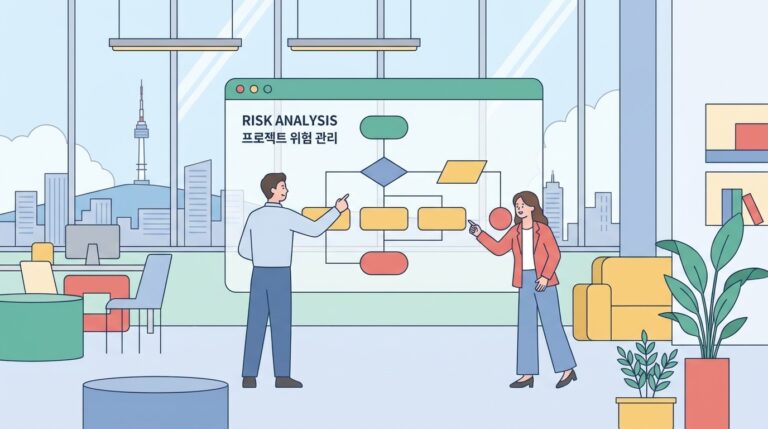
Master Risk Identification & Contingency Planning in Korean: Professional Nuance Guide
Phase 1: Empathy & Storytelling
안녕하세요! 매일한글 에디터입니다.
Imagine this: You are sitting in an ultra-sleek conference room in Pangyo Techno Valley—Korea’s bustling Silicon Valley. You’ve spotted a critical delivery delay with a third-party vendor that could derail your entire software launch. Your instinct is to stand up and blurt out, “This is a critical failure, we need to fix it now!” But you freeze. You look around the table; your Team Lead (팀장님) is reviewing slide decks, and everyone else is speaking in calm, indirect, highly polished corporate Korean.
Directly calling out a risk as an impending catastrophe can sound confrontational, unpolished, or even induce unwarranted panic in a Korean corporate setting. But staying silent? That’s a direct ticket to project failure. At the C1 level, high-stakes project management isn’t just about spotting bugs—it’s about packaging risks into tactful, preemptive solutions while maintaining team harmony (화합). This guide is built on actual case feedback from international project managers in Seoul who transformed their workplace reputation from “blunt critic” to “trusted strategic planner.”
Phase 2: Top 3 Core Expressions for Risk Management
1. 만약의 사태에 대비해 플랜 B를 미리 수립해 두는 편이 안전하겠습니다.
- Pronunciation: Man-yag-ui sa-tae-e dae-bi-hae peul-laen bi-reul mi-ri su-rip-hae du-neun pyeon-i an-jeon-ha-get-seum-ni-da. (Think: Mahn-yahg-ooee sah-teh-eh deh-bee-heh Plan B-reul mee-ree soo-reep-heh doo-noon pyun-ee ahn-jun-hah-get-soom-nee-dah)
- Meaning: Literal: “It would be safe to establish a Plan B in advance in preparation for an accidental event.” / Real Nuance: “To mitigate potential worst-case scenarios, I strongly recommend we prepare a contingency plan now.”
- K-Culture Moment: Echoing the intense strategy rooms in K-Dramas like Search: WWW or Misaeng, where competent project leads proactively hedge against unexpected market disruptions before presenting to executives.
- Editor’s Insight: Using ~는 편이 안전하겠습니다 (It would be safer to…) softens a command into an authoritative yet respectful professional recommendation.
- Situation Spectrum: Casual 🚫 | Semi-formal ⚠️ | Formal ✅
- 🤔 Think About It: In English, we often say “We must create a backup plan.” Notice how Korean frames this around collective safety (안전) rather than individual mandate.
2. 이 부분에서 병목 현상이나 일정 지연 리스크가 발생할 우려가 있습니다.
- Pronunciation: I bu-bun-e-seo byeong-mok hyeon-sang-i-na il-jeong ji-yeon ri-seu-keu-ga bal-saeng-hal u-ryeo-ga it-seum-ni-da.
- Meaning: Literal: “In this section, there is a concern that bottleneck phenomena or schedule delay risks will occur.” / Real Nuance: “We have identified a potential bottleneck here that may critically threaten our milestone deadlines.”
- K-Culture Moment: Used routinely in agile stand-ups when an engineering lead signals that server deployment might stall due to external API approvals.
- Editor’s Insight: 우려가 있습니다 (There is a concern) is the gold standard for raising red flags objectively without finger-pointing at specific teammates.
- Situation Spectrum: Casual 🚫 | Semi-formal ⚠️ | Formal ✅
- 🤔 Think About It: How does phrasing a problem as an external “concern” (우려) preserve psychological safety in high-pressure team meetings?
3. 변수가 생길 가능성을 선제적으로 차단하기 위해 대응책을 보완합시다.
- Pronunciation: Byeon-su-ga saeng-gil ga-neung-seong-eul seon-je-jeok-eu-ro cha-dan-ha-gi wi-hae dae-eung-chaek-eul bo-wan-hap-si-da.
- Meaning: Literal: “Let’s supplement countermeasures to preemptively block the possibility of variables occurring.” / Real Nuance: “Let’s reinforce our mitigation strategy proactively to eliminate any unpredictable factors.”
- K-Culture Moment: The signature phrase of visionary tech founders in Start-Up when pitching scalable risk buffers to venture capitalists.
- Editor’s Insight: 변수 (variable) is Korean corporate shorthand for unexpected hurdles, while 선제적 (preemptive) demonstrates top-tier strategic foresight.
- Situation Spectrum: Casual 🚫 | Semi-formal ✅ | Formal ✅
- 🤔 Think About It: Contrast “fixing bugs” with “eliminating variables”—which reflects a more comprehensive systems-thinking mindset?
Phase 3: Textbook Korean vs. Real Korean
Situation 1: Highlighting a risk during a sprint review
- 📖 교과서 한국어: 문제가 생길 것입니다. 일정을 바꿔야 합니다. (A problem will occur. We must change the schedule.)
- 🗣️ 진짜 한국어: 현재 진행 상황상 일정 차질 리스크가 감지되어, 일정 조율 검토가 필요해 보입니다. (Given our current progress, a schedule disruption risk has been detected, so a timeline adjustment review seems warranted.)
- 💡 왜 다를까? Textbook Korean sounds blunt and catastrophic. Real business Korean uses passive constructions (리스크가 감지되어) and probabilistic endings (~필요해 보입니다) to report facts without causing panic.
Situation 2: Proposing a backup protocol
- 📖 교과서 한국어: 다른 방법을 찾읍시다. (Let’s find another method.)
- 🗣️ 진짜 한국어: 만일의 경우에 대비해 컨틴전시 플랜(우회책)을 가동할 준비를 해두는 것이 좋겠습니다. (In case of an anomaly, it would be prudent to prepare the activation of our contingency plan / detour strategy.)
- 💡 왜 다를까? C1 professionals use industry terminology like 컨틴전시 플랜 or 우회책 combined with strategic phrasing (가동할 준비) to signal preparedness rather than desperation.
Phase 4: K-Culture Deep-Dive & Non-Verbal Manners
4-1. 눈치 (Nunchi), Gaze & Micro-Gestures in Risk Reporting
When presenting risks to Korean stakeholders, your body language dictates how your message is received:
* The Slide-Pointer Demeanor: Never point directly at team members who own the risky section. Keep your open palms facing upward toward the presentation slide or documentation.
* The “Cushion Nod”: When receiving pushback (e.g., “Can’t we just push the engineers harder?”), give a slight, slow nod (고개 끄덕임) and say, “말씀하신 취지는 충분히 이해합니다만…” (I fully understand your intent, however…) before laying out the technical risk data.
4-2. Cultural Code: The Culture of 보고 (Reporting) & Accountability
In Korean corporate hierarchy, surprises are considered the ultimate taboo. The cultural concept of 보고 (Bogoh – Structured Reporting) values the timeline of transparency. Reporting an identified risk early with three potential solutions (보고서 1안/2안/3안) is considered brilliant work, whereas discovering an issue late—even if you fix it yourself—can damage trust.
Phase 5: Real-World Roleplay Scenario
Setting: Conference Room 3B at a FinTech enterprise in Yeouido. Alex (Global PM) and Min-soo (Team Lead / 팀장) are reviewing Q3 roadmap risks.
- Turn 1 (Min-soo): 알렉스 대리, 이번 결제 모듈 연동 건, 다음 주 배포에 문제없겠습니까?
(Alex, regarding the payment module integration, is there no issue with next week’s deployment?)
🎭 Looking over rimless glasses with a neutral, expectant expression. - Turn 2 (Alex): 팀장님, 현재 PG사 연동 테스트 과정에서 간헐적인 응답 지연 리스크가 감지되었습니다.
(Team Leader, during the PG integration testing, intermittent response latency risks were detected.)
🎭 Calmly displaying the error log dashboard on screen. - Turn 3 (Min-soo): 흠… 배포가 밀리면 마케팅 캠페인 전체에 차질이 생기는데, 원인이 뭐죠?
(Hmm… If deployment is pushed back, the entire marketing campaign will be disrupted. What is the cause?)
🎭 Leaning forward, resting elbows on the table. - Turn 4 (Alex): 트래픽 집중 시 발생하는 병목 현상으로 파악되며, 현재 개발팀과 최적화 작업을 진행 중입니다.
(It is identified as a bottleneck occurring during traffic spikes, and optimization is currently underway with the dev team.)
🎭 Speaking in steady, reassuring tones without shifting eyes. - Turn 5 (Min-soo): 만약 금요일까지 해결이 안 되면 어떻게 대응할 생각입니까?
(If it isn’t resolved by Friday, how do you plan to respond?)
🎭 Tapping a pen rhythmically, testing Alex’s contingency preparedness. - Turn 6 (Alex): 만약의 사태에 대비해, 기존 결제망을 백업으로 유지하는 우회 플랜 B를 마련해 두었습니다.
(To prepare for unexpected complications, we have prepared Plan B: keeping the legacy payment gateway as an active backup.)
🎭 Transitioning seamlessly to slide 12 showing the failover architecture. - Turn 7 (Min-soo): 좋습니다. 리스크 요인을 선제적으로 파악해서 다행이군요. 공유 문서 업데이트해 주세요.
(Great. I’m relieved you preemptively identified the risk factor. Please update the shared documentation.)
🎭 Nodding approvingly and closing notebook. - Turn 8 (Alex): 네, 팀장님. 변동 사항 발생 시 즉시 추가 보고드리겠습니다.
(Yes, Team Leader. I will report immediately if any further variables arise.)
🎭 Offering a respectful 15-degree bow of acknowledgement.
🔀 Interactive Branching Point
How should Alex answer if Min-soo asks: “Can we just launch anyway and patch bugs live?”
* Option A: “절대 안 됩니다. 라이브에서 버그 터지면 팀장님이 책임지실 겁니까?” (Risk: Severely confrontational, violates business etiquette).
* Option B: “출시 후 장애 발생 시 고객 이탈률 및 신뢰도 하락 리스크가 더 크므로, 완벽 검증 후 순차 배포하는 편이 안전하겠습니다.” (Best: Data-driven, frames risk around business impact respectfully).
* Option C: “그냥 팀장님 말씀대로 진행하겠습니다.” (Bad: Passive abdication of PM responsibilities).
Phase 6: 10-Second Emotion Shadowing Drill
Practice matching the cadence / and emotional pitch markers:
[💼 진중하고 조심스럽게 / Serious & Measured]
현재 단계에서 / 예상치 못한 변수가 생길 우려가 있어 / 추가 점검을 진행하고자 합니다.
(Hyeon-jae dang-gye-e-seo / ye-sang-chi mot-han byeon-su-ga saeng-gil u-ryeo-ga it-eo / chu-ga jeom-geom-eul jin-haeng-ha-go-ja ham-ni-da.)-
[💡 확신에 찬 어조로 / Confident & Reassuring]
리스크를 선제적으로 통제하기 위해 / 즉시 플랜 B를 가동하겠습니다.
(Ri-seu-keu-reul seon-je-jeok-eu-ro tong-je-ha-gi wi-hae / jeuk-si peul-laen bi-reul ga-dong-ha-get-seum-ni-da.)
Phase 7: K-Culture Mini Dictionary
- 변수 (Byeon-su) | Uncontrollable variable / Curveball
Usage: “기상 악화라는 변수가 생겼습니다.” (An unforeseen variable—weather deterioration—has arisen.) - 병목 현상 (Byeong-mok Hyeon-sang) | Bottleneck
Usage: “검수 단계에서 병목 현상이 발생하지 않도록 리소스를 추가 투입합시다.” (Let’s allocate more resources to prevent bottlenecks in QA.) - 선제적 대응 (Seon-je-jeok Dae-eung) | Proactive / Preemptive response
Usage: “사후 약방문이 되지 않도록 선제적 대응이 필수적입니다.” (Preemptive action is crucial to avoid locking the barn door after the horse has bolted.) - 차질 (Cha-jil) | Setback / Glitch / Disruption
Usage: “프로젝트 일정에 차질이 없도록 만전을 기해 주십시오.” (Please do your utmost so there are no disruptions to the project timeline.)
Phase 8: Expat & Business Professional Survival Kit
- Top Survival Expressions:
- 일정에 차질이 생기지 않도록 조율 중입니다. (Il-jeong-e cha-jil-i saeng-gi-ji an-tot-rok jo-yul jung-im-ni-da. – I am calibrating things to avoid schedule setbacks.)
- 우회 경로(Workaround)를 확보해 두었습니다. (U-hoe gyeong-ro-reul hwak-bo-hae du-eot-seum-ni-da. – We have secured a workaround path.)
- 예상 리스크 목록을 정리하여 메일로 공유드렸습니다. (Ye-sang ri-seu-keu mok-rok-eul jeong-ri-ha-yeo me-il-ro gong-yu-deu-ryeot-seum-ni-da. – I have summarized and emailed the anticipated risk matrix.)
- Editor’s Note on Workplace Productivity Tools:
For streamlined task tracking and collaborative roadmapping in Korean corporate environments, make sure to check out your team’s preferred workspaces via the official Notion 업무 협업 템플릿 페이지 or Jira boards configured in Korean terminology.
Phase 9: “One Step Deeper” — Cultural Reflection
In Korean corporate linguistics, linguistic shielding (완곡어법 – Euphemism) is not weakness; it is a sign of high emotional intelligence (눈치). When you label a critical design flaw as a “보완이 필요한 부분” (area needing enhancement) and frame a catastrophic delivery failure as an “예상치 못한 변수” (unexpected variable), you shift the meeting’s energy from defensive finger-pointing to collective problem-solving. This linguistic cushion preserves organizational face (체면) while driving technical rigor.
💬 Your Turn: Have you ever noticed how indirect suggestions work better than blunt warnings in your own culture? How do you usually raise red flags in your workplace? Let’s discuss in the comments below!
Phase 10: FAQ & Common Mistakes
Q: Can I use the English word “Risk” directly in Korean business meetings?
A: Yes! 리스크 (Risk) and 이슈 (Issue) are standard corporate loanwords in Korea. However, pairing them with natural native verbs (e.g., 리스크를 식별하다, 리스크를 최소화하다, 이슈를 핸들링하다) is what differentiates a C1 speaker from a novice.
Q: What is the difference between ‘문제’ (Munje) and ‘리스크’ (Risk)?
A: 문제 implies an active, realized problem that has already happened. 리스크 refers to potential, future exposure or volatility. Use 리스크 식별 when forecasting and 문제 해결 when troubleshooting.
Q: How do I disagree with an unrealistic milestone deadline diplomatically?
A: Use the formula: “현재 리소스로는 [Date]까지 완성도를 담보하기에 일정상 무리가 따를 것으로 사료됩니다.” (Given our current resources, it is assessed that ensuring quality by [Date] may put excessive strain on the schedule.)
🚨 3 Common Mistakes to Avoid:
- Mistake: Saying “이건 망했습니다” (This is ruined/failed).
- Correct Action: Use “일정 차질 리스크가 매우 높은 상황입니다” (The risk of schedule disruption is exceptionally high).
- Mistake: Blaming individuals: “김 대리가 늦어서 리스크가 생겼습니다.”
- Correct Action: Depersonalize the issue: “해당 모듈 검토 과정에서 병목이 발생했습니다.”
- Mistake: Raising risks without proposals.
- Correct Action: Always present the risk alongside Plan A and Plan B (“이에 대한 우회책으로…”).
Phase 11: Action Missions
- 🥉 Bronze Mission (Self Practice): Record yourself reading Core Expression #1 aloud three times using the emotion shadowing guide.
- 🥈 Silver Mission (Social Sharing): Write a mock Slack update in the comments reporting a “schedule bottleneck” using the word 병목 현상.
- 🥇 Gold Mission (Real Life Application): In your next standup meeting or language exchange, use “만약의 사태에 대비해 플랜 B를 검토합시다” during planning.
- 🎮 K-Culture Media Mission: Watch Episode 5 of the workplace drama Misaeng (미생) and spot three instances where characters report risks to their department heads using indirect honorifics.
Phase 12: Interactive Quiz Challenge
1. Situation Judgment Quiz: Which phrase is most appropriate when warning your director about an imminent server bottleneck?
* A) 서버가 터질 것 같으니 알아서 하십시오.
* B) 트래픽 급증 시 병목 현상에 따른 서버 다운 리스크가 우려됩니다.
* C) 개발팀이 일을 안 해서 서버가 위험합니다.
2. Fill-in-the-Blank:
* 만약의 사태에 대비해 선제적으로 [ ] 플랜을 수립해 두었습니다.
3. True or False:
* In Korean business culture, you should wait until a risk is 100% confirmed as a disaster before notifying your team lead. (True / False)
🔍 Click here to reveal Answers & Explanations
- Answer: B — Phrasing the issue around 병목 현상 and 리스크가 우려됩니다 is professional, objective, and polite.
- Answer: 컨틴전시 (Contingency) or 우회 (Workaround/Detour) — Both fit perfectly at C1 level.
- Answer: False — Early risk visibility (선제적 보고) is deeply valued over late surprises in Korean corporate workflows.







