

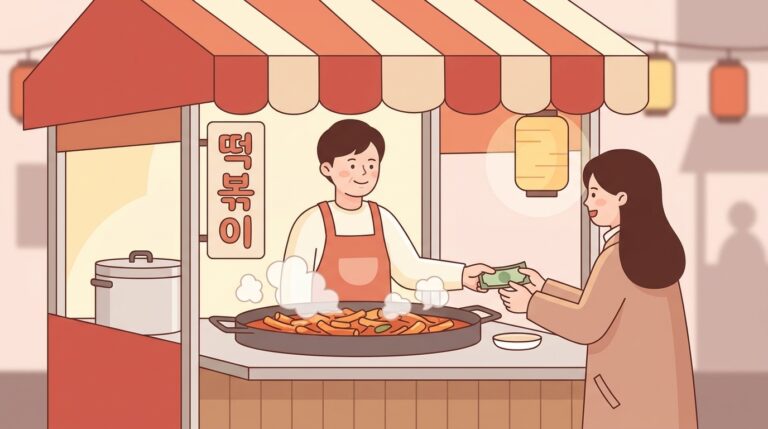
How to Pay with Cash at Korean Street Food Stalls Like a Local
Phase 1: Empathy (Story-Driven Opening)
안녕하세요! 매일한글 에디터입니다. (Hello! I’m your Daily Hangul editor.) Imagine this: you are walking through the buzzing, neon-lit alleys of Myeongdong or Gwangjang Market on a chilly evening. The irresistible aroma of sizzling tteokbokki and golden hotteok fills the air. Steam rises like a cozy cloud, and your stomach is growling. You walk up to a friendly street food cart (pojangmacha), eagerly pointing at the delicious snacks. But as you finish your treat and pull out your shiny foreign credit card, the vendor shakes their head gently with a warm smile and points toward a little box full of bills: Cash or bank transfer only!
Panic sets in. How do you ask how much it costs? How do you say “I will pay with cash” without getting tongue-tied? Many first-time travelers freeze right here. But don’t worry! Over the past ten years of coaching beginner Korean learners, I have seen this exact moment happen countless times. Today, we will master three simple, magic phrases so you can order, pay, and enjoy mouthwatering Korean street food with total confidence—no awkward hesitation needed!
Phase 2: Top 3 Core Expressions In-Depth Analysis
1. 얼마예요? (Eolmayeyo?)
- Pronunciation: [eol-ma-ye-yo] (Sounds like “All-ma-yay-yo?”)
- Meaning: Literal: “How much is it?” | Real Nuance: A polite, direct, and universally accepted way to ask the price of any item.
- K-Culture Moment: Think of classic K-drama market scenes—like in Weightlifting Fairy Kim Bok-joo—where hungry students gather at a street tent and ask for the bill before digging in!
- Editor’s Insight: This is your #1 survival phrase in Korea. Whenever you point at food, just add this word at the end!
- Situation Spectrum: Casual: ⚠️ (얼마야? – friends only) / Semi-formal: ✅ (얼마예요?) / Formal: ✅ (얼마입니까?)
- 🤔 Think About It: In English, we often ask “Can I get the check?”, but in Korean street food culture, asking the exact price immediately (얼마예요?) is totally normal and polite.
2. 현금으로 낼게요. (Hyeongeumeuro naelgeyo.)
- Pronunciation: [hyeon-geum-eu-ro nael-ge-yo] (Sounds like “Hyun-goom-oo-ro nell-gay-yo”)
- Meaning: Literal: “I will pay with cash.” | Real Nuance: A smooth, proactive statement letting the vendor know you’re handing them paper bills/coins.
- K-Culture Moment: In food vloggers’ videos visiting traditional night markets, you often hear them say this right as they pull out 1,000 or 5,000 KRW notes.
- Editor’s Insight: The particle -(으)로 (-euro) means “by means of / with”. Even just saying “현금이요” (Hyeongeum-iyo – “Cash, please!”) works wonders!
- Situation Spectrum: Casual: ⚠️ (현금으로 낼게) / Semi-formal: ✅ (현금으로 낼게요) / Formal: ✅ (현금으로 결제하겠습니다)
- 🤔 Think About It: Street vendors love cash because it saves card processing fees. Announcing it with a smile will often get you an extra fishcake broth refill!
3. 여기 있어요. (Yeogi isseoyo.)
- Pronunciation: [yeo-gi is-seo-yo] (Sounds like “Yuh-ghee ee-ssuh-yo”)
- Meaning: Literal: “Here it is.” | Real Nuance: “Here you go!” (said while handing over money or an item).
- K-Culture Moment: Every time an Imo (market auntie) hands you a piping hot cup of spicy tteokbokki, you hand your cash back saying this phrase.
- Editor’s Insight: Never just hand money over in silence. Saying 여기 있어요 softens the interaction and shows great manners.
- Situation Spectrum: Casual: ⚠️ (여기 있어) / Semi-formal: ✅ (여기 있어요) / Formal: ✅ (여기 있습니다)
- 🤔 Think About It: Handing money with two hands while saying 여기 있어요 bridges age gaps and creates instant warm rapport (Jeong / 정).
Phase 3: Textbook Korean vs. Real Korean
Situation 1: Asking if you can pay with cash
- 📖 Textbook Korean: 현금 결제가 가능합니까? (Hyeongeum gyeoljega ganeunghamnikka? – Is cash payment possible?)
- 🗣️ Real Korean: 현금 돼요? (Hyeongeum dwaeyo? – Can I do cash? / Does cash work?)
- 💡 Why is it different? Real street market conversations are fast and snappy! The verb 되다 (to work/be okay) replaces heavy formal vocabulary.
Situation 2: Asking for the total price
- 📖 Textbook Korean: 총액이 얼마입니까? (Chong-aegi eolmaimnikka? – What is the total sum?)
- 🗣️ Real Korean: 다 해서 얼마예요? (Da haeseo eolmayeyo? – How much for everything altogether?)
- 💡 Why is it different? 다 해서 literally means “doing all together”. It’s natural, warm, and understood instantly across all ages.
Phase 4: K-Culture Deep Dive & Non-Verbal Manners
4-1. Nunchi (눈치) & The Two-Handed Gesture
In Korea, etiquette is visible! When handing over cash or receiving change (geoseureumdon), always use both hands or support your right wrist/forearm with your left hand. It shows deep respect to elders. Also, keep your eye contact gentle—a slight bow of the head (nodding) as you pass the bills shows high Nunchi (social awareness).
4-2. The Soul of Korean Street Food (Pojangmacha & Bunsik)
Street food isn’t just fast food; it’s community culture. Traditional vendors (Imo / Aunties or Samchon / Uncles) take pride in their hearty portions. Because many stalls operate with small margins, small cash bills (1,000 KRW, 5,000 KRW, and 10,000 KRW) are preferred over large 50,000 KRW notes. Keeping small bills handy makes you the vendor’s favorite customer!
Phase 5: Real-Life Roleplay Scenario
Setting: A steamy street food cart on a chilly evening in Hongdae.
NPC: Warm and energetic street food vendor Imo (이모).
- You: 떡볶이 1인분 주세요. 🎭 [Politely pointing at the bubbling red rice cakes]
(Tteokbokki il-inbun juseyo. / One portion of tteokbokki, please.) - Vendor: 네~ 오뎅 국물도 같이 드세요! 🎭 [Ladling hot fishcake soup into a paper cup]
(Ne~ Odeng gungmuldo gachi deuseyo! / Sure~ Have some fishcake broth too!) - You: 와, 감사합니다! 다 해서 얼마예요? 🎭 [Smiling happily and reaching for your wallet]
(Wa, gamsahamnida! Da haeseo eolmayeyo? / Wow, thank you! How much is it all together?) - Vendor: 4,000원(사천 원)이에요~ 🎭 [Wiping the counter with a cheerful smile]
(Sacheon-won-ieyo~ / That’s 4,000 won~) - You: 현금으로 낼게요. 🎭 [Pulling out a 5,000 won bill]
(Hyeongeumeuro naelgeyo. / I will pay with cash.) - You: 여기 5,000원(오천 원) 있어요. 🎭 [Handing the bill with both hands]
(Yeogi ocheon-won isseoyo. / Here is 5,000 won.) - Vendor: 네, 여기 거스름돈 1,000원(천 원)이요! 맛있게 드세요~ 🎭 [Handing 1,000 won change back with two hands]
(Ne, yeogi geoseureumdon cheon-won-iyo! Mas-issge deuseyo~ / Yes, here is 1,000 won change! Enjoy your meal~) - You: 감사합니다! 잘 먹겠습니다! 🎭 [Bowing slightly before taking a bite]
(Gamsahamnida! Jal meokgessseumnida! / Thank you! I will eat well!)
🔀 Interactive Choice Point
The vendor gives you your food, but you only have a 50,000 KRW bill for a 3,000 KRW snack. What do you do?
- Option A: Silently hand the 50,000 KRW bill and look away.
❌ Bad: It can be difficult for small cart vendors who lack enough change, and silence might seem cold. - Option B: Say: “죄송해요, 큰 돈밖에 없어요 (I’m sorry, I only have big bills).”
⭐ Best: Shows considerate Nunchi. The vendor will appreciate the heads-up and gladly break the bill. - Option C: Turn around and leave without taking your ordered food.
⚠️ Risk: The food is already served! Street vendors prefer making change over wasting freshly prepared food.
Phase 6: 10-Second Emotion Shadowing Drill
Practice these with rhythm and feeling! (Slash / indicates a short breath pause):
[😊 Bright & Friendly]
얼마예요? / 얼마예요?
(Eol-ma-ye-yo? / Eol-ma-ye-yo?)-
[🤝 Polite & Clear]
현금으로 / 낼게요!
(Hyeon-geum-eu-ro / nael-ge-yo!) -
[🎁 Warm & Courteous]
여기 / 있어요. / 감사합니다!
(Yeo-gi / is-seo-yo. / Gam-sa-ham-ni-da!)
Phase 7: K-Culture Mini Dictionary
- 현금 (Hyeongeum) | Cash
Essential for traditional markets, street vendors, and coin karaoke (Noraebang). - 거스름돈 (Geoseureumdon) | Change (money returned)
The balance returned after paying with a larger denomination. - 계좌이체 (Gyejwa-iche) | Bank Transfer
Common in Korea; vendors often display a bank account number on a small sign when buyers run out of cash. - 포장마차 (Pojangmacha) | Tented Street Food Stall
Iconic street carts selling snacks like spicy rice cakes, fish cakes, and fried foods.
Phase 8: Traveler’s Survival Kit
Top 3 Survival Phrases
- 카드 돼요? (Kadeu dwaeyo?) – Can I use a card? (Pro Tip: Ask this first if you have no cash!)
- 영수증은 괜찮아요. (Yeongsujeungeun gwaenchanayo.) – No receipt needed, thank you. (Saves the vendor time).
- 많이 주세요! (Mani juseyo!) – Please give me plenty! (A playful, friendly phrase Koreans say with a smile).
Editor’s Travel Note
- Cash Preparation: Always carry about 10,000 to 20,000 KRW in 1,000 KRW and 5,000 KRW notes when exploring spots like Namdaemun Market or street food alleys.
- Navigation: Check out the Naver Map App Download to easily find popular street food markets and nearby ATMs with foreign card support (marked as “Global ATM”).
Phase 9: A Step Deeper (Reflection)
In Korea’s hyper-digital society where almost everything is paid via smartphones and credit cards, street food stalls remain one of the rare places where tangible cash and physical hand-to-hand exchanges still thrive. Handing money directly with both hands creates a brief moment of genuine human warmth (Jeong). It turns a simple monetary transaction into a heartwarming personal connection.
💬 Your Turn: In your home country, do people still use cash at street markets, or is everything digital? Share your experience in the comments below!
Phase 10: FAQ & Common Mistakes
Q: Can I use foreign credit cards at Korean street stalls?
A: Most temporary street stalls and open-air carts only accept Korean cash or local bank transfers (계좌이체). However, permanent food stalls inside fixed buildings often accept cards.
Q: What if I don’t have exact change?
A: Don’t worry! Street vendors always carry change for 5,000 and 10,000 KRW bills. Just hand your bill politely with both hands.
Q: Is tipping required at Korean street food carts?
A: No! Tipping is not part of Korean culture. In fact, leaving extra coins can confuse the vendor. Paying the exact amount with a polite “감사합니다” is the best etiquette.
🚨 Common Mistakes Alert
- Throwing cash onto the counter: ❌ Wrong! Always hand it directly to the vendor’s hand or place it gently in the money tray using both hands.
- Using informal speech (얼마야?): ❌ Wrong! Always keep the “-요” ending (얼마예요?) when speaking to vendors.
- Panicking over bank account numbers: If you see a card with numbers like “국민 123-456…”, that’s a bank account for domestic bank transfers. If you only have foreign apps, simply pay in cash!
Phase 11: Action Missions
- 🥉 Bronze Mission (Solo Practice): Stand in front of a mirror with a paper bill and practice saying “얼마예요? 현금으로 낼게요. 여기 있어요!” three times with a smile.
- 🥈 Silver Mission (Social Share): Leave a comment below with your favorite Korean street food you want to order using cash!
- 🥇 Gold Mission (Real Life): Visit a Korean market or restaurant and hand your payment using both hands while saying “여기 있어요 (Yeogi isseoyo)!”
🎮 K-Culture Mission: Watch any Korean variety show (like Street Food Fighter or Running Man market episodes) and spot how the cast hands over cash to stall owners!
Phase 12: Interactive Quiz Challenge
Q1. (Situation) You want to politely ask how much a cup of tteokbokki costs. What should you say?
a) 얼마야?
b) 얼마예요?
c) 돈 주세요.
Q2. (Fill in the blank) Fill in the blank to say “I will pay with cash”:
“________으로 낼게요.” (Hint: Starts with ‘현’)
Q3. (True / False) In Korea, it is polite to throw cash onto the table to avoid touching hands with the vendor.
(True / False)
👉 Click to view Answers & Explanations
- Answer: b) 얼마예요?
Explanation: “얼마예요?” is the polite standard way for beginners to ask the price. “얼마야?” is too casual for vendors. - Answer: 현금 (Hyeongeum)
Explanation: 현금 means “cash”. Together, 현금으로 낼게요 means “I will pay with cash.” - Answer: False
Explanation: Always hand money gently with two hands directly or place it politely into the change tray. Throwing money is considered very impolite.






