

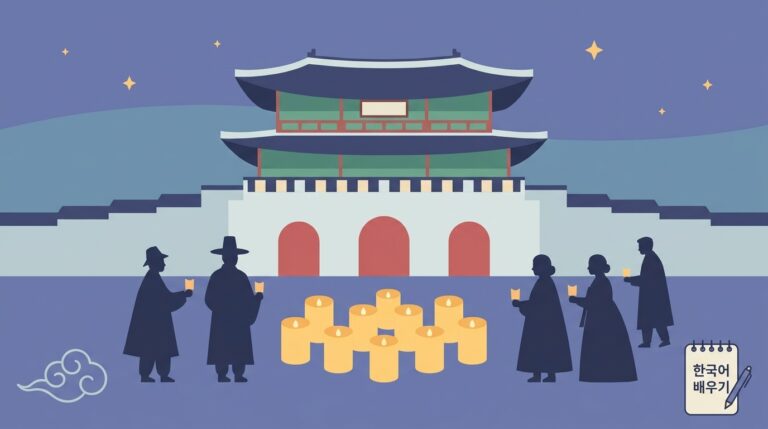
Understanding Korea’s Candlelight Vigils and Assembly Culture
Phase 1: Empathy & Immersion
안녕하세요! I’m your Daily Hangul editor.
Imagine this: You are walking past Gwanghwamun Square on a brisk autumn evening. Instead of the chaotic, aggressive demonstration you might anticipate from international news headlines, you hear upbeat K-Pop blasting from massive speakers, see families sharing warm fish cake skewers, and watch thousands of people holding glowing LED candles in harmonious synchrony. Someone gently smiles and hands you a flyer with a paper cup candle, saying, “같이 참여하실래요?” (Would you like to join us?).
For many intermediate Korean learners, navigating Korean political discourse feels like walking on eggshells. You want to understand what people are chanting, why demonstrations feel like organized festivals, and how to express social perspectives without sounding unintentionally rude or dogmatic. Korean assembly culture—most famously represented by the 촛불 집회 (Candlelight Vigil)—is deeply rooted in civic pride, collective solidarity, and peaceful expression. Mastering the language surrounding these social movements will elevate your Korean from textbook fluency to genuine sociolinguistic nuance, allowing you to engage in thoughtful, high-level discussions with Korean native speakers with confidence.
Phase 2: Top 3 Core Expressions Deep-Dive
1. 목소리를 내다 (Moksorireul naeda)
- Pronunciation: [Mok-so-ri-reul nae-da] (Sounds like “Moke-so-ree-reul neh-da”)
- Meaning: Literal: “To produce a voice” / Nuance: “To speak up, advocate, or voice one’s opinion on social/public issues.”
- K-Culture Moment: Frequently featured in socially conscious K-Dramas like Itaewon Class or news commentary when citizens unite for public policy reform.
- Editor’s Insight: This isn’t just about vocal cord volume. In Korean civic culture, ‘내다’ implies bringing something hidden from within out into the open public sphere.
- Situation Spectrum: Casual ✅ | Semi-formal ✅ | Formal ✅
- 🤔 Think About It: How does “making your voice heard” in English compare to the Korean concept of “bringing forth a collective voice” for societal harmony?
2. 평화 집회 (Pyeonghwa jiphoe)
- Pronunciation: [Pyeong-hwa jip-hoe] (Sounds like “P-yung-hwa jeap-hweh”)
- Meaning: Literal: “Peaceful assembly” / Nuance: “Orderly, non-violent civic protest/rally.”
- K-Culture Moment: Used by civic organizers, reporters, and citizens alike to characterize Gwanghwamun gatherings that prioritize safety, art performances, and cleanup campaigns.
- Editor’s Insight: Combining the Sino-Korean words 평화 (Peace) and 집회 (Assembly), this term carries a very positive connotation of dignified citizen participation.
- Situation Spectrum: Casual ⚠️ | Semi-formal ✅ | Formal ✅
- 🤔 Think About It: Why has non-violence and cultural performance become the trademark identifier of modern democratic action in Korea?
3. 뜻을 모으다 (Tteuseul moeuda)
- Pronunciation: [Tteu-seul mo-eu-da] (Sounds like “Ddeus-eul mo-ew-da”)
- Meaning: Literal: “To collect meanings/intentions” / Nuance: “To unite in purpose, reach collective solidarity, or pool public will.”
- K-Culture Moment: Highlighted during national fundraising campaigns or massive civic movements when citizens rally behind a shared community goal.
- Editor’s Insight: In Korea’s collectivist-democratic tradition, individual opinions (뜻) become powerful and meaningful when gathered (모으다) collectively.
- Situation Spectrum: Casual ⚠️ | Semi-formal ✅ | Formal ✅
- 🤔 Think About It: Notice how the Korean language emphasizes unity of purpose rather than ideological division.
Phase 3: Textbook Korean vs. Real Korean
- Situation 1: Describing a massive gathering
- 📖 Textbook Korean: “사람들이 거리에 모여서 시위를 하고 있습니다.” (People are gathered on the street conducting a protest.)
- 🗣️ Real Korean (B2 Level): “시민들이 광장에 모여서 한목소리로 외치고 있어요.” (Citizens have gathered in the square, calling out with one voice.)
- 💡 Why is it different? Native speakers often use figurative civic terms like ‘한목소리’ (one voice) and ‘광장’ (the public square) to convey collective energy rather than sterile descriptive verbs.
- Situation 2: Joining or supporting a movement
- 📖 Textbook Korean: “저도 그 정치적 행동을 지지합니다.” (I also support that political action.)
- 🗣️ Real Korean (B2 Level): “저도 그 취지에 깊이 공감해서 동참했어요.” (I deeply resonated with that purpose, so I took part.)
- 💡 Why is it different? Koreans prefer empathetic vocabulary like ‘취지’ (underlying purpose/spirit) and ‘동참하다’ (to participate together) over dry, overt political declarations.
Phase 4: K-Culture Deep Dive & Non-Verbal Etiquette
4-1. Nunchi & Street Demonstration Manners
- Respecting the Flow and Safe Distance: In Korean rallies, you will see designated volunteer marshals wearing yellow or fluorescent vests directing foot traffic. Always observe Nunchi by following human lanes and avoiding blocking subway station entrances.
- The Cleanup Culture (클린 집회): Leaving trash behind is considered a serious social faux pas. Protestors carry trash bags and pick up debris after the event ends. Participating in the post-rally cleanup earns immense respect from locals.
- Candle Safety and Gesture: LED candles are standard today, but if using wax candles with paper cup guards, hold them steadily at chest height, shielding the flame from neighbors’ clothes.
4-2. Cultural Code: The ‘Protest as a Festival’ (축제형 시위)
Korean protests are famous for turning civic grievance into communal celebration. Indie bands perform on mobile stages, parody songs set to famous K-Pop melodies (like Girls’ Generation’s Into the New World) serve as anthems, and hot drinks are handed out for free. This stems from traditional Korean Madang-geuk (outdoor community theater), where satire, music, and dance are used to process social grievances (Han) and transform them into joyful solidarity (Heung).
Phase 5: Real-World Roleplay Scenario
Setting: Gwanghwamun Square during a Saturday evening public rally. You bump into your Korean university acquaintance, Min-woo (민우), who is holding an LED candle and handing out flyers.
- Min-woo: “어? 유진 씨! 여기서 만나네요! 집회 구경 오신 거예요?” (Oh? Eugene! Fancy meeting you here! Did you come to see the assembly?)
- You: “네, 민우 씨! 광장 분위기가 생각보다 엄청 평화롭고 축제 같아서 놀랐어요.” (Yes, Min-woo! I’m surprised the atmosphere in the square is so peaceful and festive.)
🎭 [Looking around with an intrigued, respectful expression] - Min-woo: “맞아요. 우리나라는 촛불 집회처럼 문화제 형식으로 뜻을 모으는 경우가 많거든요.” (Right. In Korea, we often gather our collective voice in the form of a cultural festival, like candlelight vigils.)
- You: “다들 한목소리로 구호를 외치는 모습이 정말 인상적이네요.” (It’s truly impressive to see everyone chanting slogans with one voice.)
🎭 [Nodding warmly while holding the flyer gently] - Min-woo: “혹시 괜찮으시면 이 LED 촛불 하나 드릴까요? 같이 참여해 보실래요?” (If you don’t mind, may I give you an LED candle? Would you like to join in together?)
- You: “감사합니다! 저도 시민들의 목소리에 귀를 기울여 보고 싶었어요.” (Thank you! I wanted to listen closely to the citizens’ voices as well.)
🎭 [Receiving the LED candle with both hands politely] - Min-woo: “끝나고 주변 쓰레기 줍는 것도 같이해요. 이따 따뜻한 차 한잔 사드릴게요!” (Let’s also clean up the surrounding trash together when it ends. I’ll buy you a warm tea later!)
- You: “좋아요! 저도 깨끗하게 마무리하는 데 동참할게요.” (Sounds great! I’ll gladly join in wrapping things up cleanly.)
🎭 [Smiling enthusiastically]
🔀 Interactive Choice Point
How do you respond when a stranger approaches and asks your stance on the current rally?
- Choice A: “저는 외국인이라서 이런 정치 문제에 전혀 관심이 없고 상관없어요.” (Bluntly stating you don’t care at all because you’re a foreigner.)
- ❌ Feedback [Bad]: Overly dismissive and can sound cold or indifferent to the community’s concerns.
- Choice B: “당신들의 정책이 맞는지 틀린지 제가 따져보고 판단하겠습니다.” (Saying you will judge whether their policies are right or wrong.)
- ⚠️ Feedback [Risk]: Sounds confrontational and arrogant in a communal Korean cultural context.
- Choice C: “사회적 변화를 위해 평화롭게 목소리를 내는 모습이 참 인상 깊어서 지켜보고 있습니다.” (Expressing that you are observing with admiration how citizens voice their opinions peacefully for social change.)
- ✅ Feedback [Best]: Respectful, demonstrates advanced sociolinguistic competence, and honors their civic passion.
Phase 6: 10-Second Emotion Shadowing Drill
[😮 감탄하며 차분하게]“광장 분위기가 / 생각보다 훨씬 / 평화롭네요.” (Gwang-jang bun-wi-gi-ga / saeng-gak-bo-da hwol-ssin / pyeong-hwa-rop-ne-yo.)[🤝 공감과 연대의 마음으로]“시민들이 한마음으로 / 뜻을 모으는 모습이 / 감동적이에요.” (Si-min-deul-i han-ma-eum-eu-ro / tteu-seul mo-eu-neun mo-seub-i / gam-dong-jeok-i-e-yo.)[😊 정중하고 적극적으로]“저도 함께 / 깨끗하게 / 정리하고 갈게요.” (Jeo-do ham-kke / kkae-kkeut-ha-ge / jeong-ri-ha-go gal-ge-yo.)
Phase 7: K-Culture Mini Dictionary
- 촛불 집회 (Chot-bul Jip-hoe) | Candlelight Vigil — Symbolic of South Korea’s modern peaceful democratic protests since the 2000s.
- 공공선 (Gong-gong-seon) | The Common Good — A core philosophical concept often invoked when advocating civic responsibility and public welfare.
- 자원봉사자 (Ja-won-bong-sa-ja) | Volunteer Worker — Crucial civic participants who guide crowds, provide medical assistance, and maintain order.
- 현수막 (Hyeon-su-mak) | Placard / Banner — Fabric banners displaying witty, poetic, or hard-hitting slogans across rally zones.
Phase 8: Traveler’s Survival Kit
- Top 3 Survival Phrases:
- “행진 때문에 버스 노선이 우회하나요?” (Haeng-jin ddae-mun-e beo-seu no-seon-i u-hoe-ha-na-yo? / Are bus routes detoured due to the march?) — Pro Tip: Essential when moving through Jongno or Gwanghwamun on weekends.
- “이 부스에서 나눠주는 책자 한 권 받아도 될까요?” (I bu-seu-e-seo na-nwo-ju-neun chaek-ja han gwon bat-a-do dwel-kka-yo? / May I take a booklet being distributed at this booth?)
- “가장 가까운 개방 화장실이 어디에 있나요?” (Ga-jang ga-kka-un gae-bang hwa-jang-sil-i eo-di-e it-na-yo? / Where is the nearest publicly accessible restroom?)
- Editor’s Travel Note:
During large rallies in central Seoul, roads are blocked and subway stations near Gwanghwamun, City Hall, or Anguk may bypass stops without opening doors for crowd safety. Check the Seoul Metro Official Transport App Guide or real-time road condition updates via the Naver Map Navigation App before commuting on Saturday evenings.
Phase 9: A Step Deeper (Reflection)
In many cultures, demonstrations carry an overt overtone of friction and division. In South Korea, however, assembly culture has evolved into a unique expression of Gongdongche (공동체, community consciousness). When people stand in freezing winter nights holding candles, they view their actions not as rebellion against the fabric of society, but as a civic duty to protect and mend it together.
💬 Your Turn: How are peaceful civic assemblies viewed in your home country? Have you ever witnessed a protest that looked like a cultural festival? Share your reflections in the comments below!
Phase 10: FAQ & Common Mistakes
Q: Is it safe for foreigners to attend or watch candlelight vigils in Korea?
A: Yes, general candlelight vigils in Korea are exceptionally safe and family-friendly. However, foreign nationals should avoid participating in partisan political campaigns that could potentially violate local immigration visa regulations regarding political activities. Observing cultural rallies respectfully is widely welcomed.
Q: Why do people hold candles instead of signs or torches?
A: The candle flame represents light dispelling darkness, fragility that gains strength when gathered, and peaceful intention without destructive fire.
Q: Can I take photos or shoot videos during rallies in Gwanghwamun?
A: Photography in public spaces is common, but Korean privacy laws are strict. Avoid taking direct, identifiable close-up portraits of individual participants without their permission; focus on wide shots of the venue.
🚨 Common Mistakes Alert
- Mistake: Using aggressive words like ‘폭동’ (riot) when referring to peaceful civic rallies.
Correct Action: Use ‘집회’ (assembly) or ‘시민 집회’ (civic gathering). - Mistake: Discarding used rally signs or banners on the pavement.
Correct Action: Bring them to the recycling collection bags located near the stage or subway exits. - Mistake: Pushing through crowds while holding unshielded hot wax candles.
Correct Action: Use battery-powered LED candles or use a paper cup guard to prevent hot wax spills.
Phase 11: Action Missions
- 🥉 Bronze Mission (Solo Practice): Practice the Phase 6 Shadowing Drill 3 times out loud with clear emotional pacing.
- 🥈 Silver Mission (Social Connection): Search the hashtag
#촛불집회or#광화문on Instagram and read 3 captions to analyze how native speakers describe public gatherings. - 🥇 Gold Mission (Real Application): Next time you discuss social trends with your Korean language exchange partner, use the expression “뜻을 모으다” or “목소리를 내다” in a complete sentence.
- 🎮 K-Culture Mission: Watch a documentary clip or news feature about the 2016-2017 Gwanghwamun Candlelight Vigils and identify at least two K-Pop songs sung by the crowd!
Phase 12: Interactive Quiz Challenge
1. Situation Judgment: What is the most polite and natural way to decline taking a political flyer on the street?
* A) “저리 가세요, 관심 없어요!”
* B) “죄송하지만 괜찮습니다. 수고하세요.”
* C) “그런 거 왜 나눠줘요?”
2. Fill in the Blank:
“수많은 시민들이 사회적 변화를 위해 한마음으로 (____)을/를 모았습니다.”
3. True or False: Korean candlelight rallies are historically characterized by violent clashes and street destruction. (T / F)
🔍 Click here to reveal the answers and explanations!
- Answer: B — Saying “죄송하지만 괜찮습니다. 수고하세요” (I’m sorry, but I’m okay. Keep up the good work) is polite, acknowledging the volunteer’s effort without being abrasive.
- Answer: 뜻 — 뜻을 모으다 means to gather collective intention/will.
- Answer: F (False) — Modern Korean candlelight vigils are internationally renowned for their peaceful, art-centered, and non-violent civic festival atmosphere.







