

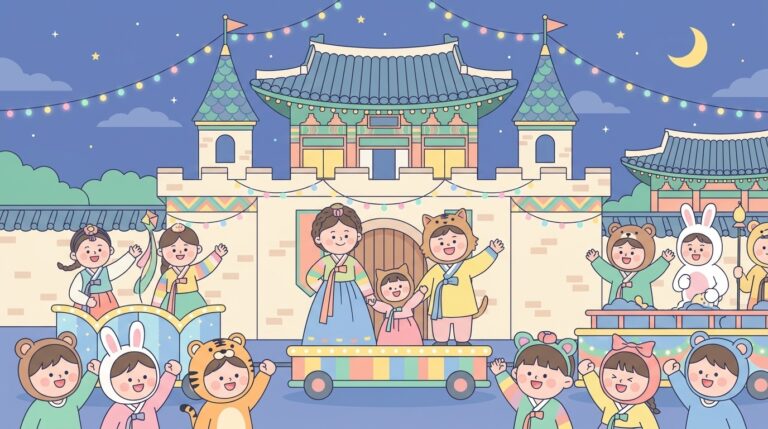
Never Miss the Magic: How to Ask About Parade Times in Korean at Lotte World and Everland
Phase 1: Empathy (Story-Driven Opening)
안녕하세요! Welcome back to Daily Hangul! I’m your Korean culture bestie and editor.
Picture this: You are finally at Lotte World or Everland, wearing cute bunny ear headbands, holding a giant churro, and feeling the magical K-Drama vibe. The sun starts to set, and fairy lights sparkle around the fairytale castle. You know the legendary theme park parade is supposed to happen soon, but the park map looks overwhelming, the digital sign is scrolling in fast Korean, and crowds are already gathering around the main plaza. You want to ask a park staff member when the parade starts and where to sit, but your mind freezes. “What if I say the wrong word? What if they reply too fast?”
Don’t panic! Missing the evening parade because of a quick language barrier is heartbreaking, but asking about schedules in Korean is actually super simple. Today, we’re unlocking the 3 magic phrases tailored for absolute beginners (A1 level) so you can smoothly ask park staff about parade timings, find the best front-row spot, and soak in the dazzling K-theme park atmosphere with 100% confidence. Let’s dive in!
Phase 2: Top 3 Core Expressions In-Depth
Here are the 3 essential expressions you need for parade time:
1. 퍼레이드 몇 시에 해요? (Peoreideu myeot sie haeyo?)
- Pronunciation: puh-ray-deu myut she-eh hae-yo? (Sounds like “Parade” + “my-ut she” like ‘chic’ + “hey-yo”)
- Meaning: “What time is the parade?” (Literal: Parade what hour at does?)
- K-Culture Moment: Just like how K-Pop idols ask staff backstage about cue times on reality shows (Run BTS or Going Seventeen), this phrase uses the magic question word 몇 시 (what time) to pinpoint the exact schedule.
- Editor’s Insight: This is the most practical phrase for beginners. “퍼레이드” is just the loanword ‘Parade’ spoken with Korean phonetics, and “몇 시에 해요?” works for concerts, fireworks, and water shows!
- Situation Spectrum: Casual: ⚠️ (Only with close friends: 퍼레이드 몇 시에 해?) | Semi-formal: ✅ (Perfect for park staff: 퍼레이드 몇 시에 해요?) | Formal: ✅ (퍼레이드 몇 시에 시작합니까?)
- 🤔 Think About It: In English, we ask “When is the parade?”, but Koreans often prefer asking “What specific hour does it do?” (몇 시에 해요?). How does asking for the exact hour change your time awareness?
2. 어디서 봐요? (Eodiseo bwayo?)
- Pronunciation: uh-dee-suh bwah-yo? (Sounds like “uh-dee” as in ‘buddy’ without b + “saw” + “bway-yo”)
- Meaning: “Where should I watch it?” / “Where is the best viewing spot?” (Literal: Where from watch?)
- K-Culture Moment: In date scenes from classic K-Dramas like Business Proposal or Weightlifting Fairy Kim Bok-joo, the couple always navigates where to catch the best view of the theme park night lights.
- Editor’s Insight: Short, sweet, and powerful! “어디서” means where (action happens) and “봐요” comes from 보다 (to see/watch). Staff will immediately point you toward designated seating lines or vantage points.
- Situation Spectrum: Casual: ⚠️ (어디서 봐?) | Semi-formal: ✅ (어디서 봐요?) | Formal: ✅ (어디서 관람할 수 있나요?)
- 🤔 Think About It: Notice how Korean drops the subject (“I” or “we”) completely! Isn’t it refreshing that you don’t need to specify “Where should I watch it“?
3. 지금 시작해요? (Jigeum sijakhaeyo?)
- Pronunciation: jee-geum she-jak-hae-yo? (Sounds like “gee-gum” + “she-jock-hey-yo”)
- Meaning: “Is it starting now?”
- K-Culture Moment: When you hear music swelling and see costumed characters approaching, asking this confirms if the main show has kicked off or if it’s just the pre-show test run.
- Editor’s Insight: “지금 (now)” is one of your top survival words in Korea. Pair it with “시작해요? (starting?)” with a rising intonation at the end to turn it into an instant question.
- Situation Spectrum: Casual: ⚠️ (지금 시작해?) | Semi-formal: ✅ (지금 시작해요?) | Formal: ✅ (지금 시작됩니까?)
- 🤔 Think About It: In Korean, you turn a statement into a question simply by raising your voice at the end. How easy is that compared to English grammar rules with auxiliary verbs?
Phase 3: Textbook Korean vs. Real-world Korean
Situation 1: Asking when the show starts
- 📖 Textbook Korean: “퍼레이드가 몇 시에 시작됩니까?” (Peoreideuga myeot sie sijakdoemnikka? – At what hour is the parade commenced?)
- 🗣️ Real-world Korean: “퍼레이드 몇 시에 해요?” (Peoreideu myeot sie haeyo? – What time is the parade?)
- 💡 Why is it different? Textbook Korean frequently overuses passive formal verbs (시작되다), whereas real native speakers in casual/service settings simplify sentences using the friendly verb 하다 (to do).
Situation 2: Asking where to stand/watch
- 📖 Textbook Korean: “어느 장소에서 관람하는 것이 가장 좋습니까?” (Eoneu jangsoeseo gwallamhameun geosi gajang joseumnikka? – In which location is viewing most optimal?)
- 🗣️ Real-world Korean: “어디가 잘 보여요?” (Eodiga jal boyeoyo? – Where can I see well?)
- 💡 Why is it different? While textbooks teach formal Sino-Korean nouns like 장소 (location) and 관람 (viewing), real theme park goers ask straightforward sensory questions: 어디가 잘 보여요? (Where gives a good view?).
Phase 4: K-Culture Deep Dive & Non-Verbal Manners
4-1. Nunchi (눈치) & Body Language at the Parade Route
When parades are about to start in Korean theme parks like Lotte World Adventure or Everland, orderly etiquette is everything:
1. The Sit-Down Line Rule: Notice people sitting flat on the ground along the tape line? That is the “Sitting Zone” (좌석/바닥 관람 구역). If you stand behind seated people, make sure you don’t block baby strollers or children.
2. Hand gestures when asking staff: When approaching a park cast member (캐스트), give a gentle 15-degree nod with both hands held lightly in front of your waist. Pointing with a full open palm (not a single index finger) shows polite K-etiquette.
3. Headband Courtesy: When the parade begins, take a quick look behind you (that’s Nunchi!). If your giant fluffy bunny ears headband blocks someone’s camera or sightline, taking it off during the show is a major polite move.
4-2. Cultural Code: The K-Theme Park Date & Headband Culture
In Korea, theme parks are iconic date courses featured in countless K-Dramas (e.g., Boys Over Flowers, Legend of the Blue Sea). Couples and groups of friends instantly buy matching character headbands (머리띠) and eat churros (츄러스) or potato tornado skewers before camping out 20 minutes early for the night parade (야간 퍼레이드). It’s not just entertainment—it’s a shared social memory!
Phase 5: Real-World Roleplay Scenario
Setting: 7:45 PM inside Lotte World Adventure. Colorful lights illuminate the indoor ice rink, upbeat music starts playing, and Cast Member Min-ho is organizing the viewing ropes.
- You: 저기요, 실례합니다! (Jeogiyo, sillyehamnida!)
🎭 Politely raising one hand with an open palm.
“Excuse me!” - Cast Member Min-ho: 네, 손님! 도와드릴까요? (Ne, sonnim! Dowadeurilkkayo?)
🎭 Smiling brightly and bowing slightly.
“Yes, guest! May I help you?” - You: 퍼레이드 몇 시에 해요? (Peoreideu myeot sie haeyo?)
🎭 Pointing softly toward the empty parade route.
“What time is the parade?” - Cast Member Min-ho: 저녁 8시에 시작해요! 15분 남았어요. (Jeonyeok yeodeolsie sijakhaeyo! Sibo-bun namasseoyo.)
🎭 Checking his wristwatch and pointing to the countdown.
“It starts at 8:00 PM! 15 minutes left.” - You: 어디서 봐요? (Eodiseo bwayo?)
🎭 Looking around for the best vantage point.
“Where should I watch it?” - Cast Member Min-ho: 여기 노란 선 안쪽에 앉으시면 잘 보여요! (Yeogi noran seon anjjoge anjeusimyeon jal boyeoyo!)
🎭 Guiding you with both hands toward the yellow floor tape.
“If you sit inside this yellow line here, you will get a great view!” - You: 아, 감사합니다! 지금 앉아도 돼요? (A, gamsahamnida! Jigeum anjado dwaeyo?)
🎭 Pointing to the floor mat spot.
“Ah, thank you! May I sit down now?” - Cast Member Min-ho: 네, 편하게 앉으세요! 즐거운 시간 되세요! (Ne, pyeonhage anjeuseyo! Jeulgeoun sigan doeseyo!)
🎭 Making a small heart gesture with a smile.
“Yes, please sit comfortably! Have a wonderful time!”
🔀 Interactive Choice Point
You see a huge crowd gathering and you can’t see the parade route clearly. What do you say to the staff member?
- Option A: “저기요, 퍼레이드 어디가 잘 보여요?” (Excuse me, where can I see the parade well?)
- Option B: “야! 퍼레이드 비켜!” (Hey! Move for the parade!)
- Option C: “퍼레이드 끝났어요?” (Is the parade finished?)
Feedback:
* Option A (Best): 🌟 Excellent! Natural, polite, and directly gets you guided to the best open viewing spot!
* Option B (Bad): 🚫 Danger! “야” is rude slang and “비켜” is a harsh command meaning “get out of the way”. Never use this with strangers!
* Option C (Risk): ⚠️ Confusing. If the parade hasn’t even started yet, asking if it ended might make staff think you are asking about an earlier afternoon show.
Phase 6: 10-Second Emotion Shadowing Drill
Repeat these lines out loud, pausing at the / marks and mimicking the target emotion:
[😊 Excitement & Curiosity]
저기요! / 퍼레이드 / 몇 시에 해요?
(Jeogiyo! / Peoreideu / myeot sie haeyo?)-
[🤔 Eager to find the best spot]
어디서 / 보면 / 잘 보여요?
(Eodiseo / bomyeon / jal boyeoyo?) -
[✨ Relief & Delight]
와, / 지금 / 시작해요! / 감사합니다!
(Wa, / jigeum / sijakhaeyo! / Gamsahamnida!)
Phase 7: K-Culture Mini Dictionary
- 야간 퍼레이드 (Yagan peoreideu) | Night Parade | The grand finale illuminated parade at theme parks, usually packed with LED lights and fireworks.
- 명당 (Myeongdang) | Prime Spot / Best Viewing Location | Originally a feng shui term, widely used in daily life to describe the best seats for parades, fireworks, or concert views.
- 머리띠 (Meoritti) | Headband | The quintessential accessory sold at theme park entrances in Korea, featuring animal ears or park mascots.
- 캐스트 (Kaeseuteu) | Cast Member / Park Staff | The friendly employees stationed throughout Korean amusement parks who guide lines and assist guests.
Phase 8: Traveler’s Survival Kit
Top 3 Survival Expressions
- 자리 있어요? (Jari isseoyo?) | Is there a seat/space here?
💡 Pro Tip: Use this before squeezing into a spot along the parade path to confirm nobody is saving it. - 사진 찍어 주실 수 있어요? (Sajin jjigeo jusil su isseoyo?) | Could you take a picture for me?
💡 Pro Tip: Hand your phone vertically to theme park cast members—they take amazing photos! - 화장실 어디예요? (Hwajangsil eodiyeyo?) | Where is the restroom?
💡 Pro Tip: Crucial to know before the 30-minute parade begins!
Editor’s Travel Note
Before heading to Lotte World (Jamsil, Seoul) or Everland (Yongin), make sure to download the official mobile apps like the Lotte World Adventure App or Everland Resort Mobile App on your smartphone. They provide live GPS countdowns for parade start times, show cancellations due to weather, and smart queue reservations. Also, remember that most Korean theme park snack stands are 100% cashless, so keep your credit card or T-Money transport card handy!
Phase 9: A Step Deeper (Reflection)
In Korean theme park culture, sharing physical space during a parade is governed by an unspoken communal consideration known as 배려 (baeryeo). You will notice high schoolers crouch down so younger kids can see, and adults gladly squeeze closer to allow latecomers a slice of the view. It reflects how Korean social harmony balances excitement with mutual respect in public spaces.
💬 Your Turn: Have you ever experienced a parade or festival in another country? How do people usually save their spots there? Share your story in the comments below!
Phase 10: FAQ & Common Mistakes
Q: Can I use “언제 해요?” instead of “몇 시에 해요?”?
A: Yes! “언제 해요?” (Eonje haeyo?) means “When is it happening?” It is 100% correct and natural. However, asking “몇 시에 해요?” (What hour/time is it?) often yields a more exact time (e.g., “8:00 PM”) rather than vague answers like “soon”.
Q: How do I ask if a parade is cancelled due to rain?
A: You can ask staff: “비 와서 취소됐어요?” (Bi waseo chwisodwaesseoyo? – Is it cancelled because of rain?).
Q: What is the polite way to get a staff member’s attention in a noisy park?
A: Raise your hand gently and say “저기요!” (Jeogiyo!) with a clear, friendly voice. Avoid snapping your fingers or shouting “Hey”.
🚨 Common Mistakes Warning Board
- Mistake: Saying “퍼레이드 타임 어디예요?” (Parade time where is?)
- Correct Action: Use “퍼레이드 몇 시에 해요?” Time is asked with 몇 시, not 어디 (where).
- Mistake: Calling park staff “아저씨 (Ajeossi)” or “아줌마 (Ajumma)”.
- Correct Action: Call them “저기요!” or “직원분 (Jik-won-bun)”. Park cast members are mostly young adults in their 20s!
- Mistake: Leaving trash on the parade floor after the show.
- Correct Action: Pick up your empty snack cups and dispose of them at the 쓰레기통 (Sseuregitong – Trash bin).
Phase 11: Action Mission
- 🥉 Bronze Mission (Solo): Stand in front of your mirror and practice saying “퍼레이드 몇 시에 해요?” 3 times with a friendly smile.
- 🥈 Silver Mission (Social): Write your favorite theme park memory in the comments using one of today’s vocabulary words (e.g., 명당 or 야간 퍼레이드)!
- 🥇 Gold Mission (Real Life): On your next trip to Korea, find a theme park cast member and ask “어디가 잘 보여요?” without glancing at your English map!
🎮 K-Culture Mission: Watch an episode of a Korean variety show filmed at an amusement park (like Running Man Episode 211) and listen for how often the members use 지금 and 몇 시!
Phase 12: Interactive Quiz Challenge
1. Situation Judgment Quiz:
You want to ask the staff what exact time the night parade starts. What is the most natural sentence?
* A) 퍼레이드 몇 시에 해요?
* B) 퍼레이드 어디 가요?
* C) 퍼레이드 맛있어요?
2. Fill-in-the-Blank:
Complete the phrase to ask where to watch:
“______ 봐요?” (Hint: means ‘where’)
3. True or False:
Saying “퍼레이드가 몇 시에 시작됩니까?” is incorrect Korean and staff won’t understand it. (True / False)
🔍 Click here to view Answer Key & Explanations
- Answer: A (퍼레이드 몇 시에 해요? = What time is the parade? B means ‘Where does the parade go?’, C means ‘Is the parade delicious?’).
- Answer: 어디서 (어디서 봐요? = Where should I watch it?).
- Answer: False (It is grammatically correct and staff will understand it, but it sounds like a formal textbook script rather than everyday spoken Korean!).







