

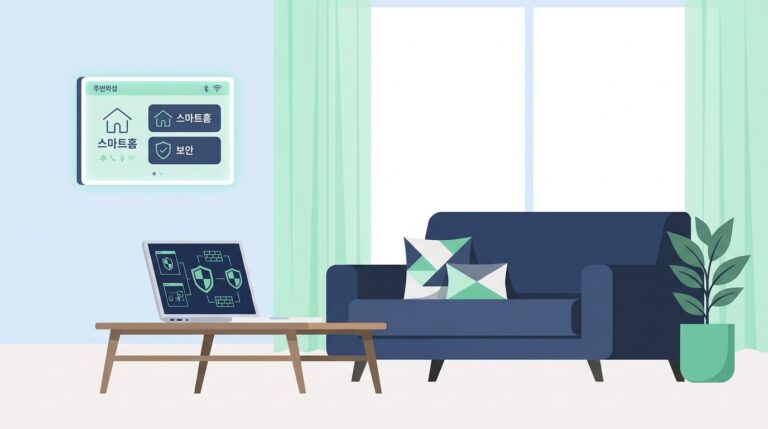
When Smart Homes Get Hacked: Advanced Korean for IoT Security and Tech Vulnerabilities
Phase 1: Empathy (Story-Driven Opening)
안녕하세요! It’s your Daily Hangul editor and cultural navigator. Imagine sitting in a sleek, ultra-modern smart officetel in Gangnam. Your floor heating turns on automatically via smartphone, your smart fridge tracks your meal kits, and your smart door lock unlocks with a tap. But suddenly, your smart speaker begins speaking in a strange voice, or your smart pet camera starts pivoting on its own. In tech-forward South Korea—where hyper-connectivity through IoT (사물인터넷) is integrated into daily life—a security flaw isn’t merely an inconvenience; it can quickly compromise your personal privacy.
Many advanced Korean learners can discuss basic tech or daily routines with ease, but struggle when navigating critical, high-stakes conversations about cybersecurity, vulnerability patches, and zero-day exploits with Korean engineers or landlord IT specialists. This guide draws upon real tech incidents and high-level corporate training to equip you with nuanced, professional C1 Korean expressions to handle IoT security incidents fluently.
Phase 2: Deep Dive into 3 Core Expressions
1. 보안 취약점을 악용하다 (Bo-an chwi-yak-jeom-eul ag-yong-ha-da)
- Pronunciation: [bo-an chwi-yak-jeom-eul ang-yong-ha-da] (Sounds like “boh-ahn chwee-yahk-jeom-eul ahng-yong-ha-da”)
- Meaning: “To exploit a security vulnerability” (Literal) vs. “To maliciously take advantage of an unpatched security loophole” (Nuance).
- K-Culture Moment: Regularly featured in Korean tech thrillers and news broadcasts when an apartment complex’s central home network (월패드) is compromised by external attackers.
- Editor’s Insight: While ‘이용하다’ means neutral ‘to use/utilize’, ‘악용하다’ specifically carries malicious intent (악 / evil). Use this when describing deliberate cyber intrusions.
- Situation Spectrum: Casual: ⚠️ | Semi-formal: ✅ | Formal: ✅
- 🤔 Think About It: How does distinguishing between ‘utilize’ (활용/이용) and ‘exploit’ (악용) sharpen your accountability arguments in professional discourse?
2. 기기 펌웨어를 최신으로 업데이트하다 (Gi-gi peom-we-eo-reul choe-sin-eu-ro eop-de-i-teu-ha-da)
- Pronunciation: [gi-gi peom-we-eo-reul choe-shin-eu-ro eop-dey-teu-ha-da] (Sounds like “gee-gee pum-weh-uh-reul chweh-sheen-oo-ro up-day-teu-hah-dah”)
- Meaning: “To update the device firmware to the latest version.”
- K-Culture Moment: Customer support hotlines and smart home tech engineers in Korea emphasize this phrase first whenever smart appliances malfunction or report unauthorized access.
- Editor’s Insight: Combining Sino-Korean ‘최신’ (most recent) with konglish technical terms creates the standard natural flow in Korean IT environments.
- Situation Spectrum: Casual: ✅ | Semi-formal: ✅ | Formal: ✅
- 🤔 Think About It: Notice how Korean blends technical loanwords with Sino-Korean prepositions naturally to convey urgency and technical precision.
3. 개인정보 유출 피해를 사전에 방지하다 (Gae-in-jeong-bo yu-chul pi-hae-reul sa-jeon-e bang-ji-ha-da)
- Pronunciation: [gae-in-jeong-bo yu-chul pi-hae-reul sa-jeon-e bang-ji-ha-da] (Sounds like “geh-een-jung-boh yoo-chool pee-heh-reul sah-jun-eh bahng-jee-hah-dah”)
- Meaning: “To proactively prevent personal information leakage damages.”
- K-Culture Moment: A hallmark phrase in Korean data privacy declarations (개인정보 처리방침) and cybersecurity compliance briefings.
- Editor’s Insight: ‘사전에’ (in advance/proactively) combined with ‘방지하다’ (to prevent) emphasizes prevention over post-incident remediation.
- Situation Spectrum: Casual: 🚫 | Semi-formal: ✅ | Formal: ✅
- 🤔 Think About It: How does the frequent usage of Sino-Korean four-character compounds elevate professional credibility during technical debates?
Phase 3: Textbook Korean vs. Real Native Korean
Situation 1: Talking about a device being hacked or taken over
- 📖 Textbook Korean: “제 사물인터넷 기기가 해킹을 당한 것 같습니다.” (It seems my IoT device was hacked.)
- 🗣️ Real Native Korean: “월패드랑 홈캠이 완전히 털린 것 같아요. 원격 제어가 안 돼요.” (It looks like our wallpad and home cam got totally breached. Remote control is locked out.)
- 💡 Why is it different? In colloquial Korean, ‘털리다’ (literally ‘to be dusted off/shaken down’) is the go-to expressive slang used by natives when accounts, servers, or devices get hacked or compromised.
Situation 2: Emphasizing that security settings are too lax
- 📖 Textbook Korean: “보안 설정이 매우 약합니다.” (The security settings are very weak.)
- 🗣️ Real Native Korean: “초기 비밀번호를 그대로 둬서 보안이 완전 뚫리기 쉬운 상태예요.” (Leaving default passwords makes the security wide open to breaches.)
- 💡 Why is it different? Koreans frequently use ‘뚫리다’ (to be punctured/breached) rather than simply ‘약하다’ (weak) to vividly illustrate cyber penetration.
Phase 4: K-Culture Deep Dive & Non-Verbal Manners
4-1. Nunchi & Professional Demeanor in Cybersecurity
When reporting or discussing security breaches in a Korean corporate or residential setting, avoid pointing direct blame at individuals (e.g., ‘당신이 잘못 설정해서’ – “Because you set it up wrong”). Instead, frame it around systemic vulnerabilities using passive constructions: “보안 패치가 누락되어 취약점이 노출된 것 같습니다” (It appears vulnerabilities were exposed due to missing security patches). Maintain direct eye contact with a calm, analytical tone, using slight nods to validate safety concerns.
4-2. Cultural Code: The Apartment ‘Wallpad’ & Smart Living Phenomenon
In South Korea’s high-rise apartment culture, the ‘월패드 (Wallpad)’ is the central nervous system of the home—controlling elevators, lighting, security cameras, and intercoms. Following major real-life incidents where apartment networks were breached, network separation (망 분리) and IoT end-point encryption became major societal topics. Demonstrating familiarity with this context shows deep cultural fluency.
Phase 5: Real-World Roleplay Scenario
Setting: A smart office / officetel maintenance office. You are addressing suspicious activity on your smart home hub with the building’s IT administrator.
- You: 관리소장님, 세대 내 스마트 홈 허브에서 비인가 접근 로그가 확인되어 말씀드리러 왔습니다. (Manager, I came to discuss unauthorized access logs detected on our unit’s smart home hub.) 🎭 Handing over a printed log sheet calmly.
- Admin (관리소장): 비인가 접근이요? 혹시 초기 비밀번호를 변경하지 않고 사용하셨나요? (Unauthorized access? Did you by any chance use it without changing the default password?) 🎭 Looking puzzled while examining the sheet.
- You: 아닙니다. 2단계 인증까지 활성화해 두었는데, 외부 IP에서 무작위 대입 공격을 시도한 흔적이 있습니다. (No. I even enabled two-factor authentication, but there are traces of brute-force attacks from external IPs.) 🎭 Pointing to the timestamp on the log.
- Admin: 아, 최근 단지 내 망 분리 작업 이후 펌웨어 취약점을 노린 공격이 늘었다고 하더군요. (Ah, they mentioned attacks targeting firmware vulnerabilities have increased since our complex-wide network separation work.) 🎭 Nodding seriously.
- You: 네, 아파트 메인 서버와 세대망 간의 방화벽 정책을 긴급 재점검해야 할 것 같습니다. (Yes, it seems urgent to re-examine the firewall policies between the apartment main server and individual household networks.) 🎭 Speaking with a composed yet firm tone.
- Admin: 알겠습니다. 보안 솔루션 업체에 즉각 연락하여 패치를 배포하도록 조치하겠습니다. (Understood. I will immediately contact the security solution vendor to deploy patches.) 🎭 Typing an urgent memo on the computer.
- You: 빠른 조치 부탁각드립니다. 2차 피해를 막으려면 전 세대에 공지도 필요해 보입니다. (Thank you for prompt action. Announcing this to all households seems necessary to prevent secondary damages.) 🎭 Showing polite gratitude with a slight bow.
- Admin: 네, 긴급 공지 방송 및 보안 점검 가이드를 바로 발송하겠습니다. (Yes, we will broadcast an emergency announcement and dispatch the security checklist immediately.) 🎭 Bow in acknowledgement.
🔀 Interactive Branching Point
If the Admin had hesitated and dismissed it as a simple glitch, how would you respond?
* Option A: “그냥 오류가 아니라 개인정보 유출로 직결될 수 있는 중대 결함입니다. 즉각적인 조치를 요구합니다.” (Best – Professional, urgent, and highlights risk clearly)
* Option B: “왜 일을 그렇게 처리하세요? 당장 고쳐내세요!” (Bad – Overly confrontational and destroys professional rapport)
* Option C: “그럼 어쩔 수 없네요. 제가 알아서 해볼게요.” (Risk – Passive, compromises safety without resolving the threat)
Phase 6: 10-Second Shadowing Drill
[🚨 단호하고 경각심을 담아 / Resolute and Alert]
“최신 펌웨어 업데이트를 소홀히 하면 / 사물인터넷 기기가 / 디도스 공격의 좀비 PC로 전락할 수 있습니다.”
(Choe-sin peom-we-eo eop-de-i-teu-reul so-hol-hi ha-myeon / sa-mul-in-teo-net gi-gi-ga / di-do-seu gong-gyeog-ui jom-bi pi-si-ro jeon-rak-hal su it-seum-ni-da.)-
[💡 차분하고 분석적으로 / Calm and Analytical]
“비밀번호를 주기적으로 변경하고 / 불필요한 원격 접속 포트는 / 사전에 차단하는 것이 안전합니다.”
(Bi-mil-beon-ho-reul ju-gi-jeok-eu-ro byeon-gyeong-ha-go / bul-pil-yo-han won-gyeok jeop-sok po-teu-neun / sa-jeon-e cha-dan-ha-neun geos-i an-jeon-ham-ni-da.)
Phase 7: K-Culture Mini Dictionary
- 월패드 (Wallpad): The wall-mounted touchscreen terminal in Korean apartments that manages home IoT, visitor intercoms, and utility controls.
- 망 분리 (Mang-bul-li): Network separation / segregation; a critical regulatory standard in South Korea preventing unauthorized cross-network access.
- 비인가 접근 (Bi-in-ga Jeop-geun): Unauthorized access; standard technical term in Korean security logs and official incident reports.
- 무차별 대입 공격 (Mu-cha-byeol Dae-ip Gong-gyeok): Brute-force attack; systematically trying all possible password combinations.
Phase 8: Traveler’s & Resident’s Survival Kit
- Survival Phrase 1: “와이파이 비밀번호가 암호화되어 있나요?” (Is this Wi-Fi password encrypted?) — Crucial for verifying public IoT hotspot safety.
- Survival Phrase 2: “스마트 도어락 배터리가 방전되었을 때 외부 전원 공급 단자가 어디에 있나요?” (Where is the 9V external power emergency terminal if the smart door lock battery dies?) — Indispensable for Korean officetel dwellers.
- Survival Phrase 3: “원격 제어 앱 연동을 해제해 주세요.” (Please unlink the remote control application integration.) — Essential when moving out of an officetel/Airbnb.
- Editor’s Travel Note: When renting Airbnb or smart officetels in Korea, consult the official security guidelines via the KISA Korea Internet & Security Agency Portal to stay informed on local cybersecurity practices.
Phase 9: A Step Deeper (Reflection)
South Korea’s rapid leap into ubiquitous computing creates unmatched daily convenience, yet it highlights the communal impact of cybersecurity. In a connected high-rise apartment, one compromised router can potentially expose the subnetwork of an entire building cluster. Cybersecurity in Korea is therefore viewed not just as personal data protection, but as an extension of communal responsibility (공동체 의식).
💬 Your Turn: In your home country, is IoT security considered primarily an individual user responsibility or a collective infrastructure requirement? Share your thoughts in Korean below!
Phase 10: FAQ & Avoiding Misunderstandings
Q: Can I use ‘해킹당하다’ in formal business presentations?
A: Yes, ‘해킹당하다’ is widely understood, but in formal C1 business documentation, expressions like ‘침해 사고가 발생하다’ (A breach incident occurred) or ‘인가되지 않은 침입이 탐지되다’ (Unauthorized intrusion was detected) convey much higher professionalism.
Q: What is the difference between ‘취약점’ and ‘결함’?
A: ‘결함’ (defect/flaw) refers broadly to any functional bug or hardware malfunction. ‘취약점’ (vulnerability) specifically denotes security flaws that adversaries can exploit.
Q: How do I say ‘Zero-Day Vulnerability’ in Korean?
A: It is directly called ‘제로데이 취약점’ (Zero-day vulnerability) or ‘미패치 취약점’ (Unpatched vulnerability).
🚨 Common Mistakes
- Mistake: Using ‘인터넷 사물’ instead of ‘사물인터넷’.
- Correct Action: Always say 사물인터넷 (IoT).
- Mistake: Saying ‘비밀번호를 깨다’ in formal contexts.
- Correct Action: Use ‘비밀번호가 무력화되다/탈취되다’ (Passwords were neutralized/stolen).
- Mistake: Confusing ‘업데이트’ (software update) with ‘업그레이드’ (hardware/tier upgrade).
- Correct Action: Use ‘보안 패치 업데이트’ for software and firmware patches.
Phase 11: Action Missions
- 🥉 Bronze Mission: Record yourself reading the Phase 6 shadowing drills with appropriate pauses at
/marks. - 🥈 Silver Mission: Check your smart device settings in Korean language mode and find the menu labeled ‘펌웨어 버전 정보’ (Firmware Version Info).
- 🥇 Gold Mission: Write a 3-sentence advisory note in formal Korean warning a colleague about changing default router passwords.
- 🎮 K-Culture Mission: Watch a clip of a Korean news report regarding ‘아파트 월패드 해킹’ and identify at least three Sino-Korean security terms introduced today.
Phase 12: Interactive Quiz Challenge
1. [Contextual Judgment] Which sentence is the most natural and formal way to inform an IT team about an ongoing exploit?
* A) 우리 기기 털렸으니까 빨리 고치세요.
* B) 기기 취약점을 통한 비인가 접근 징후가 확인되어 점검이 시급합니다.
* C) 해커가 비밀번호를 다 깼어요.
2. [Fill-in-the-Blank] Fill in the blank with the appropriate Sino-Korean term for ‘preventing proactively’:
“외부 침입으로 인한 피해를 _______(사전에) 방지하기 위해 방화벽 규칙을 업데이트했습니다.”
3. [True / False] In Korean smart apartments, the ‘Wallpad’ (월패드) is strictly an offline device with zero connection to external IoT networks.
🔍 Click here to reveal Quiz Answers & Explanations!
- Answer: B — Sentence B uses precise C1 terminology (‘취약점’, ‘비인가 접근 징후’, ‘시급합니다’) appropriate for formal technical escalations.
- Answer: 사전에 (Proactively / In advance) — Accurately collocated with ‘방지하다’.
- Answer: False — Korean Wallpads are centrally networked hubs, making them crucial focus points for IoT security regulations and firewall isolation.







