

Phase 1: 공감 (Story Opening)
안녕하세요! 매일한글 에디터입니다.
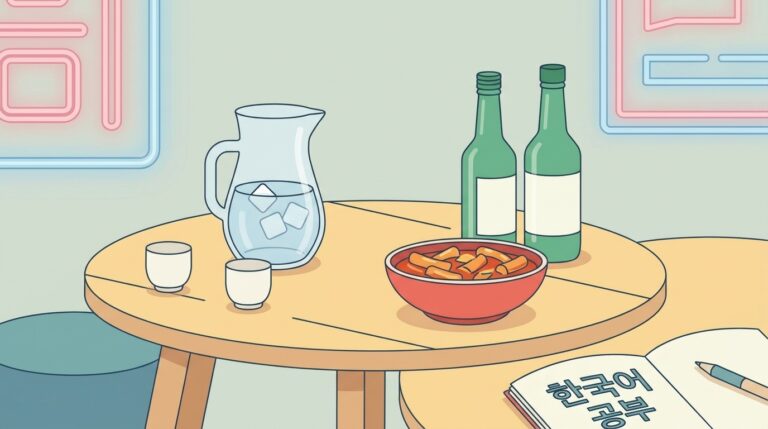
Picture this: You are sitting around a low wooden table at a bustling, neon-lit Pocha (street pub) in Hongdae with your Korean friends. The table is packed with sizzling spicy tteokbokki, crispy kimchi pancakes, and green bottles of soju. Everyone is clinking glasses and yelling “Geonbae!” You take a fiery bite of spicy chicken stew, take a quick sip of soju—and suddenly, your tongue is on fire, and your throat feels completely parched.
You want to ask the busy server for a simple jug of cold water, but your mind goes blank. In Korean dining culture, especially during drinking sessions (suljari), water is your ultimate lifesaver. Yet, many beginner learners panic, freeze up, or accidentally blurt out textbook phrases that sound like robotic poetry from the 19th century.
Don’t worry! This guide is crafted from real feedback and the survival stories of hundreds of beginner learners at Daily Hangul. In just 5 minutes, you will master the most natural, friendly ways to ask for water, decode hidden bar manners, and survive any spicy Korean drinking night like a confident local.
Phase 2: 핵심 표현 3선 (Top 3 Essential Expressions)
1. 물 좀 주세요 (Mul jom ju-se-yo)
- Pronunciation: [Mool-jom-joo-seh-yo] (Think: “Mool” like pool + “Jom” like jump without the ‘p’ + “Joo-seh-yo”)
- Meaning: Literal: “Please give me a little water.” | Real Nuance: “Could I get some water, please?”
- K-Culture Moment: You’ve seen this in almost every K-Drama drinking scene (like Itaewon Class or Work Later, Drink Now) when a character takes one too many spicy soju shots and frantically waves down the owner.
- Editor’s Insight: The tiny magic word 좀 (jom – a little) softens your entire request. Without “좀”, “물 주세요” can sound a bit demanding. Adding “좀” turns it into a polite, natural request!
- Situation Spectrum: Casual ✅ | Semi-formal ✅ | Formal ⚠️
- 🤔 Think About It: In English, we often ask “Could I possibly get…?” to sound polite. In Korean, simply inserting a soft softening particle like “좀” does all the heavy lifting of politeness!
2. 물은 셀프예요? (Mul-eun sel-peu-ye-yo?)
- Pronunciation: [Moo-reun sell-peuh-yeh-yo?]
- Meaning: Literal: “Is water self-service?” | Real Nuance: “Should I grab water myself from the fridge/dispenser?”
- K-Culture Moment: Entering a cozy mom-and-pop eatery (bunsikjib) or a casual university bar with a big sign on the wall saying “물은 셀프” (Water is self-service).
- Editor’s Insight: Koreans love efficiency. In many casual pubs and restaurants, water cups and metal carafes are stored in a stainless-steel UV sterilizer box near the kitchen. Asking this saves you and the busy staff precious time!
- Situation Spectrum: Casual ✅ | Semi-formal ✅ | Formal ⚠️
- 🤔 Think About It: Why is “self-service” (셀프) borrowed directly from English? Post-1990s Korean casual dining adopted this loanword as a staple restaurant term!
3. 시원한 물 있어요? (Si-won-han mul iss-eo-yo?)
- Pronunciation: [She-won-han mool eess-uh-yo?]
- Meaning: Literal: “Do you have cool/refreshing water?” | Real Nuance: “Do you have cold ice water?”
- K-Culture Moment: Coming inside from a humid Seoul summer night into an air-conditioned pub, craving that bone-chilling iced water.
- Editor’s Insight: The Korean word 시원하다 (siwonhada) means both “cool/refreshing” physically and “relieving/satisfying” emotionally. When you ask for “시원한 물”, staff know you need ice-cold relief immediately.
- Situation Spectrum: Casual ✅ | Semi-formal ✅ | Formal ⚠️
- 🤔 Think About It: Koreans drink iced beverages even in sub-zero winter (the famous Eol-juk-ah culture: ‘freezing to death but still drinking iced Americano’). Cold water is an absolute must-have!
Phase 3: 교과서 한국어 vs 진짜 한국어 (Textbook vs Real Korean)
Situation 1: Calling the server for water in a crowded pub
- 📖 교과서 한국어 (Textbook Korean): 저기 웨이터님, 저에게 물을 한 잔 가져다주시겠습니까? (Excuse me waiter, would you bring a glass of water to me?)
- 🗣️ 진짜 한국어 (Real Korean): 사장님, 여기 물 좀 더 주세요! (Boss/Owner, could we get some more water here, please!)
- 💡 왜 다를까? (Why is it different?): Koreans rarely say “웨이터” (waiter). Instead, calling the server 사장님 (Sajangnim – boss/owner) or 이모 (Imo – auntie) creates an instant, friendly bond while remaining respectful.
Situation 2: Asking your drinking buddy to pass the water jug
- 📖 교과서 한국어 (Textbook Korean): 물병을 제 손으로 건네주세요. (Hand the water bottle over to my hand.)
- 🗣️ 진짜 한국어 (Real Korean): 나 물 한 잔만 줘~ (Give me just a glass of water~)
- 💡 왜 다를까? (Why is it different?): Among close friends of the same age (dong-gap), ultra-formal grammar sounds like you are joking or angry. Short casual forms (banmal) like 물 한 잔만 줘 express warmth and closeness.
Phase 4: K-Culture 딥다이브 & 비언어적 매너 (Culture Deep Dive)
4-1. 눈치 (Nunchi) & Table Gestures
- The Two-Handed Water Pour: In Korean drinking culture, respect is physical. If someone older or senior at work pours water (or soju) into your cup, hold your glass with both hands (or support your right wrist/forearm with your left hand). When you pour water for others, do the same with two hands!
- The Table Call Button & Eye Contact: You don’t need to shout across the room. Look around the edge of the table or on the napkin box for a small round button called the 호출벨 (Call Bell). Press it once with a gentle chime “Ding-dong!”, and the server will come right to you.
4-2. The Golden Rule of Suljari (Korean Drinking Culture)
In Korea, alcohol (sul) and water (mul) go hand-in-hand. Koreans say: “물 많이 마시면 숙취 없다!” (Drink lots of water and you won’t get a hangover!). It is completely polite and customary to ask for a fresh metal water carafe (mul-byeong) as soon as you order your drinks. In fact, pouring water for your tablemates before your own cup shows peak 배려 (consideration) and high Nunchi score!
Phase 5: 실전 롤플레이 시나리오 (Interactive Roleplay Scenario)
Setting: A vibrant Pocha in Euljiro, Seoul. Neon signs reflect on the aluminum table. Min-jun (your Korean friend) has just ordered extra spicy tteokbokki and a bottle of soju.
- Turn 1 (Min-jun): 떡볶이 진짜 매운데, 괜찮아? 너 얼굴 빨개졌어! (The tteokbokki is really spicy, are you okay? Your face turned red!)
- Turn 2 (You): 🎭 [Fanning your mouth with your hand] 앗, 진짜 맵다! 물… 물 어디 있어? (Ah, really spicy! Water… where is the water?)
- Turn 3 (Min-jun): 우리 테이블에 물병 없네. 저기 냉장고 봐봐. (There’s no water bottle on our table. Look at the fridge over there.)
- Turn 4 (You): 🎭 [Pointing towards the kitchen fridge] 물은 셀프예요? (Is water self-service?)
- Turn 5 (Server – Sajangnim): 🎭 [Waving with a friendly smile] 네, 물은 냉장고에서 직접 가져다 드시면 돼요! (Yes, you can grab water directly from the fridge!)
- Turn 6 (You): 🎭 [Walking to the fridge, grabbing a chilled metal pitcher and two cups] 감사합니다! (Thank you!)
- Turn 7 (You): 🎭 [Pouring water into Min-jun’s cup with both hands] 민준아, 물 마셔! (Min-jun, drink some water!)
- Turn 8 (Min-jun): 🎭 [Holding his cup with both hands gratefully] 오, 센스 대박! 고마워! (Oh, your social sense is amazing! Thanks!)
🔀 인터랙티브 분기점 (Interactive Choice)
The server walks past your table with a tray. You need extra ice water immediately because your mouth is burning. What do you say?
- Option A: “야! 물 가져와!” (Hey! Bring water!)
- 🚫 Feedback (Bad): Extremely rude! “야” is like screaming “Hey you punk!” at a stranger. Never use this with restaurant staff.
- Option B: “사장님, 여기 시원한 물 좀 더 주실 수 있나요?” (Boss, could you give us some more cold water here?)
- 🌟 Feedback (Best): 100/100! Super polite, uses ‘사장님’, includes ‘시원한 물’, and softens with ‘좀’. The owner will probably give you extra snacks for free!
- Option C: “물 주세요.” (Give me water.)
- ⚠️ Feedback (Risk): Grammatically correct, but sounds slightly dry and flat without ‘여기’ (here) or ‘좀’ (a little).
Phase 6: 10초 감정 섀도잉 드릴 (10-Second Emotion Shadowing Drill)
Practice reading these out loud at normal conversational speed. Follow the slash / for short natural pauses:
- [🥺 급하고 갈증 나게 – Desperate & Thirsty]
- “사장님! / 저기 / 물 좀 빨리 주세요~”
- (Sajangnim! / Jeogi / Mul jom ppal-li ju-se-yo~)
- [😊 친절하고 상냥하게 – Polite & Friendly]
- “저기요, / 시원한 물 / 한 병만 더 / 부탁드려요!”
- (Jeo-gi-yo, / Si-won-han mul / han byeong-man deo / bu-tak-deu-ryeo-yo!)
- [🤝 친구에게 배려하며 – Warm & Caring to a Friend]
- “매우니까 / 물 먼저 마셔. / 내가 따라줄게!”
- (Mae-u-ni-kka / mul meon-jeo ma-syeo. / Nae-ga tta-ra-jul-ge!)
Phase 7: K-Culture 미니 사전 (Mini Dictionary)
- 물병 (Mul-byeong) – [Mool-byeong]
- Meaning: Water carafe / pitcher bottle.
- Usage: Pubs in Korea provide reusable stainless-steel or plastic chilled jugs filled with cold water or roasted barley tea (boricha).
- 호출벨 (Ho-chul-bel) – [Ho-chool-bell]
- Meaning: Table call bell.
- Usage: Found mounted on restaurant tables in Korea. A single tap summons your server without awkward waving.
- 셀프 (Sel-peu) – [Sell-peuh]
- Meaning: Self-service.
- Usage: Often paired as “물/반찬은 셀프” (Water/side dishes are self-service).
- 숙취 (Suk-chwi) – [Sook-chwee]
- Meaning: Hangover.
- Usage: The reason Koreans emphasize drinking water between soju rounds (“숙취 해소에는 물이 최고야!” – Water is best for hangover relief!).
Phase 8: 여행자를 위한 생존 키트 (Traveler Survival Kit)
서바이벌 표현 TOP 3 (Survival Expressions)
- “얼음물 있어요?” (Eor-eum-mul iss-eo-yo?)
- Pro Tip: If regular cold water isn’t enough, this asks for “Ice water”.
- “물 한 병 더 주세요.” (Mul han byeong deo ju-se-yo.)
- Pro Tip: Use this when your table has finished the entire water jug.
- “종이컵 있어요?” (Jong-i-keop iss-eo-yo?)
- Pro Tip: Use this to ask for disposable paper cups if you need extra cups for sharing.
Editor’s Travel Note 💡
- Tap Water vs. Purified Water: Unlike some countries where tap water is served, Korean restaurants always serve filtered water from a dispenser (jeong-su-gi) or bottled tea. It is 100% free of charge!
- Restaurant Navigation Tip: When hunting down authentic retro pochas and drinking spots in alleys, search on the 네이버 지도 앱 다운로드 (Naver Map app) using the keyword “포차 맛집” (Pocha hot spots) for the most accurate local ratings.
Phase 9: 한 발 더 깊이 (Cultural Insight & Reflection)
In many Western dining settings, water is brought automatically with a tip expected at the end of the meal. In Korea, water and unlimited banchan (side dishes) are considered 정 (Jeong – collective affection & hospitality) and 서비스 (Service – complimentary). The phrase “물 좀 주세요” reflects the casual warmth of Korean communal tables: you share food from the center, pour water for each other, and care for everyone’s well-being throughout the night.
💬 Your Turn: What is the dining etiquette for asking for water or refills in your home country? Share your experiences in the comments below!
Phase 10: FAQ & 오해 방지 (FAQ & Common Mistakes)
Q: Do I have to pay for water refills at Korean bars and restaurants?
A: No! Water at Korean dining places and pubs is virtually always free (muryo). Even if you ask for three new jugs, it is complimentary.
Q: What should I call the server if I don’t see a call button?
A: Raise your hand lightly to shoulder height and say softly but clearly: “저기요~” (Jeo-gi-yo – Excuse me) or “사장님~” (Sajangnim – Boss/Owner).
Q: Why does the water at some Korean pubs taste nutty and golden?
A: You are likely drinking 보리차 (Bori-cha – roasted barley tea) or 옥수수수염차 (corn silk tea)! It is served chilled in water jugs and is legendary for soothing the stomach.
🚨 흔한 실수 (Common Mistakes) TOP 3
- Calling the server ‘웨이터’ (Waiter): It feels robotic and unnatural.
- Correct Action: Use “사장님” (Sajangnim) or “저기요” (Jeogiyo).
- Shouting across the room when a bell exists:
- Correct Action: Check the table corners for the 호출벨 (call bell) first before speaking.
- Pouring only for yourself:
- Correct Action: Always offer to pour your friend’s glass before filling yours!
Phase 11: 액션 미션 (Action Missions)
- 🥉 Bronze Mission (Solo Practice): Stand in front of your mirror and practice saying “사장님, 여기 물 좀 주세요!” with a bright smile 5 times.
- 🥈 Silver Mission (SNS Challenge): Post an Instagram Story of your next meal with a glass of water, tagging
@DailyHangulwith the caption: “물 좀 주세요! 💧” - 🥇 Gold Mission (Real Action): Visit a local Korean restaurant or pub this week, find the call button, and order water using “물 좀 주세요” in real life!
- 🎮 K-Culture Mission: Watch an episode of a drama like Hospital Playlist or Itaewon Class. Spot the moment characters eat something spicy and listen for the word 물 (mul)!
Phase 12: 인터랙티브 퀴즈 챌린지 (Interactive Quiz)
Q1. You are at a lively Korean pub. Which word softens your request for water to make it friendly and polite?
(a) 야 (Ya)
(b) 좀 (Jom)
(c) 빨리 (Ppal-li)
👉 Click to reveal Answer & Explanation
Correct Answer: (b) 좀 (Jom)
Explanation: ‘좀’ means ‘a little’ and acts as a politeness softener in Korean conversational requests (‘물 좀 주세요’).
Q2. (True / False) If a sign says “물은 셀프”, you should press the table call button and ask the server to bring you water.
👉 Click to reveal Answer & Explanation
Correct Answer: False
Explanation: ‘셀프’ means self-service! You should walk up to the water dispenser or designated refrigerator and grab a water carafe and cups yourself.
Q3. Fill in the blank: To ask if ice-cold water is available, you say: “______ 물 있어요?”
(a) 시원한 (Si-won-han)
(b) 뜨거운 (Tteu-geo-un)
(c) 매운 (Mae-un)
👉 Click to reveal Answer & Explanation
Correct Answer: (a) 시원한 (Si-won-han)
Explanation: ‘시원한 물’ translates to refreshing / cold water, perfect for balancing spicy Korean drinking snacks!






