

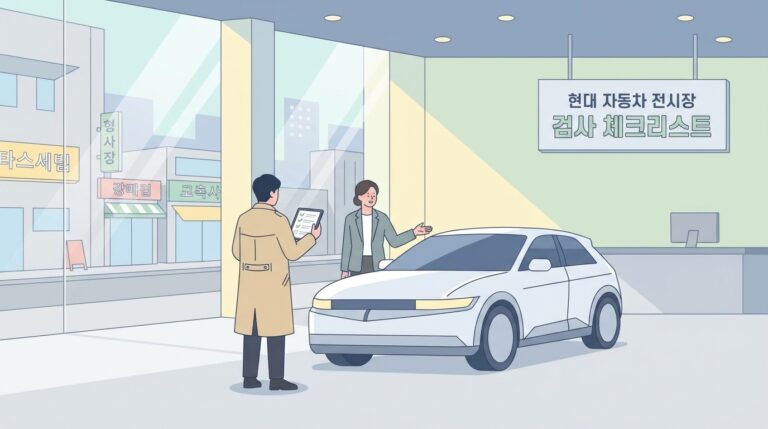
Phase 1: Empathy (Story-Driven Opening)
안녕하세요! 매일한글 에디터입니다. (Hello! This is your Daily Hangul editor.)
Picture this: You’ve been living in Korea for a year, and public transit is fantastic, but you crave spontaneous weekend getaways to Gangwon-do or coastal road trips along Jeju’s coast. You decide to buy your first car in Korea. You open up a used car app, find a sleek, low-mileage sedan at an unbelievable price in a massive complex in Incheon or Suwon, and head over full of excitement. But the moment you step onto the lot, the dealer starts throwing rapid-fire terms at you: “무사고 (accident-free),” “단순교환 (simple part swap),” “성능점검 (performance inspection),” and suddenly you feel overwhelmed. Did the car suffer frame damage? Has it been flooded during monsoon season? Are there hidden dealer fees?
Navigating the Korean used car market requires far more than basic conversational skills; it demands B2-level precision, specialized vocabulary, and an understanding of Korean consumer protections. Misunderstanding a single contractual phrase could turn your dream purchase into an endless financial headache. This guide is crafted from real feedback and field experience from our international community in Korea, giving you the exact language, negotiation tactics, and cultural radar you need to buy a pre-owned car safely, confidently, and like a seasoned local.
Phase 2: Core Expressions Deep Dive
1. 사고 이력이나 침수 여부 확실히 확인하고 싶어요.
- Pronunciation: [Sago iryeogina chimsu yeobu hwaksilhi hwaginhago sipeoyo.] (Think: “Sah-goh ee-ryeok-ee-nah cheem-soo yaw-boo hwak-sheel-hee hwah-geen-hah-goh sheep-aw-yo”)
- Meaning: Literal: “I want to clearly check accident history or flooding status.” / Nuance: “I need concrete verification regarding past collision records or water damage before we talk numbers.”
- K-Culture Moment: Seen frequently in investigative journalism shows like Han Moon-chul’s Blackbox Review or drama scenes where characters scrutinize second-hand vehicle contracts.
- Editor’s Insight: In Korean used car trading, 침수 (water submersion) is the ultimate red flag after summer monsoons. Asking for 침수 여부 (whether it was flooded) signals that you know the local market pitfalls.
- Situation Spectrum:
- Casual (Friends): 🚫
- Semi-formal (Consultations): ✅
- Formal (Contracts): ✅
- 🤔 Think About It: Why does Korean automotive culture place such high emphasis on “complete disclosure of history” compared to “buyer beware” principles in some Western countries?
2. 성능점검기록부 교부해 주시고 특약 사항에 넣어 주세요.
- Pronunciation: [Seongneung-jeomgeom-girokbu gyobuhae jusigo teugyak sahange neoheo juseyo.] (Think: “Sung-neung jum-gum gee-rok-boo gyo-boo-heh joo-she-goh teuk-yahk sah-hang-eh nuh-aw joo-seh-yo”)
- Meaning: Literal: “Please issue the vehicle performance inspection record and include it in the special terms.”
- Nuance: “Let’s make sure the mandatory government-certified inspection sheet is legally bound to our sales contract.”
- K-Culture Moment: The pivotal phrase used when dealing with licensed dealership complexes (매매단지) to protect against 허위매물 (fraudulent bait-and-switch listings).
- Editor’s Insight: 특약 사항 (Special Contract Terms) is your ultimate legal shield. Stating “침수차로 판명될 시 100% 환불 (100% refund if proven flooded)” here protects your rights.
- Situation Spectrum:
- Casual: 🚫
- Semi-formal: ⚠️
- Formal: ✅
- 🤔 Think About It: How does demanding written 특약 change the power dynamic between customer and dealer in Korean business negotiations?
3. 단순 교환인지 프레임 손상인지 말씀해 주실 수 있나요?
- Pronunciation: [Dansun gyohwan-inji peureim sonsang-inji malsseumhae jusil su innayo?]
- Meaning: Literal: “Could you tell me if it’s a simple cosmetic replacement or frame structural damage?”
- Nuance: “Is the ‘accident-free’ label merely skin-deep (fender/door bolt-on), or has the core chassis suffered structural deformation?”
- K-Culture Moment: Car enthusiast YouTubers (like CarScene or TopGear Korea hosts) emphasize this distinction whenever dissecting showroom inventory.
- Editor’s Insight: In Korea, replacing an outer door panel is officially classified as 무사고 (accident-free) under consumer law because the frame wasn’t welded. Asking this reveals you understand Korean legal automotive definitions.
- Situation Spectrum:
- Casual: ⚠️
- Semi-formal: ✅
- Formal: ✅
- 🤔 Think About It: Why do Koreans distinguish so sharply between 단순교환 and 골격/프레임 손상 when assessing asset depreciation?
Phase 3: Textbook Korean vs. Real-World Korean
Scenario 1: Inquiring about mechanical defects & oil leaks
- 📖 Textbook Korean: “이 차는 고장이 없습니까?” (Does this car have breakdowns?)
- 🗣️ Real-World Korean: “혹시 미세 누유나 하부 부식은 없나요?” (Are there any micro-oil leaks or undercarriage corrosion?)
- 💡 Why the difference? Broad textbook questions invite generic “Yes, it’s great!” responses. Specific technical terms like 미세 누유 (micro oil seepage) force the dealer to show the detailed checklist item by item.
Scenario 2: Negotiating the total final price
- 📖 Textbook Korean: “가격을 깎아 주세요.” (Please discount the price.)
- 🗣️ Real-World Korean: “이전 등록비랑 매도비 포함해서 네고 가능한가요?” (Is negotiation possible inclusive of the transfer registration and dealership handling fee?)
- 💡 Why the difference? Simply saying 깎아 주세요 sounds amateurish. In Korea, secondary fees (매도비, 취등록세) can add 7–10% to the total bill; referencing them demonstrates financial literacy and invites realistic discounts (네고).
Phase 4: K-Culture Deep Dive & Non-Verbal Manners
4-1. 눈치 (Nunchi) & Showroom Body Language
- Visual Inspection Etiquette: Never just stand with your hands in your pockets. Squat down and run a flashlight along the wheel wells and under the engine block. Check the bolts under the hood: scratched paint on bolt edges (볼트 풀림 흔적) proves a panel was replaced.
- The Rubber Strip Peel: Gently pull back the weatherstrip rubber along the door frame and trunk rim. If you spot muddy silt or rust, it’s a flood-damaged car (침수차). Doing this silently in front of the dealer shows high Nunchi without saying an aggressive word.
4-2. Cultural Code Analysis: The Evolution of Korea’s Used Car Market
Korean dramas often portrayed used car complexes as shady labyrinthine lots run by gangsters in flashy shirts. While legacy complexes in Incheon and Bucheon once had reputations for aggressive tactics, Korea’s automotive market has undergone massive corporate standardization through certified platforms like K Car (케이카) and Encar (엔카). Today, consumers demand transparent online inspections and 3D vehicle scans before even booking a test drive.
Phase 5: Real-World Roleplay Scenario
Setting: A modern, well-lit indoor used car showroom in Suwon. Alex is looking at a 2021 Hyundai Avante (Elantra).
Characters:
* Alex: Smart expat car buyer.
* Dealer Park (박 딜러): Polite, experienced auto sales consultant.
- Dealer Park: “손님, 이 아반떼는 연식 대비 주행거리가 3만km밖에 안 돼서 상태 최상입니다.”
(Son-nim, i abantteneun yeonsik daebi juhaeng-georiga sam-man-kilo-bakke an dwaeseo sangtae choesang-imnida.)
“Customer, this Avante has only 30,000 km for its model year, so it is in top-tier condition.”🎭 차 문을 열며 광택을 보여준다. -
Alex: “차량 외관은 깨끗해 보이네요. 카히스토리랑 성능점검기록부 먼저 볼 수 있을까요?”
(Charyang oegwaneun kkaekkeut-hae boineyyo. Kahiseutorirang seongneung-jeomgeom-girokbu meonjeo bol su isseulkkayo?)
“The exterior looks clean. Could I check the CarHistory report and the performance inspection record first?”🎭 태블릿 화면을 응시하며 차분하게 묻는다. -
Dealer Park: “아, 물론이죠. 단순 접촉으로 조수석 펜더 하나만 교환된 완전 무사고 차량입니다.”
(Ah, mollon-ijyo. Dansun jeopchog-euro josuseok pendeo hanaman gyohwandoen wanjeon musago charyang-imnida.)
“Ah, of course. It’s a completely accident-free car with only one passenger-side fender replaced due to a minor fender bender.”🎭 서류를 건네며 펜으로 항목을 가리킨다. -
Alex: “프레임이나 인사이드 패널 용접 흔적은 전혀 없는 거죠?”
(Peureim-ina insaideu paeneol yongjeop heunjeogeun jeonhyeo eomneun geojyo?)
“So there are no welding marks on the frame or inside panels at all, right?”🎭 본닛을 열고 펜더 체결 볼트 도색 상태를 확인한다. -
Dealer Park: “네, 하우스나 골격은 전혀 손상 없습니다. 보험 이력에도 부품비 30만 원 잡힌 게 전부예요.”
(Ne, hauseuna golgyeogeun jeonhyeo sonsang eopseumnida. Boheom iryeog-edo bupumbi samsip-man won japhin ge jeonbuyeyo.)
“Yes, no damage to the wheelhouse or structural chassis. The insurance history only shows 300,000 KRW in parts cost.”🎭 자신만만하게 보증 스티커를 가리킨다. -
Alex: “좋습니다. 계약서 특약 사항에 ‘침수나 주행거리 조작 확인 시 전액 환불’ 조항 넣어주시면 바로 진행할게요.”
(Joseumnida. Gyeyakseo teugyak sahange ‘chimsu-na juhaeng-geori jojak hwaginsi jeonaek hwanbul’ johang neoheo-jusimyeon baro jinhaenghalgeyo.)
“Great. If you insert the special clause ‘100% full refund if flooded or odometer tampered with’ into the contract, I will proceed right away.”🎭 계약서를 꼼꼼히 살피며 명확한 어조로 제안한다. -
Dealer Park: “당연히 적어 드려야죠. 저희는 안심 매매 상사라 보증보험도 의무 가입되어 있습니다.”
(Dang-yeonhi jeogeo deuryeoyajyo. Jeohuineun ansim maemae sangsara bojeungboheomdo uimu gaipdoe-eo isseumnida.)
“Of course we will write that down. We are a certified registered dealership, so guarantee warranty insurance is legally mandated.”🎭 고개를 끄덕이며 특약란에 직접 수기로 작성한다. -
Alex: “감사합니다. 이전 등록비 명세서 확인하고 계좌이체 진행하겠습니다.”
(Gamsahamnida. Ijeon deungrokbi myeongse-seo hwaginhago gyejwa-iche jinhaenghagesseumnida.)
“Thank you. I will review the transfer and registration cost breakdown and proceed with the bank wire.”🎭 미소를 지으며 신분증과 계좌 정보를 확인한다.
🔀 Interactive Choice Point
After inspecting the vehicle, you notice slight rust and a faint musty smell deep under the spare tire compartment in the trunk. What do you do?
- Option A: “에이, 중고차니까 이 정도 냄새와 녹은 당연하죠. 그냥 살게요!” (Accept immediately to maintain a friendly atmosphere.)
- 👉 Feedback (Bad): Never overlook moisture in the trunk! It is a prime indicator of flood history (침수) or trunk seal water leakage. You risk severe electrical failure later.
- Option B: “트렁크 하부에 녹과 곰팡이 흔적이 보이는데, 침수나 누수 여부 점검소 가서 다시 리프트 띄워봐도 될까요?” (Request a lift reinspection for rust/mold.)
- 👉 Feedback (Best!): Professional and respectful. Certified dealers will readily accept lifting the car at an adjacent inspection station if they have nothing to hide.
- Option C: “이거 완전 침수차 사기꾼이네! 경찰 부를 거예요!” (Accuse the dealer of being a scammer immediately.)
- 👉 Feedback (Risk): Escalates conflict without factual proof. Surface rust can sometimes result from spilled cleaning liquids. Verify facts calmly through third-party vehicle lift inspection.
Phase 6: 10-Second Emotional Shadowing Drill
[🧐 꼼꼼하고 당당하게 - Meticulously & Confidently]
“사고 이력 조회서랑 / 성능점검표 / 원본으로 / 보여주세요.”
(Sago iryeok johoesorang / seongneung-jeomgeompyo / wonbon-euro / boyeojuseyo.)-
[🤝 정중하지만 단호하게 - Polite yet Firm]
“침수 이력이 발견되면 / 전액 환불된다는 / 특약을 / 넣어주세요.”
(Chimsu iryeogi balgyeondoemyeon / jeonaek hwanbul-doendaneun / teugyageul / neoheo-juseyo.) -
[💡 계산적이고 똑똑하게 - Shrewd & Financially Savvy]
“취등록세 영수증 남는 차액은 / 제 계좌로 / 환급되는 거죠?”
(Chwideungrokse yeongsujeung namneun cha-eogeun / je gyejwa-ro / hwang-geup-doeneun geojyo?)
Phase 7: K-Culture Mini Dictionary
- 성능점검기록부 (Seongneung-jeomgeom-girokbu)
- Meaning: Vehicle Inspection & State Report
- Usage: A legally required government-format sheet rating all body panels, chassis components, oil leaks, and mechanical systems. Dealers are legally responsible for any false statements.
- 허위매물 (Heowi-maemul)
- Meaning: Bait-and-Switch Fake Listing
- Usage: An impossibly low-priced car listed online to lure customers to a lot, only for the dealer to claim “that car was just sold, look at this other car instead.”
- 취등록세 (Chwi-deung-rok-se)
- Meaning: Acquisition and Registration Tax
- Usage: The local tax paid when transferring car ownership (usually 7% for standard passenger cars, 4% for light compact cars like Ray/Morning).
- 특약 사항 (Teugyak Sahang)
- Meaning: Special Contractual Agreement / Rider
- Usage: Custom terms handwritten or typed at the bottom of the standard sales contract, crucial for warranty coverage and dispute arbitration.
Phase 8: Expat / Buyer’s Survival Kit
Top 3 Survival Phrases
- “시운전 가능한가요?” (Can I take it for a test drive?)
- Pro Tip: You must sign temporary test-drive insurance (시운전 보험) before driving off the lot.
- “카히스토리(CarHistory) 사고 이력 조회해 봤어요.” (I already looked up the CarHistory accident records.)
- Pro Tip: Mentioning 보험개발원 카히스토리 사이트 조회 instantly tells dealers that you’ve done your digital homework.
- “이전 등록 후 남은 공채 및 취득세 영수증 꼭 보내주세요.” (Please be sure to mail the receipts for remaining bond and acquisition taxes after registration.)
- Pro Tip: Dealers collect estimated tax deposits; there is often an overpayment refund (차액 환급) of 50,000~200,000 KRW due back to you.
Editor’s Practical Guidance
- Platform Recommendations: Download and browse verified platform apps directly through the K Car 직영 중고차 앱 다운로드 or KB차차차 플랫폼 서비스 for certified, company-owned inventory with guaranteed 3- to 7-day money-back trial periods.
- Expat Documentation: Foreign residents need their Alien Registration Card (외국인등록증) and a Certificate of Alien Registration (외국인등록사실증명서) issued within 3 months from your local community service center (주민센터).
Phase 9: Think Deeper (Cultural Perspective)
In Korean commerce, trust (신뢰) is reinforced through institutional documentation and fastidious administrative paper trails rather than informal handshakes. Because Korea underwent ultra-rapid urbanization and dense vehicle adoption, consumer laws surrounding vehicle performance records (성능보증제도) evolved rapidly to balance consumer safety against aggressive market practices. When you confidently request detailed documentation, you are not offending the dealer; rather, you are engaging in Korea’s recognized civic ritual of mutual accountability and smart consumerism.
💬 Your Turn: What is the used car buying process like in your home country? Are sellers legally bound by government inspection sheets, or is it strictly “buyer beware”? Share your stories below!
Phase 10: FAQ & Common Pitfalls
Q: Can a foreigner get a car loan (할부) for a used car in Korea?
A: Yes, but it depends on your visa category (typically F-series visas like F-2, F-5, F-6 have easy access; E-series visas like E-7 may require higher down payments, income certificates, and Korean credit bureau history).
Q: What is the difference between “무사고 (Accident-Free)” and “완전 무사고 (Perfect Accident-Free)”?
A: Under Korean law, “무사고” allows bolt-on outer panel replacements (fenders, hood, doors). “완전 무사고” means not a single bolt or exterior panel has ever been replaced.
Q: How can I verify that a car has never been flooded during the monsoon season?
A: Check CarHistory.or.kr for flood insurance payouts, inspect the safety belt when pulled out to its absolute limit for water stains, and check under the dash fuse box for dried mud residue.
🚨 3 Common Expat Pitfalls
- Skipping the Special Contract Rider (특약 누락): Verbal promises like “I’ll fix the air conditioner next week” evaporate. Always write them under 특약 사항.
- Ignoring Handling Fees (매도비 계산 누락): Dealership administrative fees (~330,000 to 450,000 KRW) are legally regulated per region. Confirm these upfront.
- Overlooking Mandatory Warranty Insurance (성능보증보험료): Standard used cars come with 30-day / 2,000 km mandatory warranty coverage. Confirm the warranty certificate (성능보험증권) before leaving.
Phase 11: Action Missions
- 🥉 Bronze Level: Open a Korean used car app (like K Car or Encar) and locate the 성능점검기록부 tab on 3 different listings. Find whether they have 단순교환 or 미세누유.
- 🥈 Silver Level: Record your voice speaking the core shadowing phrase: “침수 이력이 발견되면 전액 환불된다는 특약을 넣어주세요” and check your pacing.
- 🥇 Gold Level: Visit a certified dealership showroom or accompany a friend, and ask the consultant directly for the 카히스토리 이력 in Korean.
- 🎮 K-Culture Mission: Watch a YouTube review by Korean automotive creators searching for “중고차 침수차 구별법 (How to identify flooded used cars)” and spot the 3 key inspection spots.
Phase 12: Interactive Quiz Challenge
Question 1: Situation Decision
You are at a showroom and the dealer tells you the car has never had an accident. However, looking at the performance sheet, you notice the front right fender (프런트 휀더) has a mark “X” (Exchange). What does this mean?
* A) The dealer is committing criminal fraud.
* B) It is legally classified as “무사고” (accident-free) because it’s only a simple bolt-on panel swap.
* C) The engine chassis frame was heavily cut and welded.
🔍 Click to view Answer & Explanation
Correct Answer: B
Explanation: Under Korean automotive inspection regulations, outer skin panels that can be unbolted and replaced without cutting structural welding are considered 단순교환 (simple swap), which falls within the legal category of 무사고 (Accident-free). However, it is not 완전 무사고 (zero replacement).
Question 2: Fill-in-the-Blank
Fill in the missing technical term: “계약서의 (____) 사항에 침수차 확인 시 전액 환불 조항을 명시했습니다.”
* A) 취등록세
* B) 특약
* C) 허위매물
🔍 Click to view Answer & Explanation
Correct Answer: B (특약 – Special Rider/Terms)
Explanation: 특약 사항 refers to the custom contractual stipulations added to protect buyer rights in Korean contracts.
Question 3: True / False Culture Quiz
Statement: In Korea, if you pay an estimated tax deposit for vehicle registration, the dealership will always keep the excess balance as a sales bonus.
* [ ] True
* [ ] False
🔍 Click to view Answer & Explanation
Correct Answer: False
Explanation: Licensed dealerships must issue the official regional tax receipts (취등록세 영수증) and legally refund any leftover balance (차액) directly back to your Korean bank account.







