

Master Shapes in Korean: From Cute K-Stationery to Squid Game Geometry!
Phase 1: Empathy (Story-Driven Opening)
안녕하세요! Welcome back to Daily Hangul, your friendly neighborhood guide to mastering real-life Korean. I am your editor and cultural navigator!
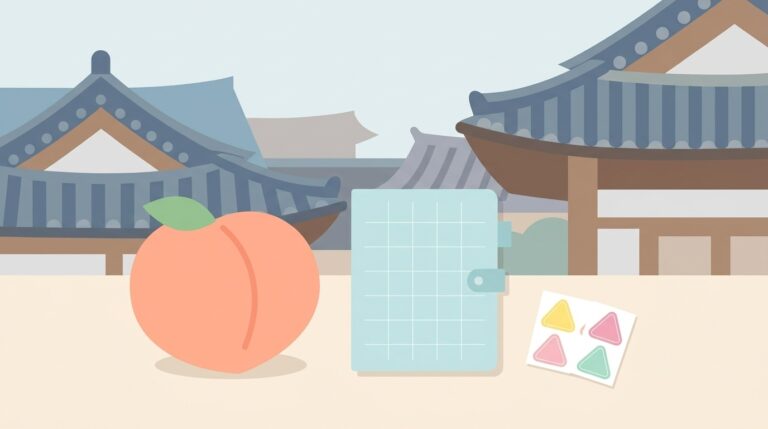
Picture this: You are standing in the middle of a trendy stationery shop in Hongdae or browsing adorable photocards and cushions in an official K-Pop merch store in Myeongdong. You see two nearly identical items on a high shelf. One is a cute round cushion (like a fluffy peach), and the other is a sleek square planner. The friendly clerk asks, “어떤 거 찾으세요? (Which one are you looking for?)”
You freeze. You know colors, but how on earth do you say “the round one” or “the square one” in Korean? You end up wildly drawing invisible circles and squares in the air while laughing nervously. If you’ve ever felt that exact freeze-up moment, don’t worry—you are in great company! Describing shapes is one of the most practical superpowers for shopping, ordering, and asking for directions in Korea. Today, we will break down simple, essential shape words and everyday phrases tailored just for beginners (A1). Let’s turn those awkward finger-drawings into confident Korean words!
Phase 2: Top 3 Core Shape Expressions Deep Dive
Here are the three foundational shape expressions you will hear and use constantly across Korea.
1. 동그라미 (Dong-geu-ra-mi) / 동그래요 (Dong-geu-rae-yo)
- Pronunciation: dong-geu-ra-mi (Sounds like “dough-n” + “goo” + “raw” + “me”)
- Meaning: “Circle / Round (It’s round)”
- K-Culture Moment: Think of Squid Game masks—the workers wearing circle masks are called 동그라미 (Dong-geu-ra-mi) by fans and staff alike! You also hear this when ordering round Bungeoppang (carp bread) or round stickers in stationary shops.
- Editor’s Insight: 동그라미 is the noun (a circle), while 동그래요 is the polite descriptive verb (“It is round”). When pointing out an item, just say “동그란 거(Round thing)”!
- Situation Spectrum:
- Casual: ✅ (동그라미! / 동그래!)
- Semi-formal (Polite): ✅ (동그란 거 주세요 – “Please give me the round one”)
- Formal: ⚠️ (원형 (Won-hyeong) is preferred in formal/business reports)
- 🤔 Think About It: In English, we say “O” or “circle”. In Korean, “O” in grading or trivia games represents correctness (O/X quiz is called OX 퀴즈 or 동그라미 엑스). Why do you think roundness symbolizes perfection and positivity in Korean everyday life?
2. 네모 (Ne-mo) / 네모나요 (Ne-mo-na-yo)
- Pronunciation: ne-mo (Sounds like “neh” + “mow”)
- Meaning: “Square / Rectangle (It is four-cornered)”
- K-Culture Moment: Korean students call lunchboxes 네모 도시락 (Nemo Dosirak), and SpongeBob is affectionately translated as 네모바지 스폰지밥 (SquarePants SpongeBob) in Korea!
- Editor’s Insight: The word 네 (Ne) comes from the native Korean number four (넷), and 모 (Mo) refers to an edge or angle. So 네모 literally means “four corners”!
- Situation Spectrum:
- Casual: ✅ (네모 박스)
- Semi-formal (Polite): ✅ (네모난 상자)
- Formal: ⚠️ (사각형 (Sa-gak-hyeong) is used in official geometric contexts)
- 🤔 Think About It: Notice how natural Korean words break down into intuitive roots (Ne = 4 + Mo = angle). How does your native language create geometric shape names?
3. 세모 (Se-mo) / 세모나요 (Se-mo-na-yo)
- Pronunciation: se-mo (Sounds like “say” + “mow”)
- Meaning: “Triangle (It is triangular)”
- K-Culture Moment: The iconic Samgak Gimbap (triangle kimbap) sold at Korean convenience stores like GS25 and CU is the ultimate triangular treat! Koreans casually call triangle shapes 세모 모양 (Semo moyang).
- Editor’s Insight: Just like 네모, 세 (Se) comes from three (셋), meaning “three corners”.
- Situation Spectrum:
- Casual: ✅ (세모 모양 젤리)
- Semi-formal (Polite): ✅ (세모난 걸로 주세요)
- Formal: ⚠️ (삼각형 (Sam-gak-hyeong) is used in textbooks/geometry)
- 🤔 Think About It: Street snack shapes in Korea often tell a culinary story—why are convenience store gimbap packed into triangles while home-rolled gimbap are round rolls?
Phase 3: Textbook Korean vs. Real-Life Korean
Situation 1: Asking for a square-shaped item at a store
- 📖 Textbook Korean: “정사각형 형태의 물건을 보여주세요.” (Jeong-sa-gak-hyeong hyeong-tae-ui mul-geon-eul bo-yeo-ju-se-yo. / Please show me an equilateral quadrilateral object.)
- 🗣️ Real-Life Korean: “네모난 거 있어요?” (Ne-mo-nan geo iss-eo-yo? / Do you have the square one?)
- 💡 Why is it different?: Hanja-based terms like 정사각형 sound like high school math class. Real Koreans use descriptive noun modifiers (네모난 거 = square thing) in casual shopping.
Situation 2: Choosing between round or heart-shaped accessories
- 📖 Textbook Korean: “원형 모양의 귀걸이가 마음에 듭니다.” (Won-hyeong mo-yang-ui gwi-geol-i-ga ma-eum-e deup-ni-da.)
- 🗣️ Real-Life Korean: “동그란 게 더 예뻐요!” (Dong-geu-ran ge deo ye-ppeo-yo! / The round one is prettier!)
- 💡 Why is it different?: Native Korean adjectives combined with ~게 (~ge, shortened from 것이) make your spoken speech sound 100% warmer and natural.
Phase 4: K-Culture Deep Dive & Non-Verbal Manners
4-1. Nunchi & Pointing Gestures
When describing an object’s shape in Korea, never point with a single index finger directly at someone or close to a store clerk’s face. Instead, open your palm facing slightly upwards and trace a soft circle or square over the display table. This displays politeness (예의) and shows you are admiring the product gently.
4-2. Cultural Code: The Geometry of K-Pop Merch & Cafe Desserts
If you visit famous cafes in Seongsu-dong or Yeonnam-dong, Korean dessert trends frequently play with shapes! You will see cube-shaped croissants (네모 크루아상), round boba waffles, and heart-shaped (하트 모양) macaroons. Knowing shape words allows you to point at the bakery glass and say “저기 하트 모양 하나 주세요! (One heart-shaped one over there, please!)” effortlessly.
Phase 5: Real-Life Roleplay Scenario
- Setting: A boutique gift shop in Insadong selling handcrafted soju glasses.
- Character: Minji (The friendly craft shop curator).
Turn 1 (Minji): 어서 오세요! 예쁜 잔 구경하세요.
(Eo-seo o-se-yo! Ye-ppeun jan gu-gyeong-ha-se-yo.)
[Welcome! Feel free to look around at our pretty glasses.]
🎭 Minji bows gently and motions toward the display.

Turn 2 (You): 잔이 진짜 예뻐요! 동그란 잔 있어요?
(Jan-i jjin-jja ye-ppeo-yo! Dong-geu-ran jan iss-eo-yo?)
[The glasses are really pretty! Do you have round glasses?]
🎭 You smile and make a subtle cup shape with two hands.

Turn 3 (Minji): 네, 이쪽에 동그란 잔이랑 네모난 잔 있어요.
(Ne, i-jjok-e dong-geu-ran jan-i-rang ne-mo-nan jan iss-eo-yo.)
[Yes, we have round ones and square ones right over here.]
🎭 Minji points open-handed to two trays.

Turn 4 (You): 와, 네모난 것도 특이하고 귀엽네요.
(Wa, ne-mo-nan geot-do teuk-i-ha-go gwi-yeop-ne-yo.)
[Wow, the square one is unique and cute too.]
🎭 You lean in to admire the handcrafted edges.

Turn 5 (Minji): 네, 네모난 잔이 요즘 제일 인기 많아요!
(Ne, ne-mo-nan jan-i yo-jeum je-il in-gi man-a-yo!)
[Yes, the square glass is the most popular one these days!]
🎭 Minji nods warmly.

Turn 6 (You): 저기 세모 모양 상자에 포장돼요?
(Jeo-gi se-mo mo-yang sang-ja-e po-jang-dwae-yo?)
[Can it be gift-wrapped in that triangle box over there?]
🎭 You point toward the gift box display.

Turn 7 (Minji): 물론이죠! 네모 잔 두 개 포장해 드릴까요?
(Mul-ron-i-jyo! Ne-mo jan du gae po-jang-hae deu-ril-kka-yo?)
[Of course! Shall I wrap two square glasses for you?]
🎭 Minji picks up the gift wrapping ribbon.

Turn 8 (You): 네! 네모난 잔 두 개 주세요. 감사합니다!
(Ne! Ne-mo-nan jan du gae ju-se-yo. Gam-sa-ham-ni-da!)
[Yes! Please give me two square glasses. Thank you!]
🎭 You hand your card with both hands.
🔀 Interactive Choice Point
Minji asks: “동그란 잔도 같이 포장할까요? (Shall I wrap a round glass together with it?)”
- Choice A: “네, 동그란 거 하나 더 주세요!” (Yes, give me one more round one!)
- Feedback: [BEST CHOICE] Natural, enthusiastic, and uses 동그란 거 perfectly. Minji will smile and wrap it gladly!
- Choice B: “원형은 싫어요.” (I dislike the circle format.)
- Feedback: [RISK] A bit stiff and blunt. 원형 sounds unnatural, and direct refusal with 싫어요 can sound slightly rude to a shopkeeper.
- Choice C: “아니요, 네모난 것만 주세요.”
- Feedback: [GOOD / POLITE] Clear, polite, and accurately uses 네모난 것만 (Only the square one).
Phase 6: 10-Second Emotion Shadowing Drill
Practice reading these out loud with rhythm! The slashes (/) indicate natural breath pauses.
[😊 Cheerful and Bright]- “동그란 모양이 / 진짜 귀여워요!”
- (Dong-geu-ran mo-yang-i / jjin-jja gwi-yeo-wo-yo!
- “The round shape / is really cute!”)
[🤔 Curious and Inquiring]- “저기 네모난 거 / 얼마예요?”
- (Jeo-gi ne-mo-nan geo / eol-ma-ye-yo?
- “That square thing over there / how much is it?”)
[🍰 Excited Foodie Tone]- “세모난 케이크로 / 하나 주세요!”
- (Se-mo-nan ke-i-keu-ro / ha-na ju-se-yo!
- “Please give me one / triangle slice of cake!”)
Phase 7: K-Culture Mini Dictionary
| Word (Hangul + Romanization) | English Translation | Real-Life Usage Insight |
|---|---|---|
| 1. 모양 (Mo-yang) | Shape / Appearance | Attach this after any shape (e.g., 하트 모양 = heart shape, 별 모양 = star shape). |
| 2. 동그라미 (Dong-geu-ra-mi) | Circle | Commonly used in games, school grades, and casual descriptions. |
| 3. 네모 (Ne-mo) | Square / Box shape | Used for stickers, windows, bento boxes, and sticky notes (네모 메모지). |
| 4. 하트 (Ha-teu) | Heart shape | Essential for K-Pop! Making finger hearts (손가락 하트) is a must-know gesture. |
Phase 8: Traveler’s Survival Kit
Survival Expressions TOP 3
- “동그란 걸로 주세요.” (Dong-geu-ran geol-ro ju-se-yo.)
- Pro Tip: Use this at bakeries when choosing between circular buns and long baguettes.
- “네모난 상자 있어요?” (Ne-mo-nan sang-ja iss-eo-yo?)
- Pro Tip: Perfect at Daiso or souvenir shops when looking for gift packaging boxes.
- “별 모양 뱃지 있어요?” (Byeol mo-yang baet-ji iss-eo-yo?)
- Pro Tip: 별 (Byeol) means star! Great for finding specific idol keyrings and badges.
Editor’s Travel Note
When shopping in underground shopping centers like Gangnam or Express Bus Terminal (GoTo Mall), items are packed tight! Instead of struggling to point, open [Naver Map Navigation App] to find nearby stationary craft stores or Daiso locations where aisles are labeled clearly by shapes and categories.
Phase 9: A Step Deeper (Reflection)
In Korean culture, the word 동글동글하다 (Dong-geul-dong-geul-ha-da) doesn’t just describe physical roundness—it is also used affectionately to describe someone’s gentle personality or smooth social relations. Just as a round pebble rolls smoothly without sharp edges, being harmonious with others is a deeply valued trait in Korean social life.
💬 Your Turn: Look around your desk right now. Pick one object—is it 동그라미 (circle), 네모 (square), or 세모 (triangle)? Tell us in the comments below using Korean: “제 컵은 동그래요! (My cup is round!)”!
Phase 10: FAQ & Common Mistakes
Q: What is the difference between 동그라미 (Donggeurami) and 원 (Won)?
A: 동그라미 is the friendly, everyday Korean word for a circle used in daily speech and children’s songs. 원 (Won) is a Sino-Korean root used in formal settings, mathematics (원형 = circular shape), or architecture.
Q: How do I say “heart-shaped” or “star-shaped” in Korean?
A: Simply add 모양 (mo-yang) after the word! For heart, say 하트 모양 (Ha-teu mo-yang). For star, say 별 모양 (Byeol mo-yang).
Q: Can I use 네모 for a long rectangle too?
A: Yes! In casual daily Korean, 네모 covers both squares and rectangles. If you specifically need a long rectangle in a formal context, you can say 직사각형 (Jik-sa-gak-hyeong), but for daily shopping, 네모난 거 is 100% understood.
🚨 Common Mistakes Alert
- Mistake: Saying “원 주세요” instead of “동그란 거 주세요”.
- Fix: 원 also means Korean currency (Won)! Asking for “원 주세요” sounds like asking for money. Always say 동그란 거 (Round one)!
- Mistake: Mixing up 네모 (Square) with 세모 (Triangle).
- Fix: Remember the count: 세 (3 = Se-mo = Triangle), 네 (4 = Ne-mo = Square).
- Mistake: Forgetting the connector ~모양 when combining loanwords.
- Fix: Don’t just say “하트 주세요” (Give me love/heart), say “하트 모양으로 주세요” (Please give me the heart-shaped one).
Phase 11: Action Missions
- 🥉 Bronze Mission: Find three objects around your room and label them aloud: 동그라미, 네모, 세모!
- 🥈 Silver Mission: Post an Instagram Story of your morning coffee mug or snack with the hashtag
#DailyHanguland caption: “동그란 머그컵 ☕”. - 🥇 Gold Mission: Next time you visit a Korean bakery or restaurant, order by specifying the shape: “저기 네모난 빵 하나 주세요!”
- 🎮 K-Culture Mission: Watch an episode of a Korean variety show (like Running Man) and spot how often they use 동그라미 (O) and 엑스 (X) during game quizzes!
Phase 12: Interactive Quiz Challenge
Question 1: Situation Match
You want to buy a triangular Samgak-Gimbap at the convenience store. Which shape name corresponds to a triangle?
* A) 네모 (Ne-mo)
* B) 동그라미 (Dong-geu-ra-mi)
* C) 세모 (Se-mo)
👉 Click to reveal Answer & Explanation
Correct Answer: C) 세모 (Se-mo)
Explanation: 세 (Se) stands for three corners (세모 = Triangle). 네모 is square (4 corners), and 동그라미 is circle!
Question 2: Fill in the Blank
“저기 ________ 모양 쿠키 주세요! (Please give me that heart-shaped cookie over there!)”
👉 Click to reveal Answer & Explanation
Correct Answer: 하트 (Ha-teu)
Explanation: 하트 모양 (Ha-teu mo-yang) means heart-shaped. You can pair 모양 with 별 (star) or 하트 (heart).
Question 3: True or False Cultural Quiz
In Korean daily conversation, using 정사각형 (Jeong-sa-gak-hyeong) while shopping for stickers is much more natural than saying 네모난 스티커.
👉 Click to reveal Answer & Explanation
Correct Answer: False (거짓)
Explanation: 정사각형 is mathematical and overly formal. In real life, native speakers naturally say 네모난 거 or 네모 스티커!







