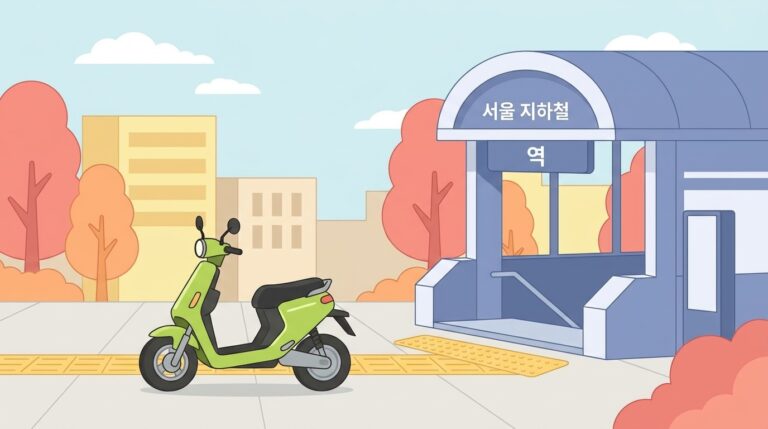
Mastering Korean E-Scooter Disputes: From Illegal Parking to Towing Grievances
Phase 1: Empathy (Story-Driven Immersion)
안녕하세요! 매일한글 (Daily Hangul) editor here! Imagine this: you’ve just wrapped up a thrilling late-night barbecue in Seongsu-dong, Seoul’s trendiest creative hub. Rather than battling for a midnight taxi or enduring a crowded subway transfer, you spot a sleek shared electric kickboard (전동 킥보드) glowing conveniently beside a bus stop. With a quick tap on an app, you effortlessly glide along the asphalt breeze. But the next morning, disaster strikes. You receive an alert from the municipal parking management agency, accompanied by a hefty 40,000 KRW towing fee (견인료) and an unyielding storage surcharge.
To make matters worse, as you rush over to the designated towing depot (견인차량보관소), an exasperated neighborhood resident and a district official (구청 단속 공무원) confront you about obstructing the tactile paving for visually impaired pedestrians (점자블록). You know your Korean is advanced, but when municipal regulations, civil complaint jargon (민원), and nuanced administrative mediation collide, standard textbook vocabulary evaporates.
Navigating public disputes, administrative penalties, and sharing-economy etiquette in South Korea requires not just grammar, but mastery of high-register, pragmatic Korean discourse. Based on actual testimonials from expat professionals and advanced language fellows living in Seoul, this deep-dive guide gives you C2-level command over civil negotiations, administrative dispute resolution, and community accountability.
Phase 2: Core Expressions Deep Dive
1. 보행에 방해되지 않도록 구석에 주차했는데요. (Bo-haeng-e bang-hae-doe-ji an-torok gu-seog-e ju-cha-haen-neun-de-yo.)
- Pronunciation: [bo-haeng-e bang-hae-dwae-ji an-to-rok goo-seog-e joo-cha-haen-neun-de-yo] (Think of ‘bang-hae’ like the energetic pop of a party horn, clipped cleanly at the end)
- Meaning: Literal: “I parked in the corner so it wouldn’t obstruct walking.” / Pragmatic Nuance: A polite yet firm defense used to demonstrate that you acted with civic mindfulness and had zero malicious intent.
- K-Culture Moment: Seen in administrative K-dramas like Search: WWW or The Good Detective during tense confrontations between local municipal officers and misunderstood citizens.
- Editor’s Insight: Using
~도록denotes a deliberate, conscious endeavor to respect public space. It subtly reframes the infraction from reckless negligence to an honest error in spatial judgment.- Situation Spectrum: Casual 🚫 | Semi-formal ✅ | Formal ✅
- 🤔 Think About It: In Korean culture, stating your conscious effort (prosocial intent) carries profound weight during conflict mediation. How does your native language express civic goodwill during an administrative dispute?
2. 즉각 견인 구역인지 미처 인지하지 못했습니다. (Jeuk-gak gyeon-in gu-yeog-in-ji mi-cheo in-ji-ha-ji mot-haet-seum-ni-da.)
- Pronunciation: [jeuk-gak gyeon-in goo-yeog-in-jee mee-chuh in-jee-ha-jee mot-taet-seum-nee-da] (Pronounce ‘jeuk-gak’ with a crisp, snapping percussive tap)
- Meaning: Literal: “I failed to perceive beforehand that this was an immediate-towing zone.” / Pragmatic Nuance: An impeccably sophisticated apology that combines formal accountability with legitimate ignorance of micro-zoning policies.
- K-Culture Moment: Resonates with scenes in legal workplace dramas where professionals articulate formal accountability without resorting to defensive excuses.
- Editor’s Insight: The adverb
미처(before realizing / in time) signals that while you respect the regulation, the situational context prevented full awareness. Combined with인지하다(to cognitively perceive), it marks your speech as exceptionally refined.- Situation Spectrum: Casual 🚫 | Semi-formal ⚠️ | Formal ✅
- 🤔 Think About It: Notice how high-register Korean uses Hanja-based verbs (
인지,견인,구역) rather than native phrasing (몰랐어요) to establish legal credibility. How does formality in your culture shift your authority in civil disputes?3. 고의성이 없었음을 감안해 선처해 주실 수 있나요? (Go-ui-seong-i eop-seoss-eum-eul gam-an-hae seon-cheo-hae ju-sil su in-na-yo?)
- Pronunciation: [go-ee-sung-ee up-ssum-eul gahm-ahn-hae sun-chuh-hae joo-shil soo een-nah-yo] (Let ‘gam-an’ glide softly like a soothing sigh)
- Meaning: Literal: “Could you take into account that there was no malicious intent and grant leniency?” / Pragmatic Nuance: The definitive C2 request for administrative mediation or penalty reduction.
- K-Culture Moment: Heard frequently in corporate boardrooms and municipal negotiation scenes in dramas like Vincenzo when de-escalating statutory disputes.
- Editor’s Insight:
선처(benevolent treatment/leniency) is a time-honored civic term. Pairing it with감안하다(to take into consideration) invites the listener to exercise discretionary administrative empathy.- Situation Spectrum: Casual 🚫 | Semi-formal ⚠️ | Formal ✅
- 🤔 Think About It: Requesting
선처acknowledges the interlocutor’s superior discretionary power while appealing to communal fairness. Is administrative discretion common in your home country?
Phase 3: Textbook Korean vs. Real Native Korean
- Situation 1: Explaining that the kickboard was parked elsewhere and moved by someone else
- 📖 교과서 한국어: 다른 사람이 내 킥보드를 다른 곳으로 옮겼습니다. (Another person moved my kickboard to another place.)
- 🗣️ 진짜 한국어: 제3자가 임의로 이동시켜서 점자블록을 침범한 것 같습니다. (It appears a third party arbitrarily relocated it, encroaching on the tactile paving.)
- 💡 왜 다를까?: In bureaucratic investigations, vague passive claims sound like evasive excuses. Using precise administrative vocabulary (
제3자,임의로,침범하다) accurately pinpoints third-party interference.
- Situation 2: Contesting an unfair towing surcharge at the administrative desk
- 📖 교과서 한국어: 벌금이 너무 비싸니까 깎아주세요. (The fine is too expensive, so please discount it.)
- 🗣️ 진짜 한국어: 유예 시간 없이 곧바로 견인된 경위에 대해 소명하고 싶습니다. (I would like to clarify and substantiate the circumstances under which it was towed immediately without a grace period.)
- 💡 왜 다를까?: Treating a municipal penalty like a market negotiation instantly damages your credibility. Using legal dispute phrasing (
유예 시간,경위,소명하다) commands institutional respect.
Phase 4: K-Culture Deep Dive & Non-Verbal Etiquette
4-1. 눈치 (Nunchi) & Dispute Posture
When interacting with South Korean municipal enforcers (단속반) or parking depot administrators, your non-verbal demeanor governs 70% of the negotiation’s outcome. Avoid crossing your arms or planting hands on your hips (a cross-cultural posture perceived in Korea as open defiance). Instead, clasp your hands loosely in front of your lower torso, maintain gentle eye contact with slight nods of acknowledgment, and keep your vocal tone subdued yet articulate. Expressing proactive empathy for the municipal worker’s demanding role (“단속 업무로 노고가 많으십니다”) instantly disarms tension.
4-2. Cultural Code Analysis: Urban Sharing vs. Pedestrian Sovereignty
South Korea’s ultra-dense smart cities lead the world in last-mile micro-mobility adoption. However, Confucian-rooted public ethics heavily prioritize the vulnerable: the elderly, wheelchair users, and strollers. The five major no-parking zones for shared mobility (지하철역 진출입로, 버스정류장 5m 이내, 횡단보도 진입로, 점자블록 위, 소방시설 5m 이내) reflect the Korean concept of 공공의 안녕 (public welfare and order). Understanding that anti-kickboard crackdowns stem from protecting civic pathways—not anti-tech sentiment—helps you frame your apologies through a lens of collective responsibility.
Phase 5: Live Role-Play Scenario
Setting: The Seoul Gangnam District Towing Vehicle Storage Facility (강남구 견인차량보관소). Fluorescent lights, stacks of paper civil complaints, and a firm, weary official.
Characters:
* Official Park (박 주임): A seasoned, regulation-abiding civil servant.
* Learner (Alex): An advanced expatriate professional resolving a contested towing fee.
- [Turn 1] 박 주임: 🎭 (Stamping a document without looking up) 어제 테헤란로 횡단보도 진입로에 주차된 킥보드 본인 명의 맞으시죠? 즉각 견인 대상이었습니다.
- [Turn 2] Alex: 🎭 (Bowing slightly with hands clasped politely) 네, 알림을 받고 바로 확인하러 왔습니다. 다만 즉각 견인 구역인지 미처 인지하지 못했습니다.
- [Turn 3] 박 주임: 🎭 (Sighs, adjusting glasses) 규정상 횡단보도 진입로와 점자블록 위는 계고장 없이 3분 내 즉시 견인 조치됩니다. 견인료 4만 원에 보관료 부과됩니다.
- [Turn 4] Alex: 🎭 (Maintaining a respectful tone while pointing to app logs) 단속 취지는 충분히 이해합니다. 다만 제가 앱에 등록한 주차 사진상으로는 구석에 거치했는데, 이후 보행자가 밀어낸 것으로 보입니다.
- [Turn 5] 박 주임: 🎭 (Leans forward, examining the timestamped photograph) 흠… 주차 완료 시점 사진과 단속 적발 당시 위치가 다소 상이하긴 하네요.
- [Turn 6] Alex: 🎭 (Gently seeking mediation) 네, 고의성이 없었음을 감안해 주류 업체의 이의신청 절차를 통해 조율할 수 있는 방안이 있는지 여쭙고 싶습니다.
- [Turn 7] 박 주임: 🎭 (Tone softens appreciably) 정황이 참작될 여지가 있으니, 소명 자료와 함께 이의신청서(민원서)를 작성해 제출해 보세요.
- [Turn 8] Alex: 🎭 (Bowing deeply) 바쁘신 와중에도 친절히 안내해 주셔서 대단히 감사드립니다.
🔀 Interactive Branching Point
If the official initially refuses to look at your evidence, how should you respond?
* Option A: “규정이 그렇다 해도 무작정 견인하면 어떡합니까? 본사에 민원 넣겠습니다.” (Why tow blindly even if that’s the rule? I’ll file a complaint to headquarters.)
* Outcome: [Bad] Provokes administrative defensiveness and guarantees an adversarial deadlock.
* Option B: “제가 외국인이라 법을 잘 몰랐는데 그냥 한 번만 봐주시면 안 돼요?” (I am a foreigner so I didn’t know the law, can’t you just let it slide once?)
* Outcome: [Risk] Sounds unprofessional; diminishes your credibility as an accountable resident.
* Option C: “선생님 말씀대로 보행 안전이 최우선이라는 점에 깊이 공감합니다. 혹시 이견이 있는 경우 거치는 공식 이의신청 절차를 안내해 주실 수 있을까요?” (I deeply agree that pedestrian safety comes first. Could you kindly guide me through the formal objection procedure for disputed cases?)
* Outcome: [Best] Validates the officer’s mandate while asserting your legal rights through institutional channels.
Phase 6: 10-Second Emotional Shadowing Drill
[😔 차분하고 진중하게]
“보행에 불편을 끼쳐드린 점은 / 진심으로 송구스럽게 생각합니다.”
(Bo-haeng-e bul-pyeon-eul kki-chyeo-deu-rin jeom-eun / jin-sim-eu-ro song-gu-seu-reop-ge saeng-gak-ham-ni-da.)-
[🧐 이성적이고 논리적으로]
“주차 당시 촬영한 증빙 사진과 / 현장 위치가 상이하여 / 소명하고자 합니다.”
(Ju-cha dang-si chwal-yeong-han jeung-bing sa-jin-gwa / hyeon-jang wi-chi-ga sang-i-ha-yeo / so-myeong-ha-go-ja ham-ni-da.) -
[🤝 정중하게 협력을 요청하며]
“제3자에 의한 무단 이동 정황을 / 부디 참작해 주시길 부탁드립니다.”
(Je-sam-ja-e ui-han mu-dan i-dong jeong-hwang-eul / bu-di cham-jak-hae ju-si-gil bu-tak-deu-rim-ni-da.)
Phase 7: K-Culture Mini Dictionary
- 견인 조치 (Gyeon-in Jo-chi) | Towing Enforcement Action
- Usage: The administrative act of hauling illegally parked micro-mobility or vehicles to designated holding impounds.
- 점자블록 (Jeom-ja-beul-rok) | Braille / Tactile Paving
- Usage: Yellow patterned sidewalk tiles crucial for visually impaired navigators; zero-tolerance parking enforcement zone.
- 소명 자료 (So-myeong Ja-ryo) | Substantiating Evidence / Explanatory Dossier
- Usage: Documentation (app screenshots, timestamps, CCTV requests) submitted to contest administrative fines.
- 정황 참작 (Jeong-hwang Cham-jak) | Consideration of Extenuating Circumstances
- Usage: Administrative or legal discretion applied when an infraction occurred without intentional wrongdoing.
Phase 8: Traveler’s Survival Kit
Top 3 Survival Expressions
- “전동 킥보드 주차 구역이 어디인가요?” (Where is the designated e-scooter parking zone?)
- Pro Tip: Look for white rectangular road stencils marked with PM (Personal Mobility) symbols near subway exits.
- “견인 보관소 위치와 운영 시간을 알려주세요.” (Please tell me the towing holding depot location and operating hours.)
- Pro Tip: Most municipal depots require identification matching the mobility app account holder.
- “앱 오류로 반납 처리가 지연되었습니다.” (The return process was delayed due to an application error.)
- Pro Tip: Take a timestamped photo of the kickboard whenever app network latency occurs.
Editor’s Travel Note
Always consult the official Seoul Smart City Mobility Map via KakaoMap App to verify geo-fenced green parking hubs before ending your ride. If involved in a towing dispute, use the National e-People Civic Complaint Portal to submit formal inquiries in English or Korean.
Phase 9: A Step Deeper (Reflection)
In modern Korea, the tension surrounding shared mobility is not merely a legal conundrum; it reflects an evolving discourse on collective spatial civility (공동체적 공간 윤리). The transition from private car ownership to micro-mobility tests the balance between individual convenience and public duty. How does public urban space in your home culture negotiate the friction between shared technological convenience and accessibility for vulnerable pedestrians?
💬 Your Turn: Have you ever encountered unexpected parking fines or bureaucratic hurdles abroad? Share your experience and practice framing your defense in high-level Korean in the comments below!
Phase 10: FAQ & Common Pitfalls
Q: What should I do if a shared scooter was towed even though I parked correctly?
A: Immediately take screenshots of your return confirmation photo within the operator’s app. Contact the customer center of the mobility company to file an objection, and submit the timestamped evidence to the district office’s towing management office.
Q: Can foreign residents submit formal civil petitions (이의신청) without a domestic resident registration card?
A: Yes, foreign passport holders and Alien Registration Card (ARC) holders can file administrative petitions via the district office civil center or the e-People grievance portal.
Q: Are all sidewalks illegal for kickboard parking in Seoul?
A: Sidewalk parking is prohibited if it obstructs pathways, subway entrances within 10 meters, tactile blocks, or fire hydrants. Parking is strictly allowed only within designated roadside PM racks or marked street zones.
🚨 Common Mistakes Warning Board
- Mistake: Using aggressive informal phrasing like “내 잘못 아니에요!” (It’s not my fault!).
- Correct Action: State “제3자의 임의 이동 가능성에 대해 소명하고자 합니다.” (I wish to substantiate the possibility of third-party relocation).
- Mistake: Abandoning the scooter inside private apartment complexes or underground garages.
- Correct Action: Park exclusively in ground-level public zones visible to GPS geo-fencing.
- Mistake: Forgetting to wear a certified helmet while operating a PM vehicle.
- Correct Action: Wear protective gear; riding without a helmet carries an immediate 20,000 KRW fine regardless of parking status.
Phase 11: Action Mission & Community Engagement
- 🥉 Bronze Mission: Practice reciting Core Expression #2 out loud using the provided emotional shadowing guide.
- 🥈 Silver Mission: Write a 2-sentence formal explanation in the comments using the words
소명 자료and정황 참작. - 🥇 Gold Mission: On your next trip across Seoul, locate a designated PM parking rack and take a photo to verify proper urban parking etiquette!
- 🎮 K-Culture Mission: Watch an episode of a Korean legal/workplace drama and spot how civil servants resolve disputes over public order.
Phase 12: Interactive Quiz Challenge
- Situational Judgment: Which phrase is most effective when explaining to a towing official that your scooter was moved by someone else?
- A) 벌금 안 내요.
- B) 제3자가 임의로 이동시킨 정황이 있어 소명하고자 합니다.
- C) 한국어 잘 못해서 몰랐어요.
- Fill in the Blank: “보행에 방해되지 않도록 구석에 주차했으나, 즉각 견인 구역인지 ______ 인지하지 못했습니다.”
-
True / False Culture Quiz: It is legally permissible to leave a shared e-scooter on yellow Braille tactile blocks as long as it’s parked for less than 5 minutes.
🔍 Click here to reveal Answers & Explanations!
- Answer: B | Explanations: Option B uses sophisticated administrative discourse (
제3자,임의로,소명하고자 합니다) which establishes immediate institutional credibility without confrontation. - Answer: 미처 | Explanation:
미처indicates that the speaker was unable to reach or perceive a condition in time. - Answer: False | Explanation: Tactile paving (
점자블록) is a zero-tolerance immediate towing zone with zero grace period under municipal micro-mobility safety ordinances.