

A Wholesome Family Fishing Trip in Korea: Essential Expressions and Culture Guide
Phase 1: Empathy & Storytelling Opening
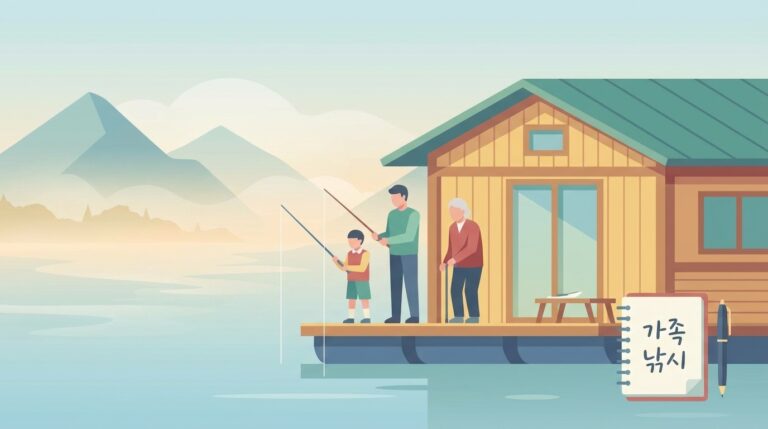
안녕하세요! It is your Daily Hangul editor and cultural navigator. Picture this: you find yourself invited on a weekend getaway with a Korean host family or in-laws to a floating fishing cabin (Jwasik Nakshiteo) nestled over the tranquil waters of Chungcheongbuk-do. The cool mountain breeze brushes past, portable butane stoves are roaring with bubbling spicy ramyeon, and fishing lines sparkle under the morning mist. Suddenly, the rod twitches violently. Everyone jumps up shouting, but in the heat of the moment, your mind goes completely blank. Do you scream “Fish!” or ask for the net?
Navigating family fishing outings (Gajok Nakshi Yeohaeng) in Korea is a cherished bonding ritual, blending multi-generational camaraderie, culinary indulgence, and serene relaxation. If you have ever felt hesitant about the right intermediate vocabulary or subtle generational manners needed at a Korean fishing spot, you are not alone! Based on feedback from our intermediate learners, this guide is crafted to transform your fishing adventure into an unforgettable cross-cultural bonding experience.
Phase 2: Top 3 Core Expressions In-Depth Analysis
1. 입질이 와요! (Ipjiri wayo!)
- Pronunciation: [Ip-ji-ri wa-yo] (Sounds like “eep-jee-ree wah-yo”, rhyming with “deep jewelry why-o”)
- Meaning: Literal: “Nibbles are coming!” | Actual Nuance: “I’m getting a bite! / The fish is nibbling!”
- K-Culture Moment: Frequently shouted in popular variety shows like City Fisherman (Doshi Eobu) when a cast member’s bobber starts bobbing rhythmically before a huge catch.
- Editor’s Insight: 입질 (ipjil) comes from 입 (mouth) and represents a fish testing the bait. Koreans also use this metaphorically in daily life when someone is showing initial interest in a deal or romantic proposal!
- Situation Spectrum: Casual (입질 와!) ✅ | Semi-formal (입질이 와요) ✅ | Formal (입질이 옵니다) ✅
- 🤔 Think About It: In English, we focus on the active verb “biting”, whereas Korean focuses on the sensation arriving (오다 – to come). How does this reflect the Korean observational mindset toward nature?
2. 손맛이 장난 아니에요! (Sonmasi jangnan anieyo!)
- Pronunciation: [Son-ma-si jang-nan a-ni-e-yo] (Sounds like “sone-mah-she jahng-nahn ah-nee-eh-yo”)
- Meaning: Literal: “The hand taste is no joke!” | Actual Nuance: “The fight/pull on the line feels incredible!”
- K-Culture Moment: In K-Dramas featuring family vacations, you’ll see enthusiastic uncles pulling a heavy carp while marveling at the thrilling resistance of the rod.
- Editor’s Insight: 손맛 (sonmat) literally means “taste of the hand” (often used for a mother’s cooking touch), but in angling, it refers to the tactile rush of fighting the fish’s pull.
- Situation Spectrum: Casual (손맛 대박이야!) ✅ | Semi-formal (손맛이 장난 아니에요!) ✅ | Formal (손맛이 참 좋습니다) ⚠️
- 🤔 Think About It: Why do you think Korean uses the word “taste (맛)” to describe physical tactile sensations and thrilling experiences?
3. 뜰채 좀 건네주세요! (Tteulchae jom geonnejuseyo!)
- Pronunciation: [Tteul-chae jom geon-ne-ju-se-yo] (Sounds like “tt-uhl-cheh johm gun-neh-joo-seh-yo”)
- Meaning: Literal: “Please pass the scoop net!” | Actual Nuance: “Could you hand me the landing net, please?”
- K-Culture Moment: The high-stakes climax when a big catch surfaces near the pier and family members scramble together to scoop it up safely.
- Editor’s Insight: Adding 좀 (jom – a little/please) softens the urgent imperative into polite cooperation, preventing you from sounding bossy during a chaotic reel-in.
- Situation Spectrum: Casual (뜰채 줘!) ⚠️ (to peers only) | Semi-formal (뜰채 좀 건네주세요!) ✅ | Formal (뜰채를 건네주시겠습니까?) ✅
- 🤔 Think About It: How does utilizing humble softeners like 좀 preserve harmony during stressful, time-sensitive physical tasks?
Phase 3: Textbook Korean vs. Real Korean
Situation 1: Expressing that a fish got away
- 📖 Textbook Korean: 물고기가 도망갔습니다. (Mulgogiga domanggasseumnida. – “The fish has escaped.”)
- 🗣️ Real Korean: 아, 다 왔는데 놓쳤어요! (A, da wanneunde nochyeosseoyo! – “Ah, it was right there and I lost it!”)
- 💡 Why is it different? Native speakers emphasize proximity and regret (다 왔는데 – it had almost arrived) rather than describing the fish’s action of fleeing.
Situation 2: Suggesting it is time to eat freshly caught fish or ramyeon
- 📖 Textbook Korean: 이제 잡은 생선으로 요리를 시작합시다. (Ije jabeun saengseoneuro yorireul sijakhapssida. – “Let us now start cooking with the caught fish.”)
- 🗣️ Real Korean: 슬슬 라면에 회 한 점 먹을까요? (Seulseul ramyeone hoe han jeom meogeulkkayo? – “Shall we slowly make some ramyeon and slice some fresh sashimi?”)
- 💡 Why is it different? The adverb 슬슬 (seulseul) gently proposes transition time, fitting the relaxed, communal atmosphere of Korean outdoor eating.
Phase 4: K-Culture Deep Dive & Non-Verbal Manners
4-1. 눈치 (Nunchi) & Respectful Gestures by the Water
- Quiet Stepping & Low Voices: Korean fishing reservoirs (Jeosuji) are considered meditative sanctuaries. Slamming tackle boxes or stomping on wooden docks (Jwadae) disrupts the fish and attracts disapproving stares from neighboring elders (Eoreushin).
- Handing Tools with Two Hands: When passing hooks, bait, or landing nets to in-laws or elders, support your right forearm with your left hand or use both hands as a sign of courteous respect.
- The Assistant Mindset: If you are a junior member, proactively keeping the deck clean, preparing wet wipes, and managing the bucket shows stellar Nunchi.
4-2. Cultural Code: The Culture of Meokbang on Water
Korean recreational fishing is as much about gastronomic bonding as it is about catching fish. Korean freshwater fishing sites often feature floating bungalows equipped with ondol (heated flooring), TVs, and outdoor picnic tables. Cooking spicy seafood ramyeon (Haemul Ramyeon) or grilling pork belly (Samgyeopsal) while watching the bobber (Jjipogi) under the stars is the quintessential peak of Korean Healing (힐링) travel.
Phase 5: Real-Life Roleplay Scenario
Setting: A peaceful morning at a floating fishing cabin in Chungju Lake. You are fishing alongside Min-jun’s father (Abeonim).
- Abeonim: 어젯밤엔 입질이 뜸하더니, 아침 되니까 찌가 춤을 추네! (Eojetbamen ipjiri tteumhadeoni, achim doenikka jjiga chumeul chune! / “The bites were slow last night, but the bobber is dancing this morning!”)
- You: 🎭 (Gazing intently at the floating red bobber) 네, 아버님! 지금 살짝 가라앉는 것 같아요. (Ne, abeonim! Jigeum saljjak garaanneun geot gatayo. / “Yes, Sir! It looks like it is sinking slightly right now.”)
- Abeonim: 🎭 (Gripping rod) 지금이야! 챔질해라! (Jigeumiya! Chaemjilhaera! / “Now! Set the hook!”)
- You: 🎭 (Reeling in while feeling intense pull) 우와, 손맛이 장난 아니에요! 낚싯대가 휘어요! (Uwa, sonmasi jangnan anieyo! Nakssitdaega hwieoyo! / “Wow, the pull is unbelievable! The rod is bending!”)
- Abeonim: 🎭 (Reaching for the side rail) 크다, 커! 줄 끊어지지 않게 조심하고! (Keuda, keo! Jul kkeuneojiji anke josimhago! / “It’s huge! Be careful not to snap the line!”)
- You: 🎭 (Keeping rod high) 아버님, 물 위로 떴어요! 뜰채 좀 건네주세요! (Abeonim, mul wiro tteosseoyo! Tteulchae jom geonnejuseyo! / “Sir, it surfaced! Please pass the net!”)
- Abeonim: 🎭 (Skillfully scooping the fish into the net) 나이스! 월척이다, 월척! 오늘 매운탕 끓여 먹자. (Naiseu! Wolcheogida, wolcheok! Oneul maeuntang kkeullyeo meokja. / “Nice! It’s a trophy catch! Let’s boil spicy fish stew today.”)
- You: 🎭 (Smiling proudly) 아버님 덕분에 잡았어요. 정말 신나요! (Abeonim deokbune jabasseoyo. Jeongmal sinnayo! / “I caught it thanks to you, Sir. This is so exciting!”)
🔀 Interactive Choice Point
The fish is safely in the bucket, and Abeonim is preparing to clean the hook. How do you respond?
- Option A: “아버님, 제가 장갑 끼고 바늘 뺄게요. 커피 한잔 드세요!” (Sir, I’ll put on gloves and remove the hook. Please enjoy a cup of coffee!)
- Feedback (Best): Superb! Showing thoughtful consideration (Baeryeo) for the elder earns you instant affection and praise.
- Option B: “제가 제일 큰 거 잡았죠? 제가 제일 잘하네요!” (I caught the biggest one, right? I’m the best!)
- Feedback (Risk): Playful, but can come across as boastful in a traditional Korean family hierarchy context.
- Option C: “비린내 나니까 아버님이 다 알아서 해주세요.” (It smells fishy so please take care of everything, Sir.)
- Feedback (Bad): Disrespectful and dampens the communal holiday spirit.
Phase 6: 10-Second Emotion Shadowing Drill
Practice matching native intonation and rhythm using speech-pause markers (/):
[😲 Excitement & Anticipation]- 찌가 / 쑥 들어갔어요! / 입질 와요! (Jjiga / ssuk deureogasseoyo! / Ipjil wayo!)
[🔥 Exhilarating Thrill]- 와, / 손맛이 장난 아니에요! / 줄 좀 잡아주세요! (Wa, / sonmasi jangnan anieyo! / Jul jom jabajuseyo!)
[🥺 Polite Urgency]- 놓칠 것 같아요! / 뜰채 좀 / 빨리 건네주세요! (Nochil geot gatayo! / Tteulchae jom / ppalli geonnejuseyo!)
Phase 7: K-Culture Mini Dictionary
- 월척 (Wolcheok) | A Trophy Catch / Giant Carp
- Historically refers to a freshwater fish over 30.3 cm. In modern slang, it describes landing a massive achievement or windfall.
- 손맛 (Sonmat) | Tactile Thrill / Hand Sensation
- Angling context: the dynamic muscular thrill felt through the rod. Culinary context: instinctive cooking talent.
- 좌대 (Jwadae) | Floating Fishing Cabin / Platform
- Built over lakes or coastal bays, equipped with sleeping amenities for all-night family fishing retreats.
- 매운탕 (Maeuntang) | Spicy Fish Stew
- A hearty stew seasoned with gochujang, gochugaru, and crown daisy (ssukgat), traditionally cooked right after harvesting the day’s catch.
Phase 8: Survival Kit for Travelers
Top 3 On-Site Angling Phrases
- 미끼는 어떤 걸 써야 하나요? (Mikkineun eotteon geol sseoya hanayo? – Which bait should I use?)
- Pro Tip: Useful when buying bait (worms vs. gluten paste) at local tackle shops (Nakshi-jeom).
- 구명조끼 대여할 수 있나요? (Gumyeongjjokki daeyeohal su innayo? – Can I rent a life vest?)
- Pro Tip: Safety is strictly enforced on Korean recreational platforms; always check safety gear availability.
- 여기 수심이 얼마나 돼요? (Yeogi susimi eolmana dwaeyo? – How deep is the water here?)
- Pro Tip: Essential for adjusting your bobber float depth (Jji matchum).
🧳 Editor’s Travel Note
- App Recommendation: When navigating remote coastal piers or mountain reservoirs, public transport info can be spotty. Check the official Naver Map Navigation App to find exact pier addresses and real-time driving routes.
- Payment & Manners: While most fishing reservoirs accept credit cards, keep 20,000–30,000 KRW in cash for buying supplementary live bait or hiring small motor transport boats (Boateu-unhaeng).
Phase 9: “One Step Deeper” (Cultural Reflection)
In many Western cultures, fishing is often regarded as an individual sport of solitary contemplation. In Korea, however, recreational fishing is fundamentally communal—encapsulating Jeong (affectionate communal bonding). Whether sharing a steaming pot of ramyeon on a breezy floating platform or cheering together when a family member lands a catch, angling serves as a multi-generational bridge where formal social barriers dissolve over shared laughter and water mist.
💬 Your Turn: Have you ever joined an outdoor trip with local friends or family in another country? How did sharing food change the dynamic? Share your thoughts in the comments below!
Phase 10: FAQ & Common Pitfalls
Q: Can we immediately eat freshwater fish raw (as Hoe) at Korean reservoirs?
A: It is strongly discouraged for freshwater catches due to freshwater parasites. In Korea, freshwater fish like carp or catfish are almost always cooked into spicy stew (Maeuntang) or braised (Jjorim). Marine/sea fish caught on ocean boat trips, however, are frequently prepared as fresh sashimi (Hoe) on board!
Q: What is the most polite way to address the owner of a fishing bungalow facility?
A: Address them warmly as 사장님 (Sajangnim – Business Owner) or 관리인님 (Gwalli-innim – Manager) when asking for assistance.
Q: Is night fishing safe for beginners with families?
A: Yes, especially at established Jwadae (cabins) with guardrails, electricity, and heated indoor rooms. Always ensure children wear life vests when stepping outside the cabin deck after dark.
🚨 Common Mistakes Alert Board
- ❌ Mistake 1: Shouting loudly when hooking a fish on a quiet freshwater reservoir.
- 👉 Correct Action: Express excitement in a joyful yet contained voice to respect neighboring anglers.
- ❌ Mistake 2: Leaving leftover bait and fish scales on the platform deck.
- 👉 Correct Action: Clean down the deck with lake water and dispose of trash in designated sorting bags (Bunri-sugeo).
- ❌ Mistake 3: Saying “생선 (Saengseon)” when pointing to live fish in the lake.
- 👉 Correct Action: Use 물고기 (Mulgogi) for live fish swimming in nature, and reserve 생선 (Saengseon) for fish prepared as food/ingredients!
Phase 11: Action Missions
- 🥉 Bronze Mission (Solo Mastery): Practice saying “손맛이 장난 아니에요!” 5 times with lively emotional inflection in front of the mirror.
- 🥈 Silver Mission (Social Sharing): Share a short social media post or story with a picture of water or food using the caption: “슬슬 라면 먹을까요? 🍜”.
- 🥇 Gold Mission (Real Application): Use “입질이 와요!” or “손맛이 대박이에요!” during your next real outdoor trip or Korean restaurant meal with Korean acquaintances.
- 🎮 K-Culture Media Mission: Watch an episode of variety show City Fisherman (도시어부) and identify at least three times the cast shouts “입질!” or “월척!”.
Phase 12: Interactive Quiz Challenge
Q1. Situation: You are fishing with your Korean in-laws. Your rod tip bends sharply and you feel a strong pull. What should you exclaim?
* A) 물고기 도망갔어요!
* B) 입질이 와요! 손맛이 장난 아니에요!
* C) 생선을 먹읍시다!
🔍 Click here to view Answer & Explanation
Correct Answer: B
Explanation: “입질이 와요! 손맛이 장난 아니에요!” naturally communicates that a fish is biting and the line resistance feels exciting. (A means the fish escaped; C inappropriately suggests eating culinary fish right away).
Q2. Fill in the Blank:
* “물 위로 떴어요! 바늘에서 빠지기 전에 ______ 좀 건네주세요!” (It surfaced! Before it comes off the hook, please pass the landing net!)
🔍 Click here to view Answer & Explanation
Correct Answer: 뜰채 (Tteulchae)
Explanation: 뜰채 is the Korean scoop/landing net used to bring hooked fish safely out of the water.
Q3. True or False: In Korean, you should use the term 생선 (Saengseon) when watching wild fish swim in a freshwater lake.
🔍 Click here to view Answer & Explanation
Correct Answer: False (X)
Explanation: Swimming wild fish are called 물고기 (Mulgogi). The term 생선 (Saengseon) is strictly used for edible fish ready for cooking or consumption.







