

Phase 1: Empathy & Storytelling
안녕하세요! 매일한글 에디터입니다. (Hello! I’m your Daily Hangul editor.)
Have you ever waited anxiously for an email ping, your heart pounding like the intro beat of a BTS song, only to read the dreaded line: “귀하의 뛰어난 역량에도 불구하고…” (Despite your outstanding qualifications…)? In K-Dramas like Record of Youth or Misaeng, you often see hardworking protagonists stare at their phones after a job interview, sigh deeply, and head straight to a pojangmacha (street food tent) with their best friend for comfort food.
Job hunting and interview rejection (불합격 – bulhapgyeok) is tough no matter where you are in the world, but navigating it in Korean can feel doubly overwhelming. As an absolute beginner (A1 level), you don’t need complicated corporate jargon to express your feelings or comfort a friend. Based on real questions from hundreds of our beginner learners, this practical guide gives you the exact, warm, and natural expressions you need to pick yourself back up, maintain professional courtesy, and bounce back stronger.
Phase 2: 3 Core Expressions Deep Dive
1. 괜찮아요 (Gwaenchanayo)
- Pronunciation: [Gwaen-chan-ah-yo] (Sounds like “gwen-chahn-ah-yo”, rhymes with “ten-on-a-boat”)
- Meaning: Literal: “It is tolerable / fine.” | Real Nuance: “I am okay,” “Don’t worry about it,” or “It’s all good.”
- K-Culture Moment: The universal phrase you hear in every K-Drama when a character drops their resume or hides their tears after a tough interview result.
- Editor’s Insight: This is the Swiss Army knife of Korean comfort. When someone says “Cheer up!”, answering “괜찮아요” shows resilience and reassures the other person.
- Situation Spectrum:
- Casual: 괜찮아 (Gwaenchana) ✅ (Friends only)
- Semi-formal: 괜찮아요 (Gwaenchanayo) ✅ (Colleagues & polite daily life)
- Formal: 괜찮습니다 (Gwaenchanseumnida) ✅ (Official workplace reply)
- 🤔 Think About It: In English, “I’m fine” can sound cold or passive-aggressive. In Korean, 괜찮아요 carries genuine warmth to ease others’ concern. How do you usually tell friends you’re okay?
2. 다음에 더 잘할게요 (Daeume deo jalhalgeyo)
- Pronunciation: [Da-eum-e deo jal-hal-ge-yo] (Da-eum = next time, deo = more, jal-hal-ge-yo = I will do well)
- Meaning: Literal: “Next time I will do better.” | Real Nuance: “I’ll nail it next time! / Moving on with a positive attitude!”
- K-Culture Moment: Often said by K-Pop trainees to their mentors after receiving tough feedback during evaluation rounds.
- Editor’s Insight: Koreans value baewoom (learning through trial). Saying this shows humility, determination, and a forward-looking mindset.
- Situation Spectrum:
- Casual: 다음에 더 잘할게 (Daeume deo jalhalge) ✅
- Semi-formal: 다음에 더 잘할게요 (Daeume deo jalhalgeyo) ✅
- Formal: 다음에는 더 잘 준비하겠습니다 (Daeumeneun deo jal junbihagessumnida) ✅
- 🤔 Think About It: Why is focusing on “next time” so powerful in Korean work culture compared to dwelling on why a mistake happened?
3. 수고하셨습니다 (Sugohasyeossumnida)
- Pronunciation: [Su-go-ha-syeot-seum-ni-da] (Sounds like “soo-go-hah-shot-sum-nee-dah”)
- Meaning: Literal: “You endured trouble/labor.” | Real Nuance: “Thank you for your hard work / You did your best!”
- K-Culture Moment: Spoken by staff members packing up interview rooms or friends congratulating an applicant just for finishing the interview day.
- Editor’s Insight: Even if the result is rejection, ending an interaction with this phrase leaves an indelible impression of polite professionalism.
- Situation Spectrum:
- Casual: 수고했어 (Sugohaesseo) ✅ (To younger people/peers)
- Semi-formal: 수고하셨어요 (Sugohasyeosseoyo) ✅
- Formal: 수고하셨습니다 (Sugohasyeossumnida) ✅
- 🤔 Think About It: English lacks a direct 1:1 translation for acknowledging another person’s emotional and physical labor. How does this phrase foster community solidarity?
Phase 3: Textbook Korean vs. Real Korean
Situation 1: Talking about not passing the interview
- 📖 교과서 한국어 (Textbook): “저는 면접에서 탈락했습니다.” (I was eliminated from the interview.)
- 🗣️ 진짜 한국어 (Real Native): “면접 떨어졌어요.” (I dropped/didn’t make the interview.)
- 💡 왜 다를까? (Why the difference?): While 탈락 (elimination) is used in official notifications or game shows, native Koreans use the intuitive verb 떨어지다 (to fall/drop) in everyday spoken Korean.
Situation 2: Comforting a friend who didn’t get the job
- 📖 교과서 한국어 (Textbook): “슬퍼하지 마십시오.” (Do not be sad.)
- 🗣️ 진짜 한국어 (Real Native): “속상하지? 맛있는 거 먹으러 가자!” (You must be bummed out, right? Let’s go eat something delicious!)
- 💡 왜 다를까? (Why the difference?): Real Korean friendship is expressed through empathy first (속상하지 = feeling upset inside) followed immediately by food-based healing.
Phase 4: K-Culture Deep Dive & Non-Verbal Manners
4-1. 눈치 (Nunchi) & Body Language
- The Empathetic Nod: When hearing bad news from a peer, avoid overly dramatic gasps. Tilt your head slightly forward and offer a gentle, rhythmic nod.
- The Arm Touch / Shoulder Pat: A light touch on the upper arm or shoulder accompanied by “힘내요” (Stay strong) conveys deep solidarity without needing long sentences.
- Eye Contact: Lower your eyes slightly when someone is opening up about disappointment; staring directly into their eyes can feel confrontational.
4-2. Cultural Code: Food as Emotional First Aid
In Korea, food is therapy. When dealing with rejection (불합격), friends rarely hold lengthy analytical discussions immediately. Instead, they say “밥 먹었어?” (Did you eat?) and head out for comfort meals like spicy Tteokbokki to release stress, or sizzling Samgyeopsal (grilled pork belly). Healing happens together over a shared meal.
Phase 5: Real-World Roleplay Scenario
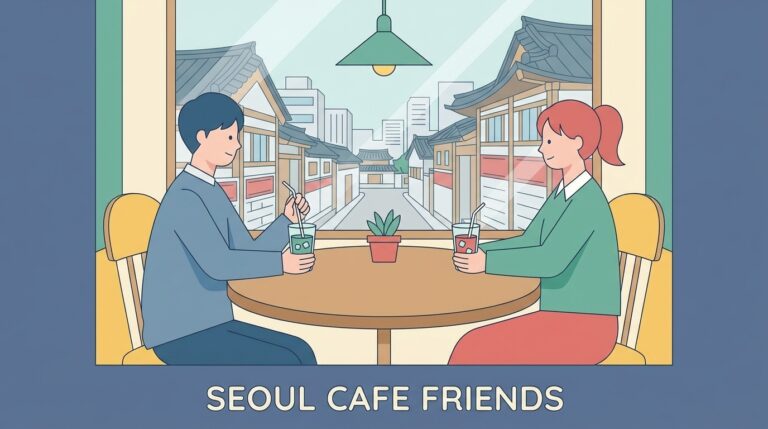
Setting: Sarah (A1 Korean learner) meets her Korean friend Minho at a quiet cafe after receiving an email from a company in Seoul.
- Minho: 사라 씨, 면접 결과 나왔어요?
(Sarah-ssi, myeonjeop gyeolgwa nawasseoyo? / Sarah, did the interview results come out?)
🎭[👀 Looking curious and slightly cautious] - Sarah: 네, 방금 확인했어요. 떨어졌어요.
(Ne, banggeum hwaginhaesseoyo. Tteoreojyeosseoyo. / Yes, I just checked. I didn’t get it.)
🎭[🥺 Sighing softly with a gentle smile] - Minho: 아이고, 진짜 속상하겠다. 괜찮아요?
(Aigo, jinjja soksanghagetda. Gwaenchanayo? / Oh no, you must be so upset. Are you okay?)
🎭[🤲 Offering a comforting cup of tea] - Sarah: 속상하지만 괜찮아요! 다음에 더 잘할게요.
(Soksanghajiman gwaenchanayo! Daeume deo jalhalgeyo. / I’m bummed, but I’m okay! I will do better next time.)
🎭[💪 Clenching fist lightly with renewed energy] - Minho: 맞아요! 사라 씨는 잘할 수 있어요. 오늘 수고 많았어요.
(Majayo! Sarah-ssineun jalhal su isseoyo. Oneul sugo manasseoyo. / That’s right! You can do it. You worked so hard today.)
🎭[😊 Nodding warmly] - Sarah: 고마워요, 민호 씨. 덕분에 힘이 나요.
(Gomawoyo, Minho-ssi. Deokbune himi nayo. / Thank you, Minho. Thanks to you, I feel energized.)
🎭[✨ Brightening up] - Minho: 그럼 맛있는 저녁 먹으러 갈까요? 제가 살게요!
(Geureom masinneun jeonyeok meogeureo galkkayo? Jega salgeyo! / Then shall we get delicious dinner? My treat!)
🎭[😋 Patting his wallet cheerfully] - Sarah: 와, 좋아요! 가요!
(Wa, joayo! Gayo! / Wow, sounds great! Let’s go!)
🎭[😄 Grinning happily]
🔀 Interactive Choice Point
How should Sarah respond if the interviewer personally called to deliver the rejection?
* Option A: “왜 저를 안 뽑았어요?” (Why didn’t you pick me?)
❌ Bad: Confrontational and destroys future networking opportunities.
* Option B: “알려주셔서 감사합니다. 좋은 경험이었습니다.” (Thank you for letting me know. It was a good experience.)
🏆 Best: Professional, respectful, and leaves a memorable positive impression.
* Option C: (Hang up silently without saying anything)
⚠️ Risk: Extremely rude in Korean business etiquette and may blacklist future applications.
Phase 6: 10-Second Emotional Shadowing Drill
Practice matching your tone to natural Korean pitch curves!
[🥺 Slightly disappointed but brave]
속상하지만 / 괜찮아요.
(Soksanghajiman / gwaen-chan-ah-yo.)-
[💪 Motivated and energetic]
다음에 / 더 잘할게요!
(Daeume / deo jal-hal-ge-yo!) -
[🤝 Sincere and respectful]
오늘 / 수고하셨습니다.
(Oneul / su-go-ha-syeot-seum-ni-da.)
Phase 7: K-Culture Mini Dictionary
- 취준생 (Chwijunsaeng) | Job Seeker
Short for 취업 준비생. Refers to university grads actively studying and applying for jobs. - 불합격 (Bulhapgyeok) | Rejection / Failure to Pass
The official status on job and school portals, contrasted with 합격 (Habgyeok – Accepted). - 위로 (Wiro) | Consolation / Comfort
The act of offering emotional support through words, drinks, or companionship. - 멘탈관리 (Mental-gwalli) | Mindset Management
A popular Korean phrase for maintaining mental toughness and positivity during stressful life chapters.
Phase 8: Survival Kit for Travelers & Expats
Top 3 Survival Phrases
- 힘내요! (Himnaeyo!)
Romanization: [Him-nae-yo]
Pro Tip: The number one cheer-up phrase in Korea. Use it when anyone looks exhausted. - 밥 사줄게요. (Bap sajulgeyo.)
Romanization: [Bap sa-jul-ge-yo]
Pro Tip: “I’ll buy you a meal.” The ultimate Korean expression of care. - 잊어버려요! (Ijeobeoryeoyo!)
Romanization: [Ee-jeo-beo-ryeo-yo]
Pro Tip: Means “Shake it off / Forget about it!”
Editor’s Travel & Life Note
If you are job hunting or attending interviews in Korea, punctuality is everything. Check transportation in real-time by using the Naver Map app download to calculate subway transfers down to the exact door number. If an interview goes sour, use the app to search for nearby “힐링 카페” (healing cafes) to reset your mood.
Phase 9: Think Deeper (“한 발 더 깊이”)
In modern Korean culture, there is a viral buzzword known as 중꺾마 (Jung-ggeok-ma), short for “중요한 것은 꺾이지 않는 마음” (What matters most is an unbreakable heart). Originating from the Esports World Championship in Seoul, this phrase became a national slogan for anyone struggling with job interviews, exams, or life obstacles. In Korea, failing an interview is not seen as the end of the world; rather, picking yourself back up with your friends’ support is considered the true mark of character.
💬 Your Turn: How do people in your home country usually bounce back after a difficult interview or rejection? Share your story in the comments below!
Phase 10: FAQ & Common Mistakes
Q: Can I use “괜찮아” to the interviewer?
A: No! “괜찮아” is informal (반말). To an interviewer or elder, always use polite formal forms like “괜찮습니다” (Gwaenchanseumnida) or “감사합니다” (Gamsahamnida).
Q: What does “탈락” mean when I see it in an email?
A: “탈락” (Tal-rak) literally means eliminated or did not advance. It is the formal terminology used on application portals.
Q: How can I reply politely to a rejection email?
A: A short sentence such as “결과 안내 감사합니다. 더 성장하겠습니다.” (Thank you for notifying me of the result. I will continue to grow.) is both polite and memorable.
🚨 Common Mistakes Board
- ❌ Mistake 1: Saying “미안해요” (I’m sorry) to friends when you don’t pass.
➡️ Correct Action: Say “괜찮아요” (I’m okay). You did nothing wrong, so don’t apologize for interview results! - ❌ Mistake 2: Using “수고하세요” to an interviewer who is much older or higher ranking upon leaving.
➡️ Correct Action: Say “감사합니다. 안녕히 계세요” (Thank you. Goodbye). “수고하세요” can unintentionally sound condescending if said to superiors. - ❌ Mistake 3: Overthinking formal words when talking to friends.
➡️ Correct Action: Keep it simple! A genuine “속상해” (I feel bummed) is all your Korean friends need to support you.
Phase 11: Action Missions
- 🥉 Bronze Mission (Solo Practice): Stand in front of the mirror, smile gently, and say: “속상하지만 괜찮아요! 다음에 더 잘할게요!” 3 times.
- 🥈 Silver Mission (Social): Leave a comment on Daily Hangul’s Instagram using the word 괜찮아요 in a sentence.
- 🥇 Gold Mission (Real Life): Next time a friend or language partner shares disappointing news, comfort them with: “괜찮아요, 힘내요!”
- 🎮 K-Culture Mission: Watch an episode of a workplace K-Drama (like Misaeng or Start-Up) and spot the exact scene where someone says 수고하셨습니다!
Phase 12: Interactive Quiz Challenge
1. Situational Judgment: Your friend didn’t pass their college or job interview. What is the most natural Korean reaction?
* A) 왜 탈락했어요? (Why were you eliminated?)
* B) 속상하겠다. 맛있는 거 먹으러 가자! (You must be upset. Let’s get something good to eat!)
* C) 축하해요! (Congratulations!)
👉 Click to view Answer & Explanation
Correct Answer: B
Explanation: Option B validates their emotion (속상하겠다) and follows the classic Korean tradition of sharing food for comfort.
2. Fill in the Blank:
다음에 ____ 잘할게요! (I’ll do better next time!)
* A) 안 (An – Not)
* B) 더 (Deo – More/Better)
* C) 못 (Mot – Cannot)
👉 Click to view Answer & Explanation
Correct Answer: B
Explanation: 더 (Deo) means “more” or “further,” making the phrase mean “I will do even better next time.”
3. True or False:
In spoken Korean with friends, people usually say “면접 떨어졌어요” rather than “면접에서 탈락했습니다.”
👉 Click to view Answer & Explanation
Correct Answer: True
Explanation: 떨어지다 (to drop/fail) is the natural, conversational everyday word used by native speakers.







